
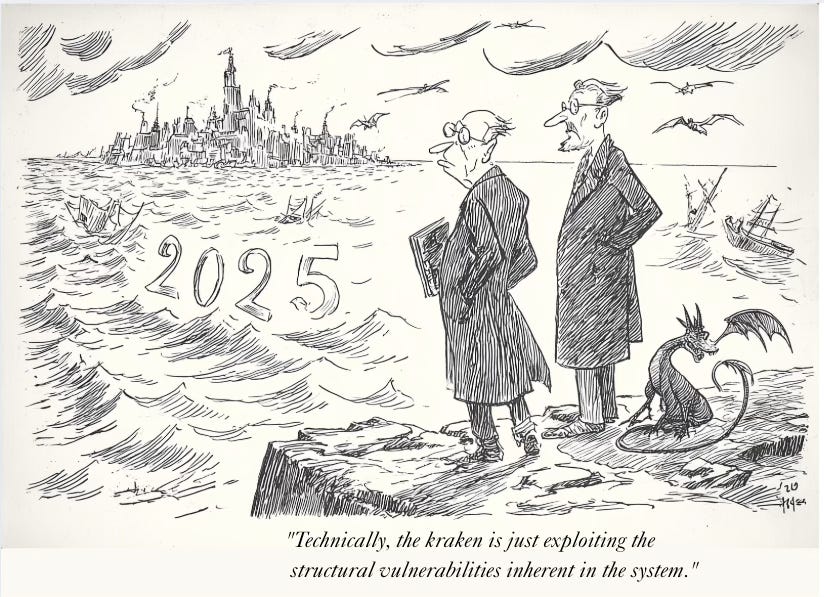
I wrote a bunch of pieces in 2025. Some resonated more than others.
Below are the five most popular—the ones that went beyond the subscriber list, thanks to social sharing.
Looking back, all five capture what I’m trying to do here at Undercurrent Events: put the daily headlines in broader context—to see the big picture, the hidden structures, and the larger forces at work.
Maybe popularity isn’t the perfect metric for quality—which is why I’m including one bonus piece I had the most fun writing.
Posted: JUL 03, 2025
Here, I was trying to understand what felt like a real puzzle. Republicans had just passed their “One Big Beautiful Bill” despite polling that Americans opposed the thing by a 2-to-1 margin. This felt like political malpractice. Maybe it was. But as I wrote, “I don’t think Republicans will pay any exceptional penalty for this legislation (beyond the usual midterm penalty for the party in the White House).” I still don’t.
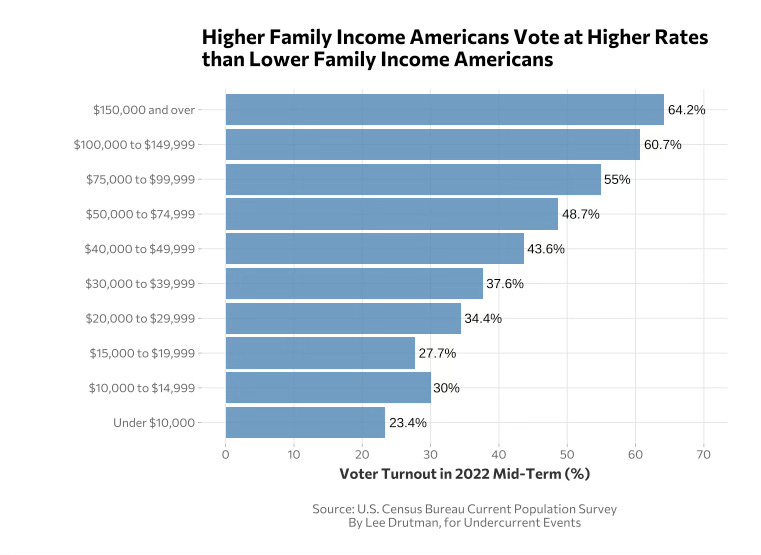
As I explained, there were three main reasons. First, and most importantly, the low-income people who would be most directly harmed by the cuts in the bill are the people least likely to vote. I made a chart, based on US Census data, to prove it. It’s pretty shocking. Compare: People with family income over $150,000 voted at a rate of 64.2 percent in the 2022 midterms. Keep going down the income scale and turnout declines. At the lowest levels (below $20,000), it’s under 30 percent turnout.
Second: policy design. The most popular things in the bill, the tax cuts, were front loaded. The least popular parts, the cuts to Medicaid, wouldn’t go into effect until after the 2026 mid-terms. And since Medicaid is often administered by the private sector, and it goes by different names in different states, and since these are not so much direct cuts as they are new hurdles for applying, the whole thing becomes very confusing for voters to hold anybody to account.
Third, politics is more about status than materialism. We don’t vote in our economic self-interest—we vote in our status interest. There’s a lot of social psychology in support of this point, and it’s something I hope to write more about in the future.
The full piece is here:
Posted: FEB 19, 2025
All of my pieces are variations on the “big think” piece. But this was big-thinkiest big-think piece of the year for sure. It was a lot of systems thinking, thermodynamics, and physics, as a way to conceptualize the phase change I thought (and still think) we are witnessing in this moment of US politics.
It’s not an easy piece to summarize, which is why I ended the introduction like this: “So grab a big mug of coffee (or something stronger - these are constitutional crisis times after all), and let’s dig in. We’ve got some big ideas to discuss.”
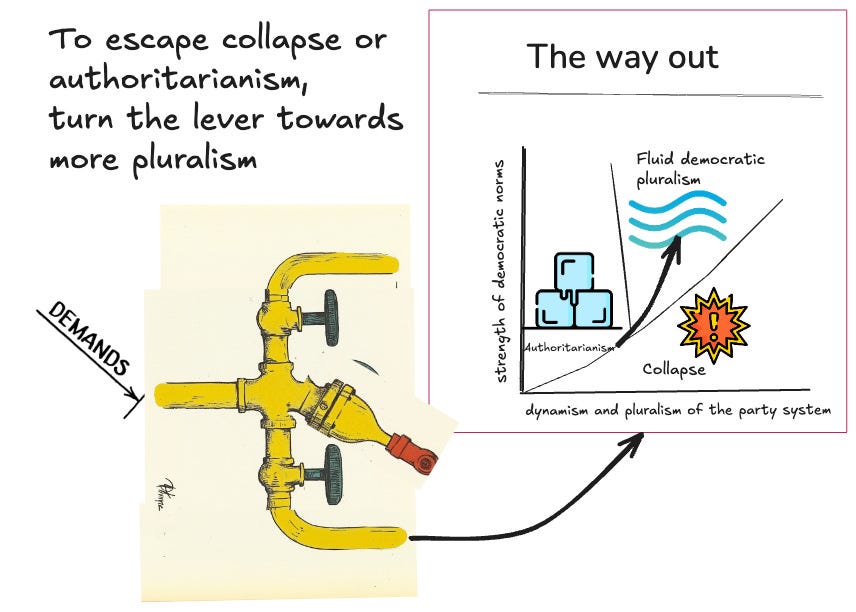
But to give you a flavor, here is the final diagram, which I build up to throughout the course of the piece:
But if I had to summarize it in a few paragraphs, I would cut and paste the following (In fact, I just did)
The election system serves as our master lever, directing demands through the system. The political thermodynamics framework, however, makes clear the challenge we face. We must simultaneously strengthen our democratic institutions and our democratic commitments. Reaching the liquid state requires movement along both dimensions – allowing more electoral dynamism while also restoring constraint. Moving the lever is delicate work, demanding careful calibration
…
Big change, like a phase transition in physics, can seem impossible until suddenly it isn’t. A watched pot of water never boils. Until it does. Too many couldn’t imagine our current constitutional crisis. Now, too many can’t imagine a more fluid, dynamic system.
But phase transitions work in both directions.
Posted: SEP 10, 2025
I wrote this right before the longest government shutdown in American political history. At the time I worried that the healthcare subsidy fight was maybe not a fight that Democrats could “win” a government shutdown over. My broader point was that Democrats could use this moment to try to elevate other issues that could possibly realign political conflicts in ways that might help us escape this zero-sum trench warfare. And healthcare was a tired old fight.
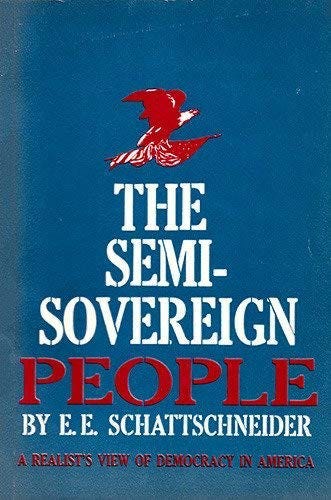
A lot of this piece was an extension of a separate essay I had published on Vox, riffing on one of my favorite books of all time, E.E. Schattschneider’s The Semi-Sovereign People.
In the end, maybe Democrats did “win” the shutdown in that the public blamed Republicans more than Democrats for the shutdown. And maybe they did win in that they raised the salience of expiring healthcare subsidies in the public conversation. And maybe they did win in that they gave space for Trump to make a fool of himself (again). But this still feels like thinking in inches to me. Inches might win you a midterm, but continued political trench warfare is still miserable and destructive.
I understand more clearly now that the shutdown was really an act of coalition management by Democratic leadership. They had to shut the government down because their supporters were demanding it. And healthcare subsidies was one issue they the leaders could unify the party around. Maybe, then, this was on the activists more than the leaders. The activists need a new issue that’s not just Trump’s terribleness, or social welfare benefits. Something that surprise and engage the too-many voters who are just checked out.
Perhaps there is more for me to reflect on in 2026. But I stand by my opening paragraphs.
It is 2025. America is falling into authoritarianism. And the Democratic Party does not have a strategic theory of political conflict.
A theory of attention is not a strategic theory of conflict.
A theory of moderation is not a strategic theory of conflict.
A strategic theory of conflict is about choosing the fight that brings the most people to your side.
A strategic theory of conflict is about starting new fights, not accepting old ones.
Read the full piece here:
Posted: SEP. 03, 2025
I often feel like a good chart is worth more than a thousand words, and the chart that begins this piece is a pretty damn good one
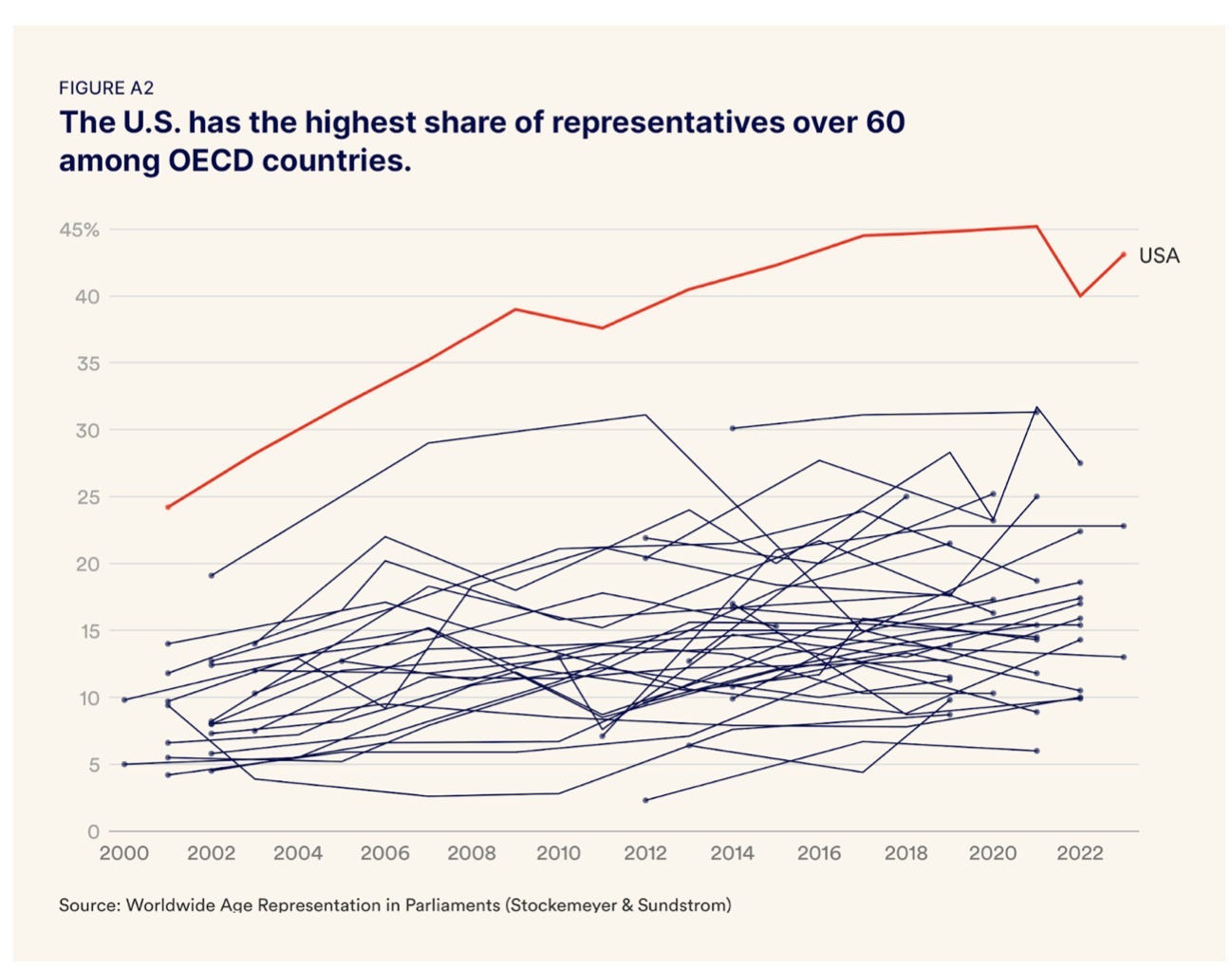
It shows how much the United States is a true outlier in having the highest share of elected representatives over 60 — far and above other advanced industrial democracies.
The chart comes from a report called The Age Divide: How America’s electoral system reinforces the gerontocracy and inhibits young people’s full participation in democracy. The report is by my colleagues Oscar Pocasangre (at New America) and Dustin Wahl (Executive Director of Fix Our House, a campaign for proportional representation that I co-founded).
The report shows in painstaking detail how America’s system of candidate-centered elections, wildly open and participatory primary elections, campaign finance system, and of course, winner-take-all elections contributes to our aging political class. The short version is that it makes it harder to dislodge incumbents. And as people live longer, politicians stick around longer.
But the surprising point was that even freshmen members of Congress are old. Again, because our system is so candidate-centered, middle-aged established professionals — especially men — are best positioned to take advantage of the openings when they come up. There’s a lot more in both the post and the report. But the basic point is simple: it’s no surprise our politicians have been the oldest in the world for decades. It’s the electoral system.
The piece is my riff on the report, and other reflections on the state of our gerontocracy. I think it resonated because it captured a real current in the conversation.
And the number one most popular piece…
POSTED: OCT 29, 2025
Here, I jumped into the “moderation wars.” I had grown frustrated with what I felt was a very narrow debate over how much “moderation” mattered in elections. Was it one percentage point? Was it three percentage points? And more importantly, what was moderation anyway? How did you measure it? Or was it a you-know-it-when-you-see-it kind of thing, in which case...again, how do you measure it?
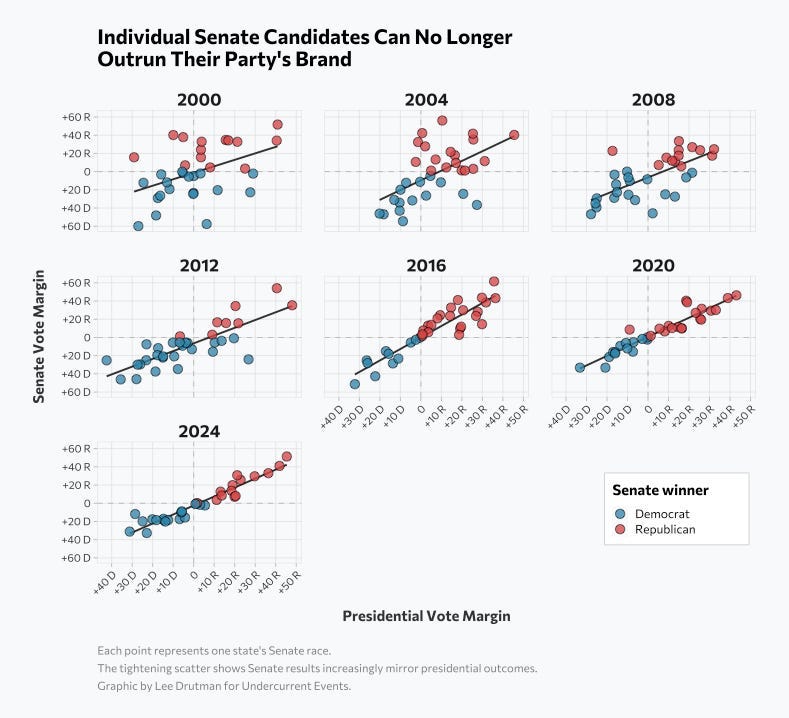
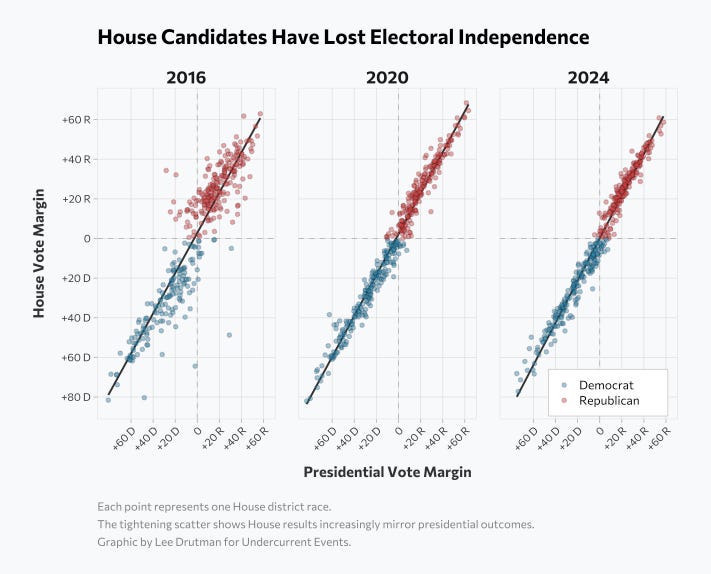
My big point was that the debate had lost the plot. The big story was that the nationalization of politics had collapsed all elections into simple partisanship, and taken a whole lot of seats off the even-remotely-competitive list. And that this collapse of dimensionality was the real issue.
Because I love scatterplots, I illustrated this problem with a faceted scatterplot showing Senate elections from 2000-2024, in presidential years. On the x-axis: presidential partisan vote share in the state. On the Y-axis, Senate partisan vote share. And there is the collapse of dimensionality: Senate candidates used to run independently of their parties, often to a great extent. By 2024, they don’t.
The House results were even more stark. Everything is explained by a single dimension.
The piece also explores fusion voting could bring back some of this lost dimensionality and competition, by introducing new parties that could elevate new issues and new dimensions out of the destructive binary conflict.
You can read the full piece here:
And the one piece that I had the most fun writing…
POSTED: AUG 01, 2025
I’ve written about gerrymandering so many times already that I thought it would be fun to do something new and different here, something experimental. So I set up a Socratic dialogue about gerrymandering, with myself as the Socrates figure, and used the Glaucon character from The Republic as the earnest interlocutor.
This came out just as Texas Republicans announced their plans for a mid-district gerrymander, so some of the assumptions about how this would play out have been overtaken by events. But it still stands as a fun explainer on why single-member districts remain problematic, and why the only way to end the gerrymandering wars for good and create genuine electoral competition across the country is, yes, proportional representation.
The introduction sets the tone well.
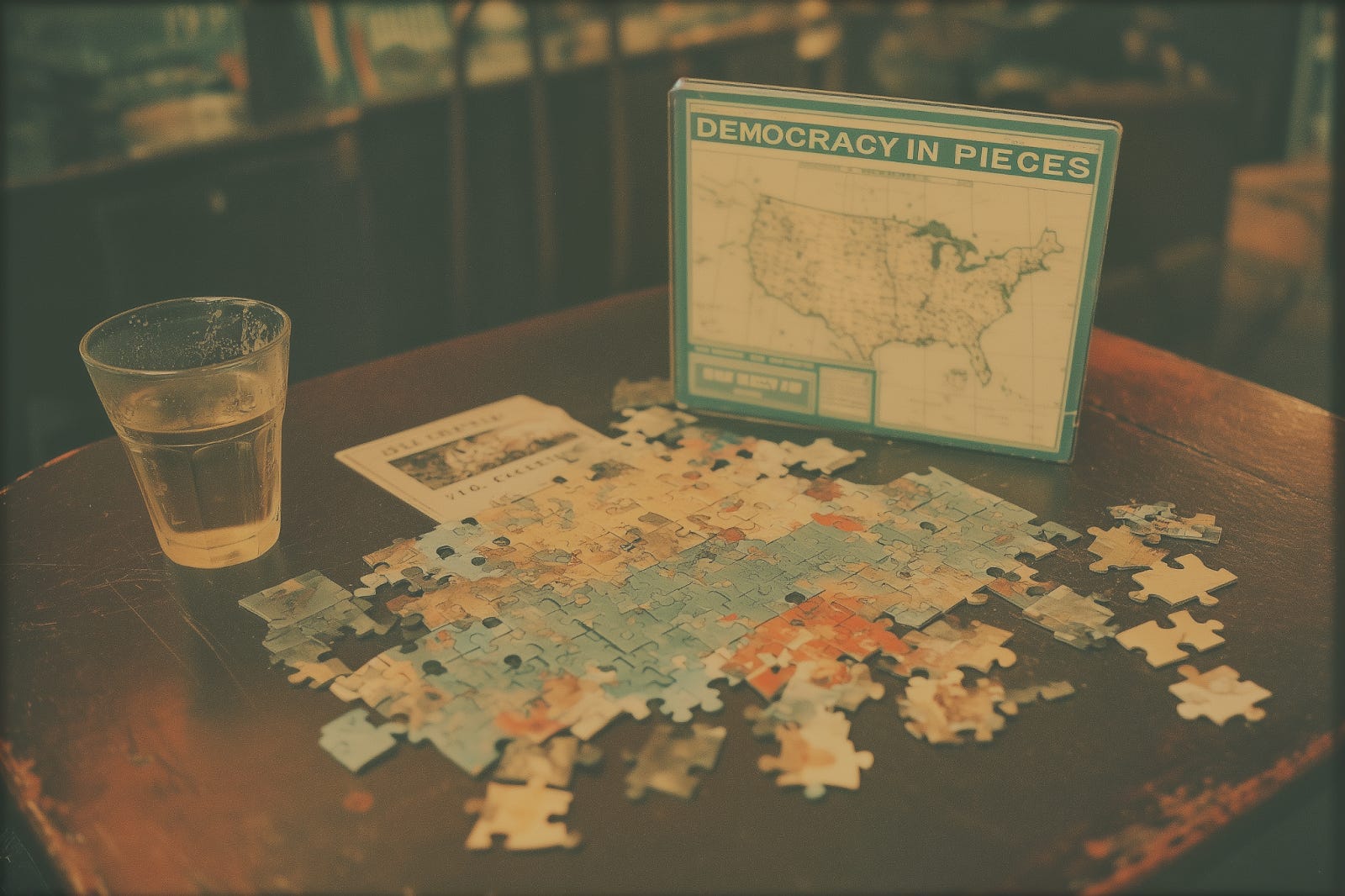
Setting: Happy hour at the Socrates Gastropub & Dialectical Drinkery. Lee and Glaucon (a young earnest liberal) claim a corner table propped up by a dog-eared copy of The Republic (Book VII). Pythagorean theorems sprawl across exposed brick between concert posters and philosophical graffiti. On a nearby table, a half-completed jigsaw puzzle labeled “Democracy in Pieces” sits abandoned, district-shaped pieces scattered across the surface. They order Philosopher King Pale Ales from the chalkboard menu of Epistemological IPA specials—the happy hour prices almost making up for the puns.
Here’s the whole piece:
Now a question for you: What should I write about in 2026?
Thanks for reading Undercurrent Events! This post is public so feel free to share it.
No posts
Comments
Nothing yet. Say the first thing.
Sign in to join the conversation.