
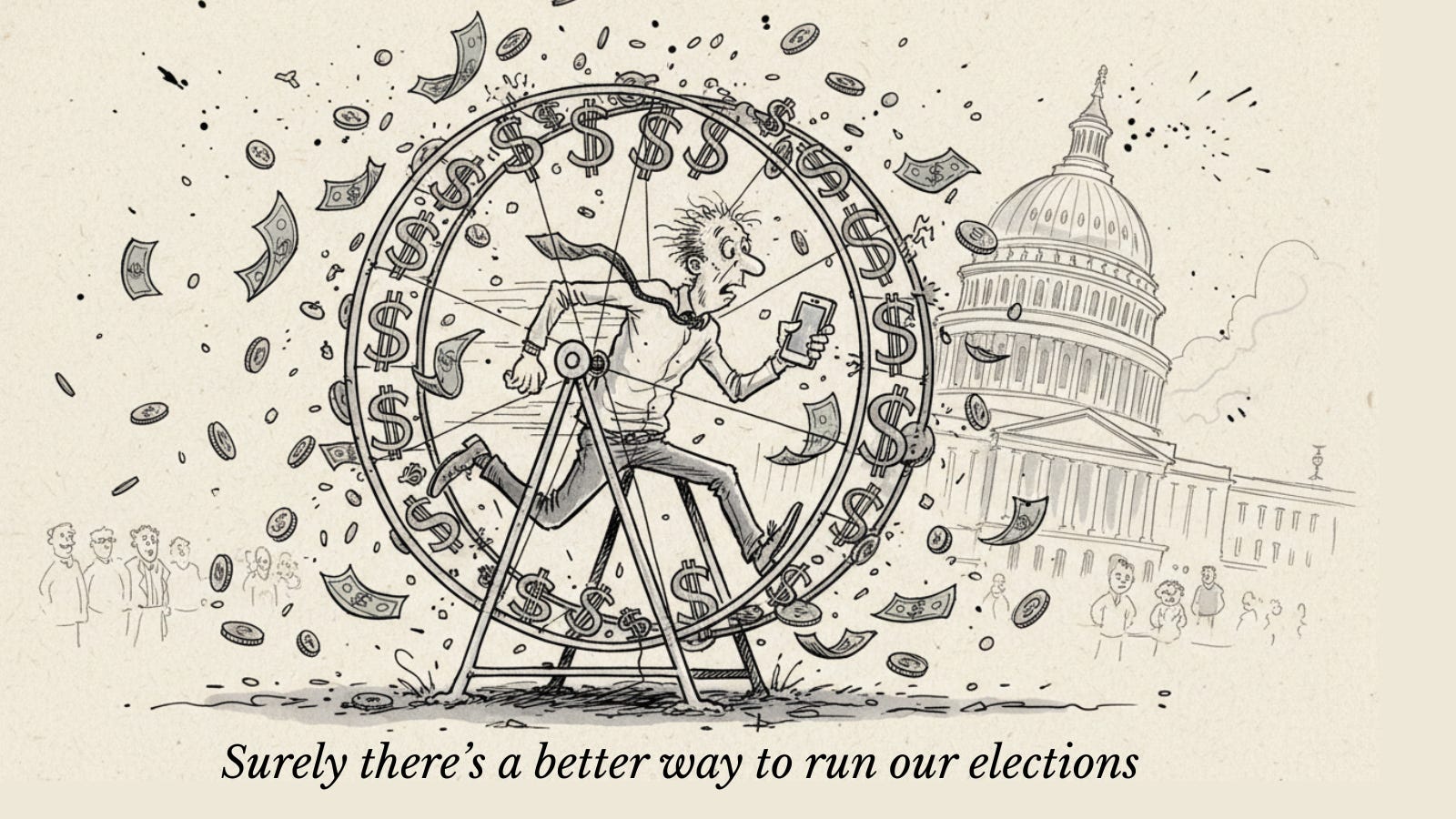
When I talk about proportional representation or fusion voting, I usually get a question about the money. What’s the point of redesigning the electoral system if billionaires can still buy the results?
My answer used to be: Do the electoral reform first, start breaking the two-party doom loop, and campaign finance reform gets easier. Try to fix the money problem inside the current electoral system, and you’ll keep losing.
But lately I’m not so sure. I think the moment has changed: it may now be both possible and necessary to do electoral and campaign finance reform together. So lately I’ve been mulling a new question: What would the money rules look like if we designed them for the electoral system we actually want, as a single architecture?
Here’s my current thinking: A campaign finance system for a multiparty electoral system should have four components: public funding for qualifying state parties, small-donor matching to state party organizations, contribution limits that privilege the party channel over the candidate channel, and aggressive original-source transparency for independent expenditures.
In other words:
Fund state parties with public money.
Match small-donor contributions to parties.
Channel whatever private money remains through state parties.
Disclose whatever flows outside the parties.
Start with the numbers. The 2024 federal election involved $15.9 billion in political spending. Elon Musk alone spent $290 million. Six others crossed the $100 million line. In 2000, billionaires accounted for 0.3 percent of federal campaign contributions. In 2024, it was 19 percent. Dark money nearly doubled to a record $1.9 billion. Small donors gave just 16 percent of all the money, down from over 20 percent in recent cycles. Projected spending on advertising alone: $10.8 billion. Wheeee.
Meanwhile, the Federal Election Commission hasn’t had a quorum since May 2025. The 2026 midterms will be the first modern federal election conducted without a functioning campaign finance regulator.
And somehow, for all that money, it’s not enough. Your phone buzzes every six seconds with an urgent ask. DEMOCRACY HANGS IN THE BALANCE and only your $5 before the MIDNIGHT DEADLINE can save it. Rage opens wallets. Political scientists Kim, Zilinsky, and Brew find that fundraising appeals are more toxic than the messages aimed at actually winning votes. The extraction machine has optimized for what works.
Here’s the structural story: Parties hollowed out. Reforms pushed money out of party channels. Primaries bypassed party gatekeeping. Media and fundraising nationalized. Everything professionalized. At the same time, American politics grew more candidate-centered. Each candidate developed a standalone operation, needing to distinguish herself, raise her own money, build her own brand.
The two trends fed each other. Weak parties made candidates more candidate-centered because nobody else was running their campaigns. Candidate-centrism made parties weaker because parties couldn’t control their own nominees. Into that space walked the consultants. The strategic work parties used to do (allocating money, picking fights, disciplining candidates, managing coalitions) still had to get done. Consultants took over the work, and got rich doing it. I’ve written about this pattern before and more recently.
Consultants live off fundraising and push for more. More fundraising means more consultants means more candidate-centric campaigns means weaker parties means more fundraising. Adam Bonica has documented that the share of every fundraised dollar spent back on fundraising itself has roughly quadrupled since 2004, from 9 cents to 38 cents. The more the system runs on fundraising, the more it pays everyone inside it to keep the fundraising going.
Danielle Thomsen’s The Money Signal: How Fundraising Matters in American Politics shows that fundraising totals work as a viability heuristic — donors, journalists, candidates, and party leaders all read an early war chest as proof a candidate can win. In a primary, every candidate wears the same party jersey, so the label tells you nothing about which one to pick. That’s when money takes over as the signal: an early war chest reads as strength, the strength attracts more money, and the candidate becomes viable because everyone treated her as viable. Money rules the primary because the cue everyone shares can’t tell anyone apart. In a general election, the party label is back on the ballot to compete with the dollar signs.
Candidate-centered fundraising also leaves every candidate naked to a single check. One mega-donor or super PAC can make or break an individual the way it never could a whole party. A party spreads the pressure across a coalition; a lone candidate absorbs it alone.
And most of the money gets spent on negative advertising. Consultants know that tearing down an opponent is cheaper and more reliable than building up a candidate. Every cycle, billions of dollars of attack ads train voters to see politics as a zero-sum contest between two sets of villains, where the best available outcome is the lesser disaster winning.
No wonder voters hate the parties. No wonder they hate politics. Look at what we’ve built. Half the country spends billions telling everyone the other half is a menace to the republic. The other half spends billions telling everyone the first half is worse. The whole machine runs on convincing you to despise your neighbors. Of course everyone’s miserable. We paid for it.
This is what candidate-centered politics, weak parties, and winner-take-all elections have wrought. And the natural thing to want is to make the money stop.
The most popular reform answers (versions of: just get money out of politics, overturn Citizens United) aren’t really possible right now. (And for the record, I’m skeptical of the constitutional-amendment route, too; I doubt anyone can write one that empowers regulators without also arming them against their own critics.)
And we have to reckon with a hard reality: Buckley v. Valeo‘s 1976 equation of money with speech has survived fifty years and several ideological shifts on the Court. Tabatha Abu El-Haj, writing in a 2016 law review article, argues that the First Amendment barrier to campaign finance regulation is “formidable regardless of Court composition.” She’s right. Attempting to regulate campaign finance directly is fighting wildfires with bottled water. But there’s a better way to deal with the money. And it goes through political parties. More of them.
Democratic Party favorability sits at 34 percent, the lowest Gallup has ever measured. A record 45 percent of Americans identify as independents. Roughly three-quarters want major changes to the political system or complete reform. Four in five say the country is in a political crisis. Americans, by every available measure, are done with the parties they have.
What they want, instead, is more parties. More ways to express political views that don’t fit the binary they’ve been handed. This is why we need reforms that make more parties possible, like proportional representation and fusion.
But more parties isn’t only about choice. It’s also how you make politics less vulnerable to narrow money. Our politics is candidate-centered because the parties are hollow, and the parties are hollow because they don’t have to be anything more. In a two-party system, each party survives as the only available opposition to the other. That monopoly is enough. Neither has to build a real organization, so neither does, and every candidate is left to assemble her own. And a politics of lone candidates is exactly the kind narrow money can capture.
Of course, if you think the problem with American politics is political parties and partisanship, your reform instinct is to weaken parties further. Nonpartisan primaries. Nonpartisan elections. Campaign finance rules that bypass party organizations.
But here’s the problem: All of these candidate-centered reforms make money and consultants even more influential. Each candidate has to work harder to distinguish herself, which means more fundraising and more consultants. And stripping the party cue from a twelve-candidate primary creates the conditions under which money is most powerful – where a single donor can elevate a single candidate. Or a single super-wealthy candidate can elevate himself: in the current California governor’s race, Tom Steyer has poured more than $200 million of his own money into the primary (as of May 29), many times what the strongest conventional fundraiser in the field has raised.
Money you wall out of the disclosed channels doesn’t disappear. It goes dark. It flows to the 501(c)(4)s and shell PACs inside shell PACs that hide themselves in cryptic acronyms and patriotic refrigerator poetry.
Inside a broken system, small-donor matching and campaign vouchers are modest improvements. At least they pull candidates toward voters who can spare ten dollars instead of financiers who can write thousand-dollar checks, which makes the money a less distorted signal of actual support. But it’s still a patch on a candidate-centered, two-party system that’s the real problem.
I’ve been making this argument for a while. (See especially “A healthy democracy requires healthy political parties” and “We need more (and better) parties.”)
Didi Kuo makes the case as powerfully as anyone in her recent book The Great Retreat. “Parties are integral to the functioning of democracy, because they give meaning to participation, to political conflict, and the very purpose of government.” Kuo’s larger argument is that the long-term health of democracy requires strong intermediaries, and that no other institution can do what parties do. She is 100% correct.
Progressive-era reformers tried to replace parties with nonpartisan administration. They got interest groups operating in the shadows. 1970s reformers tried to replace party bosses. They got candidate-centered campaigns funded by individual donors. Campaign finance reforms pushed money out of accountable party channels and into unaccountable ones. Nonpartisan elections atomized what they claimed to clean up.
Our system of single-member districts makes every seat a standalone contest. Partisan primaries force candidates to win two elections, the first in a low-information environment where voters have no partisan cue. Campaigns stretch across months or years, so the fundraising burden never stops.
When party organizations are weak, candidates have to build their own fundraising operations. That means building their own relationships with donors. Without public funding, that means developing their own dependence on the wealthy donors who write the checks. No iron law of politics says a candidate must grovel to the rich. We just arranged things that way.
As I’ve argued repeatedly, we need a combination of proportional representation and fusion voting to make multiparty democracy possible in America and break the two-party doom loop. That’s PR wherever possible, which means the House, state legislatures, and city councils. Fusion wherever single-winner elections are unavoidable: governor, senator, mayor, president.
Start with fusion voting. Fusion lets minor parties cross-nominate major-party candidates and build a brand without funding standalone campaigns. It substantially lowers the cost of party-building. You can demonstrate electoral support, recruit members, and accumulate bargaining power on a fraction of what an independent candidacy would cost. And it shifts donor energy from individual candidates toward party organizations. Under fusion, a minor party’s vote total on its line is public, quantified, and legible to every political actor in the system. That number is leverage. It tells the major party how much support flows through the minor line and what it would cost to lose it. Donors who care about the minor party’s agenda have reason to fund the organization that generates the leverage, not just the candidate who benefits from it.
Then comes proportional representation, the real structural fix. Under PR, the party is the unit of competition, so campaigns become party operations: the party aggregates the fundraising, allocates the resources, runs on a shared platform. A candidate doesn’t need her own war chest, because she isn’t a standalone business anymore, she’s running on a team. The donor-candidate pipeline doesn’t get regulated away. It just becomes less important.
Some of the negativity recedes. Move from two parties to many and the zero-sum logic that makes attacks pay starts to break down, because the voter you drive away from a rival might land on someone else entirely rather than on you. (The comparative evidence points this way.) But that solves only part of the money problem.
Moneyed interests will still try to influence parties, and to boost favored candidates inside them. Which is why a public financing component for the state party system is crucial.
If a state adopted fusion, open-list PR (voters pick a party and the specific candidate they want from that party’s list), and a new campaign finance system as a package, here’s my proposal for what the money rules could look like.
Public funding for state parties. Every state party that clears a low threshold, say half a percent of the statewide vote, gets public money proportional to its share of votes cast. Germany uses the same 0.5 percent threshold, and about twenty parties qualify. The formula rewards smaller parties on a per-vote basis for their first tranche of support, then tapers. New parties qualify through petition, which gives them an on-ramp before they’ve won their first election.
State and local parties are the level where a party can still be a real thing. State and local parties are close enough to voters to build actual relationships, to know a neighborhood, to show up between elections instead of only at fundraising time. National parties are brands and bank accounts; state parties can be organizations. If the goal is to rebuild parties as institutions that connect people to politics, you fund them where that connection is still possible to make.
State parties should have to raise at least half their own budget from private sources, however, within the contribution limits below. Membership dues, small donations, fundraising events. The state funds parties that demonstrate real support, not zombies kept alive on public money alone.
“But won’t this just entrench the party leaders we have?” you might ask. It’s the worry I take most seriously. Reformers who’ve fought state parties know that leadership power, once funded, can calcify into a machine that resists the very reforms that would discipline it.
Two things answer it.
First, the money follows votes. A poorly run party, one captured by its leaders and coasting on insider control, bleeds supporters, and a party that bleeds supporters bleeds funding. The voters do what no oversight board can.
Second, parties can be built to resist capture from the inside. New York’s Working Families Party, anticipating that its largest union affiliates might someday dominate, capped any single member’s voting power and set representation floors for small grassroots groups. The design forced factions to build internal alliances rather than outspend each other for control.
In theory, public money should reward parties that are more internally democratic. In practice, I don’t know how to write that rule. Any test you can put on paper, a determined machine can satisfy on paper. But the principle stands: the money should pull parties toward genuine rootedness, not just reward whoever already holds the gavel.
How much public money should parties get? How about two or three dollars per resident per year across all qualifying state parties? That’s roughly what Germany spends per capita on its public funding for parties system. In a state of ten million people, that’s $20-30 million a year. Roughly 0.005 percent of the state budget. Less than the state’s tourism promotion budget. Less than a competitive U.S. Senate race already costs in private money.
Small-donor matching to state party organizations. Match every dollar a state resident gives to a state party at six to one, up to $50 per donor. Pair it with a tax refund for small contributions to parties. Minnesota has been doing the refund half since 1990. Up to $75 per person, straight from the state treasury, no constitutional challenge in thirty-five years.
The match goes to the party, not the candidate. The refund goes to the donor, not the candidate. Both flip the fundraising incentive. Instead of 47 panic texts from 47 individual candidates, the party has a reason to talk to supporters about what it stands for. The match applies to the first small dollars a donor gives, within the larger contribution limits below; the point is to make the small gift worth chasing. The extraction model breaks because the structure no longer demands it.
Contribution limits that privilege the party channel. Let donors give something like ten times as much to a state party as to any single candidate on its list. Maybe $2,500 to the party and $250 to the candidate, maybe $5,000 and $500. The exact numbers are a design choice. The principle isn’t: make the party channel the easy one and the candidate channel too narrow for anyone to go it alone, so the money pools in the party instead of scattering across candidates. That’s what keeps it flowing through the institution rather than around it.
Original-source transparency for independent expenditures. Here we should follow the Arizona model. When a super PAC or 501(c)(4) spends above a threshold on state elections, it has to trace the money back and disclose the original donors, not just the shell entity that wrote the check. That closes the dark-money loophole. Arizona’s Prop 211 passed in 2022 with 72 percent of the vote and has so far survived legal challenges. Apply the same rule to spending that targets state parties, and to spending that targets individual candidates within a party list. Under open-list PR, the vector for donor-class capture isn’t buying a party outright. It’s boosting your preferred candidates to the top of a party’s list through “independent” preference-vote campaigns. Full disclosure makes that vector visible.
Does this package work? I think so, but this is a first pass. I hope it’s the start of a conversation.
What I’m more sure of: campaign finance reform has to accompany electoral system reform. And the reform has to encourage healthy parties, not keep gutting them.
A moment is opening for democracy reform. The current system is failing visibly enough, and on enough dimensions simultaneously, that the case for structural change is becoming impossible to ignore.
When that moment opens, the reform package can’t be just electoral system design. It has to include campaign finance. And the campaign finance piece has to match the new electoral system, not bolt on to the old one.
Thanks for reading Undercurrent Events! This post is public so feel free to share it.
No posts
Comments
Nothing yet. Say the first thing.
Sign in to join the conversation.