
Apologies for the tardiness of the sermon and materials this week. Sometimes, it’s Wednesday that sure does roll around (rather than Sunday!)
“In the Shadow”
A Sermon for the Thirteenth Sunday after Pentecost • Matthew 16:13–20
If you were traveling with Jesus and the disciples in the region of Galilee, and you asked to see the most impressive religious and political sight nearby, someone would probably have taken you to Caesarea Philippi.
Caesarea Philippi was a city about twenty-five miles north of the Sea of Galilee, built at the base of Mount Hermon. It had been renamed and rebuilt about thirty years earlier by Herod the Great’s son Philip — who named it after himself and after Caesar. So the city carried two names on it: the emperor’s, and the local ruler’s. Everywhere you looked, you saw signs of Roman power.
But that was not the only thing you saw.
At the base of the mountain there was a massive rock cliff, and cut into that cliff was a huge cave. Water poured out of the cave — it was one of the main sources of the Jordan River. And for centuries, that cave had been considered sacred. It was a shrine to the Greek god Pan. Statues of Pan were carved into the rock face. Ritual sacrifices were performed there. The cave was called the Gates of Hades, because people believed the underworld could be reached through it.
So imagine the scene. You are standing in the shadow of a massive cliff with the shrine of another god carved into it. You are inside a city named after the emperor of Rome. Everywhere you look, there are competing claims about who is in charge, who is worthy of worship, and where the real power lies.
And this is the place — this exact place, in the shadow of Caesar and Pan — where Jesus turns to his disciples and asks: “Who do you say that I am?”
Matthew tells us this location on purpose.
Jesus could have asked the question anywhere. He could have asked it in Galilee, on a familiar hillside. He could have asked it in the synagogue. He could have asked it in a quiet moment on the road. Instead, he brings them here — to the place where the competing answers to the question are carved into stone.
That is worth sitting with, because I think Matthew is telling us something about when the question of Jesus’s identity actually gets asked in real life. It does not get asked in the neutral rooms. It does not get asked in the theoretical seminars. It gets asked in the places where other voices are already very loudly saying: I am the one who matters. I am the one you should worship. I am the one who has real power.
Jesus asks the question in the shadow.
And I think we make our answer in the shadow, too.
Because none of us confesses our faith in a neutral space. All of us live our lives in some Caesarea Philippi — some place where other powers are already claiming our attention, our loyalty, our worship. Some of those shadows are political. Some are economic. Some are personal. Some of them are the loud, constant voices of a culture telling us who to be, what to want, what to fear, what to buy, whom to hate.
Jesus asks the question in the shadow because that is where the answer actually costs something. It is easy to say “you are the Messiah” in a room where no one else is claiming that title. It is much harder in a place where Caesar’s name is on every coin and Pan’s face is carved into every cliff.
Now let me tell you how the question unfolds. Because Jesus asks it in two stages, and both stages matter.
First he asks, “Who do people say that the Son of Man is?”
The disciples answer easily. This is a question they can handle. They report what they have been hearing. Some say John the Baptist — people who saw Herod’s guilt at having killed John, and imagined he had come back. Others say Elijah — the great prophet who never died, who was expected to return. Still others say Jeremiah, or one of the prophets.
Now I want you to notice something about these answers. They are all good answers.
John the Baptist was a good answer. He was the herald, the one who prepared the way, the last of the great prophets before Jesus. To be compared to John the Baptist was a serious compliment.
Elijah was a good answer. Elijah was one of the two greatest prophets Israel had ever produced. Elijah had confronted kings, called down fire from heaven, been taken up in a whirlwind. To be compared to Elijah placed Jesus in the highest company of Hebrew prophecy.
Jeremiah was a good answer. Jeremiah was the great prophet of the exile, the weeping prophet, the one who spoke God’s word to a nation that would not listen. To be compared to Jeremiah was to name Jesus as a prophet of unusual depth.
These were not bad answers. Nobody was saying Jesus was a fraud. Nobody was saying he was nothing. The crowd was recognizing something in him and reaching for the highest categories they had.
But they were not enough.
And here is something I want you to hold this morning. Sometimes the good answers are what stand in the way of the true one. It is not always the outright rejections of Christ that keep people from him. Sometimes it is the perfectly respectful, perfectly religious, perfectly acceptable answers that stop just short of what Jesus actually is.
Some of us have been given good answers about Jesus all our lives. He was a great teacher. A moral example. A prophet of love. A wise voice from the ancient world. A model of nonviolent resistance. A challenger of the powers.
All of those things are true. But none of them, by itself, is enough.
And then Jesus asks the sharper question.
“But who do you say that I am?”
That “you” is emphatic in the Greek. Jesus is not asking for a report anymore. He is asking his disciples — the ones who have followed him, eaten with him, watched him heal, seen him weep, been in the boat with him during the storm — to say what they have come to believe.
There is a pause in the story you can almost feel. And then Peter answers.
“You are the Messiah. The Son of the living God.”
It is one of the great sentences in the Gospels.
Notice what Peter does not say. He does not say “you are a prophet like John or Elijah.” He does not settle for the categories the crowd has been offering. He goes further. He uses the word Messiah — the Anointed One, the one Israel has been waiting for. And he adds the phrase “Son of the living God” — a phrase that places Jesus in a relationship to God that no prophet, however great, has ever been placed in.
Peter answers with more than the good answers. He answers with the true one.
And Jesus responds by blessing him.
“Blessed are you, Simon son of Jonah! For flesh and blood has not revealed this to you, but my Father in heaven.”
I want us to slow down on that line, because it is doing something important.
Jesus does not say, “Well done, Peter, you finally figured it out.” He does not say, “Congratulations on your theological insight.” He says: this did not come from you. This is not something you worked out on your own. My Father revealed this to you.
Peter’s confession is a gift.
That matters, because a lot of us have been taught to think of faith as something we work up. Something we accumulate. Something we earn by trying harder. And when we do not feel it as strongly as we think we should, we assume something is wrong with us.
Jesus is saying the opposite. The true confession — the moment when you look at Jesus and know, in the bones of you, that he is the Messiah, the Son of the living God — that is a gift from the Father. It is not something you produce. It is something you receive. And what you do with it is what matters next.
Now Jesus keeps going, and this is where we get one of the most famous lines in the Gospels.
“You are Peter, and on this rock I will build my church.”
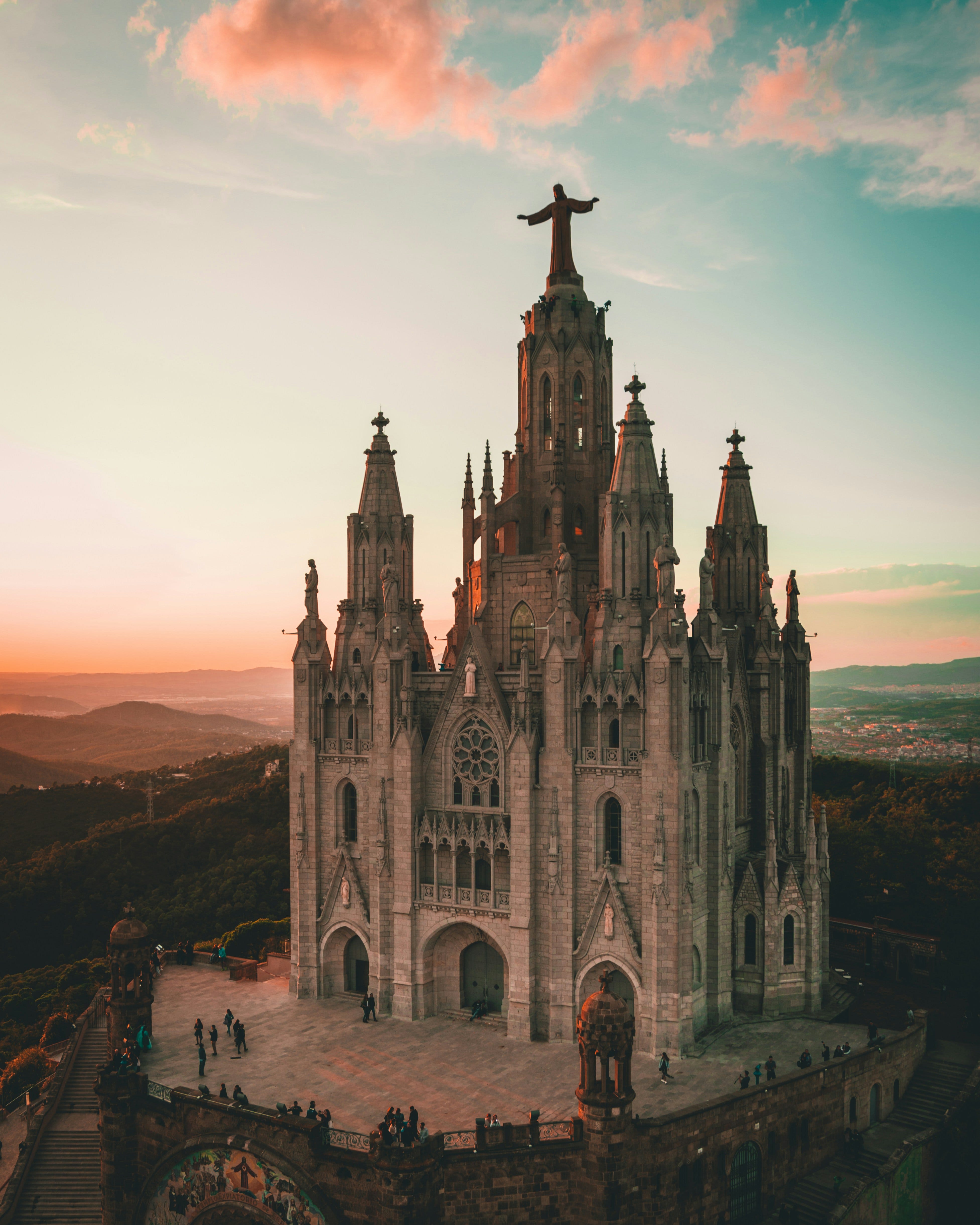
Photo by Biel Morro on Unsplash
There is a play on words here. Peter’s name means “rock.” And Jesus says: on this rock I will build my church. Christians have argued for centuries about whether the “rock” is Peter himself, or Peter’s confession, or something else. Whole traditions have been built on one reading or the other, and I am not going to try to settle that this morning.
But I want to name what all the traditions agree on. The church is built on a rock. And that rock is not our building. It is not our institutional strength. It is not our numbers, our budget, our facilities, or our staff. It is not our cleverness. It is not our correctness on every issue. It is not our reputation in the community.
The church is built on the confession that Jesus is the Messiah, the Son of the living God.
And when that confession is being made — even by one person, even in a shadow, even in the presence of every competing claim to authority — the gates of Hades will not prevail against it.
Do you hear how big that promise is? Jesus makes this promise while pointing at the actual gates of Hades — the cave in the cliff behind him, the place people believed the underworld could be reached. He is saying: even in the shadow of this place, even under Caesar’s name, even next to the shrine of another god — what is being built here will outlast all of it.
So here is where I want to land this morning.
The question Jesus asks at Caesarea Philippi is not a museum question. It is not a question asked once, long ago, to twelve men in a place we can now visit as tourists. It is the question the Gospel keeps putting to every congregation, in every generation, in whatever shadow they happen to be standing in.
Who do you say that I am?
I do not think you can answer that question honestly without noticing the shadow you are standing in. What are the competing voices in your life right now? What are the powers claiming your loyalty? What are the false confessions you have been quietly saying with your calendar, your bank account, your attention? Where is Caesar’s name on your coins, and where is Pan’s face carved into your cliffs?
Peter answered the question in the shadow. He did not wait for the shadows to clear. He answered in the presence of everything that was competing for his allegiance, and he answered anyway. Not with a good answer, but with the true one.
And Jesus blessed him for it. And built the church on it. And promised that the shadows would not, in the end, prevail.
That is the invitation of this morning’s Gospel. Not to have the theology all worked out. Not to be free of the competing voices before you answer. Just to say, in whatever shadow you are standing in this morning, what Peter said in his.
You are the Messiah. The Son of the living God.
And to trust that this confession — which you did not produce, which was given to you by the Father — is enough to build a church on. Enough to build a life on. Enough to outlast every shadow the world can throw at it.
Amen.
Christ of the true confession — you took your disciples to Caesarea Philippi, into the shadow of Caesar and of Pan, and asked them the hardest question they had ever been asked. You asked them who you were.
And Peter answered. Not because he was clever. Not because he had earned it. Because your Father, in that moment, gave him the truth to speak, and he had the courage to speak it in the presence of every voice that would have preferred a different answer.
We come to you in our own shadows this morning. The powers that claim our attention have not softened. The competing voices are as loud as they have ever been. Our own coins carry other names; our own cliffs have other faces carved into them. And still you ask us: who do you say that I am?
Give us Peter’s grace. Not his cleverness — his gift. Reveal yourself to us as your Father revealed himself to Peter. Give us the words. And give us the courage to say them where they are least easy to say — in the middle of ordinary weeks, in front of people whose approval we would rather not risk, in the shadows we live in.
You are the Christ, O Lord. The Son of the living God. Build your church on that confession — again this morning, in each of us who came in with less faith than we would like to have. And let the shadows around us not prevail.
Amen.
Comments
Nothing yet. Say the first thing.
Sign in to join the conversation.