
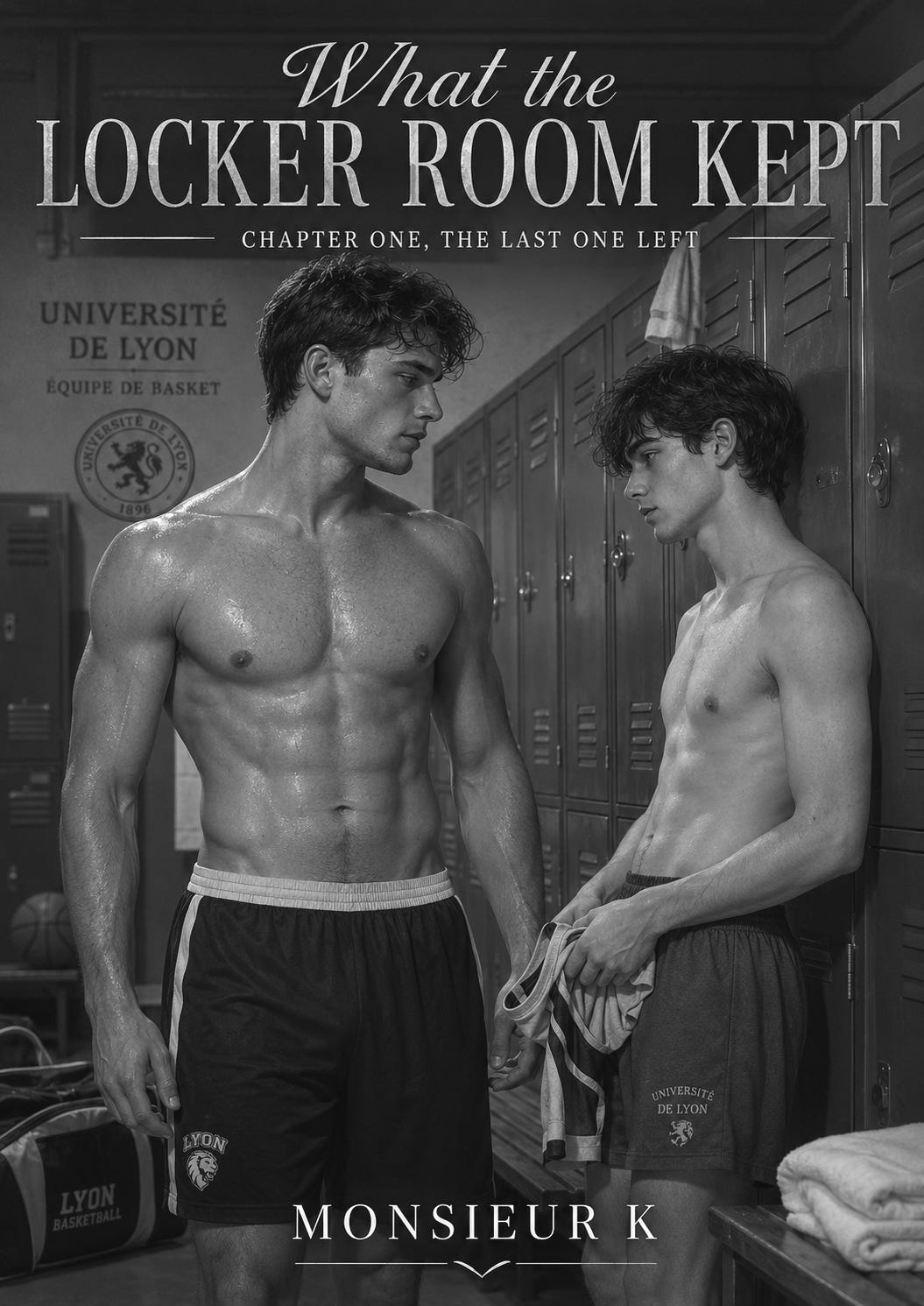
By the time Quentin stepped onto the court, the university gymnasium had already begun to feel too small for him.
The stands were not full, not quite, but the noise rose toward the steel beams with enough force to imitate a larger crowd. Shoes squealed across varnished wood. The electronic scoreboard cast red numbers onto faces flushed by heat and expectation. Somewhere behind the first row, a group of students had begun chanting Quentin’s name before the referee had even placed the ball in play.
He pretended not to hear them.
That was part of what made people love him.
At twenty one, Quentin had learned the careful art of appearing unaware of his own effect. He did not look toward the girls holding homemade signs near the middle of the stands. He did not acknowledge the students calling his number from behind the basket. He simply rolled his shoulders beneath the dark blue university jersey, flexed his fingers once, and waited for the whistle.
He was tall even among the other players, with the dense, balanced build of someone whose strength had been trained rather than merely inherited. His shoulders filled the jersey cleanly. His thighs shifted beneath his shorts whenever he lowered into position. Sweat had already begun to darken the hair at his temples during the warm up, sharpening the angles of a face that was handsome without delicacy.
Quentin was not the captain, but the team seemed to bend around him anyway.
When he moved, the others adjusted.
When he called for the ball, it arrived.
When he scored, the gym erupted as though everyone had known it would happen and was still delighted to be proven right.
From the far end of the court, near the equipment bench, Elio watched him.
He stood beside two crates of water bottles with a towel folded over one arm and a clipboard pressed against his narrow chest. Nobody in the stands knew his name. Most of the players used it only when they needed something.
“Elio, bottle.”
“Elio, where’s my tape?”
“Elio, we’re out of towels.”
He answered quickly, carried what was required, and moved away before anyone could decide whether to continue the conversation.
He was twenty one too, though beside the players he looked younger. Slim shoulders. Fine wrists. Dark hair that fell forward no matter how often he pushed it back. His university sweatshirt was always one size too large, its sleeves reaching almost to his knuckles, as though he had selected his clothes according to how effectively they might erase him.
There was beauty in him, but it lived beneath neglect.
His mouth was soft and serious. His eyes were large, dark, and difficult to meet for long because they appeared to notice too much. A faint line divided his brows whenever he concentrated. When he smiled, which happened rarely around the team, one side of his face softened before the other.
Nobody looked closely enough to see any of it.
Quentin had not looked closely either.
Not until that night.
The match was harder than expected. Their opponents played with the desperate precision of men who had been told they were weaker and wanted to punish everyone for believing it. By the final quarter, Quentin’s jersey clung to him as if painted there. Sweat gathered beneath his arms, between his shoulder blades, along the deep center of his chest. Every breath brought the taste of salt to his mouth.
He liked the exhaustion of a close game. It stripped everything down. There was no popularity inside it, no applause, no cleverness. Only weight, impact, instinct.
He took an elbow to the ribs. A shoulder struck his jaw. He hit the floor hard enough to feel the vibration in his teeth, then rose before anyone could offer a hand.
With less than a minute remaining, the score was tied.
The ball came to Quentin at the edge of the court. He heard the crowd rise, but the noise flattened into something distant and useless. One defender moved toward him. Another waited near the basket. Quentin shifted left, turned, drove between them, and felt both bodies close around him.
For a second, there was only pressure.
Then the space opened.
He jumped.
The ball left his hand with three seconds remaining and struck the backboard before falling through the net.
The final buzzer sounded beneath the roar.
His teammates crashed into him. Hands struck his shoulders, his head, the back of his neck. Someone shouted directly into his ear. Quentin laughed, breathless, caught between bodies hot with effort and triumph.
Beyond them, Elio remained beside the bench.
He was smiling.
Not widely. Not like the people in the stands. His expression held something quieter, almost private. His gaze moved over Quentin’s face, then lower, following the sweat shining down the column of his throat.
Their eyes met.
Elio looked away first.
The moment was so brief that Quentin would ordinarily have forgotten it. Yet when the team disappeared into the locker room, carrying their noise with them, the image followed him.
Elio watching.
Elio smiling.
Elio looking down.
Inside, the players filled the room with the dense energy of victory. Music played from someone’s phone. Locker doors slammed. Wet shoes struck the tiles. Men shouted across benches while stripping off their uniforms, their voices larger because the match had left something wild in them.
The room smelled of exertion.
Sweat soaked into polyester. Damp socks. Rubber soles. Cheap deodorant sprayed too heavily into warm air. Steam began drifting from the shower entrance, carrying the mineral scent of hot water and industrial soap.
Quentin sat on the central bench and pulled his jersey over his head.
The fabric resisted briefly, caught against the damp breadth of his shoulders, then peeled free with a soft suction. Cool air touched his skin. He wiped his face with the inside of the shirt before dropping it beside him.
One of his teammates, Mathieu, glanced at the darkened cloth.
“That thing could walk to the laundry room by itself.”
Quentin pushed him away with one hand.
“You were the one hanging off me for the last five minutes.”
“Professional affection.”
“Professional neediness.”
Mathieu laughed and disappeared toward the showers, naked except for the towel over his shoulder.
Quentin remained seated for another moment. His pulse was settling, but a pain had begun to form near his right shoulder, not sharp enough to worry him, only deep and warm where he had collided with the floor. He rotated his arm slowly.
At the entrance to the locker room, Elio appeared with two large black laundry bags.
Nobody greeted him.
He entered while the players continued changing around him, moving through the room with his gaze trained on the floor. He collected abandoned tape, empty bottles, crumpled towels. When someone dropped a shirt near his shoes, he picked it up without complaint.
Quentin watched him without intending to.
Elio worked carefully. That was the first thing he noticed.
He did not simply throw everything into one bag. Towels went into one container, uniforms into another. He checked beneath the benches. He separated damp clothing from forgotten personal items. When he found a phone or wallet, he placed it on the owner’s shelf rather than leaving it exposed.
He knew where everything belonged.
More strangely, he seemed to know whom everything belonged to.
A jersey landed inside out near the showers. Elio glanced at the narrow strip of visible number and placed it directly into the correct player’s locker basket before continuing.
Quentin had never considered how much attention the task required.
“Elio,” someone called from the shower. “There’s no more soap.”
“I’ll replace it.”
His voice was quiet but pleasant. Softer than Quentin expected.
“Tonight, preferably.”
Laughter came from behind the tiled wall.
Elio did not react. He crossed to the supply cupboard, removed a refill, and carried it toward the showers. As he passed the bench, Quentin noticed the delicate flush rising along his neck.
It might have been embarrassment.
It might have been heat.
Quentin looked away before Elio could catch him staring.
The others left in groups, still loud, already discussing the party planned near the river. Invitations moved through the room with the casual cruelty of popularity. Names were assumed. Others were omitted without anyone consciously deciding to omit them.
Quentin dressed slowly because of his shoulder.
“Elio,” Mathieu called while pulling on his shoes. “You coming tonight?”
The room went briefly quiet.
Elio looked up from the bag he was tying.
The question sounded generous, but Quentin knew Mathieu well enough to hear the amusement beneath it. Everyone did. They waited to see how Elio would handle the impossible invitation, one offered only because the person giving it expected refusal.
“I have to finish here,” Elio said.
“Of course you do.”
Mathieu smiled and turned away.
Something tightened in Quentin’s chest.
He almost said that Elio could join them afterward. The sentence rose and stopped behind his teeth. He did not know why it felt so difficult. Perhaps because speaking would draw the attention of the entire room. Perhaps because Quentin had spent years understanding exactly how groups worked, and he knew that a single kind gesture could become another form of exposure.
Elio bent over the laundry bag again.
The conversation moved on.
Within ten minutes, the locker room had emptied.
Quentin should have left with the others. Instead, he sat alone near the end of the bench, pressing the heel of his hand into his shoulder. The gym beyond the doors had fallen silent. Without the crowd and music, the building seemed cavernous.
Elio returned from the storage room and stopped when he noticed him.
“You’re still here.”
It was the longest sentence he had ever directed at Quentin.
“Shoulder,” Quentin said.
Elio hesitated, then placed the bag on the floor. “Did you fall on it?”
“Second quarter.”
“I saw.”
The words came too quickly.
Elio looked down.
Quentin studied him. “You remember that?”
“You stayed down longer than usual.”
“I was down for about two seconds.”
“Yes.”
Elio’s face reddened more deeply.
Quentin felt the beginning of a smile. “You pay attention.”
“I have to. For the equipment.”
The answer was reasonable, but it did not explain why Elio had counted the seconds.
Before Quentin could say anything else, Elio crossed to the medical cabinet. He removed a flexible cold pack, wrapped it in a clean towel, and returned.
“Here.”
Quentin accepted it. Their fingers touched.
Elio withdrew his hand immediately.
The contact was nothing, barely skin against skin, yet Quentin felt it with peculiar clarity. Elio’s fingers had been cool. His own were still warm from the game.
“Thanks.”
“You should keep it there for fifteen minutes.”
“Yes, doctor.”
Elio looked uncertain whether Quentin was mocking him.
Quentin softened his voice. “I mean it. Thanks.”
A small change moved through Elio’s face. Not quite a smile. Something more fragile.
“You’re welcome.”
He walked away and resumed his work.
Quentin sat with the cold pack against his shoulder and watched him.
Elio moved differently now that the room was empty. The nervous contraction of his body had lessened. He no longer hurried. He opened lockers, collected abandoned garments, and checked each label before placing anything into the correct bag.
There was a kind of ceremony in it.
The players had left behind the evidence of themselves. Wet towels lay twisted across benches. Socks had been abandoned beneath lockers. Shirts carried dark maps of sweat at the chest and back. Jockstraps and compression shorts were tangled inside discarded uniforms.
Elio handled each object with an attention that exceeded duty.
Not dramatically. Nothing he did could have been called improper. Yet his fingers sometimes paused before releasing a piece of clothing. His gaze lingered on the shapes left behind in damp fabric. Once, while lifting a shirt from the floor, he pressed his thumb into the darker material at the chest as though testing whether it remained warm.
Quentin’s curiosity sharpened.
He told himself he was bored.
He told himself the cold pack required time.
He told himself that Elio was simply thorough.
Then Elio approached Quentin’s bench.
Quentin’s jersey still lay where he had dropped it, inside out, dark with sweat. His shorts rested beneath it. The white compression layer he had worn under the uniform had been pushed halfway beneath the bench.
Elio stopped.
Quentin could not see his expression clearly from where he sat, but he saw the subtle rise of his chest.
Elio bent and picked up the jersey.
He recognized it before turning the number outward.
Of course he did.
Number twelve.
Quentin.
Elio’s fingers gathered the damp fabric carefully. For one second, he held it at the level of his waist. Then his gaze shifted toward Quentin.
Quentin lowered his eyes and pretended to adjust the cold pack.
When he looked again, Elio was walking toward the laundry room with the jersey held separately from the other uniforms.
A pulse of interest moved low through Quentin’s body.
It was not yet desire. He would not have called it that. It was simply the awareness that something had happened beyond the surface of an ordinary gesture.
Elio had looked at him.
Elio had carried his jersey differently.
Quentin waited another minute, then rose.
The pain in his shoulder had eased. He could have dressed and left. Instead, he crossed quietly toward the row of lockers near the showers, where the angle of the wall concealed him from the laundry room entrance.
He heard water running into a utility sink.
Fabric shifted.
A metal cart rolled against the tiles.
Then silence.
Quentin moved closer.
Through the narrow gap between the lockers and the tiled partition, he could see part of the laundry room. Elio stood beside the sorting table with his back turned. The overhead light was harsher there, bleaching the room of warmth.
Quentin’s jersey lay in front of him.
Elio placed both hands on it.
His shoulders rose with a slow breath.
For several seconds, he did nothing else.
Quentin felt his heartbeat change.
Elio lifted the jersey.
He brought the collar toward his face.
Then he closed his eyes.
Elio pressed his face into the fabric.
Not carelessly. Not with the rushed greed of someone stealing a forbidden pleasure before he could be caught. He held the jersey with both hands and lowered his mouth and nose into the damp collar as if approaching something precious.
Then he breathed in.
The sound was almost inaudible.
A long, controlled inhalation.
His chest expanded beneath the oversized sweatshirt. His fingers tightened around the cloth. The dark blue fabric folded against his cheeks, still carrying the heat Quentin had left inside it.
Quentin stopped breathing.
The sight should have repelled him.
Perhaps it should have embarrassed him. Another person was holding something that had touched his naked skin, breathing in the sweat he had produced through effort, impact, pain. The act crossed a boundary Quentin had never needed to define because he had never imagined anyone approaching it.
Yet revulsion did not come.
Instead, heat moved through him.
Slowly at first, spreading from the base of his spine into his stomach, then gathering there with a density that made him press one shoulder against the lockers for balance.
Elio breathed in again.
Deeper.
His face changed.
The anxious caution disappeared from it. His lips parted against the collar. His brow softened. The expression was not obscene. That was what disturbed Quentin most. There was longing in it, certainly, but also relief.
Elio looked as though the scent allowed him to become someone he hid from the rest of the world.
Someone hungry.
Someone capable of wanting without apology.
He lowered the jersey and stared at the number.
His thumb moved across the white print.
Twelve.
Quentin imagined what remained in the material. The salt from his chest. Sweat from beneath his arms. The musk that gathered when his body had been pushed past comfort. The clean residue of detergent beneath everything newer and warmer.
He knew his own smell after a game. It was strong. Male. Difficult to disguise even after deodorant.
Elio wanted it.
The knowledge entered Quentin with startling force.
He had been desired before. People flirted with him at parties. Messages appeared on his phone after matches. Strangers found reasons to touch his arms or stand close in crowded rooms. That kind of desire was easy to understand. It concerned his face, his body, the public shape of him.
This was different.
Elio wanted what remained when the performance was over.
The sweat.
The exhaustion.
The evidence of effort.
The private animal truth of his body.
Comments
Nothing yet. Say the first thing.
Sign in to join the conversation.