
It seems I’ve been studying languages all my life. French is the one constant, which has stayed with me from childhood to the present. In between I learned German, partly for professional reasons, partly to live happily while living in Germany. And there were a few others along the way. But this is about the two languages (other than English) I use almost every day.
This is a revised version of the original published 2 October 2024, when I had 37 subscribers.
Growing up I found the notion of speaking languages other than English intriguing. There was a bookcase in our home that held, among other things, the books an uncle had used while a student at Massachusetts Agricultural College (now the University of Massachusetts). He had died in an accident on campus, plunging his parents into a lifetime of mourning, and his textbooks, some of which were in German, were among the relics that had been carefully preserved.1
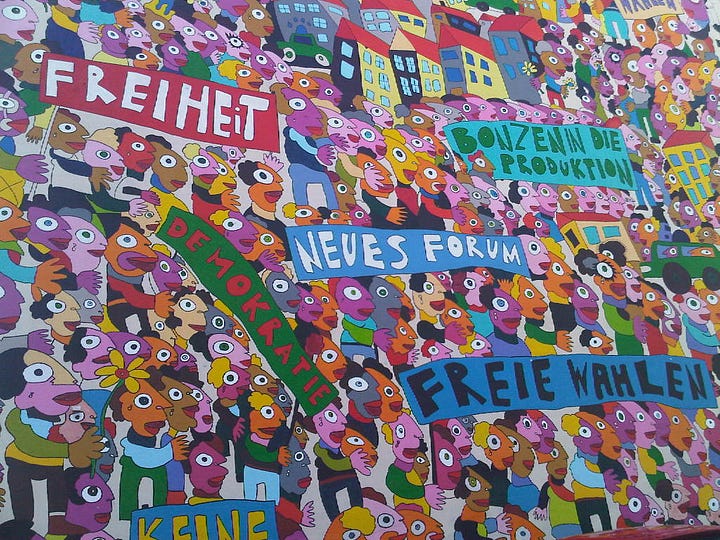
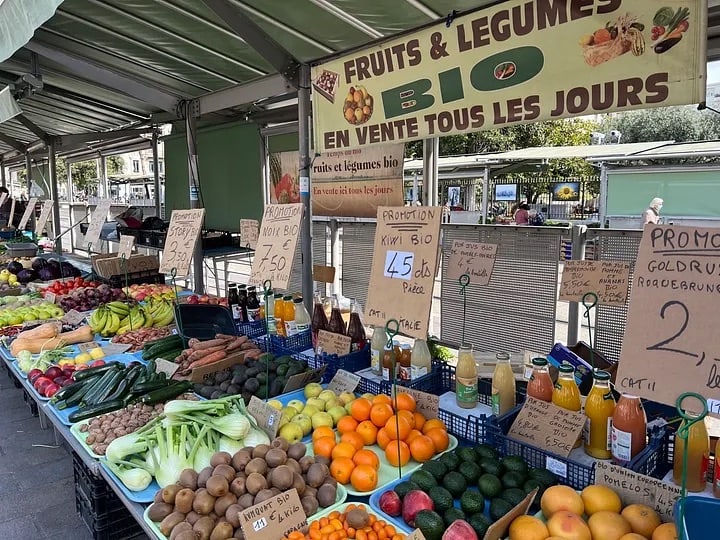
I was fascinated by the unusual fonts in my uncle’s German-language books—they were from the 1920s and were printed using German Fraktur typefaces.2 They covered subjects in physics, chemistry and zoology, and there was also a textbook for beginning learners of German. My mother explained to me that German was “the language of science,” and to study zoology as my uncle had, you had to be able to read German. Time had moved on, however, and I suspected that this was no longer the case. When in college, however, I was made to understand that if I were to pursue the study of music from a scholarly perspective, knowing German was critical. It was, and for my interests, it still is.
So I began two years of college German. The experience was dreadful, focused on learning grammar, which was made more complicated by elucidations of the various cases (nominative, accusative, dative, genitive) with concepts borrowed from English grammar. Nonetheless I struggled ahead with it. I even chose in my final undergraduate year to live in the college’s “language dormitory” so I could participate in the German Stammtisch that convened in the dorm’s dining room. By graduation I could read well enough. But speaking ability? Not so much.
Graduate school required, in the second year, passing language exams in both German and French; this consisted of translating a passage from a scholarly article. That was no problem. After my third year I earned a fellowship to work on my doctoral research and I planned a year in Germany. I knew that in spite of passing these tests, I had to get serious about learning to actually speak German in order to get by.
The day after arriving in Germany in 1978 I travelled to Freiburg im Breisgau to enrol in a four-week intensive German class at the Goethe Institut. A language test placed me, disappointingly, in Grundstufe II—advanced basic German (equivalent to the current CEFR A2 classification)—but the course for that level was full and I was sent across the country to Munich instead (actually a village outside of Munich, Grafing-bei-München). So off I went, hitch-hiking, only to learn upon arriving that the course there was also full. Fortunately I was given the choice of enrolling in the more challenging, four-week intensive Mittelstufe II class (advanced intermediate, equivalent now to CEFR level B23). That was the best thing that could have happened.
In the classroom it seemed like the shroud of complexity in learning German was lifted. The miserable and repetitive explanations of grammar I had found so constipated were simply dispensed with. We were taught, for example, that verbs governed case and that by itself simplified things considerably. The focus was on reading, listening, understanding and speaking. The mantra was that fluency consisted of understanding and being able to make oneself understood, which made the objective of language competency much more attainable.
The other dimension of the Goethe Institut experience was being placed in the home of one of the village’s residents. The family to which I was assigned had been resettled in Germany after the end of World War II, having previously been part of a population of German-speaking people in what was to become Yugoslavia. The woman who ran the household took her role in helping students learn German quite seriously and engaged me daily in some kind of conversation. Her language, though, was a dialect that was, to me, nigh incomprehensible, and quite different from the Bavarian dialect that was generally spoken in the village. In our brief conversations I would speak in my school-taught high German, and she would dutifully correct me by re-stating or re-pronouncing my sentences in her dialect.
By the end of the four-week class I felt that I’d achieved the goal—I could understand most things and could make myself understood across a broad range of different situations. Compared to my university experience this was truly transformative. It was just the beginning, however.
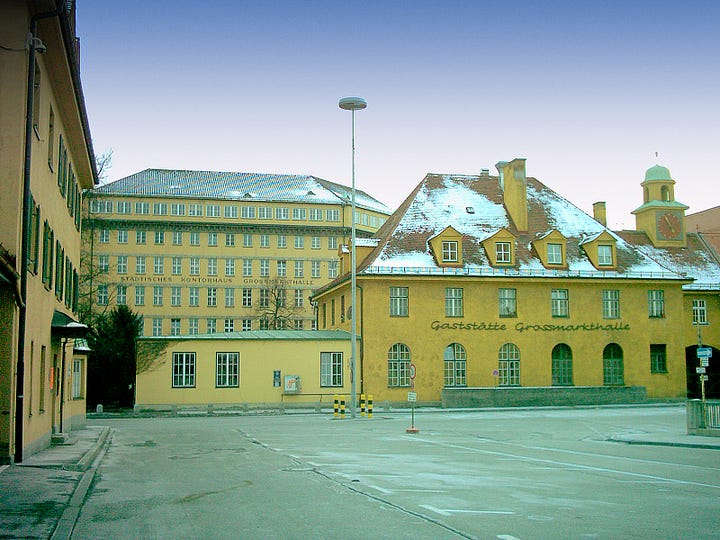
I started about my academic research, spending days at the Bavarian State Library reading and transcribing music from the 17th century. However, the U.S. dollar was going through a steep decline in value and I could not live on my stipend. I learned from a fellow I had met when first arriving in Munich that one could earn 60 German Marks through day labour at the Großmarkthalle—the enormous fruit and produce distribution centre in the south of Munich. One would report at 4AM to stand outside a bar frequented by day workers (the Gaststätte Großmarkthalle; some workmen would go inside and order coffee then mix it with Jägermeister), and trucks would come by looking for labourers. The driver would lean out the window and point and yell; it was almost guaranteed that eventually you’d get summoned.
I was fortunate in that, whenever I needed money, the same person would pick me up, so I became familiar with him and some of the other workers at his facility. The work was varied. Some days, for example, it meant unloading railroad freight cars, or the easier task of separating bananas into clusters for sale and wrapping them; at other times it could involve dragging 25 kilogram bags of potatoes from Czechoslovakia to a hole in the floor, ripping open the bag and dumping the potatoes down a chute.
This was a place where Bayrisch (Bavarian) was spoken. Bayrisch is not something that was taught at the Goethe Institut, of course, and I struggled. I did, however, become fluent in Bavarian curse words, or Fluchen, which drew upon religious symbols (Fluchen differ from Schimpfen, which are secular swear words). When things went wrong, the boss would cry out “Sakrament!” or “Kruzifix!” When they went very wrong, it might even be “Herr Gott Sakrament!” (The most dramatic secular swear I heard was “gekochte Scheiße !”) I also learned there about Karl Valentin, a comedian who has been called the Bavarian Charlie Chaplin. He spoke the Munich dialect, and recordings and transcriptions were available. I began to study them with great zeal and diligence.
I’d also met an English fellow who had moved to Munich to be close to the alps. His passion was rock climbing and there was hardly room to sit in his tiny car since it was always full of mountaineering equipment. We often had “tea” together, frequently dining on damaged salad-makings I had brought home from the Großmarkthalle. He had found a job working in the kitchen of the Hotel Vier Jahreszeiten, but eventually secured a professional position at Messerschmitt-Bölkow-Blohm as a draftsman. He spoke to the steward on my behalf when he left the hotel, and before you knew it, I was engaged as a part-time Spüler, or dish-washer.
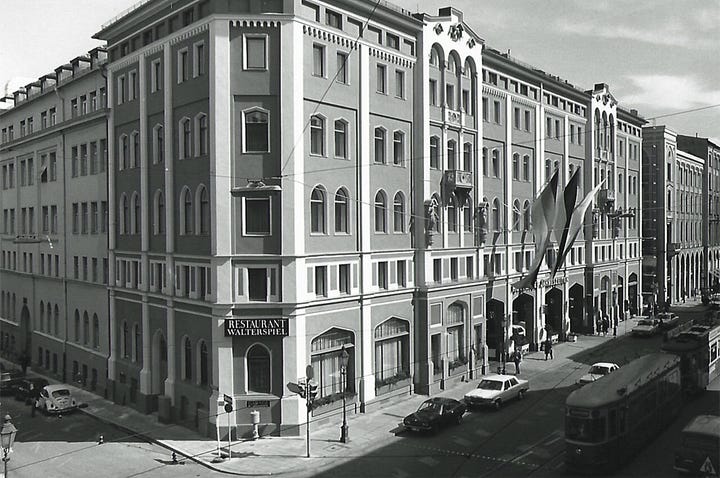
The job at the hotel was a new linguistic and cultural experience. There, language seemed to follow a distinct pecking order. The Chef, who was from Hannover in north Germany, could be heard speaking in his Hanoverian high-German; most of the line cooks were Bavarian or from other parts of Germany or Austria. The Steward, a Bavarian fellow, played the role of middleman between the Chef on the one hand and the lowly kitchen staff on the other.
The Steward’s crew was the most diverse in the kitchen, with individuals from the U.K., southern Europe and Asia. The entire crew that ran the huge steam-belching dishwasher was Indian and spoke only English and Hindi (they taught me the vilest words in the Hindi language). I recall one fellow from England who spoke only English and who magically believed he would “pick up” German from simply being there—I remember him saying several times that he was “on the verge of speaking German”—but he never crossed that imaginary threshold. As I recall, a former miner from Hesse and I were the only ones in this cohort who spoke passable German.
It was all part of an education and by the end of the year my German intonation had a distinctly Bavarian sound and I could cope with much of the regional dialect.
The point of this, I suppose, is that learning German under these circumstances seemed to be part of a complex and changeable social and cultural experience. The lasting result is that now, although I live in France and speak French every day, German still feels more natural to me—even though my competence has suffered through lack of use.
My mother was once again instrumental in shaping how I thought about French at an early age. She explained that it was important to know French since it was “the international language.” She emphasised this by explaining that French was also the “language of diplomacy”—the language of choice for international meetings and treaties. Now I accept that this was perhaps the case when she was in grade school, or at least I can imagine that this is what she had been taught. This conviction about the importance of French led her to arrange private lessons for me and my siblings with a woman who lived nearby, who I think was actually Norwegian. I enjoyed the learning sessions and especially the books, above all the French versions of the Beatrix Potter stories (I only realised in perhaps my thirties that they were originally written in English). But the lessons ended when I started school.
My grandmother was also a native French speaker, having immigrated to the U.S. at an early age from an Acadian community in eastern Nova Scotia. Learning French held the promise of being able to speak with her in her mother language, but self-consciousness often deterred her. It was possible to start a conversation in French with her, but she’d eventually exclaim with laughter “I’m speaking French !” then switch back to English.
This childhood experience might have had some benefit. I can pronounce French very well, as can my sister. But it also contributed to the awful Groundhog-day experience of French classes in school, where year after year the classes assumed no prior knowledge of French, or were populated by children who had taken French classes previously but had learned almost nothing in them. I developed a genuine disdain for studying French until college. There I became curious about a French literature class that was reserved for those “concentrating” in French, but the professor, the wonderful Madame Deguise,4 allowed me to enrol as an auditor. It was a survey of French literature, and a revelation. Above all I loved the early weeks of the class where we were introduced to the poetry of Ronsard and du Bellay. Hearing Madame Deguise read these texts aloud was inspiration enough to want to set aside the earlier bad classroom experiences and learn French for the joy of it. Alas, that was the last French class I ever took. Studying music had so many requirements that it was just not possible to do more.
In the years thereafter I spent a great deal of time in Alsace, where I had friends. I got to know people from Spain, Algeria, Syria and elswehere with whom French was the obvious common language. But with Alsatian friends I also heard and struggled with the local Strasbourgeois language, a Swabian dialect that younger people sought to avoid speaking but which was the everyday language of their parents. In many situations, for me and for those with whom I was speaking, it was easier to switch to our best-spoken common language, which was German. I maintained my level of French competence in that environment, but did not see it improve.
That was then.
Now really began at the end of 2021 when after more than twelve years of working in Dublin (another curious cultural and linguistic experience) our family moved to Nice, France for retirement. We arrived during the Covid pandemic with an agenda to quickly establish ourselves with banking, housing, and to integrate with French administrative systems. This experience takes one into a completely new language domain. During a couple months’ time we were confronted with lengthy lease agreements; insurance policies for housing and health insurance; service contracts for phone and utilities; and administrative documents to transition driver’s licences, health service entitlements, and much more.
The language and concepts involved in these processes are not taught in French class. It’s possible to hire consultants to look after such issues when moving to another country, but it seems to me that, in spite of the challenges, to do so would be to miss an opportunity to gain competence with specialised language, administrative concerns and systems that are an important and recurrent part of everyday life.
We live in France now, and I see this as a lifetime commitment. I want to be part of the community we live in, to participate in it, and to do so without challenges of language comprehension, as well as without challenging the patience of people I interact with. So how to meet that goal?
Initially I thought I might replicate the experience of my twenties and hone my French abilities through formal language study. The reality is, that hasn’t worked, although I have favourable words for Alliance Française,5 where I took a refresher “B2 avancé” class in Dublin. It’s probably a function of age, or perhaps it also has something to do with the nature of the French language, but the experience since has been no three- or four-week trek to fluency. I attend several language exchange groups each week, plus there are routine interactions with acquaintances, merchants and service providers. I recognise, happily, that my abilities with French have improved exponentially over the past thirty months. I now speak spontaneously with little effort, and listening comprehension is also very good. But I still pick up new vocabulary, especially from reading, and there are still times when I hardly understand a spoken word—just ask my youthful barber.
The point is, again, that learning a language is not just about acquiring vocabulary, mastering grammar, picking up expressions and slang. Language and culture are sometimes hard to differentiate, and trying to separate them seems to me to be probably one of the great hindrances of learning new languages. Language is inherently and obviously social—everyone seems to speak their language a little (or a lot) differently. In my student days in Germany, social contacts were far more diverse than they would be later in my professional life and I learned so much more as a result. Language is also a physiological phenomenon. Obviously we use the many muscles of the speech organs differently in approximating the sounds, accent and rhythm of a foreign language than we do with our mother tongue. It feels different to speak English than to speak German or French.6 And we speak with our eyes and our bodies too—if you are skeptical, just try having a telephone conversation in a language you are still learning.
Let me put it this way: learning a language is a multi-faceted cultural experience. I’ve been intrigued by it most of my life. And fortunately for me, I really love it.
If you enjoyed this post or found it useful in some way, please feel free to …

Fraktur typefaces were used in Germany from the early sixteenth century through the mid-twentieth century, even somewhat after the official government decree of 1941 which gave preference to antiqua typefaces. See the article “Fraktur,” Wikipedia https://en.wikipedia.org/wiki/Fraktur (consulted 26 July 2026)
There might be an element of attitude as well. A dance instructor used to emphasise the importance of adopting an “appropriate attitude” to convincingly execute different styles of dance—to make the movements expressive and meaningful. Sometimes I wonder if that might be the case with languages as well.
Comments
Nothing yet. Say the first thing.
Sign in to join the conversation.