
With our Summer Latin for Beginners Course only a few weeks away from starting, I wanted to share how our lessons are structured — and why I believe structure is one of the most important ingredients for success in learning Latin.
Many people begin studying Latin full of enthusiasm, only to give up after a few months, discouraged and overwhelmed. In my experience, this often happens because they lack a clear and well-structured learning path.
My Latin lessons — and all of my specialized courses — are fundamentally inspired by the medieval scholastic method, which organized learning into distinct and purposeful stages. Each lesson is carefully structured to guide the student step by step, making progress feel natural, coherent, and rewarding.
Each lesson begins with the Schola, the section dedicated to grammar.
Here, I explain step by step the new grammatical concepts necessary to understand the Latin text assigned for that lesson. Rather than overwhelming students with abstract rules, the goal is to gently prepare the mind for reading and analysis.
Whenever necessary, we also revisit previously learned material (recēnsiō), reinforcing earlier concepts and ensuring that knowledge is built steadily rather than forgotten.
👉 Join the Latin for Beginners — Summer Live Course 2026
The purpose of the Schola is not merely to explain grammar, but to create confidence and clarity before approaching the text itself.
An essential component of the Schola is the Tabulae: lesson slides carefully prepared for each class.
These materials are designed with meticulous attention to detail to complement the student’s personal study effectively.
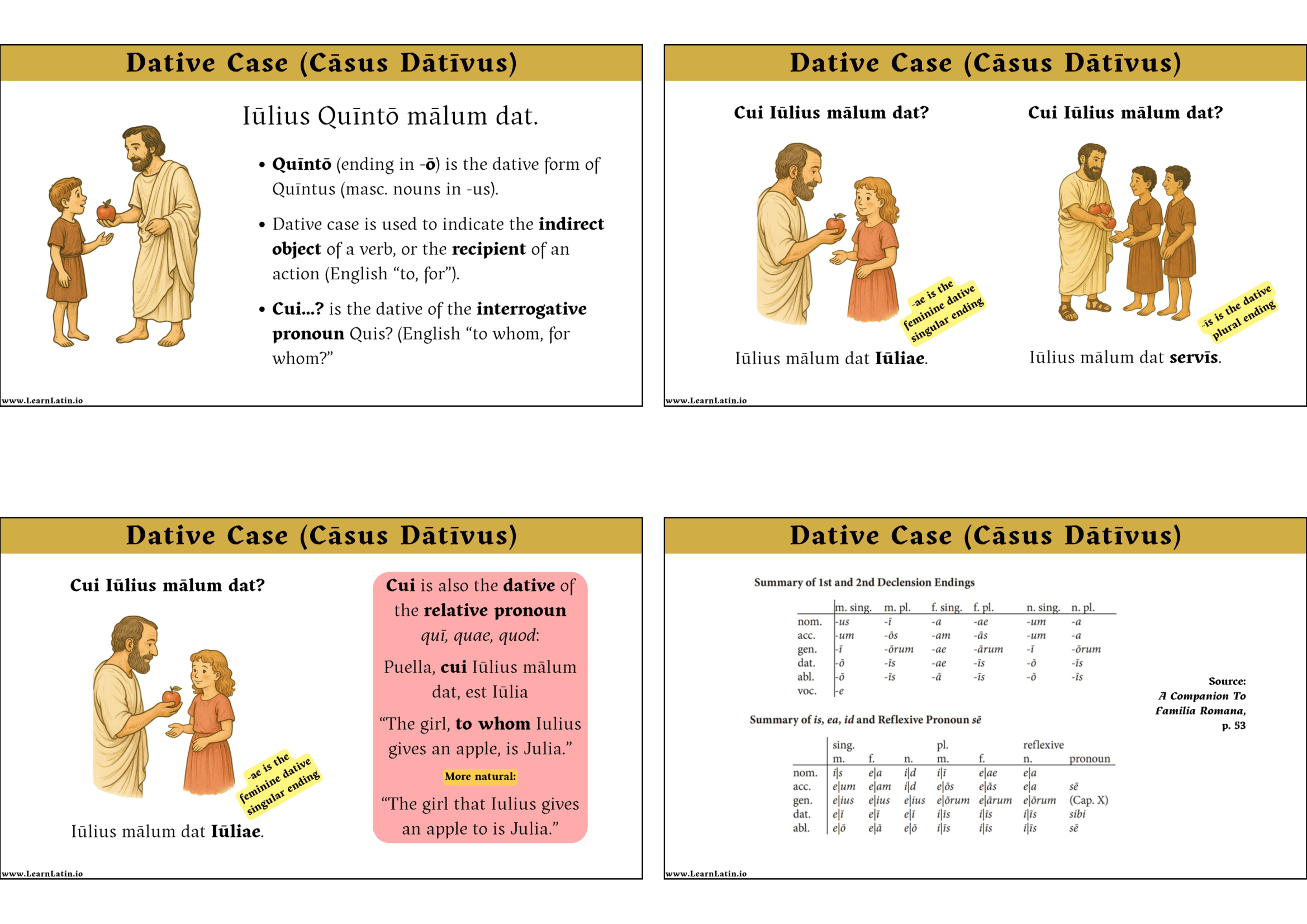
Grammar rules are summarized clearly and concisely, supported by simple examples and precise references to chapters and passages from Familia Rōmāna. New vocabulary is richly illustrated with images and, whenever possible, enhanced with beautiful medieval and Renaissance artwork that makes memorization more vivid and lasting.
All of these materials — together with additional exclusive resources — are made available to students to encourage effective review and long-term retention of what is covered during the lesson.
The Lēctiō is the true heart of the course.
In this section, we carefully read the Latin text assigned for the lesson — often a chapter from Familia Rōmāna — analyzing it word by word and sentence by sentence.
This is where students begin to recognize vocabulary and immediately apply the grammar introduced during the Schola, guided through the text with close explanation and commentary.
👉 Join the Latin for Beginners — Summer Live Course 2026
The story itself — following the life and adventures of a Roman family in the 2nd century AD — unfolds almost like a modern novel. This rich narrative context provides an ideal environment for long-term absorption of grammar and vocabulary.
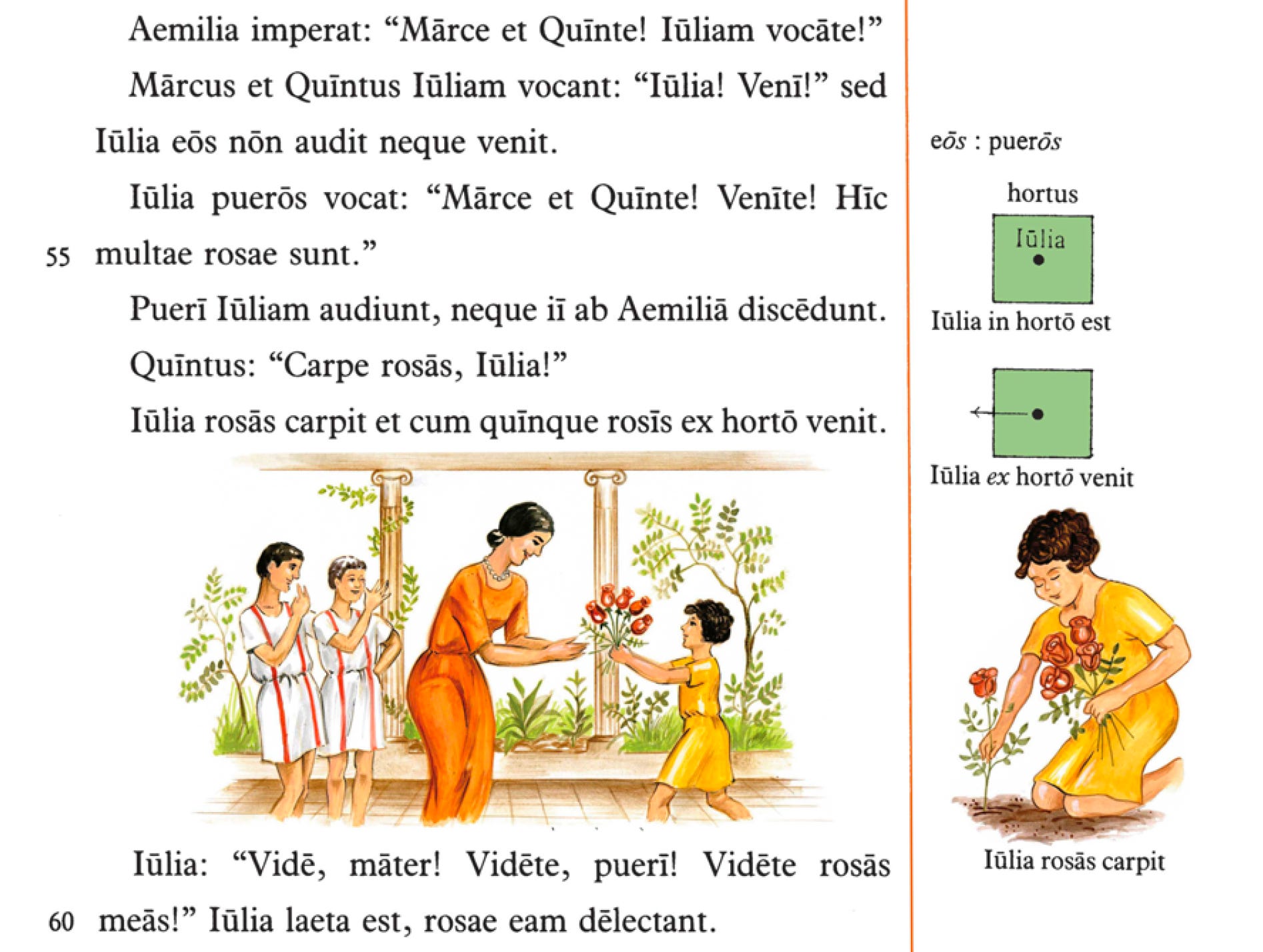
The method is remarkably effective because students are not simply memorizing rules: they are actively trying to understand a compelling story, drawn in by vivid dialogue, memorable characters, and moments of genuine drama.
After reading the text, we move to the Exercitātiō: the active practice of the language through spoken and written Latin.
This is where the natural method differs radically from older, translation-heavy approaches that rely primarily on dictionaries and English equivalents.
In oral practice, students are questioned in Latin about the story and its characters — and encouraged to respond in Latin as well. Spoken Latin is introduced from the very first class, and students are often surprised by how much they are capable of expressing far earlier than expected.
You may surprise yourself with how quickly the language begins to feel alive.
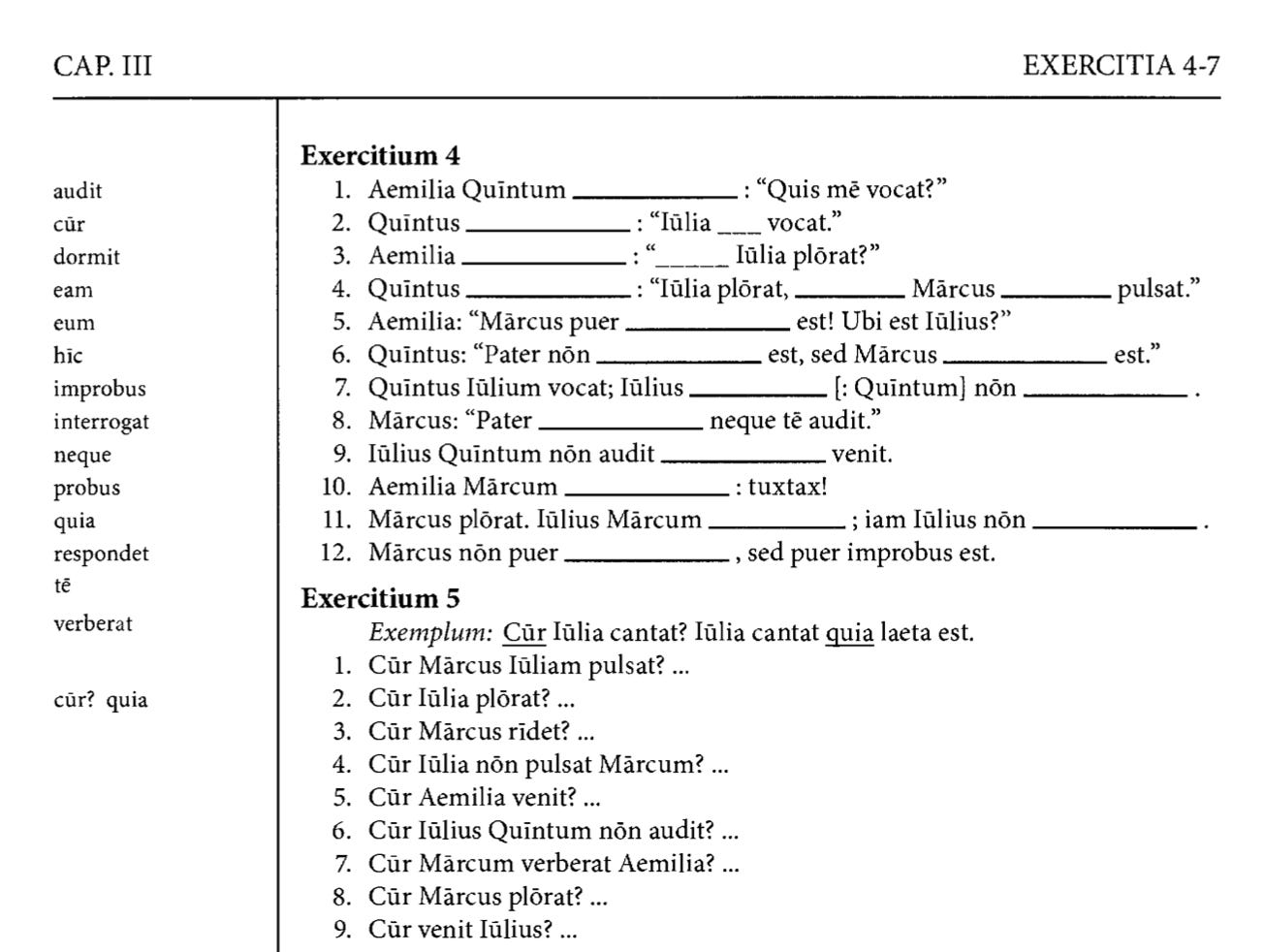
Between lessons, students are expected to complete the Pēnsa Domestica: the homework exercises corresponding to each chapter of Familia Rōmāna.
Written exercises are designed to be engaging, intuitive, and optimized for learning — much like what one would encounter in a modern language course: fill-in-the-blank activities, word-order exercises, and open-ended questions that gradually guide students toward composing simple Latin sentences of their own.
In addition, students have access to exclusive quizzes on the platform, offering immediate feedback and constant opportunities for self-assessment.
At the end of the day, as an instructor, I can only guide you along the path I myself have walked — sharing methods, advice, and lessons learned through experience.
But the journey must ultimately be taken by you.
👉 Join the Latin for Beginners — Summer Live Course 2026
No language — living or dead — can be learned without practice. And if you are willing to take those steps consistently, Latin will reward your efforts more generously than you might imagine.
Comments
Nothing yet. Say the first thing.
Sign in to join the conversation.