
Hi there
I hope you had a lovely long weekend (if you’re in the UK) and managed to stay cool if you too are experiencing the first of the hot weather this year. And speaking of hot, there is a topic that has been heating up of late that I wanted to dig into a bit more today. Competence.
It’s almost the Summer of 2026 and sometimes it feels like anything could be around the corner.
You wouldn’t be blamed for feeling a little tentative when switching on the news in the morning, bracing ourselves for… what next? And sometimes the rifts and plot twists within governments are more akin to a bad reality TV show than an organisation trying to maintain order and protect its’ citizens.
I read an article in The Guardian earlier this year called Competency porn: is there any greater escapism than watching a capable person on TV?
“There was once a time when we would seek escapism with something fantastical like Game of Thrones. But watching a show about a handful of power-hungry leaders slaughtering their populations like chum to further their own megalomaniacal ideals these days feels a bit, you know, on the nose…..
And so, instead, we’re all getting off to content about people who can quietly go about their days, improving things for people without any fuss.”
Hilarious, and oh so true!
The Dr. who says “it’s nothing to worry about, we can fix it”; the gardener who diligently tends to their plants, knowing when to prune and which species can be planted beside one another; the receptionist who gets you an appointment that is both soon and at a convenient time without the slightest hesitation, grumble or sound that implies “Ooooh I’m not sure about that.”
Total bliss, right!
When once we may have gotten our kicks from a motorcycling Danny Zuko type character, it’s now a Monty Don-esque calm reassuring safe pair of hands that makes us go all weak at the knees.
I joke, but there is something in this.
As a society we have become obsessed with productivity and technological advances intended to save us more time, and yet business owners and “successful” individuals are still having to rise before 5am to fit everything in.
We have glamorised being busy and equate running around doing a million things in a day as a sign of importance within society, a badge of honour, code for thriving in life.
But is cramming our days and feeling constantly rushed actually resulting in good work?
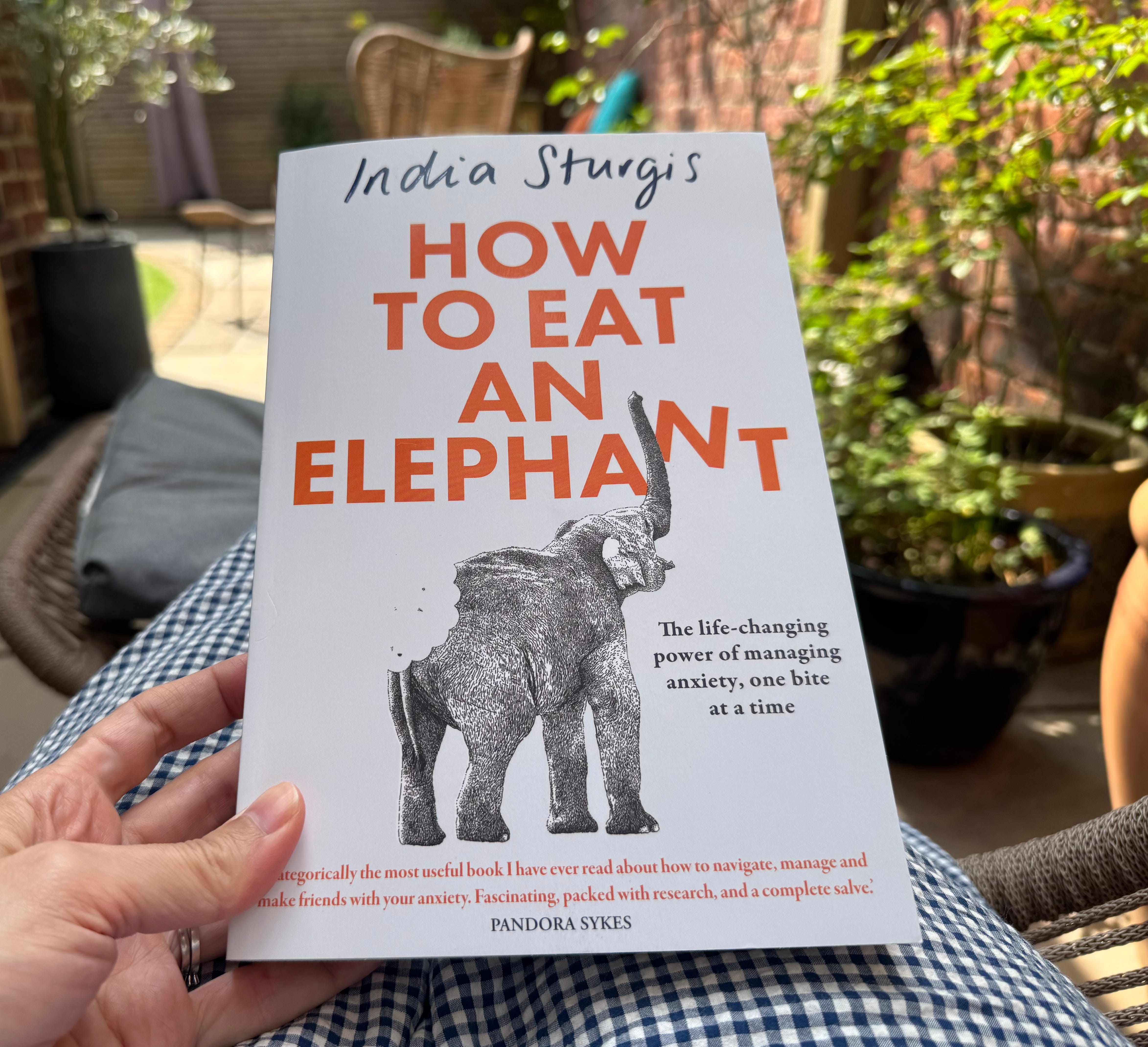
Last week, after reading Pandora Sykes’ article, I picked up India Sturgis’ brilliant book on anxiety, How To Eat An Elephant. I was drawn to the practical sections discussing breath work, yoga and the body but there is so much detail in this book I can see myself returning to it and dipping in and out when I feel I need it.
There is a whole chapter about slowing down which starts with a quote from science historian James Gleick from 1999:
“we are reaching ‘the biological, psychological and neurological limits of just how much we are capable of doing.’”
Gleick wrote about the duality of technology in that it is intended to save us time whilst simultaneously taking it away. Sturgis asks that if we were reaching our capacity back then, before the arrival of the iPhone and social media, then where on earth are we today?
Are we killing it or have we reached our limit?
Rest and doing nothing has evolved to be seen as somewhat of a luxury. Something you save up for that summer holiday or for the weekend, when you have fully earned it after running around being “busy” all week.
But rest and recuperation is actually highly productive.
Sturgis discusses the Default Mode Network (DMN) in her book. Neurologists have come to discover that our brains are just as busy even when we are thinking and doing less. Though the DMN is a setting our brains can only switch into when nothing is demanded of it. And it conducts essential unconscious actions like problem-solving and consolidating memories.
I have been teaching mindfulness for coming up to 6 years and yoga for 3.5. And whenever I extol the benefits of both to someone who is struggling with stress and overwhelm, I often hear the phrases: “it’s too slow for me;” “I can’t sit still and empty my mind as I just have such a busy mind;” “I need to always be doing.”
It seems that those in “high powered” professions fear that engaging in holistic practises, slowing down or building rest into their days, is a bit woo-woo, flakey or, even worse, will make them lose their edge.
When in actual fact what makes us lose our edge is having a brain that has not been allowed time for its essential maintenance, to fortify, and to sharpen its ability to interpret and problem solve.
Buddhist monk and meditation teacher, Gelong Thubten, often talks about how spending time just being and observing our thoughts can actually make us the CEO of our own minds.
It allows us space and distance to actively choose our thoughts and emotional responses instead of just allowing our mind to operate on autopilot. Instead of getting carried along by stress or unhelpful ways of thinking, we can train our minds to act as an objective leader.
Surely if people, more widely, understood the benefits of slowing down on our mental capacity, sharpness and all-round wellbeing, we would be bragging about how much time we spent resting rather than how much we crammed into our weeks?
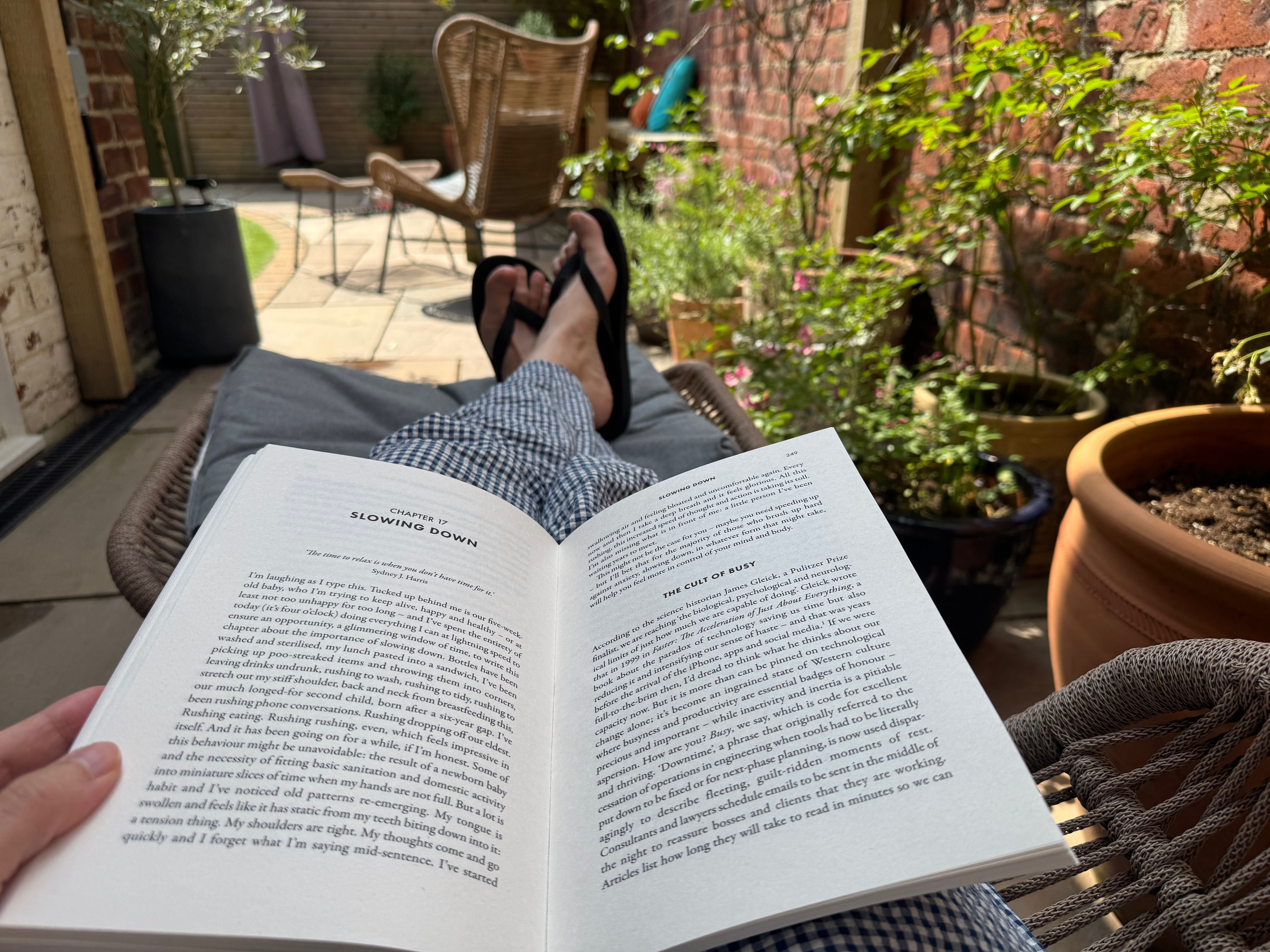
So how can we realistically slow down more in a world that is always on and encourages us to be the same?
The brave pause. I say brave because I honestly think there is nothing more radical than someone who embraces silence. Who is not afraid to leave space. Who doesn’t race to respond when someone says something to them. Who waits an afternoon or, God forbid, a whole night to respond to a complex email request. There are of course times when we need to act fast but for things when we are not quite sure how to respond, give it a minute.
Start and end our day slowly. This doesn’t mean hours of complex routines. It could be some conscious deep breaths for 10 minutes. I know that I could easily spend more than 10 minutes on my phone first and last thing in bed. So starting the morning slowly could be a great way to set the tone for a calm and competent day.
The noticing walk. I talked about this more last week. But taking the time to notice things as you walk somewhere can really boost mindfulness and give your mind a break in the present moment. Observe your surroundings and notice the people, wildlife and environment. This is really peaceful and restful if done in nature, but can still be beneficial on a busy street of shops and cafes. As you notice people coming and going for their coffee, the pigeons pecking at scraps, the business owners getting ready for the day.
Daydream. When was the last time you took a train journey without work or even a book or music? Just allowing yourself to look out of the window. Let the mind drift and do what it wants. Slowing down doesn’t have to be intentional or difficult. It is removing the distractions and the need to be busy and productive that is usually the most challenging part.
The long rest. And there are times when we need a little more than short practises. Sturgis discusses the importance of convalescence. It sounds like an old-fashioned concept these days doesn’t it? Not sure why. But if we have been ill or are recovering from something then we need to allow time to let our body and mind heal. There is really no prize given for rushing recovery as we will just be returning to our life and work before we are fully capable, and who wants that? The sabbatical is also a longer break which Sturgis outlines. Detailing how many academic institutions offer their professors sabbaticals now as they found that the leave resulted in a “fruitful impact on their output and longevity” at their workplace.
Stop boasting about how busy we are. To fundamentally change the culture and shift the way we think about slowing down we need to all change the narrative. So next time someone asks how’ve you been, instead of saying “good, BUSY!” Try something different. Maybe “I’m good, I just had my lunch on a bench in the park” or “Great thanks, I’m reading this brilliant book at the moment, do you want to borrow it?”
The world needs competent individuals, it is our duty to give ourselves the rest needed to be that safe pair of hands.
The End.
Until next time,
Rebecca x
Comments
Nothing yet. Say the first thing.
Sign in to join the conversation.