
What would your students still be able to explain if you took away the final answer?
We have all seen the limits of the traditional classroom conveyor belt. A student crams a list of historical dates or geographical terms into short-term memory, writes them down on a Friday exam, and forgets most of them by Monday morning.
Rote memorization has a place in establishing foundational knowledge. Students do need to learn vocabulary, dates, formulas, and basic facts. But memorization alone treats the mind as a storage bin rather than an active processor.
In a world where information—and increasingly, polished answers—can be generated almost instantly, the more important question is no longer simply what a learner can remember.
It is what they can do with what they know.
Can they explain it in their own words? Connect it to another idea? Question it? Use it to solve a problem, make a decision, or create something meaningful?
I realized the true scale of this shift during my time teaching seventh-grade humanities at Sampoerna Academy.
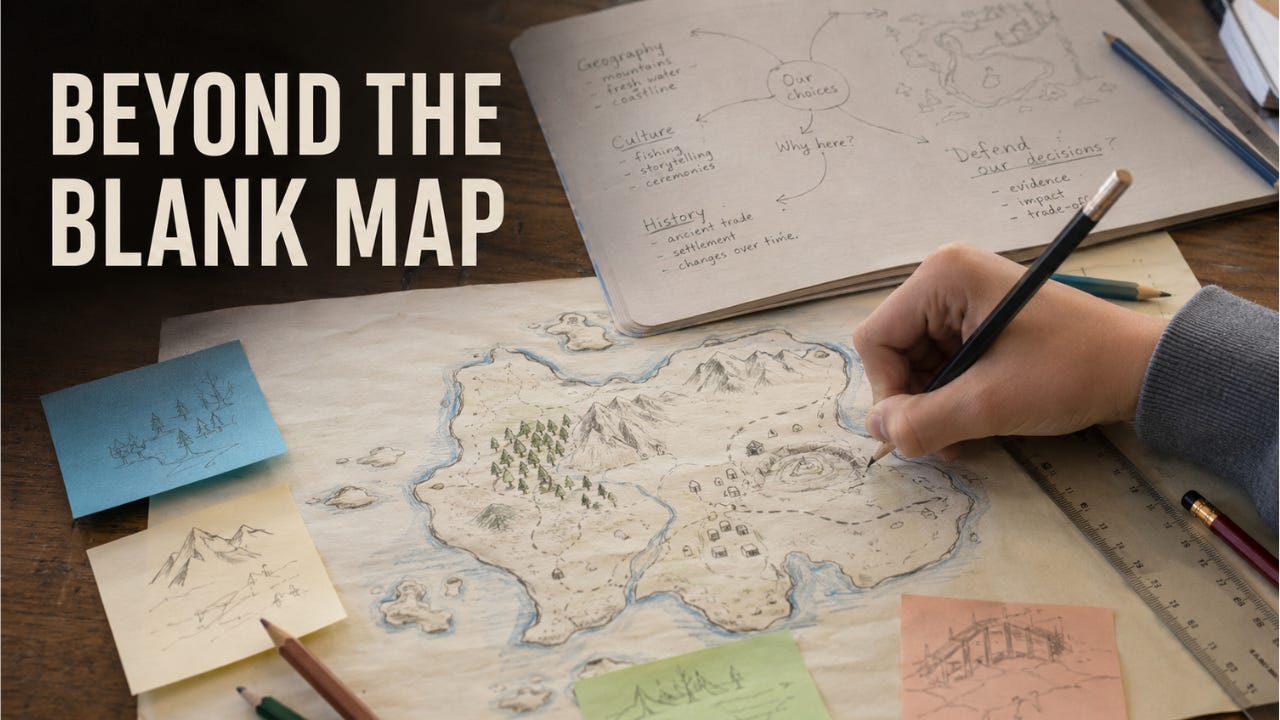
I wanted to move away from isolated textbook chapters and introduce a project that required students to combine different kinds of knowledge. So I asked my students to design an entirely new island from scratch.
The assignment began with a blank page.
Students had to create an island, map its topography, identify its climate zones and natural resources, and imagine the civilization that would eventually develop there.
First, they became cartographers and geographers. They considered mountains, rivers, coastlines, harbors, fertile soil, and access to fresh water.
Then they shifted into the roles of historians and anthropologists. They had to write a cultural history explaining how their fictional society formed, adapted, governed itself, and traded with neighboring communities.
Finally, they had to present and defend their civilization in front of their peers.
The project was deliberately multi-layered. It demanded written creativity, visual communication, research, reasoning, collaboration, and public speaking.
It also made shallow understanding much more difficult to hide.
If a student placed a large mountain range in the middle of the island but later described a civilization that developed through easy travel across that same region, the contradiction became obvious.
If a student located the capital city far from a reliable water source, someone was likely to ask about it during the presentation.
If the written history did not align with the geography, the student had to revise one or both pieces.
The project became an active creative ecosystem. Each decision affected another decision.
To build a believable history, students had to understand how geography influences human migration, trade, conflict, settlement, and cultural development. They were not simply recalling information about human geography. They were using it to build something of their own.
That distinction matters.
The island project worked because it brought several well-established learning principles together.
Students could not simply reread a definition of human geography and copy it into their project. They had to retrieve what they understood about rivers, mountains, climate, resources, and settlement patterns, then reconstruct those ideas in a new fictional context.
Research on retrieval practice has consistently shown that recalling information strengthens learning more effectively than simply studying it again. Importantly, a meta-analytic review also found that testing can support transfer beyond the original learning situation. Karpicke and Roediger’s research on retrieval practice and Pan and Rickard’s meta-analysis of transfer both help explain why students often learn more by trying to produce an answer than by repeatedly looking at one.
The island project required students to use knowledge, not merely recognize it.
A student could not successfully write the history of an island civilization without explaining how physical features shaped human behavior.
A mountain range had to become more than a visual symbol. It had to become a reason for political division, cultural isolation, migration, or economic difficulty.
A river had to become more than a blue line on a map. It had to become a source of transportation, agriculture, conflict, or settlement.
This is the work of elaboration.
Students were continually asking:
What does this feature mean?
Why does it matter?
What would happen because of it?
How would people adapt?
What other ideas does it connect to?
Research on self-explanation has shown that explaining relationships and reasoning—not merely repeating information—can improve understanding and problem-solving. Chi and colleagues’ research on self-explanation offers an important foundation for this kind of classroom practice.
The strongest learning did not happen when students copied information about geography.
It happened when they used geography to explain their own world.
The assignment was too large to complete successfully in one sitting.
Students needed to plan what they would create, monitor whether their map and history still made sense together, and evaluate their work before presenting it.
This is metacognition in action.
The Education Endowment Foundation describes metacognitive and self-regulated learning strategies as approaches that help students plan, monitor, and evaluate their learning. Its evidence review identifies these strategies as high-impact when they are explicitly taught and embedded within normal subject learning. EEF guidance on metacognition and self-regulation is especially relevant here.
The students were not completing a separate lesson called “metacognition.” They were using metacognitive habits because the project required them to.
They had to ask:
What am I trying to create?
What have I completed?
What no longer makes sense?
What feedback should I act on?
What needs to change before I present this?
Instead of collecting one final project at the end, I divided the assignment into milestones.
Students submitted their maps first. Then they developed their cultural histories. Then they presented and defended their work.
This created a feedback loop.
The teacher could identify problems while there was still time to address them. Students could make changes before the final presentation. Peer review became part of the learning process rather than an optional activity after the real work was finished.
This aligns with the distinction made by Hattie and Timperley: useful feedback helps learners understand where they are going, how they are progressing, and what they should do next. Their review of the power of feedback helps explain why feedback is most powerful when it informs the next decision.
A comment on a final paper might tell a student what went wrong.
A check-in during the process gives the student a chance to do something about it.
Project-based learning is not automatically effective. A project can become a decorative craft activity if students are not required to think carefully, make decisions, revise their work, and connect the final product to meaningful knowledge.
But when it is designed well, project-based learning can create opportunities for students to apply knowledge across contexts.
A 2019 meta-analysis found positive effects of project-based learning on academic achievement compared with traditional instruction, although the design and implementation of the project mattered. The study by Chen and colleagues is a useful reminder that “project” is not enough by itself. The project has to be intellectually purposeful.
The island assignment was not simply an art project.
The map, history, and presentation had to depend on one another.
To move away from basic memorization, a project cannot be a creative activity added to the end of a unit.
It has to become the engine of the unit itself.
The island project relied on three operational pillars.
Students submitted their geographic maps in the first week, their cultural histories in the second week, and their presentations in the third week.
This made the evolution of the work visible.
It also made it more difficult to rely on last-minute cramming or shortcuts.
The teacher could see where students began, how their ideas developed, and whether they used feedback to improve the final product.
The map and the written history had to interact.
A change in one domain could create a problem in another.
If students moved a mountain range, they might need to rethink migration patterns. If they changed the location of a river, they might need to revise the location of settlements or trade routes.
This friction was productive because it forced students to recognize that knowledge is connected.
The geography was not background decoration. It became a cause of historical and cultural development.
Students had to present their civilization and answer questions about their choices.
This created a powerful form of accountability.
It is difficult to hide behind polished language when someone asks:
Why did your civilization settle there?
How did this mountain range affect trade?
Where did the population get fresh water?
Why did the government develop in that form?
What would happen if one of your resources disappeared?
The verbal defense transformed passive knowledge into active competence.
Students were not simply submitting something for the teacher to read. They were demonstrating that they understood the choices embedded in their work.
I now think of this kind of learning as an agentic workflow.
The word “agentic” can sound unnecessarily technical, but the basic idea is simple: learners are not merely receiving information and following instructions. They are making meaningful decisions about what they are trying to understand, how they will develop their ideas, and what they will do with the result.
The CARE Teaching Method gives this process a simple structure:
Students identify what they are trying to understand, solve, question, notice, or create.
Before they search for a finished answer—or open an AI tool—they record their purpose, current understanding, and uncertainty.
Students explain what they currently understand in their own words.
This might be a rough paragraph, a diagram, a short oral explanation, a prediction, or a notebook entry.
The first explanation does not need to be polished.
It needs to be theirs.
Students connect, compare, question, test, and improve their ideas.
They might use peer feedback, teacher conferences, counterarguments, additional sources, or an approved AI thinking partner.
But the learner remains responsible for deciding what to accept, reject, adapt, or verify.
Students turn refined understanding into something visible and useful.
They might write an essay, deliver a presentation, solve a problem, create a model, design a lesson, make a recommendation, or carry out an experiment.
Execution is where learning leaves the worksheet and enters the world.
This is why I often say:
AI gives students access. CARE teaches them what to do with it.
AI did not create passive learning. It exposed it.
Students were already copying textbook language, collecting disconnected notes, searching for answers, and submitting first drafts before generative AI became widely available.
AI simply made it easier to produce the appearance of learning.
The solution is not necessarily to ban every tool. It is to redesign the learning process so that students have to show their thinking before, during, and after outside assistance.
UNESCO’s guidance on generative AI in education emphasizes the importance of a human-centered approach, including critical thinking, ethics, inclusion, and human agency. UNESCO’s guidance on generative AI in education and research supports the idea that students should not simply receive AI-generated answers. They need the knowledge and judgment to evaluate and use these tools responsibly.
The goal is not to pretend that AI is absent.
The goal is to make sure AI enters downstream from thinking rather than replacing the beginning of thinking.
The framework may make sense. But knowing what good learning looks like and designing a complete multi-layered assignment are two different things.
Teachers do not need another abstract explanation of why process matters.
They need something they can adapt.
That is why I want the paid version of Learning to Learn Well to focus on practical, high-utility resources rather than simply offering more essays about education.
Paid subscribers will receive access to the classroom-ready materials connected to this post, including:
The complete 7th-grade Island Exploration Project Mission Brief
A three-week project timeline
Student milestone and planning sheets
A process-and-execution rubric
A “My Thinking First” worksheet
A digital integration guide
Reflection questions for students
A policy-flexible AI thinking-partner protocol
The purpose is not to give teachers a rigid script.
It is to reduce the planning burden involved in turning a promising idea into a usable lesson.
Comments
Nothing yet. Say the first thing.
Sign in to join the conversation.