
Writing Updates:
I have two stories out in print this month: “The Alligator’s Curse” in Jackrabbit Journal and a print edition of “The Ice House at the End of the World” in the Fabilist’s lit mag.
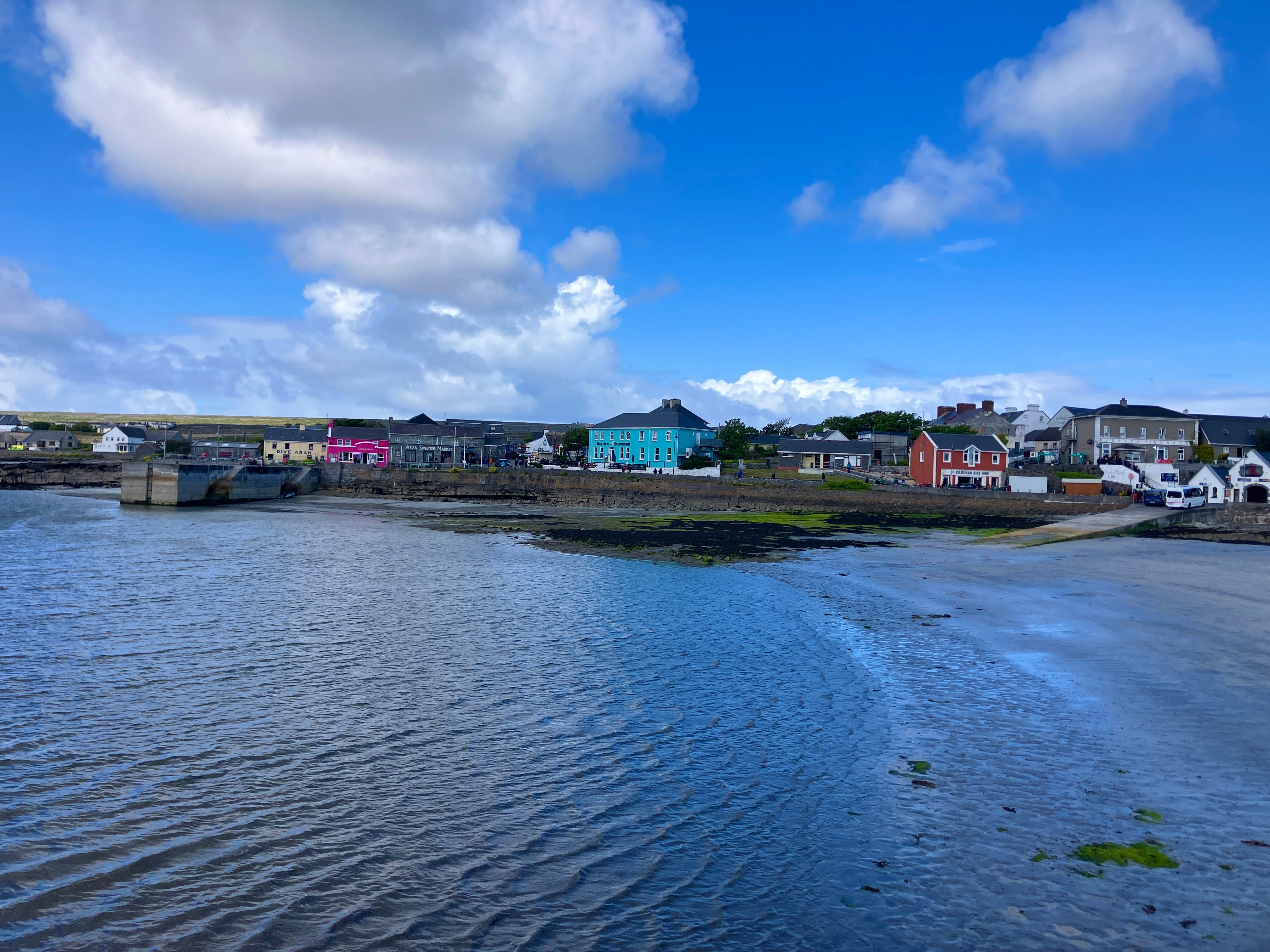
It’s been a minute since I’ve had the occasion to use my passport, but my husband and I took a lovely trip to Ireland this month. Our goal was to go somewhere the polar opposite of our current desert locale and, upon arrival at the endlessly green island, I felt satisfied we had achieved it.
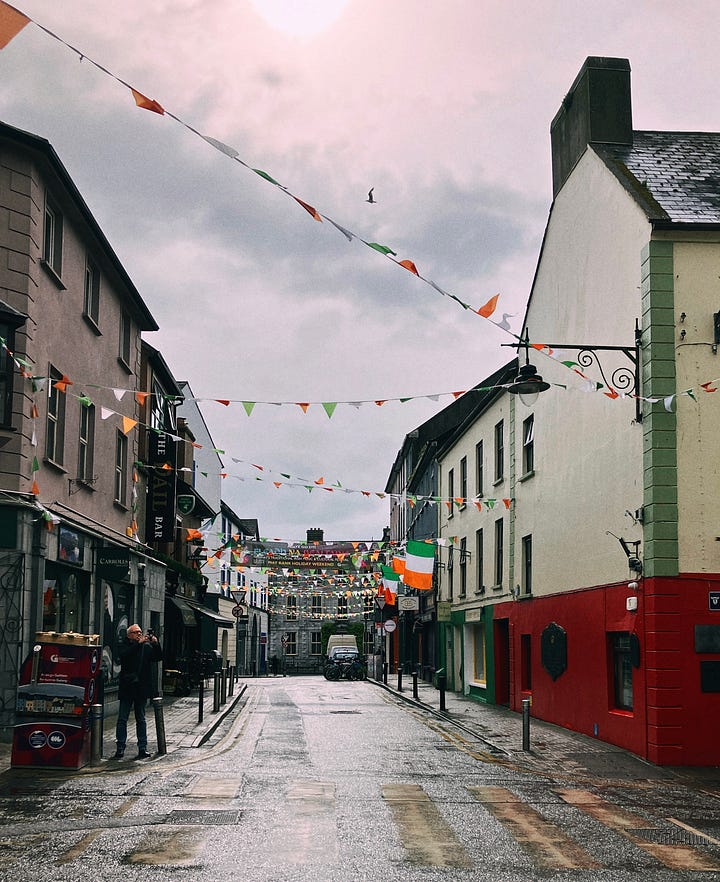
We visited Galway, stayed a couple of nights on Inishmore, and spent time in Dublin. We listened to a lot of pub music, ate a lot of pub oysters, walked alongside the ocean, spent time in Temple Bar, toured the Guinness Factory, and I bought an Aran wool sweater, something I swore I’d purchase if I ever returned to Ireland after my initial trip 17 years ago. Although the threat of rain loomed, we only really had one truly rain-washed day. We took a tour to Newgrange, which was, for me, the most moving part of the trip — to be able to stand among Neolithic stones in a structure that predates the pyramids by 1000 years was truly magical. We also took a side quest to the National Museum of Ireland in Dublin where we were able to see four bodies that had been pulled from the bogs, the skin and hair preserved.
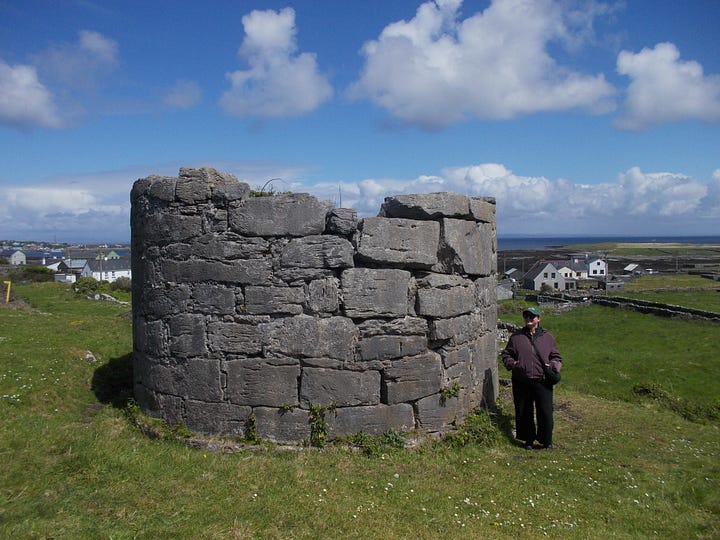
Ireland is a place where the past is jutted up against the present. We hiked to the ruins of a small church one of St. Patrick’s priests built in 460 AD. The King’s Head pub in Galway where we stopped for a whiskey is 800 years old. It makes everything you’re doing feel comically small in comparison.
On the trip I read a book that deals similarly with the concept of time — the intertwining of past and present and preserving the rugged landscapes of history. The Duke by Matteo Melchiorre was brought to my attention by its inclusion on the Booker International longlist and I thought, what better time than on a long plane flight to tackle this 500 page tome. I wasn’t sure what to expect from the description, but, ultimately, The Duke was delightful.
The duke is the last in the centuries’ old line of the Cimamontes, an orphan who decided to sell his city estate and move to the ancient family manor in Vallorgana, an isolated village in the foothills of the Dolomites where he owns a not insignificant portion of “the mountain.” The sudden reappearance of a Cimamonte reawakens latent feelings in the villagers — some are deferential to the duke while others are incensed that he felt the need to take up the mantle of his ancestors.
Mellichore’s prose, as seen through Antonella Lettieri’s translation, has something of the nineteenth century and European postmodernism to it and Mellichore paints the duke as an iconoclast thrust into modernity. For almost a decade, he lives on the family estate, poring over the family archive and trying to make sense of the past.
“Why unspool a story that is long dead? Why reawaken something which history has decided to devour? I wanted to counter that my purpose was indeed the opposite: I wanted to kill the past whose subject I had been for too long, I wanted to hurl it down the well of the collapsing past, because the correct way to get rid of the past is not to forget it but indeed to know it.”
The duke’s glorious, studious isolation is interrupted by a land dispute with a local farmer who views himself as the king of the mountain. As a reader, I initially thought the land dispute between two opposing barons of a small mountain village in the Dolomites would not make for a compelling story, but I was wrong. The descriptions of the village, the landscapes, the estate, and the people ensured I never grew tired of reading.
The duke is something of a pretentious figure, both emboldened and restricted by his bloodline, with no small amount of naivete as to how the world works, despite all of his studies. In the end, the duke must decide if that same bloodline condemns one to a certain path or opens one up to new possibilities.
“You live half in the past and half in a present that has very little to do with the present. You’re a nobleman, be it a count or a duke. You have a coat of arms. A house. Land. Woods. Meadows. Fields. Antiques. Old papers. Ancestors who sold their souls to the devil.”
Honestly, The Duke was a surprise hit for me and, while I don’t understand its exclusion from the Booker International shortlist, it’s probably going to rank among my favorite books of this year. But alas, I am a sucker for books with ponderous prose which seem to be, often deceptively, about “nothing” and instead explore the historical philosophy of several somethings.
Now, I am reading Taiwan Travelogue, the book that actually won this year’s Booker International, for my local book club’s inaugural meeting. I am interested to hear what other people think about both of these novels as I suspect they may end up being rather divisive.
Summer has also arrived in the desert with next week’s temperature forecasts threatening to slip into the high 90’s. Even in the desert, I love summer. While we have periodic monsoons that are not always enjoyable, once the clouds part, I can smell the creosote and petrichor and everything feels very alive. At the same time, life gets slower and quieter and time unspools like sticky fly paper, but we are quite good at making our own fun and I am looking forward to spending another summer (our second, hard to believe!) here.
No posts
Comments
Nothing yet. Say the first thing.
Sign in to join the conversation.