
This Career Pivot Playbook features Ellie Krasne, a former tech professional turned strategic communications advisor, and the founder of Ellie is Based in Paris.
In this interview it is evidently clear that the skills you’ve built for someone else’s institution can become the foundation of your own business.
Her career began in tech, where she’d spent years overseeing data integration teams, earned a graduate degree in American religious history, and turned down several fully-funded PhD programs most people wouldn’t have.
Then, during COVID, a colleague on a work call said something that stuck.
What she did next is the playbook.
Inside, Ellie talks about the pivot from tech into policy communications, the years spent inside some of Washington’s most influential think tanks, and the decision to eventually move to Paris and build something of her own.
She’s honest about what came easily and what didn’t, and what she’d tell anyone else weighing the same kind of leap.
If you’ve ever wondered whether your expertise is portable, this one is for you.
A public archive of modern career blueprints…
Most careers no longer follow a straight line.
People pivot gradually.
They extend their work beyond institutions.
They combine roles, platforms, and income streams.
Career Pivot Playbooks is a weekly series curated by Katharine Gallagher documenting how professionals build resilient, future-ready careers by turning existing skills into income, often combining Substack with consulting, teaching, research, creative work, or business ownership.
The focus isn’t outcomes.
It’s about how careers are shaped in practice.
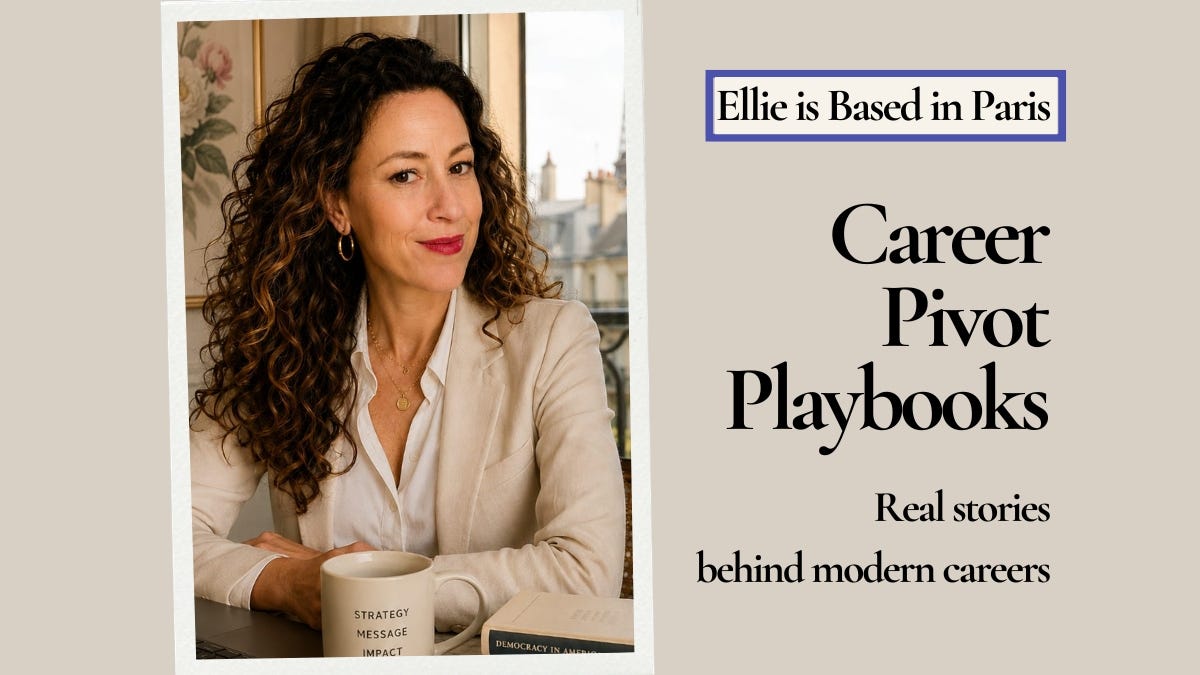
Ellie Krasne is a strategic communications advisor who helps nonpartisan policy and legal organizations communicate complex ideas with clarity, precision, and judgment.
She has an MA from The University of Chicago and lives in Paris, France.
She runs Krasne Strategies, working with clients whose messages have reached outlets like the New York Times, Reuters, and Forbes, and teaches media relations at a business school in Paris.
You can follow her work here →
I started my career in tech, overseeing data integration teams. I then earned a graduate degree in American religious history, was accepted into several PhD programs, and ultimately decided not to pursue the academic path. Instead, I stayed in tech for several more years.
Over time, I started to feel pulled toward the policy decisions that shape institutions, and daily life — tax, regulation, education, and more. So I made a career pivot from tech into policy communications.
Since then, I have worked for some of the most influential think tanks and policy organizations in Washington, D.C. and New York City. Today, I run my own strategic communications firm, Krasne Strategies, from Paris, working with nonpartisan policy and legal organizations.
During COVID, I was on the phone with a woman from another department while she was working from home. She yelled to her son, “Adam, can you believe it? Ellie went to the University of Chicago, and here she is a party planner. Can you believe it? A party planner.”
For context, I oversaw the strategy, production, and marketing for about 200 events per year, featuring Cabinet secretaries, United States senators, foreign heads of state, and other major public figures. During that time, we increased event attendance by about 200% and grew the email list from roughly 3,000 to more than 30,000 in 18 months.
I had also started publishing articles that did well and received good feedback from colleagues. I vowed to myself I would never be spoken to like that again.
Eventually, I moved to Paris and opened my own strategic communications firm. I have had the good fortune of working with numerous nonpartisan policy and legal organizations on messaging, media, and public positioning.
So many. One of the biggest is organization, which is an underrated entrepreneurial skill.
Running a business requires managing contracts, invoices, client deliverables, editorial calendars, and long-term strategy — often all at once. My background in tech taught me how to keep complicated projects moving, manage many details without losing the larger purpose.
I also learned how to translate complex ideas for different audiences. That is a huge part of what I do now: helping policy and legal organizations explain serious, often technical issues in a way that is clear.
My audience is made up of people who care about policy, institutions, law, culture, and public argument. They are readers- NYT, NPR, WSJ, etc.. They are more likely to spend time on Substack and LinkedIn than on highly visual platforms.
Substack gives me a place to be creative, develop my writing, and share my professional perspective. LinkedIn is more directly tied to professional credibility and business development. Together, they allow me to show both how I think and what I do.
My firm works with nonpartisan policy and legal organizations that need to communicate complex ideas with clarity, precision, and judgment.
Policy and law shape people’s lives, but often the language around them is too technical, too partisan, or vague. I help organizations explain their work in a way that is credible and useful.
At its core, my work is about helping serious organizations build trust and communicate with the audiences they need to reach.
Harder? Selling.
It is tough to put yourself out there and explain the value of your work. Selling is a skill, and it can be learned and practiced, but that does not mean it comes naturally at first. I had to learn that business development is about understanding what problem you solve and being able to communicate that clearly.
Easier? Time and task management.
I tend to be a good independent worker, so perhaps this came naturally to me. But, I find it less stressful to power through a to-do list on my own than I did to engage in water cooler banter.
I really enjoy Substack. I love hearing people’s perspectives and connecting with others who share an interest in ideas, culture, policy, and public life.
The emphasis on writing is one of the platform’s strengths. It gives people space to really develop an argument.
My biggest piece of advice is to develop a positive vision for what you want to share. Whether your subject is business advice, cooking, home decor, politics, or anything else, it is easier to write takedowns than it is to build a point of view. But in the long run, it is much more valuable to write about what you think is good or useful.
I didn’t have an “I quit” moment in self employment.
What keeps me going is the desire to build a business that supports my life, allows me to do serious work, and gives me enough flexibility to visit my family in the United States.
For me, entrepreneurship is about building a sustainable professional life with more ownership, more flexibility, and more responsibility.
Have a savings account, build a business plan, and identify your target market.
There is a lot of advice online about starting an LLC or building a side hustle, but flexibility still requires structure. Before monetizing a skill, ask yourself some serious questions: Who needs this? Why would they pay for it? How will I reach them?
Most importantly, whether this is a hobby or a business. There is nothing wrong with either, but they require different levels of discipline and risk assessment.
I teach media relations at a business school in Paris. The students are bright, curious, and eager to work, and teaching has become one of the great joys of my professional life.
It also connects naturally to my consulting work. Teaching forces you to break down complex ideas and give people a practical roadmap. That is very similar to what I do with clients: take something complicated and make it clearer, more strategic, and more actionable.
The best part is helping students realize that they can understand the media landscape, think strategically, and learn how to communicate well.
I would say one decision that changed everything was after grad school when I declined some fully-funded PhD programs. I beat out hundreds, yes, hundreds of other students. I knew, deep down, that the academic path was not the life I wanted. What we say “no” to is just as important as what we say “yes” to.
What’s next? Maintaining my business!
For me, the goal is building something useful and true to the way I want to work and live.

Connect with Ellie…
Moving to France Showed Me True Cost of ‘Free’ European Health Care, Child Care, and Retirement
In Defense of the Cat Ladies at Christmas
Learn how to turn your current skills and experience into income and build a portfolio career beyond a single job, so you’re more resilient and in control.
Real-world career pivots, portfolio paths, and practical lessons from some of your favourite Substackers you can apply to your own next move.
Practical, strategic answers to the career questions ambitious professionals are asking as work, security, and opportunity continue to change.
I’m Katharine — a future-focused career strategist helping professionals build income options and stay relevant as work evolves.
🙏 I appreciate you being here and supporting this growing archive… and thank you to all the creators who contribute, it’s such a pleasure to learn from them.
❤️ Loved it? Restack 🔁 and share ✅
🤔Is there a question you wish had been asked?
Drop it in the comments, and let’s keep the conversation going.
Comments
Nothing yet. Say the first thing.
Sign in to join the conversation.