
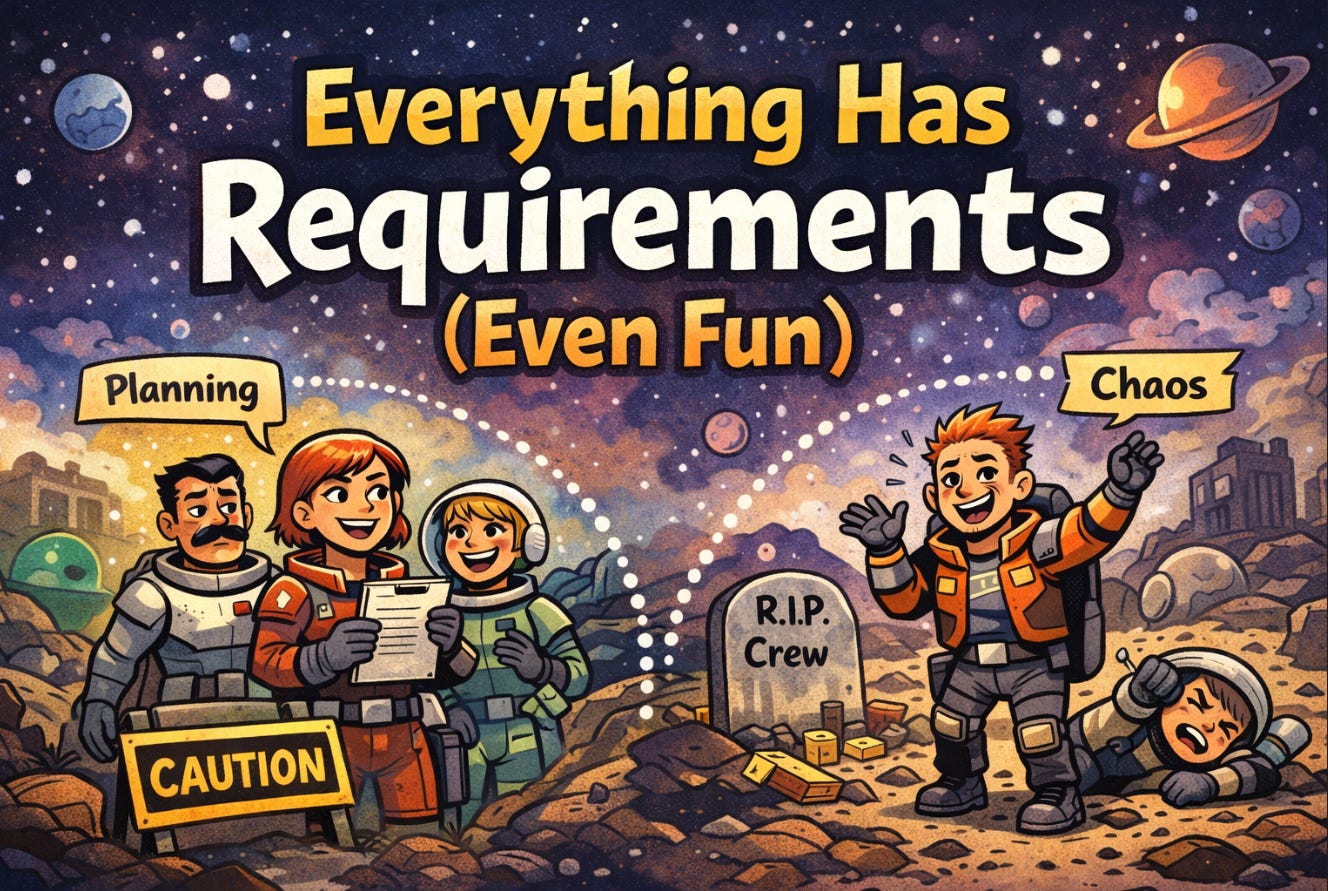
We like to pretend that requirements are a corporate invention. Something born in boardrooms, spreadsheets, and project managers with color coded calendars. But requirements are older than paperwork. They show up everywhere, quietly, even in the places we call fun.
Sports have rules. Games have mechanics. Friendships have boundaries. Your “chill weekend” still requires sleep, food, and some agreement with reality. Life runs on requirements whether we acknowledge them or not.
Ignore them, and the system does not get offended. It just stops working.
You can call them rules, expectations, constraints, or guardrails. The name does not matter. What matters is that every scenario maintains a baseline. Below that line, things break. Above it, things get interesting.
Consider two space explorers.
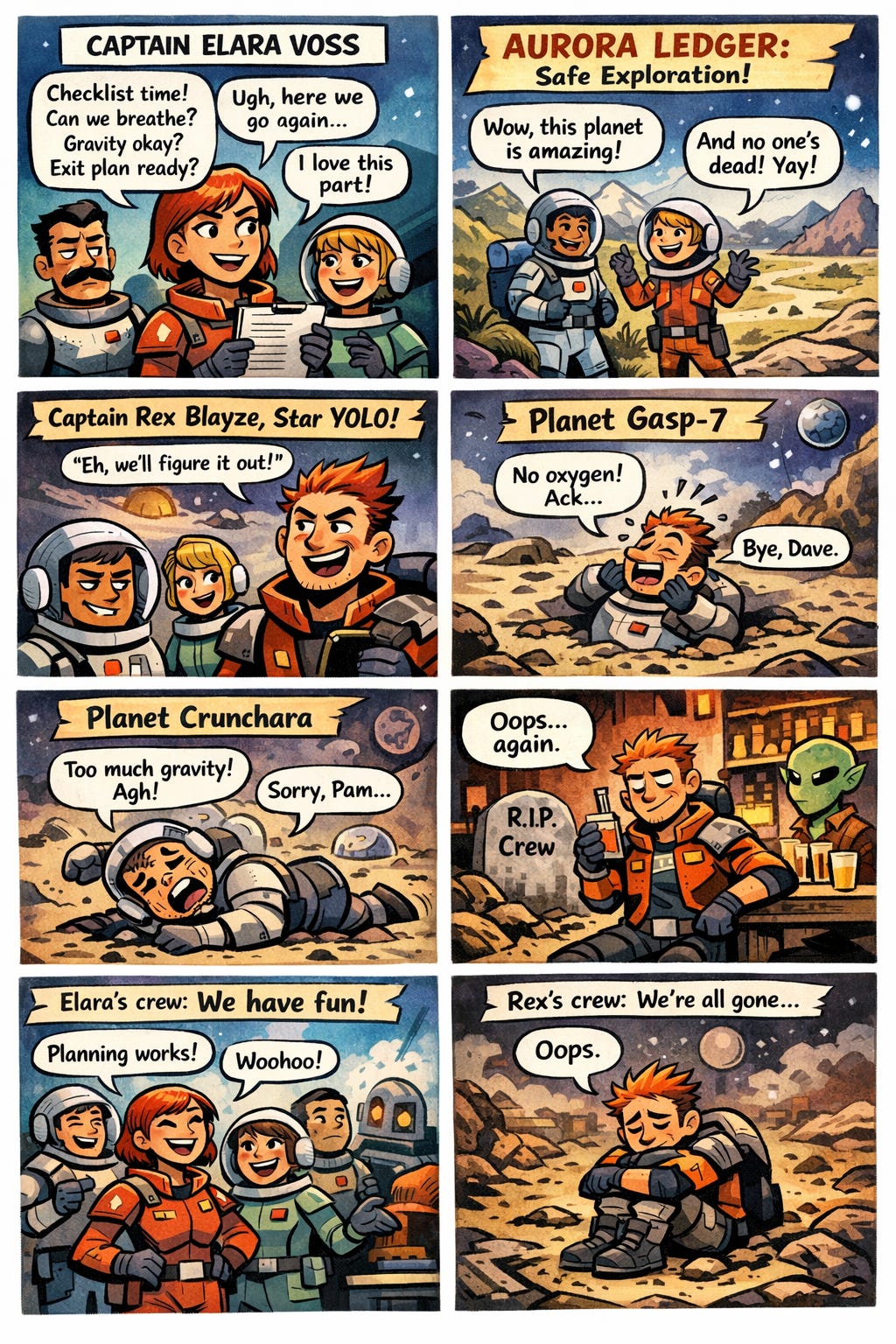
Captain Elara Voss leads the Aurora Ledger, a ship known for one thing: nobody dies for preventable reasons. Before landing on any planet, Elara checks a simple list.
Can we breathe?
What is the gravity?
Is the surface solid?
Do we have a way home?
Nothing fancy. No overengineering. Just a baseline set of requirements that keeps curiosity alive without feeding the void.
Her crew knows the routine. Lieutenant Milo Quark complains every time. Engineer Tamsin Bolt secretly loves the checklist. The ship lands. The crew explores. Everyone returns with stories instead of memorial plaques.
Then there is Captain Rex Blayze of the Star YOLO.
Rex believes requirements limit creativity. His philosophy is simple: “We’ll figure it out when we get there.” If they can breathe, great. If not, well… space is dangerous. Adds character.
Their first stop is Planet Gasp-7. Beautiful skies. Zero oxygen. Goodbye, Crewman Dave.
Next is Crunchara, gravity so intense it turns knees into soup. Farewell, Lieutenant Pam.
Then Oopsilon Prime, which looks friendly until the ground starts screaming. No survivors, but very memorable last words.
Rex calls it exploration.
Elara calls it poor planning.
Most of us are not landing on alien planets. But we do this exact thing all the time.
We jump into projects without understanding what “done” means.
We start relationships without agreeing on expectations.
We chase fun without accounting for sleep, money, or consequences.
We skip the basics and act surprised when things collapse.
Requirements are not cages. They are life support systems.
They do not kill creativity. They keep it alive long enough to matter.
The crew of the Aurora Ledger gets to explore strange worlds because they respect the minimum conditions required to survive them. The crew of the Star YOLO becomes a cautionary tale told at space bars, usually followed by a moment of silence and a free drink.
The irony is this: Captain Elara, the “boring” one, has more fun.
Her crew laughs more.
They take bigger risks after the basics are handled.
They go further because they come back.
Captain Rex has fewer rules and fewer friends. Eventually, fewer crew members. His ship log is mostly just the word “oops” in different fonts.
Every scenario has requirements.
You do not escape them by ignoring them.
You only choose whether they work for you or against you.
Set the baseline.
Protect the basics.
Then explore like your life depends on it.
Because sometimes it does.
The Malik Paradox is a reader-supported publication. To receive new posts and support my work, consider becoming a free or paid subscriber.
No posts
Comments
Nothing yet. Say the first thing.
Sign in to join the conversation.