
One of the most important things we can create in our business is space.
When our schedules are packed and we’re continuously moving from one thing to the next, there isn’t much room to step outside of what we’re already doing and see what else might be possible.
More space is something almost every founder craves more of, and yet, something interesting happens when we finally create it.
Someone tells you they’re leaving the team and puts in their notice, or you make a decision to let someone go, and you immediately jump into figuring out how to replace them.
You delegate something (whether to another human or AI) and free up 10 hours a week… but that somehow gets reallocated to something else.
We create space, and then we fill it right back up.
There are things we only notice once we stop rushing to fill every opening, including things we no longer need or an idea we never would have known to make room for in the first place.
And that can open up an entirely different way to scale.
As business owners, we’re fantastic problem solvers.
We’re used to figuring things out and moving things forward quickly, so when something opens up, the natural instinct is to decide what belongs there next.
And most of the time, what we put there looks a lot like what was there before.
A team member leaves, so another person gets hired to do pretty much the same thing. One revenue stream ends and something strikingly similar takes its place.
If we give ourselves some time before deciding what belongs in the open space, we have the opportunity to identify something we may never have considered otherwise.
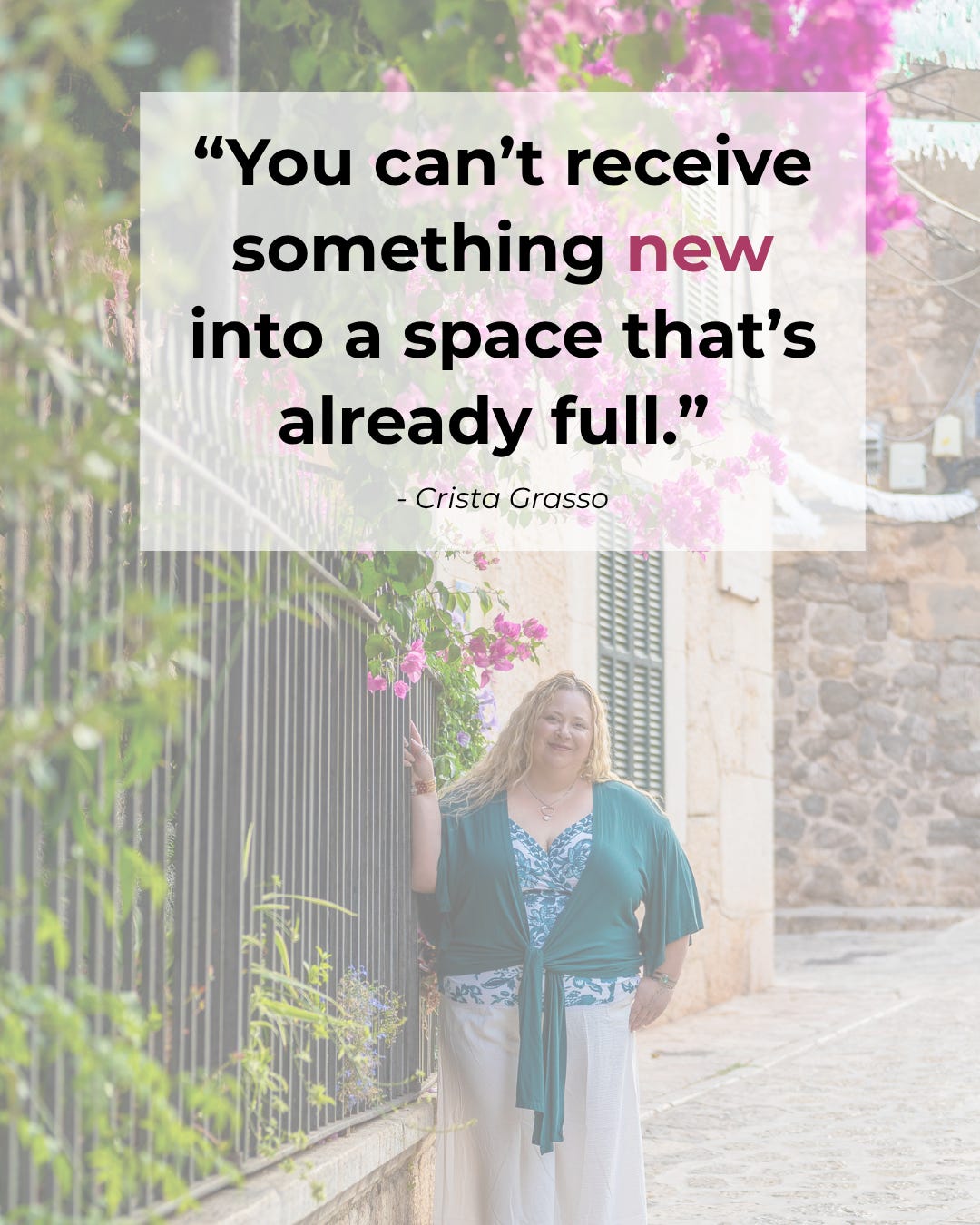
When you intentionally leave open space, you may discover that you never needed to replace what was there in the first place.
For example, instead of immediately backfilling a role, giving yourself space allows you to evaluate if the role is even needed or if there may be other options that would save money and improve results.
I remember an experience from the earlier days of my business when I hosted a Q&A every week as part of one of my programs. People brought their questions and got my insight on their businesses.
Clients told me all the time how helpful the sessions were, and I believed so strongly in the value of those calls that I revolved a ridiculous amount of my life around making them happen.
When I traveled, I figured out how to dial in, and when I went on an actual off-the-grid vacation, I made sure I had someone lined up to cover for me.
Then there was a period of about three weeks when I couldn’t do the call, so we paused the calls for a few weeks.
When I came back, I was surprised to discover that people didn’t miss it nearly as much as I thought they would.
I realized that I had literally scheduled my life around something that wasn’t as important to people as I had assumed.
I had enough distance to see that every week wasn’t necessary, so I eventually moved it to every other week and later to monthly.
Leaving the space open long enough gives you a new vantage point.
This has been especially true for me after getting back from Mallorca, where I went to experience the eclipse.
It was an absolutely amazing experience and the first time I got to see a full eclipse in totality.

Going into the trip, I had two things planned - experience the eclipse and do a photo shoot.
Aside from those two things, I planned nothing else (which was definitely uncomfortable because I am very much a go-go-go kind of person).
But instead of filling in every space in my schedule while I was there, I wanted to see what would happen if I didn’t.
I brought my laptop with me and never opened it for the entire 10 days.
Instead, I spent a ton of time journaling, pulling oracle cards and reflecting on them, sitting in my private pool, and reading. I even took naps in the middle of the day, which is a foreign concept for me!

There were plenty of times when my natural instinct was to think about what I should schedule or where I could go, but I kept reminding myself that I didn’t need to fill the time simply because it was available.
And then something happened that frequently happens for me when I finally have enough room to think without trying to force anything.
A brand new product fully created and something I am incredibly excited to introduce!
If I had created a plan to build it and carved out time to work on it before the end of the year, it probably would have taken me months to put it together, and I don’t think it would have been half as good.
What stood out the most for me about this is that I hadn’t gone into the trip trying to come up with this idea.
I wasn’t taking time off because I wanted to figure out what I should create next or because I had something specific I needed to solve.
I had simply given myself enough open space for whatever wanted to surface to have somewhere to surface.
This is very different from blocking three hours on your calendar and deciding that’s when you’re going to figure out your next offer or deciding what you’re going to do with that time.
And while there is value in setting aside that kind of focused time, the kind of space I’m talking about here is different. I’m talking about what happens when you create capacity without already knowing what you’re going to do with it.
Maybe it’s an idea that connects things you’ve been thinking about for years. Maybe a conversation sparks something that sends you in an entirely different direction.
Or maybe you suddenly remember something you always wanted to do that you stopped thinking about because there was never enough room for it.
Maybe the idea wasn’t possible when you originally had it, but now the technology has shifted enough to make it possible.
Or maybe you, your team, and your business have evolved enough that something you couldn’t have done before suddenly works.
When every opening is already allocated, you don’t always get the chance to find out.
Of course, this doesn’t mean every open space should stay open.
Some open spaces in a business do need to be addressed quickly, which is why I find it helpful to distinguish between a void and an opening.
A void is something that requires a response, while an opening gives you some time to see what happens next.
If someone leaves and there is literally nobody else who can work with your clients, leaving the position unfilled could affect your ability to fulfill the commitments you’ve already made.
That’s a void, and it needs to be addressed.
There are other times when someone leaving creates an opening.
The team may have to adjust for a while, and during that time you may discover a completely different way to structure the work or realize that you never needed to fill the position in the first place.
The same thing can happen when an offer ends or you get a significant amount of time back on your calendar. Something may eventually belong in that opening, and there is value in giving yourself enough time to find out what that is.
Sometimes what emerges isn’t even something new.
That, to me, is some of the magic of keeping space open.
This brings me back to the eclipse…
Everyone was gathered around watching the eclipse but once totality was over, people started to disperse. They went downstairs to use the restroom or to get drinks and started moving on to whatever was next.
A few of us stayed because we had a feeling there was still something else to see, so we watched the sky without knowing exactly what we were waiting for.

Then the eclipsed sun re-emerged and started to fall below the horizon. The sky and water turned this gorgeous, brilliant hot pink and orange.
I had seen countless sunsets before, and I had never seen anything like this.
It looked like a crescent moon that was on fire, slowly sinking down into the ocean.

It was so incredibly beautiful and completely unexpected. It’s unlikely I will ever see anything like it again in my lifetime.
And sadly, many of the people on the boat missed it because they immediately moved on to the next thing.
I didn’t know what I was waiting for but I am so grateful I stayed long enough to find out what it was.
I think there is such an interesting parallel to business in that.
You can’t plan everything in business (and this is coming from someone who has spent decades helping people with planning).
I think planning is incredibly important, but unexpected things will happen, and there are unknown unknowns that come at you all the time.
There are ideas and opportunities that can change the direction of a business that you never could have known to make time for in advance.
When everything is a cycle of starting something, finishing it, and immediately moving on to what’s next, there can literally be nowhere for that unexpected magic to go.
An incredible opportunity could be right in front of you, and you may not have the capacity to see it or do anything with it.
When you give yourself space to breathe without immediately filling it, you give yourself room for the unexpected.
So take a look at where some capacity already exists in your business, or where you know some is about to open up. Is there something you could leave open a little longer before deciding what belongs there?
I would love to hear what comes up for you in the comments.



Dig deeper into this topic on episode 295 of Scale Differently on Apple, Spotify, or search Creating Space for the Unexpected in Business on your favorite podcast player.
No posts
Comments
Nothing yet. Say the first thing.
Sign in to join the conversation.