
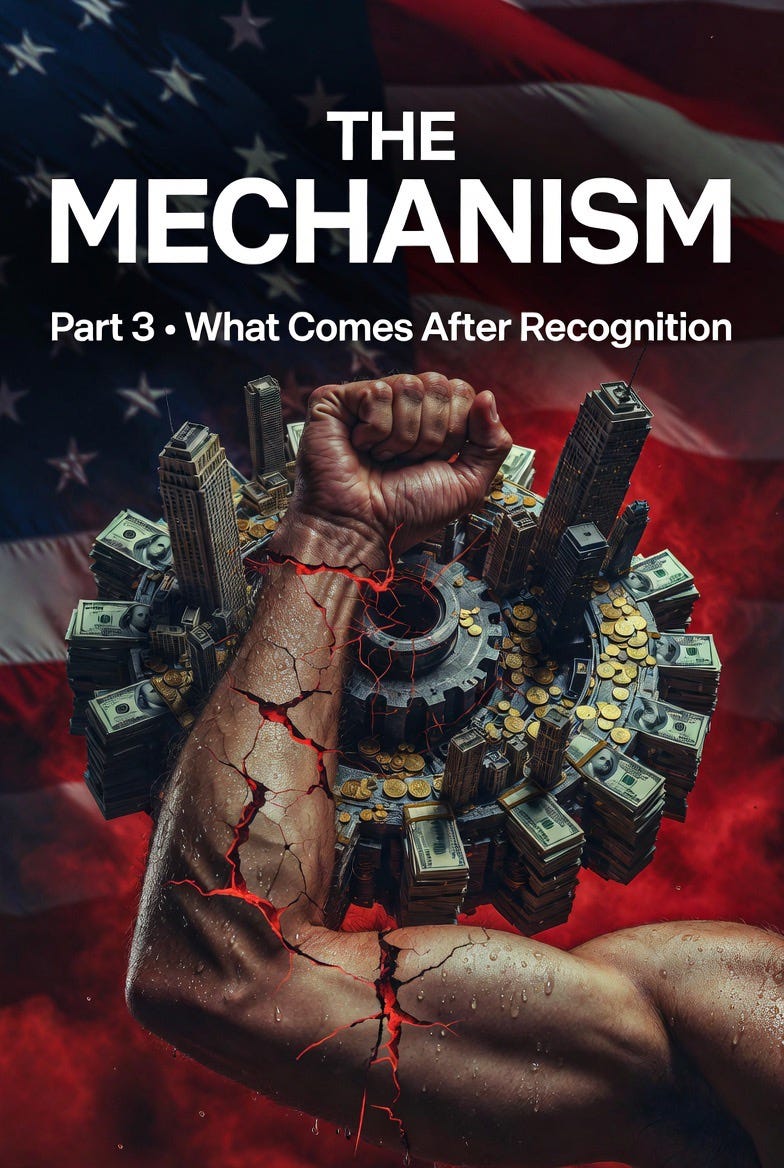
If you’ve been here for the first two pieces, you know where we are. Peter Girnus wrote something that became the rope piece — about Oracle, about VEST_CANCEL_BATCH, about the sentence that should be posted in every business school in the country: loyalty is a liability with a vesting schedule. Then the layoffs kept coming, and I went back to the historians — to Thompson’s poor stockinger, to Montgomery’s craftsmen losing functional autonomy to the man with the clipboard, to Gutman’s workers defending a whole moral world that capital needed to dismantle before it could fully consolidate its hold. I argued that the managerial class had just discovered it was always labor. That the parking space was a costume. That recognition, once it arrives, has a way of becoming the beginning of everything.
That recognition has arrived. And this morning, of all things, a Tom Bilyeu video handed me the third piece — because the argument was still incomplete without what comes after recognition.
Here is what happens next. Not as theory — as mechanism. As the thing that has happened, with documented regularity, every time the squeeze becomes unbearable and people mistake a symptom for a solution.
I’ve been a massage therapist for nearly thirty years. I have had my hands on a lot of bodies held together by sheer stubbornness — people who couldn’t afford to break down, so they didn’t, until they did. The shoulder compensating for the bad hip so long that the person couldn’t locate the original injury anymore. The chronic tension that had been there so long it registered as normal. You don’t walk into my office because you’re in a little pain. You walk in because the thing you’ve been absorbing has finally exceeded your capacity to absorb it.
A country works on the same principle. You can load it, and load it, and load it — and for a long time the loading disappears into the tissue. Until it doesn’t.
I keep getting asked why ordinary Americans — not radicals, not ideologues, people with jobs and kids and mortgages — are raising legal defense funds for a man who shot a health insurance executive on a Manhattan sidewalk. Why a guy who torched a warehouse and filmed it himself is considered, by a meaningful slice of the public, to have performed an act of justice. Where is this coming from?
It is coming from the same place it has always come from. It is the body telling you the injury is real. That part is correct. Everything that follows is where things go catastrophically wrong.
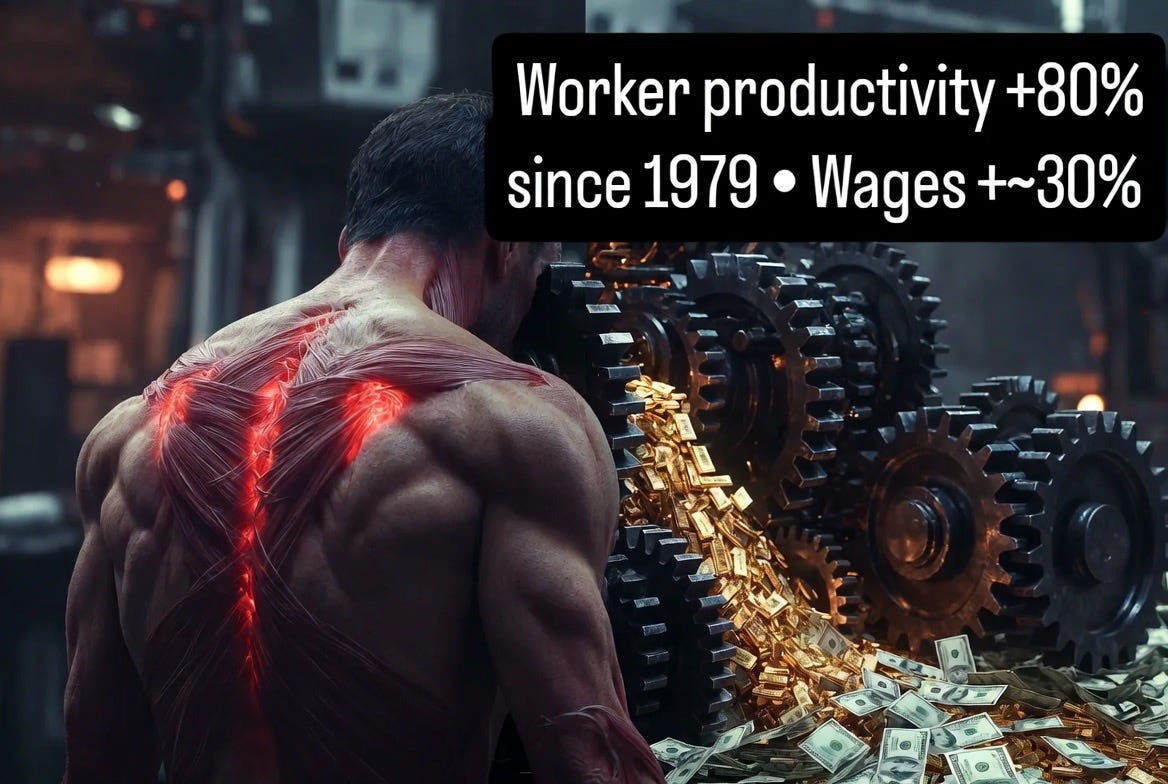
Since 1979, worker productivity in the United States has grown by more than 80 percent. Wages have grown by less than 30 percent. That gap is not a policy failure. It is a policy choice. The gains went somewhere. They went up.
Meanwhile, the federal government has spent decades running deficits and covering them through monetary policy rather than fiscal discipline. When you print money to cover the gap between what you spend and what you take in, prices rise. This is arithmetic. And what rises fastest is what you cannot cut: housing, groceries, energy, healthcare. For six consecutive years through 2025, the bottom 80 percent of American consumers failed to keep pace with inflation. Not one year. Six. In a row. On necessities.
What that means in a real life: a full-time worker making $18 an hour takes home roughly $37,000 a year. A one-bedroom apartment in many American cities runs over $2,000 a month — 65 percent of take-home pay before food, before gas, before a single dollar goes toward the assets that would provide any protection from the next round of inflation. Running as hard as possible. Falling behind. Phone full of people on private jets.
This is the two-sided squeeze. Inequality at the top, unaffordability at the bottom, colliding in the compressed middle — the people Montgomery showed us had genuine functional autonomy over their own labor until capital ran a decades-long campaign to take it, one time-motion study at a time. The people Gutman showed us had built whole moral worlds — mutual aid, craft solidarity, the dignity of showing up and not being made to beg for the privilege — precisely because they understood the system was not going to protect them. The people Thompson spent his career trying to rescue from the condescension of those who would look back and call them obsolete. The people who, in every generation, see the injustice first — and are consumed by the response to it first.
Everyone who thought their degree and their moderate politics and their professional title placed them above that waterline: you are in this group too. The Oracle layoffs, the vesting cliffs, the 65-percent-of-income-on-rent math — these are not happening to someone else. The parking space was a costume. The managerial class is finding out this week what Gutman already knew. It was always labor. It just didn’t know it yet.
The mechanism that produces Luigi Mangione and warehouse fires is old and legible. History has run this experiment enough times to make the structure plain.
In 1786, three years after the men who fought the Revolutionary War came home, they were losing their farms to debt collectors. Massachusetts had loaded its citizens with taxes to pay off its own war debts, courts were seizing property, and men were being thrown into debtor’s prison — men who had bled for the principle that no government gets to crush the people who built it. Daniel Shays led an armed revolt. It was put down, but it terrified the founders so completely that Madison wrote about it obsessively and Hamilton cited it by name. Both pointed to Shays’ Rebellion as proof that the Articles of Confederation couldn’t contain what economic despair produces. The Constitutional Convention of 1787 was America’s structural answer to rage with no legitimate channel.
In 1892, Andrew Carnegie cut wages 18 percent at his most profitable steel plant while it was producing record output. Twelve people died in the gunfight that followed. In 2019, Chile — economically stable, not a failing state — raised its subway fare by four cents. One point two million people took to the streets. Their phrase: No son 30 pesos, son 30 años. It’s not 30 pesos. It’s 30 years. The fare was not the problem. It was the moment the last cushion disappeared and people stopped absorbing it.
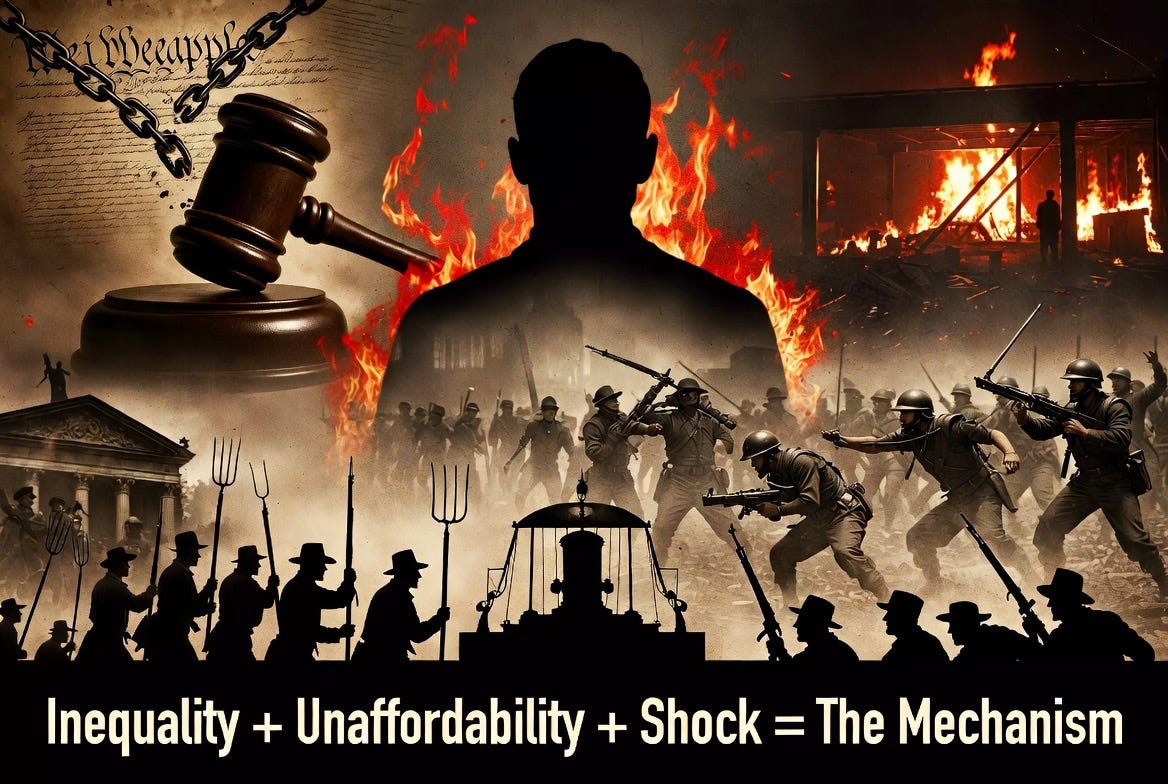
These are not stories about unstable places or unhinged people. They are stories about a mechanism. Inequality plus unaffordability plus a fresh shock, hitting a system with no margin left. The only variable is whether people aim at the machine or at the faces nearest to them.
The faces nearest to them are not the machine.
The health insurance executive and the warehouse owner are inside the machine. They are not the machine. The machine is a two-trillion-dollar annual deficit that converts the gap between what you earn and what you owe into somebody else’s asset appreciation — year after year, invisibly, with full bipartisan participation and zero electoral consequence. The machine is the monetary policy that inflates your rent while the asset-owning class rides the appreciation. It is the rope that both parties have sold for fifty years — and that the compressed middle has bought, election after election, under the lethal illusion that it was on the selling end.
It was not. It was never on the selling end. Montgomery and Gutman knew that. The longshoremen who struck in 1934 knew that — they weren’t just fighting a labor practice, they were fighting to restore a man’s right to show up in the morning without being made to beg. That distinction between a worker who has standing and a worker who is merely available is the whole argument. Nina Lewis had standing for 34 years. The algorithm found her expensive. The calendar found her inconvenient. That was the whole of the calculation. The compressed middle is finding out now, the hard way, what the men on the dock already knew.
I understand the pull of the vigilante narrative. The diagnosis — that the people at the top have accumulated obscene wealth while the people at the bottom have been stripped of any cushion — is correct. What is catastrophically wrong is the conclusion that the solution is a target rather than a structure. Not just wrong in a moral sense. Wrong in the specific, documented sense that when you abandon the rule of law for the righteous face, the logic does not stop there.
Maximilien Robespierre was not wrong about the suffering of the French people. The inequality was real. The exploitation was real. The aristocracy’s indifference was real. He came to power on legitimate grievance. Then the guillotine logic took over. Once you decide the enemy is a class of people rather than a set of structural arrangements, the blade has no natural stopping point. The Terror consumed the middle first — the professionals, the moderates, the people who believed their education and civic temperament placed them above the waterline. And then it consumed Robespierre himself. He was guillotined by the revolution he built.
When we abandon the rule of law — even against people who seem to deserve it, even with a story that feels righteous — we end up where Robespierre was. And the people who end up there with him are not the billionaires, who have planes and lawyers and options. The people who end up there are the compressed middle. The ones who will become the condescension — the cautionary tale — if they choose the blade over the structure.
So what does the rational path actually look like?
This week, a federal court ruled against Live Nation — the monopoly that controls concert venues, ticketing, artist management, and promotion simultaneously, extracting billions from artists and fans alike for two decades while regulatory capture kept any serious challenge at bay. The ruling matters. It also arrived about twenty years late, and its outcome is still uncertain. That delay is not an accident. That delay is what concentrated corporate power purchases with the money it extracts from the people who can no longer afford a concert ticket.
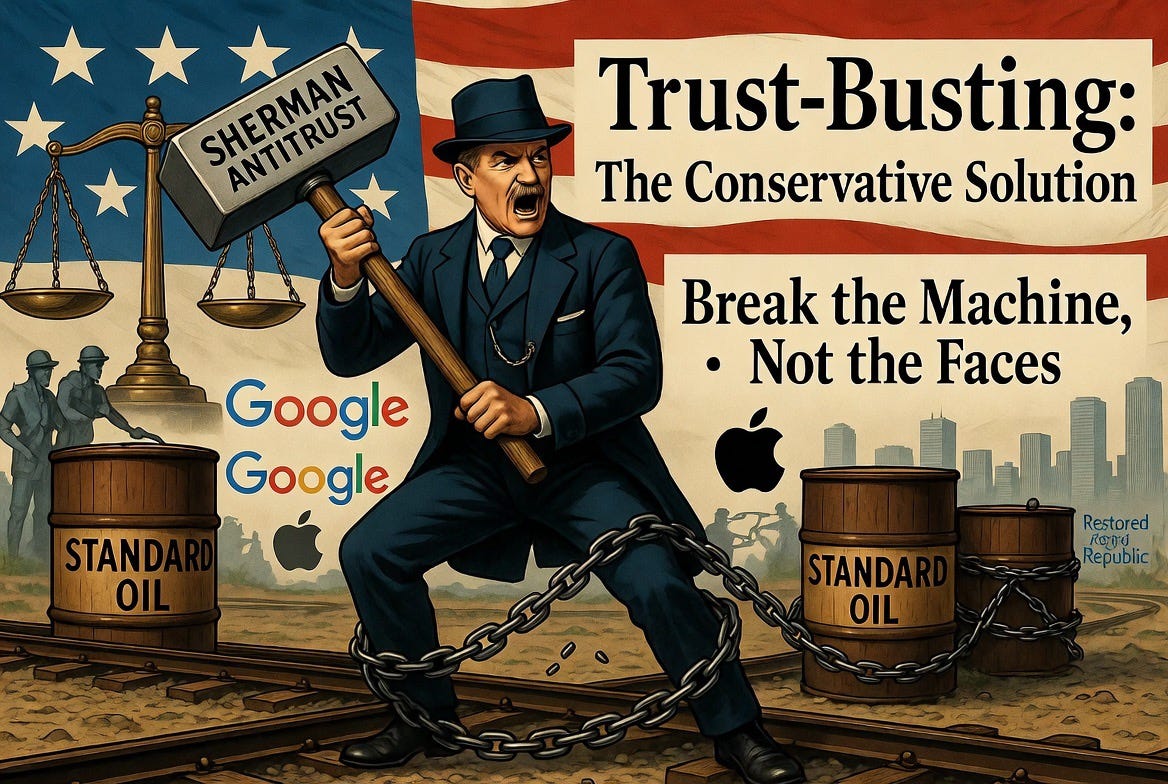
We have been here before, and we have had a way through. Theodore Roosevelt was not a radical. He was a man from the ruling class who looked at what the concentration of corporate power was doing to the republic and decided the republic mattered more than the comfort of the class he came from. He had, in his way, the Debs moment — not from Terre Haute but from the same recognition. Eugene Debs said: while there is a lower class I am in it. He didn’t mean it as defeat. He meant it as solidarity. TR meant something adjacent: while there is a republic being hollowed out, I am going to do something about it. He broke Standard Oil. He broke the railroad trusts. He used the Sherman Antitrust Act like the instrument it was designed to be. He did not need a guillotine. He needed institutional will. He had it. He used it.
A lot of people hoped Donald Trump would be that. The disruption, the anti-establishment energy, the contempt for the donor class — it read, to a lot of exhausted people, like the beginning of something structural. It was not. What followed was another war, another expansion of the deficit, another set of asset-class-friendly policies dressed in populist language, and a roster of billionaires placed in charge of the institutions they had spent decades trying to dismantle. Another salesman. Another length of rope.
The era of the corporation as it currently operates — vertically integrated, politically captured, too large to answer to anything but its own perpetuation — needs to end. Not because corporations are evil in the abstract, but because concentrated power without accountability is the machine running the two-sided squeeze. The trust-busting was not a radical act in 1903. It was a conservative one — an act of preservation, an attempt to keep the republic from being hollowed out by the concentrations of power inside it. We need that again. We need candidates at every level who will answer the question Roosevelt answered: what are you willing to break?
Recognition has arrived. The stockinger is real. The longshoreman is real. Nina Lewis is real, and she is open to ideas. That recognition is the whole thing — it always has been.
The rope is still available. So is the alternative. What we do not have is unlimited time to decide.
If you enjoy any of my writing, please consider becoming a paid subscriber. Either way, I appreciate anyone who reads my work.
LeAnne Owen is the head writer of the LGB Courage Coalition, a 501(c)(3) advocacy organization. She is also a licensed massage therapist with nearly thirty years of practice in Montgomery, Alabama. This is the third in a series on labor, capital, and the moment we are in — all three written in a single week, because the week did not leave room for anything else.
Comments
Nothing yet. Say the first thing.
Sign in to join the conversation.