
In January 2027, I’m launching the Read Like a Writer Book Club for subscribers to The Scribblers Club (details below). In the meantime, this post is free to read and will give you a taste of what it means to read like a writer, how doing so can improve your own writing, and the kinds of things we’ll talk about as we read together in the Read Like a Writer Book Club.
Warning: Spoilers ahead.
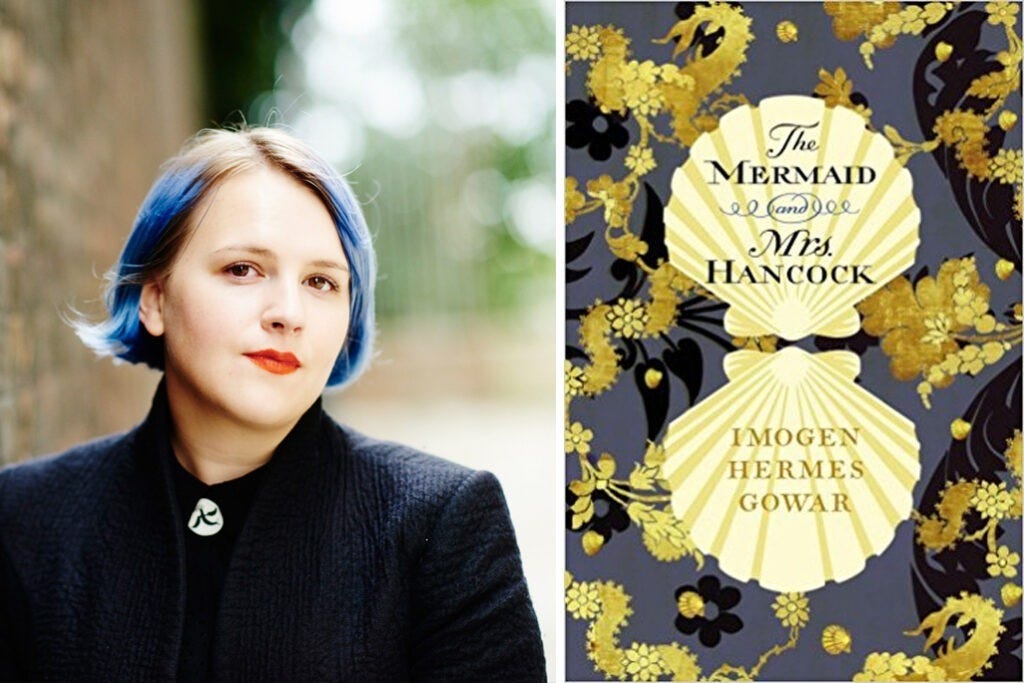
I often write about the beauty of establishing a sense of place in writing. It’s my passion and a big part of my own voice as a writer. There are many ways to infuse a sense of place in prose. This week, I’m writing about a book called The Mermaid and Mrs. Hancock (2018) by Imogen Hermes Gower. Gower masterfully uses language itself to ground her readers in the era and the geographical part of the world in which her novel is set.
The Mermaid and Mrs. Hancock by Imogen Hermes Gowar is a story set in 18th century London, amidst the English shipping industry, and in a world where mermaids exist. As I began to read, I was immediately reminded of Melville, tall ships, and whaling villages. I felt transported to another era, but there was something more, something gothic and haunting. I began to pay attention to the way Gowar uses language and even punctuation to create these feelings for the reader.
One of the first things I noticed was Gowar’s use of single quotes around speaking lines throughout the novel. This subtly implies double quotes around the entire novel, creating the sense that some unseen and unidentified narrator is telling the story through the lens of the past. But Gowar’s most compelling device is her use of language to pull the reader into another era and another place.
It’s no wonder Madeline Miller (Circe and The Song of Achilles) called Gowar’s novel, “Wonderful … completely transporting.” Readers are transported to 1780s London. But what I became most interested in as I read was how Gowar accomplished this. It was easy to see why Gowar’s 2018 book was shortlisted for the Baileys Women’s Prize for Fiction and was named People magazine’s Best Book of the Fall, Refinery 29’s Favorite Book of the Year, and one of Booklist’s Top 10 First Novels of the Year.
It is clear a great deal of research went into the language. Gowar, an archaeologist, anthropologist, and art historian, uses archaic words and phrases, but she strategically places them so that their meaning can be gleaned from the context in which they are used. These are words that not even the most well-read person would likely be familiar with, so the reader not only feels pulled into another time and place, but perhaps feels a bit off-kilter, thrown into deep, uncharted waters, like the characters in the story.
One way Gowar uses language to set her story and to place her characters within the social hierarchy of the time is with vernacular speech. For example, most of the story’s prostitute characters are low-born, but they have been trained in the social graces by the madam for whom they work. Their use of slang and gramatically improper speech betrays them, however, with phrases such as, “That don’t bode well” (180) and, “She don’t deserve me” (197).1
Gowar also uses archaic words, for example, “sorrel-pated” instead of “redheaded” (268); archaic phrases, for example, “it don’t signify” instead of “it doesn’t matter” (108), “in her cups” instead of “drunk” (283), and “do herself a mischief” instead of “commit suicide” (303); and archaic spellings of words, for example, “sopha” instead of “sofa” (180). This use of language helps to create the sense that the story is set in the past.
Another trick that very much gives the story its sense of being set in the past is the descriptions of food and other items. The characters indulge in food and beverages like “tipsy-cake” (225), “hot brandy and plum cakes” (257), “plum pie” (261), “small beer and cold boiled beef,” and “cold mustard” (356). They play games like “spillikens” (196) and “knucklebones” (258). They wear “patched mantua[s]” (193). Their hair is “scorched [in] curl paper[s]” (11). They carry their glasses in “shagreen case[s]” (247). They play the “clavichord” (375), they nibble “millefruits” (350), and they call each other names like, “Nebbity, yepping, thingsnitch” (413). Gowar’s descriptions of the everyday items the characters use bring the story’s setting to life.
The emotional feel of the story comes from Gowar’s frequent use of various language and literary devices to create a feeling of the past, a nautical setting, and a feeling of other-worldliness. The reader senses that each word is carefully chosen, each sentence carefully crafted. Gowar’s flowery, beautiful phrasing makes the reader feel that she has been pulled into the past. For example, when she talks about the Hancock siblings, instead of writing that their mother had been dead so long that they did not remember her, she writes, “[T]heir mother was dead beyond remembrance.” When she describes a set of curtains, she writes, “The curtains are heavy brocade, riotously worked with birds and flowers … marvelously wrought ….” (242). This language is almost biblical and recalls the description of the Ark of the Covenant in the Book of Exodus. When she writes about the arrival of her female protagonist’s friend for a visit, she writes that, “Mrs Frost’s blowsy aura makes her large; the hallway is full of her ….” (348).2 Writing about how precious and expensive a character’s glassware is, she describes the glasses as being “as fine as sharded ice on winter puddles” (446).
The nautical feel of the story is reinforced by Gowar’s use of simile and metaphor. For example, she writes at page 19 that a character has “a mouth like a low tide.” At one point, the female protagonist, thinking about her traumatic childhood, conjures mermaid imagery: “She would like to have been born full-formed and pristine from sea foam.” At page 433, Gowar writes that, “Angelica’s slow breathing fills the room, in and out pacific as tides.” At page 436, she describes the movement of Angelica’s hair in a way that summons a visual image of water: “[H]er hair in the cold breeze washes back upon his hand.”
One of the most beautiful passages in the story is at page 417 and carries out this theme:
“He stares out of the window. He feels as if he were on a ship in the middle of a great ocean, too far from home to turn about, but so distant from the strange shore ahead that his craft will be buffeted apart by the waves before it reaches it.
“‘Mr Hancock,’ she whispers.
“And he turns and sees her, golden as a beacon.”
Here, the male protagonist not only feels like a ship lost at sea, he sees the female protagonist as a lighthouse. These passages remind me somewhat of Virginia Woolf’s To the Lighthouse, which also uses a great deal of sea and ship imagery and language.
The story also has a very gothic feel. Writing about the shriveled body of a dead mermaid that is on display in the male protagonist’s office, Gowar writes, “The mermaid watches from the sideboard” (186). The imagery is haunting, and this gives the reader one of the first hints of the story’s trajectory. Gowar’s sparse use of omniscience also contributes to this feeling, for example, when young Sukie’s “secret ambition” to marry and quickly become a widow, so that she can have freedom, is revealed only to the reader (73), and when the reader learns even before Angelica does that she is pregnant (347). Gowar also uses well-placed mini-chapters and the italicized thoughts of the mermaids themselves to deepen the haunting feel of the story.
Even the tiniest details of the novel are used to contribute to the author’s mission to create a sense of history. She even uses a typeface, Caslon, which she indicates is in wide use today, but which was first created and first became popular in the late 18th century, the time period in which the story is set.
Aside from the magnificent use of language, I was also impressed by the theme of freedom that emerges in the story and the way the reader gradually becomes aware of it. Gowar writes about different types of constraints on freedom, including slavery (outlawed in England by that time, but still the norm in the United States), as well as the constraints on freedom suffered by women in that period, including the lack of freedom in being a wife, a young unmarried woman, a prostitute, or even a mermaid. The slavery discussion comes out in dialogue between characters, but attention is very quickly drawn to the female characters, some of whom argue against slavery while not realizing the levels to which they themselves have been deprived of freedom.
I was extremely impressed by the way Gowar used various aspects of language to weave her story’s setting and the emotional feel of the story. The amount of work that must have gone into the research and writing of this story is incredible, and reading it taught me a great deal about the ways different aspects of language can be used to show readers where and when a story is set versus just telling them.
Of course, one doesn’t have to go all out like Gowar did to establish a sense of place and time, but this book is a master class in adding detail and texture to your book and using those things to ground your readers in your book’s era and setting. It is filled with a smorgasbord of literary devices and ideas to add to your toolkit as a writer, from which you can pick and choose.
“Language exerts hidden power, like the moon on the tides.”
—Rita May Brown
The Scribblers Club is here!
In January 2027, I’m launching The Scribblers Club, a subscription tier for writers who want to work on their craft, navigate the writing life, and level up their writing with guidance from a prize-winning author, triple threat certified book coach (fiction, nonfiction, and memoir), and professional editor … me!
BONUS: The annual price for The Scribblers Club will be $195. But, anyone who is an annual paid subscriber as of December 31, 2026, will receive a full year of The Scribblers Club—through December 31, 2027—FREE!
On top of everything available to free and paid subscribers, members of The Scribblers Club will receive access to a growing library of recorded video lessons, community chats, a monthly accountability group, a monthly Ask Me Anything session, and more, including the Read Like a Writer Book Club coming in January 2027.
For less than the cost of one workshop, you’ll receive a full year of learning with me. And I’m guessing we’ll be a very small group to start, which should be lovely.
I hope you’ll join me!
“Words—so innocent and powerless as they are, as standing in a dictionary, how potent for good and evil they become in the hands of one who knows how to combine them.”
—Nathaniel Hawthorne
UPCOMING EVENTS
August 4th - 12 p.m. noon Pacific Time
Join us on pub day for Take Hart! Jaime Parker Stickle, author of the thrillers Vicious Cycle and Take Hart, will be the first guest on my new live series, Origin Story. I hope you’ll join us.

September 25th - 3:45 p.m. to 4:45 p.m. Pacific Time
Central Coast Writers’ Conference
“Does an MFA Matter?” There’s a lot of noise around the question to MFA or not to MFA. So let’s have a conversation that explores the role of an MFA in shaping craft, building a literary community, and opening professional doors. We will discuss the benefits of workshops, mentorship, networking, and teaching opportunities. Whether you’re considering graduate school or questioning its value, we’ll provide an honest look at what an MFA can and can’t do for a writing career. Panel with Jaime Parker Stickle (Vicious Cycle and Take Hart); Leanne Phillips (California Is an Earthquake, fall 2027); Brenna Humphreys (writer and professional audiobook narrator); and Lisa Diane Kastner (Running Wild Press).
September 26th - 3:15 p.m. to 4:15 p.m. Pacific Time
Central Coast Writers’ Conference
“How to Write a Book Proposal for Memoir and Nonfiction.” A book proposal is a marketing tool that will help you sell your book to an agent and that will help your agent sell your book to a publisher. Traditionally used to pitch nonfiction books in the self-help and how-to genres, book proposals not only sell your book but show your prospective agent that you’re a business-savvy author who knows the publishing industry and will be able to help promote your book. Increasingly, book proposals are being used to help non-celebrities establish the marketability of their memoirs.
October 13th at 6:30 p.m. Pacific Time
SLO NightWriters
“Elevating Your Prose: Eliminating common mistakes and adding craft elements to develop your voice and improve your writing style.”
“I admire people who dare to take the language, English,
and understand it and understand the melody.”
—Maya Angelou
The School for Good Mothers by Jessamine Chan
(Stephanie Wheeless for Wheeless Edits)
I’m Still Thinking About the Ladder
(Paulla Rich Estes for Paulla Rich Estes)
Use Your Voice
(Stacy Stern for Life Edits)
My newest paid Substack subscription is Faire Le Bookstore. It’s “a weekly dispatch from the smallest brick & mortar bookshop in Los Angeles.” The proprietor of the newly opened Librairie, 3928 W. Sunset Blvd., in the Silver Lake neighborhood of Los Angeles, writes about the ins and outs of opening an indie bookstore. Her July 5th post (below) is free if you’d like to get a sense of her writing style and the kinds of things she’ll share—it’s heartfelt, funny, and informative. I got to visit this gorgeous, tiny bookshop over the weekend. You can support the little bookshop that could by subscribing—I know this is one newsletter I’m going to look forward to each week, and I’ll enjoy following along as the bookshop finds its footing and grows.
“Language is wine upon the lips.”
—Virginia Woolf
Why Your Essay Got Rejected: And how to fix that right now.
(Allison K Williams for Adventures in Writing)
When it Comes to Cutting Your Word Count, Line Edits Won’t Cut It
(Monica Cox for Beyond the First Draft)
Elizabeth Strout, author of THE THINGS WE NEVER SAY
(Barbara DeMarco-Barrett interviews Elizabeth Strout for Pen on Fire)
12 Things You Don’t Know About Publishing Until After You’re Published
(Jenna Satterthwaite for Author + Agent + Human)
“Touch me again with your speaking. … I would drink it all in.”
—Imogen Hermes Gowar, The Mermaid and Mrs. Hancock
Leanne Phillips
Writer | Book Coach | Editor
leannephillips.com
Thank you for reading Leanne by the Sea. If you liked it, please share it with a friend who might enjoy it. If you’re receiving this via email and no longer wish to receive my posts, you can unsubscribe below.
Page references are from the hardcover first edition published by Harper on 9/11/2018.
The omission of the period in “Mrs” is intentional and is another example of Gowar’s use of 18th century punctuation conventions.
Comments
Nothing yet. Say the first thing.
Sign in to join the conversation.