
If, like me, you have ever spent countless hours on a genealogy research project and then found—to your surprise—how few people (even relatives!) care, then you might benefit from “demand-side genealogy.”
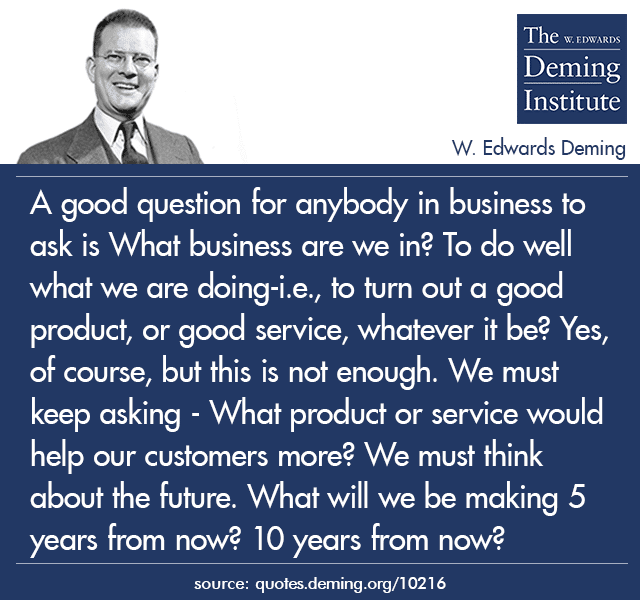
In 1993, Dr. W. Edwards Deming forced producers and creators to ask themselves the question, “What business are we in? … To turn out a good product? … Yes, of course, but this is not enough. We must keep asking—what product or service would help our customers more?”
We genealogists, especially if we do genealogy as a hobby and not as a paying profession, don’t often think of ourselves as having “customers.” For many of us, doing genealogy might seem like the equivalent of doing jigsaw puzzles—something that feels enjoyable, satiates our own personal curiosity, passes the time, but which nobody else might ever see or care about.
However, when we shift our time horizon and begin thinking about what will happen to our research at the end of our life, all genealogists eventually ask questions like:
What was the point of all that research?
Will anyone care about the documentation I uncovered and the linkages I made?
What will happen to the results of my research after I’m gone?
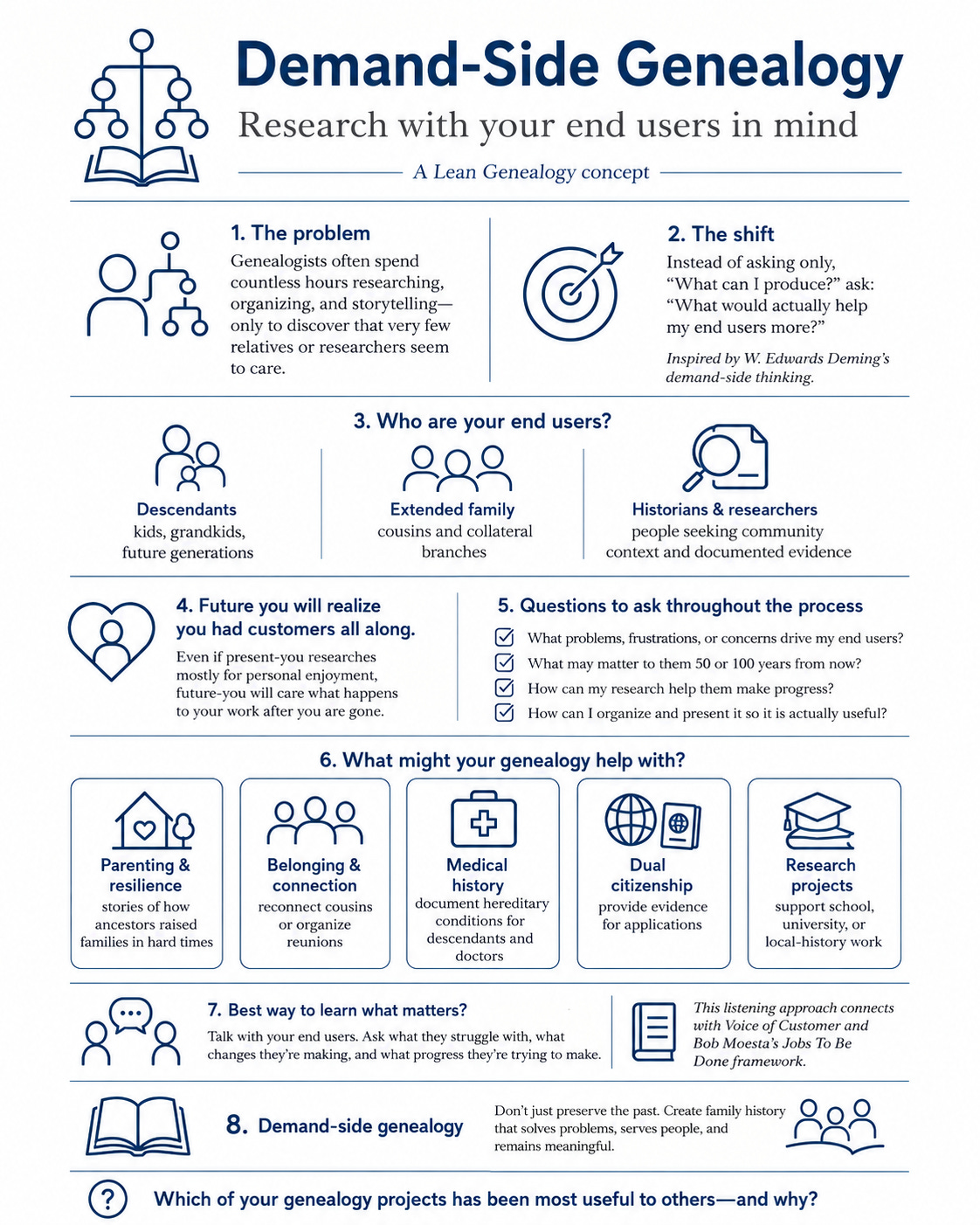
Even if “present” you thinks you’re researching solely for your own enjoyment, “future” you will understand that—all along—you have had “customers” or “end users,” whether you gave them much thought or not.
Take some time to brainstorm who your end users might be. A few examples:
Your own descendants? (your kids, grandkids, or even great great great grandkids)
Other branches of your extended family? (your second cousin’s descendants or third cousin’s descendants, who may one day forget about the connection between their branch of the family and yours, and who may only learn about that connection because of the well-researched documentation you leave behind)
Historians and researchers (not related to you) who want to understand the context and complexity of the community or the society that your family inhabited
Like many creators, genealogy hobbyists (once again, myself included) often spend hundreds of hours putting together a family tree, weaving a story, or amassing a collection of photos and artifacts, putting it on display, and then begging people: “Hey, look at this amazing thing I put together! Isn’t it cool? Don’t you want to come see it, read it, download it, buy it, etc.?” Then, we feel disappointed when only a few people—if any at all—appreciate it or even take the time to view it.
As we research ancestors and communities, and begin to organize the results of our research, we can ask some helpful questions throughout the entire process, like:
What problems, frustrations, or concerns drive my end users (whether grandkids or distant cousins or fellow historians)?
What problems, frustrations, or concerns might drive my end users 50 or 100 years from now?
How can I research aspects of my subject ancestor’s life, or my subject community’s way of life, that can speak to my end users’ problems/frustrations/concerns and help them make progress?
How can I organize and present the results of my research, such that it can speak to my end users’ problems/frustrations/concerns and help them make progress?
You can get some insight into this by sitting with these questions yourself, thinking of what problems/frustrations/concerns you have, and thinking of the things you’ve seen your offspring or cousins or other researchers struggle with.
However, the best way to tailor your genealogy to your end users is by actually talking with your end users!
You could cross your fingers and hope that, when your kids reach your age, they will grow to share your appreciation for the genealogy research you have done. Or, rather than just hoping your research will feel relevant to them someday, you could find out how to make your genealogy research relevant to them today, by asking them what they currently struggle with making progress on.
Do your kids express that they struggle with raising their kids in a changing world? (Maybe you can weave together stories of how your ancestors raised families in challenging conditions!)
Do they express feeling lonely and lacking a sense of community? (Maybe you could put them back in touch with cousins they haven’t interacted with since they were little, or organize a family reunion to bring branches of the family back together!)
Are they dealing with medical/health concerns? (Maybe you could put together a medical family tree, showing the conditions their grandparents, great grandparents, and great great grandparents had—documented through death certificates, obituaries, newspaper articles, diaries, oral history, etc. This could give them insights into hereditary conditions they should look out for, and could give them data they could share with their doctor!)
Have they talked about wanting to get dual citizenship from another country? (Your research documentation could actually help them in the application process!)
Are they working on a historical research project for a university degree, a class project, or a historical/genealogical society? (Find out the objective of their project, and you might be able to find data that could help them!)
These represent just a few examples. You can find out more about your end user’s concerns by asking them, and listening to them talk at length, about life changes they’ve made, decisions they’ve made, or purchases they’ve made recently. Bob Moesta, who learned under the aforementioned Dr. Deming, has developed a brilliant system for these types of listening conversations. Moesta calls this system the “Jobs To Be Done” framework. Check out this great explanation of JTBD at the Digestible Deming substack.
So, which of your own genealogy research projects have proven the most well-received by your family members or other researchers, and what problem(s) did your research solve for them? Why was it so appealing to them? Leave a comment below and give your best examples!
No posts
Comments
Nothing yet. Say the first thing.
Sign in to join the conversation.