
In May 2023, I made a decision I had been circling for months and left my corporate career. It was a one-way door. Once I walked through it – signing the separation agreement, posting the “big announcement” LinkedIn post – I couldn’t walk back through it to my old title, team or rhythm.
I didn’t have a framework for that kind of decision back then. But I knew it needed slowness, deliberation, and a lot of conversations before I could act with confidence,
Looking back, I was practicing an early version of Intuition Strategy® to make my decision. I just didn’t have the language for it yet. That kind of decision – high-stakes, hard to reverse – is one every leader faces, just at different scales.
Last time, I wrote about how to recognize the forms your intuition takes and the channels it speaks through. But once you receive the signal, what do you do? You need an action plan. Some decisions call for speed. Others demand that you slow all the way down.
Some decisions call for speed. Others demand that you slow all the way down.
This article is about building the skill to recognize the type of decision in front of you, and knowing when it calls for your intuition.
Leaders face countless decisions every day. They must diagnose situations to keep pace, discern when to make quick decisions when they serve the speed of operations and intentionally make thoughtful, slow decisions when called for.
Leaders who learn to use their intuition and train this skill intentionally develop confidence in their judgement, can trust their gut, and make decisions with conviction that others can follow.
One popular leadership example of decision discernment is Jeff Bezos’s one-way and two-way doors decision framework. Bezos observed that “one-size-fits-all” decision making was a common leadership pitfall in his 2015 letter to Amazon shareholders.
One-Way Doors (Type 1): Permanent choices that are hard and costly to undo; if a mistake is made, you cannot easily return to the starting point.
“Some decisions are consequential and irreversible or nearly irreversible – one-way doors – and these decisions must be made methodically, carefully, slowly, with great deliberation and consultation. If you walk through and don’t like what you see on the other side, you can’t get back to where you were before. We can call these Type 1 decisions.”
If it’s a one-way door, you take your time. Assemble a team with expertise and experience to compliment and supplement your own. Find additional supporting data to support or refute what your intuition may be telling you.
Two-Way Doors (Type 2): Reversible choices where you can test an idea, see if it fails, and walk back through the door to try something else.
“But most decisions aren’t like that – they are changeable, reversible – they’re two-way doors. If you’ve made a suboptimal Type 2 decision, you don’t have to live with the consequences for that long. You can reopen the door and go back through. Type 2 decisions can and should be made quickly by high judgment individuals or small groups.”
If it’s a two-way door – a decision that can be changed (and most decisions are) – you can test to see what your fast thinking brings up. Take the opportunity to listen to what your intuition tells you – train yourself to become a “high judgement individual”.
If it is an area in which you have expertise and experience, your intuition is already primed. Invisible data has been training your Human AI algorithm — your Actionable Intuition™ — from every project, every meeting, every decision you’ve already lived through. When it’s a two-way door, you can trust what your gut is telling you and move. You’ll have opportunities to make different decisions later if needed.
Nine months after leaving corporate, I decided to test decisions around my next steps. I was busy writing, designing frameworks, and prototyping Corporate Tarot Cards®. I had a lot of ideas but I didn’t know where to focus my time and energy. So I did something I’d never done: I invited nine women into a room for one evening, laid out everything I was building, and asked them to reflect my own clarity back to me. I designed a test by hosting my first Focus Gathering.
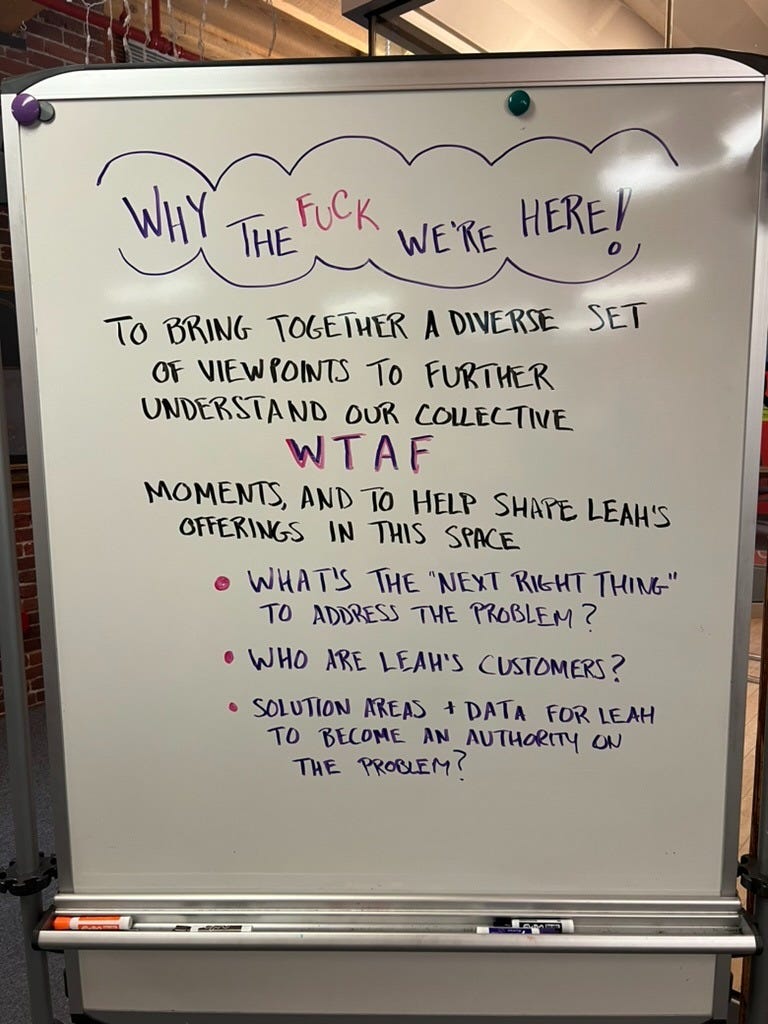
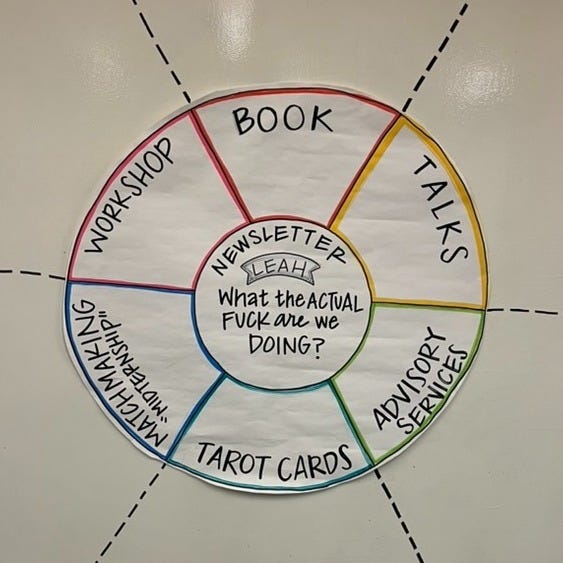
The Focus Gathering wasn’t an announcement or commitment; it was a test and a two-way door. I walked out with real decisions — Corporate Tarot Cards® had energy, my podcast needed to exist, and I didn’t need to figure it all out before moving.
If this test hadn’t worked, it was still a fun experiment and opportunity to be with my supportive community. And it helped me de-risk what could have been a big one-way door decision if I wanted to go full-steam ahead into entrepreneurship.
That’s what a two-way door feels like: low cost to test, easy to walk back through if it’s wrong. Where my corporate exit was a door I couldn’t walk back through, the Focus Gathering was one I could reopen anytime.
Choose the wrong decision type at your own risk. Consider Bezos’ guidance as you consider your decisions:
“As organizations get larger, there seems to be a tendency to use the heavy-weight Type 1 decision-making process on most decisions, including many Type 2 decisions. The end result of this is slowness, unthoughtful risk aversion, failure to experiment sufficiently, and consequently diminished invention. The opposite situation is less interesting and there is undoubtedly some survivorship bias. Any companies that habitually use the light-weight Type 2 decision-making process to make Type 1 decisions go extinct before they get large.”
This distinction matters more than ever because most leaders today aren’t just choosing between fast and slow. They’re doing it without reliable data to tell them which door they’re even standing at.
We live and operate in a world where intuition is no longer optional. Leaders are making more decisions faster than ever before. We have access to more information than has ever been available at any other time in human history, but we still find ourselves facing new challenges that don’t fit the empirical data we have on hand.
The acronym VUCA (Volatile, Uncertain, Complex, and Ambiguous) characterizes the world that we’re living in right now. VUCA was first used by the military to describe the messy, multilateral post-Cold War world without traditional front lines of war. Now the term is used in business and has become an apt description of the world that we live in every day.
When situations are simple or when there is a series of several simple conditions, it is apparent how cause and effect are related. There is a semblance of order and understanding in the system. It is in these conditions that historical data serves us well, because the future will most likely behave as past conditions as long as the simple rules and laws hold up. This is not the case in complex and chaotic situations.
In complex and chaotic situations, cause and effect are only visible in retrospect, if at all, and historical data becomes a lagging indicator. We live in a world where the analytical data no longer describes the actual environment in which we’re making decisions.
We live in a world where the analytical data no longer describes the actual environment in which we’re making decisions.
Consider recent chaotic situations like the emergence of a global pandemic, the disruption and multi-front causes and effects of the Strait of Hormuz, and the future of work and innovation in the age of GenAI. Each of these situations present new data that seemingly have no relationship or dependence of historical data. There is no best practice or right answer.
Leaders and innovators who have to make decisions in a VUCA world do so without a roadmap. These leaders are already operating past the point where historical data analysis can keep up.
And yet we still need to make decisions.
Where are you right now, standing at a one-way door
or facing a two-way door? Share in the comments.
Practice discernment about what decisions require which thinking – fast or slow. The next time you are facing a decision, try this.
Step 1: Determine what type of door you’re facing. If it’s a Type 1 / one-way door decision, determine what information you will need to make a slow, thorough decision. If it’s a Type 2 / two-way door decision, try listening to what your intuition tells you.
Step 2: Listen to your intuition. If it’s a Type 2 / two-way door, use what you know about your Human AI algorithm to come to your decision. Identify the form your intuition takes and the channel it speaks through. Then act on what you know and see how it turns out.
Step 3: Collect the data. (It is all data.) Pay attention to what information you now have and use this to make your next right move. Confirm if you were truly at a one-way or two-way door. Consider the form and channel. Match what you thought you heard to what action you took. Would you make any of these decisions differently next time?
The more practice you get at matching decision types with appropriate approaches, the better you will get at making fast, confident decisions.
When I left my job, I couldn’t run the numbers and get a clean answer for what to do with my life. There wasn’t a spreadsheet that could tell me it was the right call. I had to trust what I’d gathered from twenty years of work and life experience.
Decision discernment is knowing when to slow down and consult, and knowing when to test something small... and let the results tell you where to go next.
Decision discernment is knowing when to slow down and consult, and knowing when to test something small, like a Focus Gathering of nine women, and let the results tell you where to go next.
This is what Intuition Strategy® is for.
—
Intuition Strategy® is the operating system to use invisible data to your advantage. Intuition without action is just a daydream. Leah Goldman, The Intuition Strategist, helps leaders trust their gut to make fast confident decisions and get aligned results.
Comments
Nothing yet. Say the first thing.
Sign in to join the conversation.