
In this lecture from the University of Toledo’s Institute of American Constitutional Thought and Leadership (IACTL), Professor Diana Schaub (Loyola University Maryland) turns to Frederick Douglass as a guide for thinking through this enduring tension. She traces Douglass’s intellectual journey from early denunciations of the Constitution as complicit in slavery to his later defense of it as a “glorious liberty document.” Schaub argues that Douglass models a form of principled criticism joined to constitutional fidelity.
Professor Schaub, a distinguished scholar of Lincoln and American political thought, explores how Frederick Douglass moved from radical alienation to constitutional argument. Through close analysis of his most famous speech, “What to the Slave Is the Fourth of July?”, Schaub demonstrates how Douglass combined moral indictment with careful textual reasoning. Rather than rejecting the American founding outright, Douglass argued that the Constitution, rightly interpreted, contained the principles necessary for slavery’s ultimate abolition.
Schaub also examines Douglass’s break with William Lloyd Garrison and the radical abolitionists who viewed the Constitution as irredeemably pro-slavery. By contrast, Douglass came to insist that the document’s text, especially when read in light of the Preamble, committed the nation to liberty and justice. His adoption of a strict textual method strengthened rather than softened his opposition to slavery.
[04:16] - The Logic of “What to the Slave Is the Fourth of July?” Schaub breaks down the three-part structure of Douglass’s masterpiece: celebrating the Revolution, castigating the present hypocrisy, and defending the Constitution as a tool for the future.
[05:40] - From Alienation to Attachment An exploration of Douglass’s radical shift in 1851, where he moved from viewing the Constitution as a “covenant with death” to a “glorious liberty document” through a searching confrontation with the text.
[08:02] - “Your Fathers” vs. “Our Principles” A look at Douglass’s rhetorical genius: how he praised the “saving principles” of the Founders while shaming the current generation for betraying that inheritance.
[13:30] - Constitutional Fundamentalism Why Douglass encouraged citizens to read the plain text of the Constitution for themselves, arguing that the word “slavery” never appearing in the document was a deliberate and hopeful omission.
[18:32] - The “Garrisonian” Mistake Schaub explains why Douglass broke with radical abolitionists like William Lloyd Garrison, who unwittingly helped the pro-slavery cause by agreeing that the Constitution was inherently pro-slavery.
[28:05] - Rules of Reading: The Influence of Lysander Spooner How Douglass adopted a “liberationist” version of strict constructionism—interpreting every clause in light of the Preamble’s promise of liberty and justice.
[36:15] - Reclaiming the “Three-Fifths Clause” A startling reinterpretation of the most controversial clause in the Constitution. Douglass argued it was actually a “penalty” on slave states, not a denial of black humanity.
[41:40] - The “Scaffolding” Metaphor One of Douglass’s most powerful images: that slavery was never the “building” of America, but merely the ugly, temporary scaffolding meant to be torn down once the edifice of liberty was complete.
[45:48] - Q&A: The Evolution of the Douglass-Lincoln Bond Schaub discusses the complex relationship between the activist and the statesman, showing how Douglass eventually came to trust Lincoln’s “comprehensive” statesmanship.
[52:00] - Resisting the Fugitive Slave Act A deep dive into why Douglass viewed the Fugitive Slave Act as completely unconstitutional and why he believed Americans had a revolutionary right to resist “kidnappers” with force.


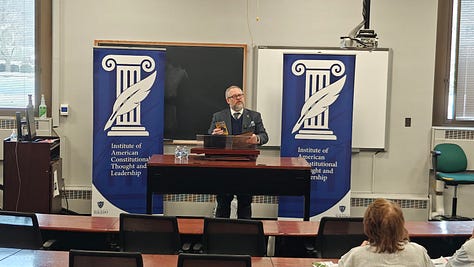
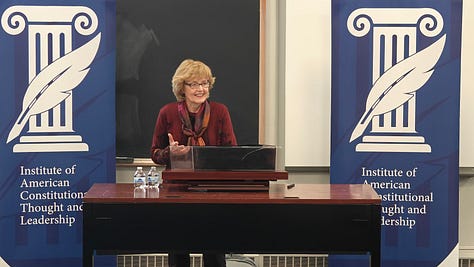




At the University of Toledo, the Institute of American Constitutional Thought and Leadership (IACTL) has a mission that is both simple and urgent:
To restore the civic and intellectual foundations essential for a flourishing republic—by forming educators, equipping citizens, and cultivating a culture of conversation grounded in the American Founding and the liberal arts.
GO: The Deliberate Republic
Your hub for thoughtful conversations, event videos, and essays that form citizens rather than spectators.
GO: Leadership / Scholarship Opportunities
Apply for fellowships, leadership roles, and scholarships worth up to several thousand dollars each year while developing the judgment and skills essential for responsible citizenship.
GO: Captivating Courses
Explore courses that challenge how you think about justice, leadership, and the constitutional foundations of a free society.
GO: Colloquia
Join lively, faculty-led discussions where students engage big ideas, ask honest questions, and practice the habits of thoughtful civic leadership.
GO: Oxford Study Abroad
Spend a transformative term studying political philosophy at Oxford and engaging with ideas where they first shaped the modern world.
No posts
Comments
Nothing yet. Say the first thing.
Sign in to join the conversation.