
The most important skill a Chief Financial Officer will need in the next five years cannot be found on a balance sheet. It isn’t forecasting accuracy, GAAP compliance, or even AI fluency. It is the ability to read a room, build trust across cultures, and translate a financial thesis into a story that moves people to act. The numbers are increasingly doing themselves. The humans are not.
According to PwC’s 2025 ‘What’s Important to the CFO’ survey, 57% of CFOs are reshaping short-term strategies in response to economic policy shifts, while 58% are investing in new technologies to enhance forecasting and planning. And yet the same institutions tracking these investments are sounding an alarm that technology cannot resolve: the human leadership gap inside the finance function is widening precisely as the technical demands are being automated away.
Over 70% of CFOs now hold responsibilities beyond finance, including enterprise strategy, ESG leadership, and digital transformation, according to Gartner’s Top 5 Finance Trends and Priorities for CFOs in 2025. The modern CFO is now simultaneously a strategic navigator, a cultural translator, a talent developer, and a communication architect. The bean counter era is over. What has replaced it is far more demanding — and far more human.
Roman Labutin knows this better than most. A seasoned CFO with more than two decades at Citigroup — spanning Smith Barney, Citi Private Bank, and ultimately the CFO seat of Citibank Korea, the fourth largest bank in a country that operates by entirely different cultural rules — Labutin has spent his career at the intersection of financial rigor and human complexity. His story is a case study in what the CFO role is becoming, and what it demands of those who hold it.
Leading a global finance organization across radically different cultures and business environments? LeaderbookAI helps executives and their portfolio organizations turn market signals and leadership insights like these into decisions and competitive advantage. More on that at the end.
The narrative that CFOs are “becoming more strategic” understates what has actually happened. The role has not evolved gradually. It has been restructured around an entirely different mandate.
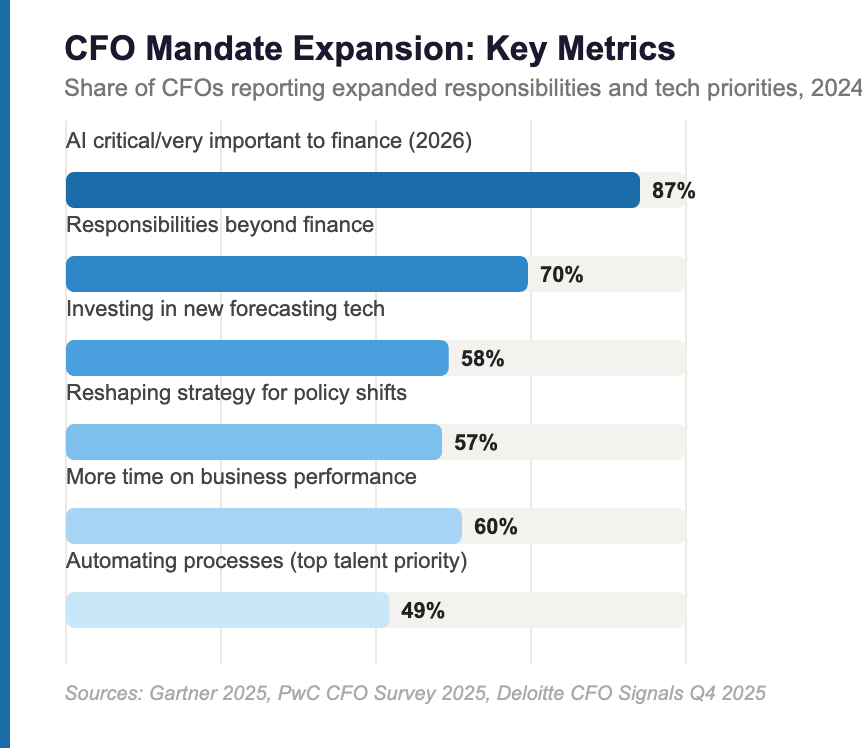
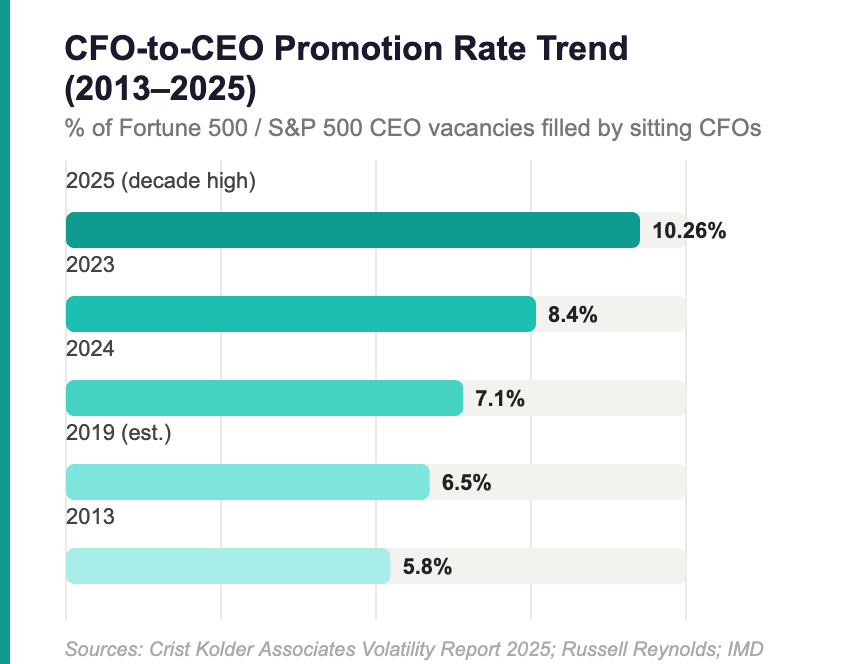
In 2024, 34% of departing CFOs moved to higher leadership roles as president or CEO— a signal that the finance chief has become the organization’s most credible strategic successor. In 2025, 10.26% of sitting CEOs at Fortune 500 and S&P 500 firms came directly from the CFO role — the highest level of CFO-to-CEO promotions seen in a decade. For comparison, that figure was 5.8% a decade earlier.
About one-third of FTSE 100 CEOs have previously served as CFOs, up from 21% in 2019. The market is voting: the CFO who can lead people — not just manage numbers — is now the most valuable executive in the building.
The CFO’s expanding mandate comes with an uncomfortable truth: most finance leaders were not trained for what the role now demands. Technical finance expertise is table stakes. The differentiating competency is human-centered leadership — and it is precisely where the largest gaps exist.
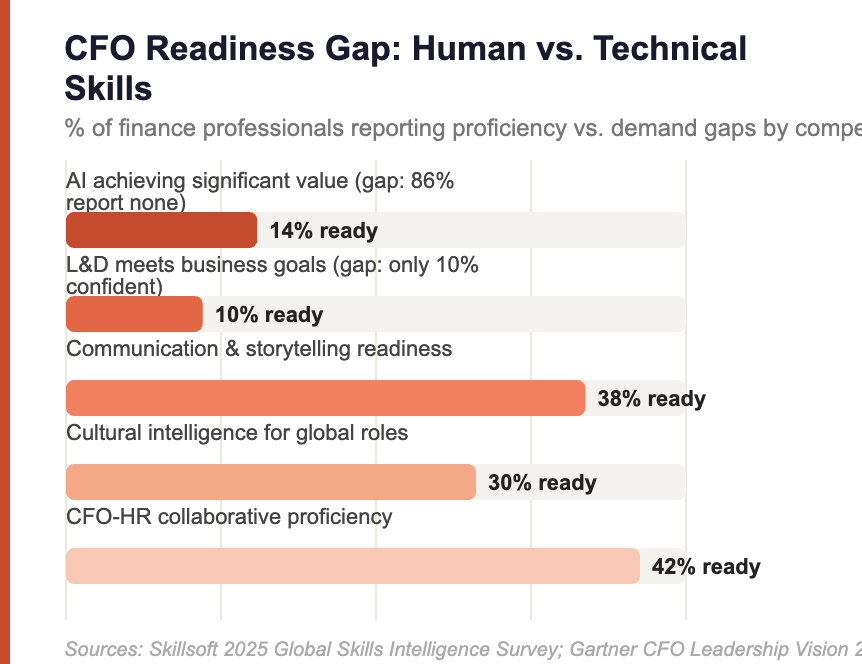
Only 10% of HR and L&D professionals believe their teams have the skills needed to meet business goals in the next one to two years, according to Skillsoft’s 2025 Global Skills Intelligence Survey. The same report found that skills gaps are concentrated in exactly the areas CFOs now need most: leadership, AI, and strategic communication.
Roman Labutin identifies three pillars of trust-building that define effective CFO leadership: transparency, consistency, and empathy. Each is measurable in its consequences. Transparency drives alignment. Consistency prevents the exploitation of perceived inconsistency by senior teams. Empathy enables change management in high-stakes moments — restructurings, cultural integrations, technology transitions.
EY and Oxford research found that providing emotional support improved the average likelihood of transformation success by nearly 20%. The study also found that the potential for a successful transformation increased by a factor of 2.6 when the workforce understood the leader’s strategy and vision.
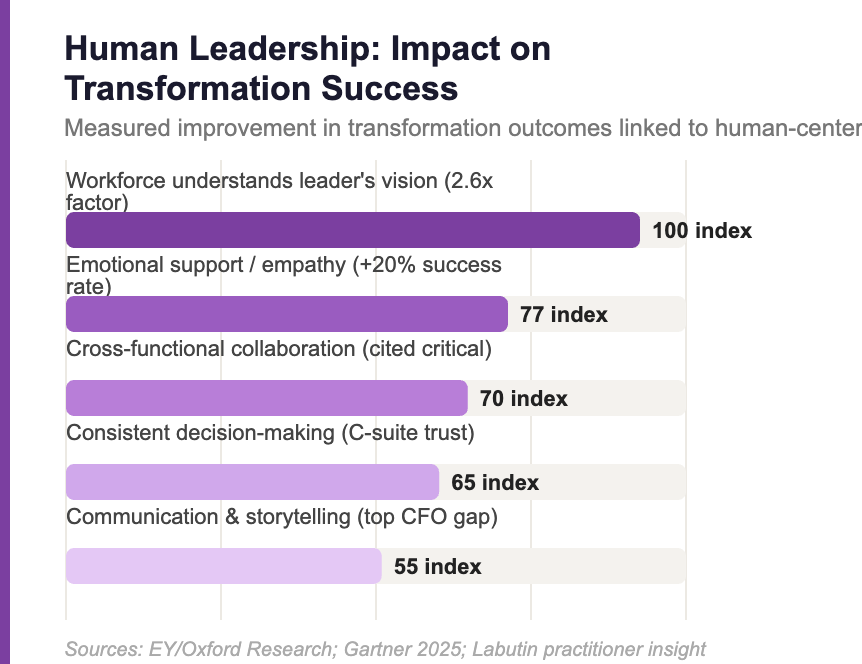
Labutin is unambiguous on this point: finance leaders who retreat into technical complexity as a defense mechanism are not demonstrating expertise — they are avoiding leadership. The CFO role, as he describes it, is fundamentally a translation function. Finance is the language; the business is the audience; and the CFO is the interpreter who must make the numbers mean something.
This is not merely a philosophical point. According to the Deloitte survey, only 1% of finance leaders are not consulted at all concerning strategy decisions, and 57% say they play a leading role in shaping strategy in their organizations. Being consulted and actually influencing strategy are different things. The CFO who presents numbers without narrative loses the room. The CFO who brings the story wins it.
The clearest argument for CFO investment in human leadership skills is not philosophical. It is structural. AI is consuming the technical core of the finance function faster than most organizations are prepared to acknowledge.
For C-suite leaders and portfolio company operators: The same AI wave automating finance tasks is raising the premium on the judgment, communication, and empathy skills that machines cannot replicate. LeaderbookAI gives executives and portfolio teams the market signals and leadership frameworks to stay ahead. See how it works →
In FP&A, AI powers real-time scenario planning, while in procure-to-pay it autonomously matches purchase orders and processes invoices — cutting cycle times by up to 80%. Three in 10 companies plan to replace employees with artificial intelligence next year as the technology drives increased automation in the workplace, impacting industries from IT to financial services and accounting.
In Deloitte’s Finance Trends 2026 survey of nearly 1,500 global finance leaders, respondents chose artificial intelligence and automation skills as their top finance skills development priority. Nearly half (49%) of CFOs cite automating processes to free employees to do higher-value work as their top priority for finance talent in 2026.
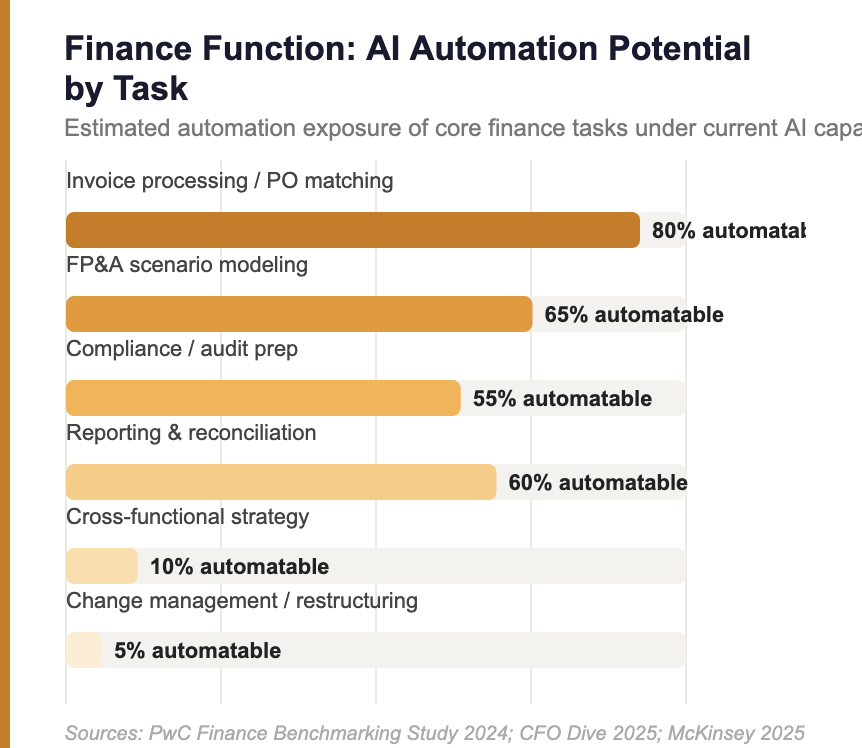
Despite the urgency, 86% of finance teams say they have achieved no significant value from their AI investments, according to Gartner’s 2025 Leadership Vision for CFOs report. The bottleneck is not the technology. It is the leadership capacity to implement it, communicate it, and bring people with it through the transition.
Roman Labutin’s four years as CFO of Citibank Korea — the country’s fourth largest bank at the time — offer a master class in a dimension of CFO leadership that is almost entirely absent from finance curricula: cultural intelligence.
The Korean business environment operates on explicit hierarchical norms. Senior management decisions are followed without challenge. Feedback is delivered before decisions are made, never after. The first-time expatriate executive who misreads this dynamic — who takes the silence of a Korean leadership team for agreement — has already made an uncorrectable error.
Emotional intelligence is becoming increasingly important. CFOs must navigate complex interpersonal dynamics, manage diverse teams, and foster a culture of trust and accountability. The ability to empathize, listen and respond thoughtfully is now a core leadership competency, especially in environments undergoing rapid change.
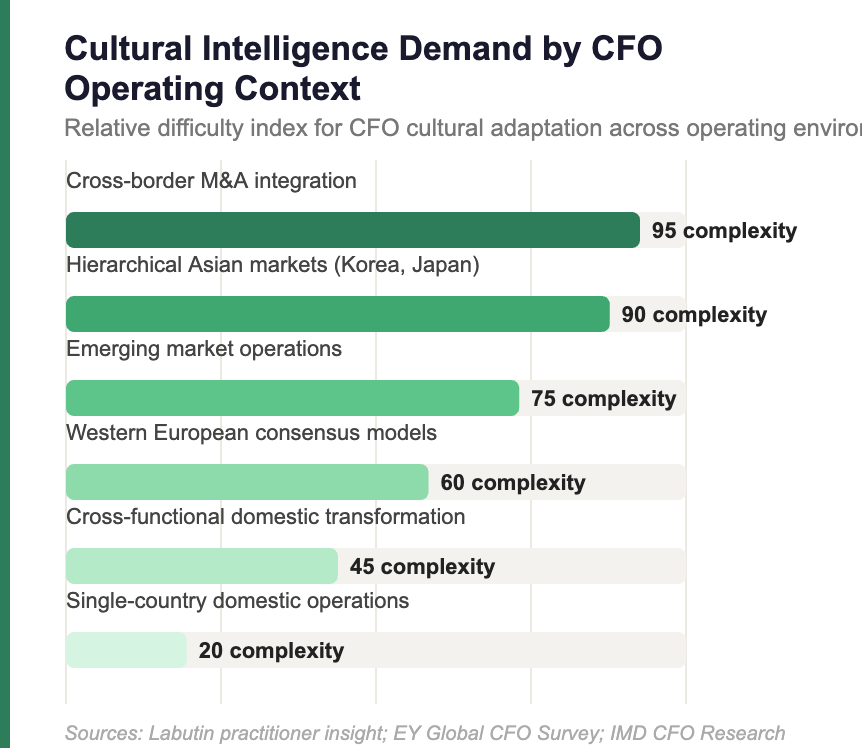
Labutin’s response to the Korean cultural context illustrates a principle that applies well beyond Asia: the investment in visible cultural respect compounds over time. When he became the first expatriate executive to record a New Year’s message in Korean — 50 takes to get it right — the return was not goodwill. It was trust capital that funded his ability to lead a complex retail branch closure program affecting hundreds of employees and thousands of customers.
The CFO who understands that culture has no small details — that what looks optional is often load-bearing — operates at a fundamentally different level of organizational effectiveness than one who treats culture as a soft-skills elective.
Of all the structural changes reshaping the CFO role, the evolution of the CFO-CHRO relationship may be the most consequential — and the most overlooked.
Compensation is simultaneously the largest controllable expense on most P&Ls and the primary lever for behavioral alignment across an organization. The CFO who treats it as a cost item is leaving value on the table. The CFO who treats it as a strategy instrument — working hand-in-hand with HR to align incentive structures with organizational direction — is building a machine.
With more than 75% of CFOs now responsible for data and analytics enterprise-wide, finance executives ranked “metrics, analytics, and reporting” as their top focus area on Gartner’s 2025 CFO priorities report. Applied to people strategy, this means CFOs can calculate return on investment for training programs, model capacity utilization by function, and build compensation scorecards that reinforce strategic direction.
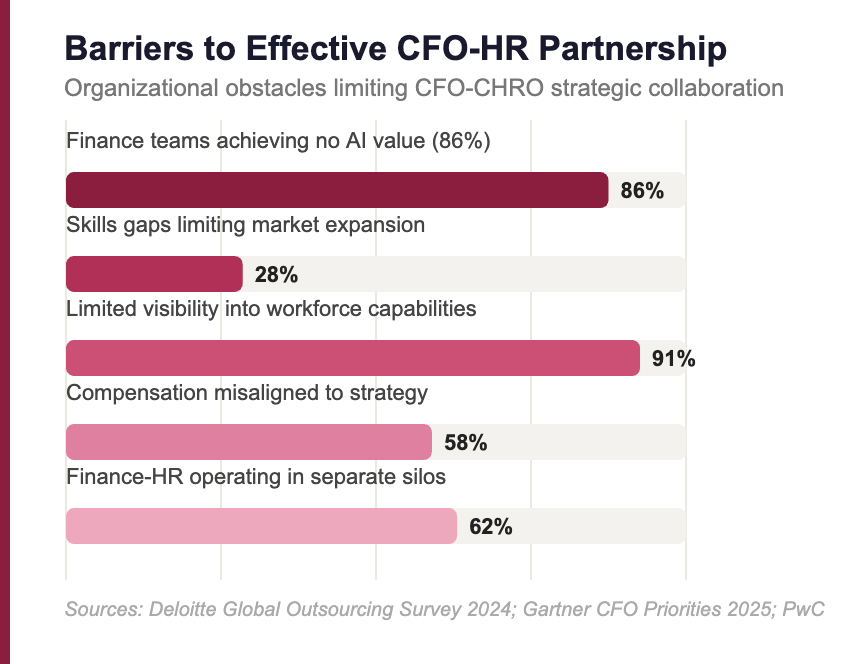
The Citigroup Private Bank example Labutin describes — rebuilding the investment revenue stream through a restructured banker scorecard, developed in collaboration with HR after the Smith Barney sale to Morgan Stanley — illustrates the model precisely. The analytics came from finance. The behavioral architecture came from HR. The result came from the intersection.
For executives and portfolio leaders acting on signals like these: LeaderbookAI is built for C-suite leaders and the portfolio companies they oversee — helping teams move from insight to action. Book a demo with the LeaderbookAI team →
These signals are not predictions about the future of the CFO role. They are already in effect. The question for every C-suite executive and portfolio company leader is whether their finance leadership is calibrated for them.
Signal 1: The CFO who cannot communicate a financial story is already obsolete — regardless of their technical expertise
The future CFO will need to lead with empathy, communicating a vision where technology enhances human capabilities rather than replacing them. They must foster a culture of curiosity and continuous learning, making so-called soft skills like emotional intelligence, communication, and collaboration as critical to a finance professional’s success as technical accounting knowledge.
Labutin puts it more directly: the CFO is a translator. The moment they stop translating and start hiding behind technical language, they lose the room. For portfolio company boards and CEOs evaluating their CFOs, the first question to ask is not about financial modeling proficiency. It is: can this person stand in front of the leadership team and tell the story of our numbers — and make that story move the organization?
Signal 2: AI is accelerating the premium on human leadership, not reducing it
The counterintuitive consequence of AI automating the technical finance function is that the human judgment, empathy, and communication skills that AI cannot replicate become proportionally more valuable. The skills that protect workers from AI displacement share a common property: they require judgment in ambiguous situations, relationship management, creative synthesis, or physical presence.
For CFOs, this means that the path to sustained relevance is not deeper technical fluency — it is expanding the human leadership surface area of the role. The CFOs who survive the automation wave are the ones who have built trust networks, board relationships, and organizational credibility that no AI system can replicate.
Signal 3: Cultural intelligence is no longer a nice-to-have for global organizations — it is table stakes
The widespread adoption of AI and automation is exacerbating an existing skills gap in finance, making it a top priority for leaders. The CFO must now proactively lead the upskilling of their team, cultivating a workforce with hybrid skills in data analytics, technology, and strategic thinking. This pillar is as much about change management as it is about hiring.
But change management in a multicultural organization requires a layer of cultural intelligence that most finance training programs do not provide. Roman Labutin’s experience in Korea demonstrates that what looks like a “soft” investment — recording a New Year’s speech in Korean, listening extensively before decisions — is actually a precision tool for organizational trust. For portfolio companies operating across borders, the CFO’s cultural fluency is a material risk factor.
Signal 4: The CFO-HR partnership is one of the highest-ROI relationships in the C-suite — and most organizations are leaving it underdeveloped
Compensation design is strategy. Capacity planning is competitive positioning. Training ROI is capital allocation. All of these are finance questions that sit at the intersection of HR and the CFO’s domain. Organizations that treat the CFO-CHRO relationship as transactional — a handoff of headcount numbers and comp bands — are systematically underinvesting in one of the highest-leverage strategic relationships available to them.
The CFOs who have built genuine partnership models with their HR counterparts — shared analytical frameworks, aligned incentive structures, coordinated change communication — consistently report better forecasting accuracy, lower voluntary attrition during restructurings, and stronger organizational alignment with strategy.
Signal 5: The CFO-to-CEO pipeline is the most important leadership succession signal in the market right now
In 2025, 10.26% of sitting CEOs at Fortune 500 and S&P 500 firms came directly from the CFO role — the highest level of CFO-to-CEO promotions seen in a decade. “CFOs with a broader mandate than finance are carving a path to CEO,” according to Crist Kolder Associates.
For portfolio company boards and investors, this signal has direct implications. The CFO who is being developed with strategic, communicative, and human-centered leadership skills is not just a finance executive — they are the highest-probability internal successor to the CEO seat. Building the CFO into a full-stack C-suite leader is not a development investment. It is succession planning.
LeaderbookAI’s podcast goes deeper on exactly what this article covers — with someone who has done it for a living, across multiple countries and one of the most complex financial institutions in the world.
Roman Labutin, CFO at WI Harper Group and former Divisional CFO at Citigroup — with more than two decades navigating cultural integrations, large-scale restructurings, and strategic transformations across the United States, Europe, and South Korea, Labutin is one of the most globally experienced finance executives in the field.
In this conversation with LeaderbookAI host Felicia Shakiba, Labutin unpacks the human dimensions of the CFO role that rarely appear in finance curricula — from building trust across hierarchical Asian corporate cultures to designing compensation scorecards that align banker behavior with strategic repositioning after a major divestiture.
In this episode:
Why CFOs must be translators, not just number-generators — and what happens when they hide behind technical expertise
The transparency-consistency-empathy framework Labutin uses to build trust with CEOs, boards, and leadership teams
How Citibank Korea’s cultural norms forced him to completely rethink his decision-making and feedback process
The structural case for a deep CFO-HR partnership — and how it improved both forecasting accuracy and organizational alignment at Citi Private Bank
“Technical skills more and more will start to be replaced by AI. Nobody will replace how you communicate those decisions — because you need to get buy-in. That’s the skill that the chief financial officer needs to develop. That’s where we’re going.” — Roman Labutin, CFO, WI Harper Group
The conversation about AI and the CFO role has been dominated by a question of replacement: which finance tasks will machines do better, and how fast? That question is worth asking. But it is the wrong question to lead with. The more important question is what gets left when you remove everything a machine can do. The answer, it turns out, is the most strategically valuable thing a CFO has to offer.
Trust cannot be automated. Cultural intelligence cannot be modeled in Python. The judgment to know when a Korean leadership team’s silence is agreement and when it is the suppression of a serious objection — that is not a data science problem. The ability to sit in front of a board during a restructuring and communicate not just what is happening financially but why it matters, what it costs, what it preserves, and what comes next — that is a human performance, and it is one that the best CFOs have always been capable of, even when the finance function rewarded them for staying at the spreadsheet instead.
Roman Labutin’s career is a decades-long argument that the CFO who invests in human leadership — who learns the language, builds the relationships, earns the trust — outperforms the one who does not, in every measurable way. Stronger forecasts. More successful restructurings. Better organizational alignment. And, increasingly, a direct path to the CEO seat.
The data on CFO-to-CEO transitions is not a trend. It is a verdict. Boards are telling us that the finance executive who can lead people is the one they want running the entire organization. The question for every CFO in the room — and every portfolio board evaluating its finance leadership — is whether the person in that seat is being developed for the role that exists, or the one that used to.
The numbers will take care of themselves. The humans will not.
LeaderbookAI is an AI platform built for C-suite leaders and the portfolio companies they lead. We help executives develop the judgment and decision-making frameworks for an AI-first world — and give portfolio organizations the market intelligence, leadership coaching, and strategic tools to compete at the speed AI demands.
If this analysis was useful, LeaderbookAI was built for people like you.
Explore LeaderbookAI → Request a demo · leaderbook.ai
Workday — “How the CFO’s Role Will Evolve in 2026 and Beyond” — https://www.workday.com/en-us/perspectives/finance/2025/10/cfo-role-evolution.html
PwC — “What’s Important to the CFO in 2026” — https://www.pwc.com/us/en/executive-leadership-hub/cfo.html
Financier Worldwide — “The New CFO: Transformation, Strategy and Geopolitics” — https://www.financierworldwide.com/the-new-cfo-transformation-strategy-and-geopolitics
Epicflow — “CFO Trends 2025–2026: How Finance Leaders Are Redefining Strategy” — https://www.epicflow.com/blog/cfo-trends/
Russell Reynolds Associates — “Great Expectations: Where Next for the CFO Role?” — https://www.russellreynolds.com/en/insights/reports-surveys/global-cfo-turnover-index/where-next-for-the-cfo-role
Auxis — “4 CFO Priorities in 2025 and the Solutions Driving Success” — https://www.auxis.com/4-cfo-priorities-in-2025-and-the-solutions-driving-success/
NetSuite — “The Evolving Role of the CFO: 8 Responsibilities” — https://www.netsuite.com/portal/resource/articles/accounting/evolving-role-cfo.shtml
Deloitte — “CFO Expectations for 2026” — https://www.deloitte.com/us/en/insights/topics/business-strategy-growth/4q-2025-cfo-signals-survey.html
EY — “CFO Strategy: A Transformation Guide for Finance Leaders” — https://www.ey.com/en_us/services/consulting/finance-consulting-services/cfo-evolution-strategic-vision-and-tech-in-modern-finance
Skillsoft — “2025 Global Skills Intelligence Survey” — https://www.skillsoft.com/blog/2025-global-skills-intelligence-survey
CFO.com — “CFO-to-CEO Promotions Reach Decade High” — https://www.cfo.com/news/cfo-to-ceo-promotions-reach-decade-high/811600/
Fortune — “Where Does the CFO Path Lead? New Data Shows 34% Became President or CEO in 2024” — https://fortune.com/2025/02/19/cfo-path-new-data-34-percent-became-president-ceo-2024/
IMD — “Out of Your Comfort Zone: What It Takes for Traditional CFOs to Become CEOs” — https://www.imd.org/ibyimd/cfo-horizons/what-it-takes-for-traditional-cfos-to-become-ceos/
CFO Dive — “3 in 10 Firms Plan to Replace Workers with AI Next Year” — https://www.cfodive.com/news/3-in-10-firms-expect-swap-workers-ai-next-year/805090/
Final Round AI — “AI Job Displacement 2025: Which Jobs Are At Risk?” — https://www.finalroundai.com/blog/ai-replacing-jobs-2025
No posts
Comments
Nothing yet. Say the first thing.
Sign in to join the conversation.