
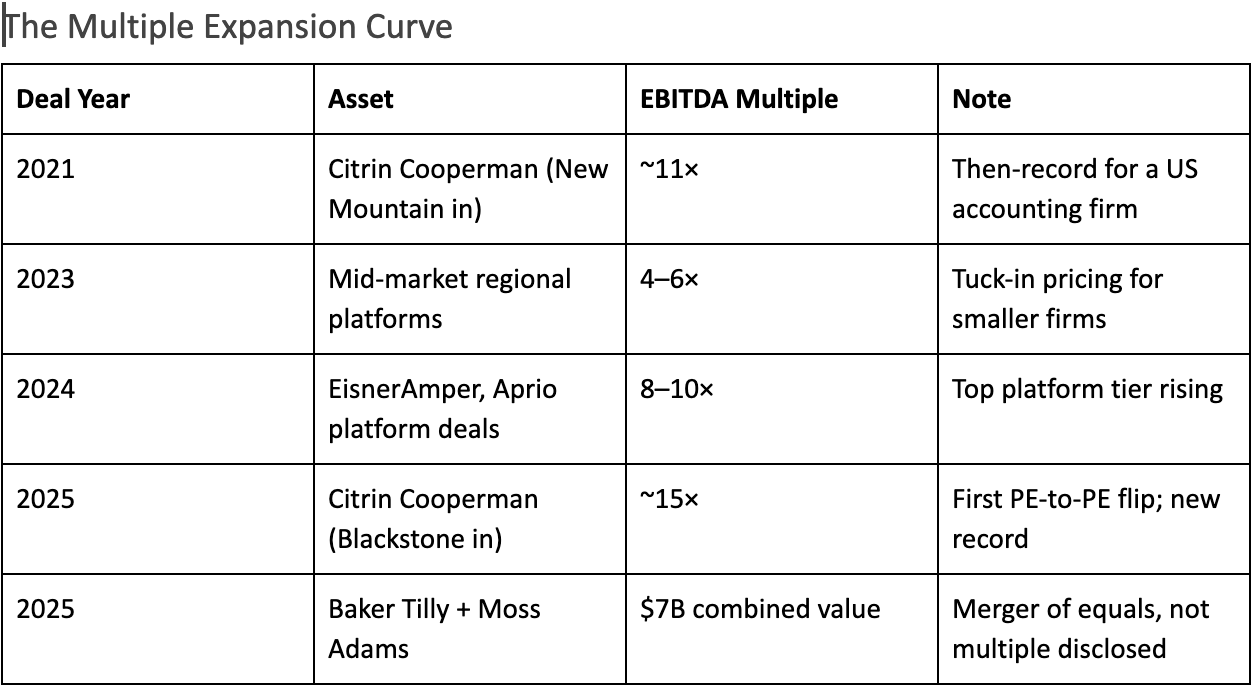
In January 2025, Blackstone closed a deal that didn’t get the attention it deserved. The firm took a majority stake in Citrin Cooperman, a top-20 US accounting firm, in a transaction that valued the business north of $2 billion. New Mountain Capital, which had bought into Citrin Cooperman in late 2021 at roughly $500 million enterprise value, walked away with what industry observers immediately labeled “the first flip” — the first time a major US accounting firm changed private equity hands twice (Capital Brief, 2025; CFO Brew, January 2025).
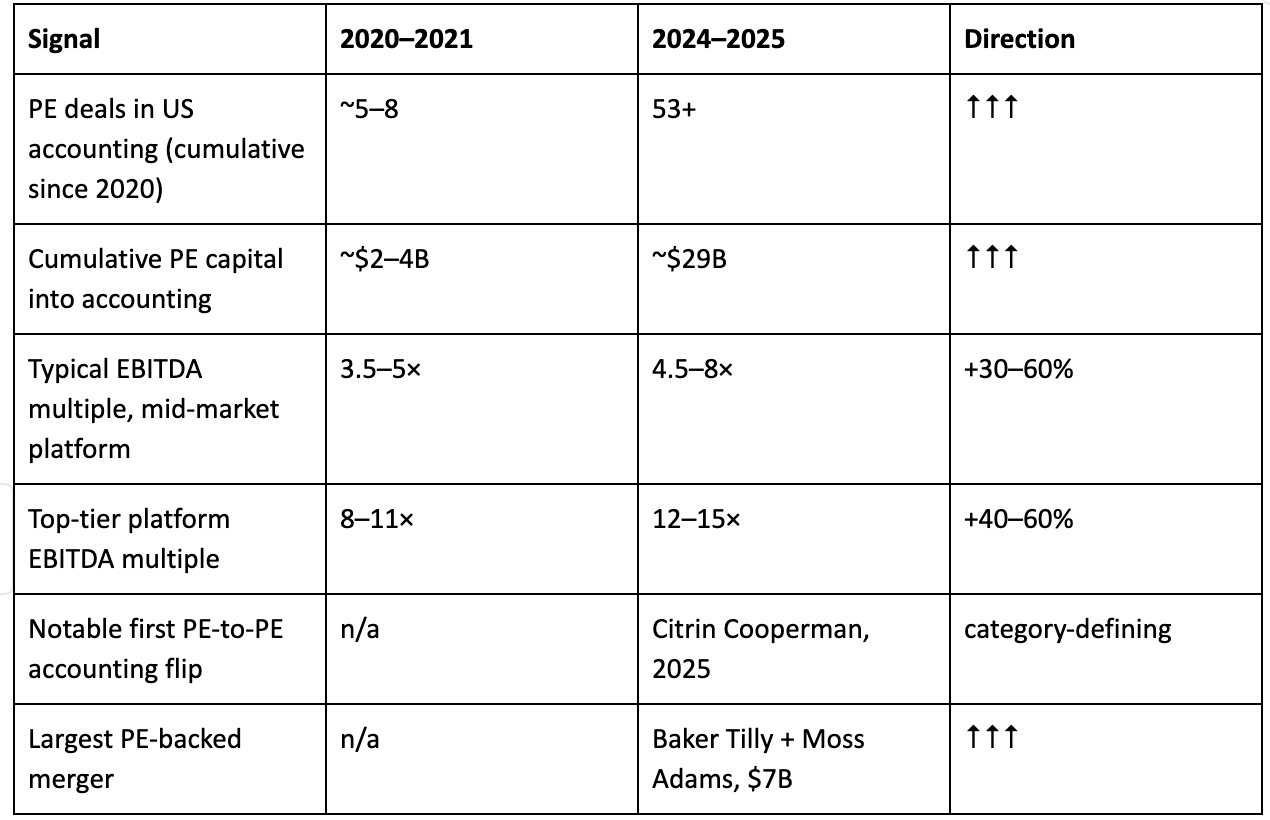
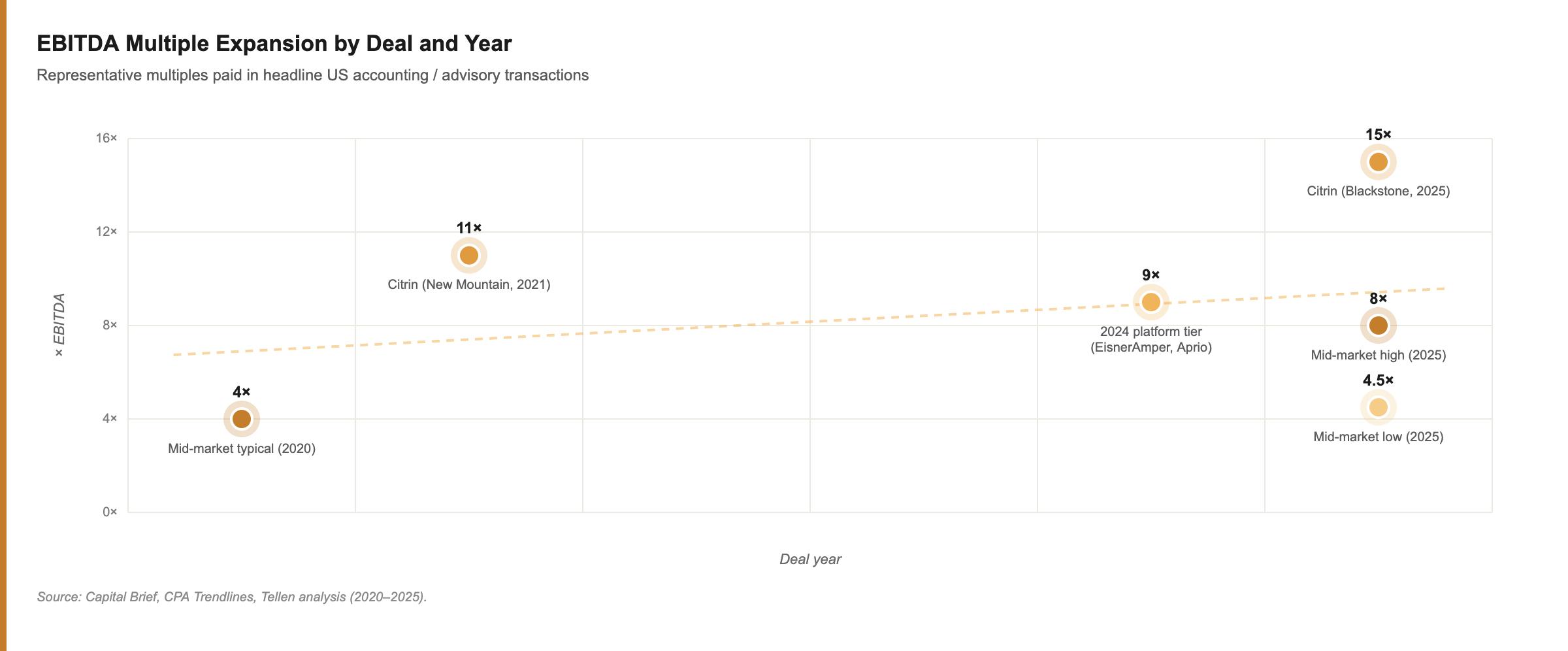
The multiple tells the story most cleanly. New Mountain paid roughly 11× EBITDA in 2021. Blackstone paid roughly 15× in 2025. Citrin Cooperman’s revenue had grown from $350 million to $850 million during the New Mountain hold, fueled by a steady cadence of regional acquisitions (Private Equity Wire, 2025). Five years ago, mid-sized professional services platforms traded at 3.5× to 5× EBITDA. Today they trade at 4.5× to 8×, and the top platforms — the ones with multi-state footprints, partner retention frameworks, and credible integration playbooks — clear 12× to 15× (Tellen analysis of accounting PE, 2025; Capital Brief, 2025).
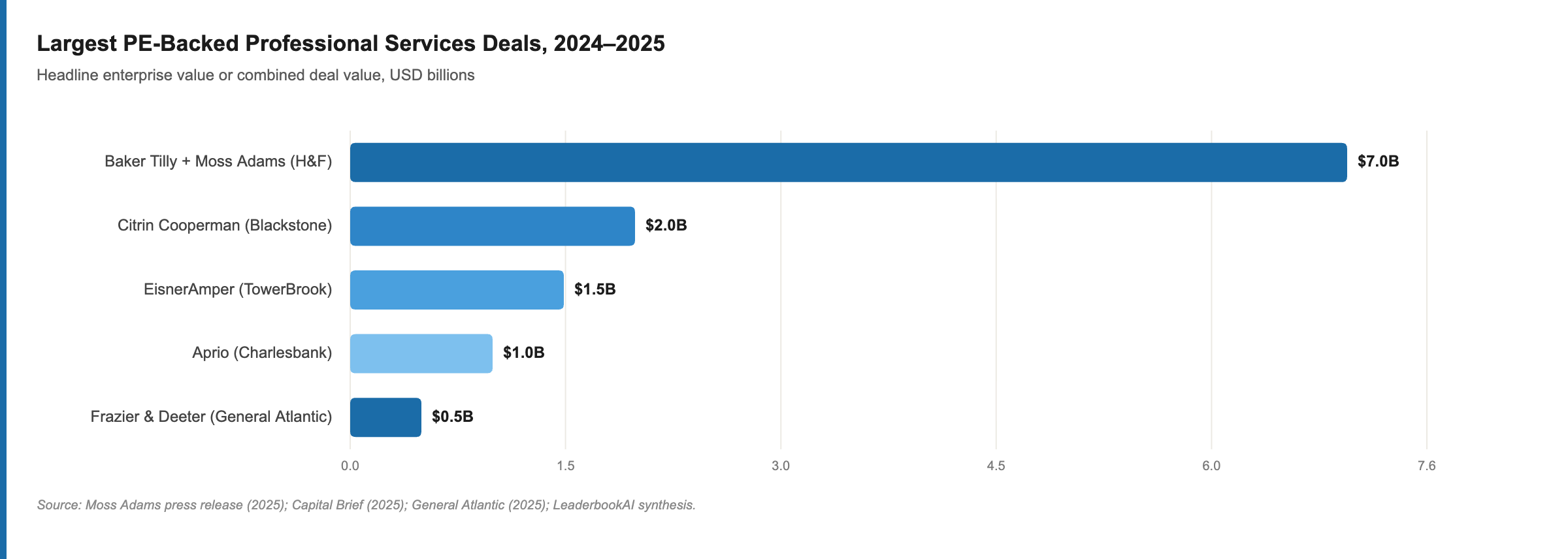
Between 2020 and mid-2025, private equity capital sponsored more than 53 transactions in the US accounting industry alone, deploying roughly $29 billion of capital into a sector that, five years prior, sat almost entirely outside institutional ownership (CPA Trendlines, November 2025). Adjacent professional services — law, consulting, IT advisory, healthcare services — are moving down the same curve, two to four years behind. Baker Tilly and Moss Adams combined in a $7 billion merger backed by Hellman & Friedman to form the country’s sixth-largest CPA firm; Frazier & Deeter took a General Atlantic growth investment in April 2025 and immediately closed two acquisitions in the second half of the year (Moss Adams press release, April 2025; General Atlantic, 2025; Inside Public Accounting, November 2025).
The implication for executives in any professional services category — and the portfolio companies sitting next to them in fund structures — is sharp. The category economics have repriced. The buyer set has institutionalized. The talent equation has structurally shifted. And the firms still running on partnership economics designed in 1985 are being valued against platforms running 2025 capital structures.
Operating inside or adjacent to a category that’s being repriced by private equity? LeaderbookAI helps executives and their portfolio organizations turn market signals like these into decisions and competitive advantage. More on that at the end.
For 40 years, US professional services firms operated under a single ownership template: the partnership. Equity rolled forward to senior partners, voted on capital decisions, and exited via internal succession at book value. Five years ago, that model still defined the category. It no longer does
Sources: CPA Trendlines; Capital Brief; Moss Adams.
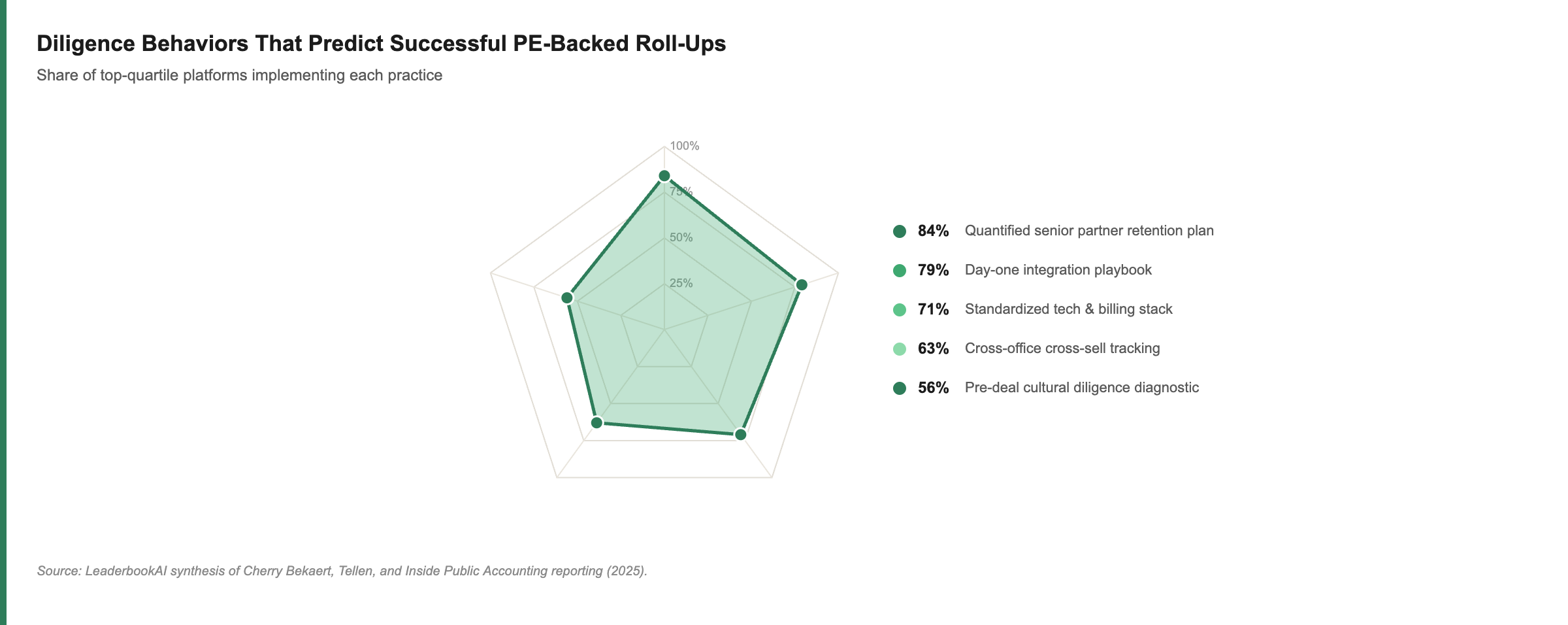
The category’s appeal to institutional capital is obvious once you assemble the data points. Recurring revenue. Predictable demand cycles tied to regulatory and tax calendars. Long client relationships measured in decades. Strong cash conversion. Limited working capital intensity. A talent gap (more on that below) that creates pricing power for whoever builds the talent retention infrastructure first. Cherry Bekaert’s 2025 PE report called professional services “an important and resilient segment of private equity investment activity in 2025, driven by structural trends, stable demand, and the ability to build larger, integrated service platforms through capital and operational expertise” (Cherry Bekaert, 2025).
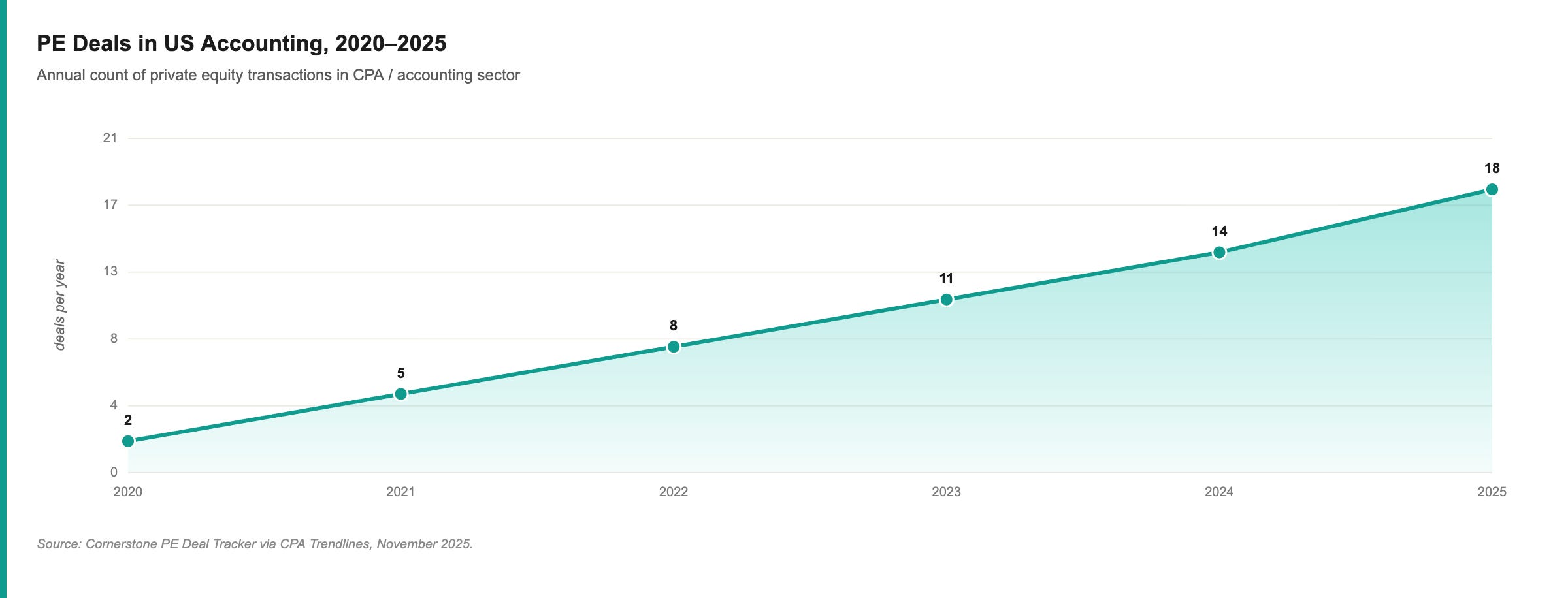
The most consequential pattern in the data is not the size of any one deal. It is the cadence of follow-on transactions inside each platform.
When New Mountain bought Citrin Cooperman at $350 million in revenue, it didn’t just sit on the asset. Over the next four years, the firm absorbed a series of regional accounting practices that took revenue to $850 million by the time Blackstone arrived (Private Equity Wire, 2025). That’s the playbook every PE-backed platform is now executing. Anchor the platform with a top-quartile firm. Use the platform’s balance sheet to acquire regional practices at lower multiples. Integrate. Standardize tech, billing, partner comp, and back-office. Sell into a higher multiple at exit.
Frazier & Deeter is running the same playbook in real time. General Atlantic invested in April 2025. In November 2025, F&D announced it had acquired both Rosen Sapperstein & Friedlander (Towson, MD, FY24 net revenue $24 million) and Pesta Finnie & Associates (Charlotte, NC), extending its footprint into the Mid-Atlantic and Southeast in a single quarter (Inside Public Accounting, November 2025). F&D itself reported $184 million in FY24 net revenue, 101 partners, and 800+ employees across 11 offices (Frazier & Deeter leadership disclosures, 2025–2026). The platform was built first. The roll-up engine started immediately.
Sources: Capital Brief; CPA Trendlines; Tellen.
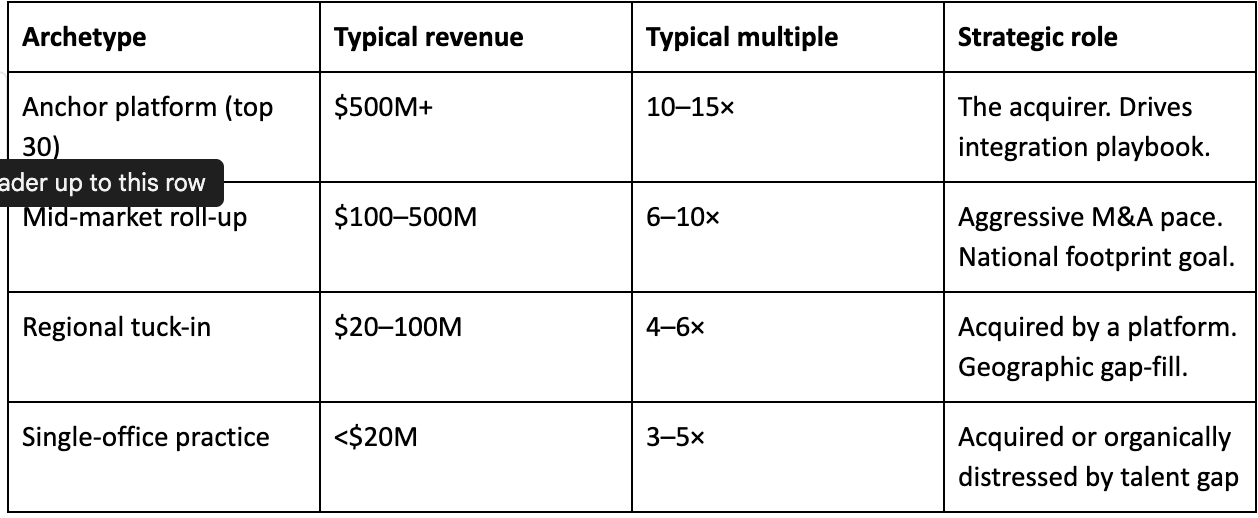
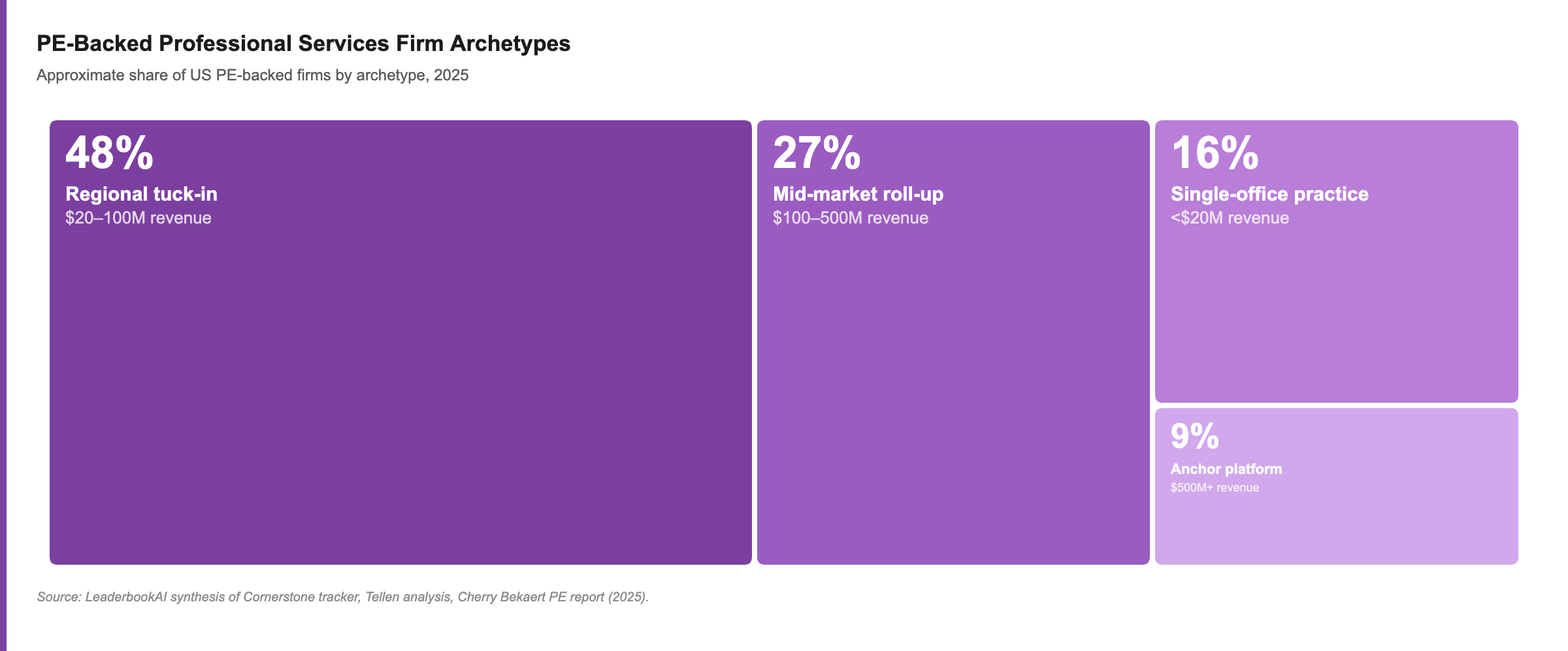
There are now four distinct profiles of PE-backed professional services firms in the market. Each has different economics, different talent dynamics, and different value-creation playbooks
Sources: Cornerstone PE Deal Tracker via CPA Trendlines; Tellen; LeaderbookAI synthesis.
The architecture of these platforms matters more than any single deal. The platforms that integrate well — partner compensation, technology, brand, back-office, client service standards — clear a higher multiple at exit. The platforms that don’t run a real integration playbook end up as holding companies of regional partnerships with no operating leverage, and they fail the second-flip test that Citrin Cooperman just passed.
The buyer set has tightened to a small group of sponsors with deep professional services pattern libraries and the operating partner depth to integrate complex partnership-economics conversions. Blackstone, Hellman & Friedman, New Mountain, General Atlantic, and Valeas Capital are the names that show up most consistently across the marquee deals.
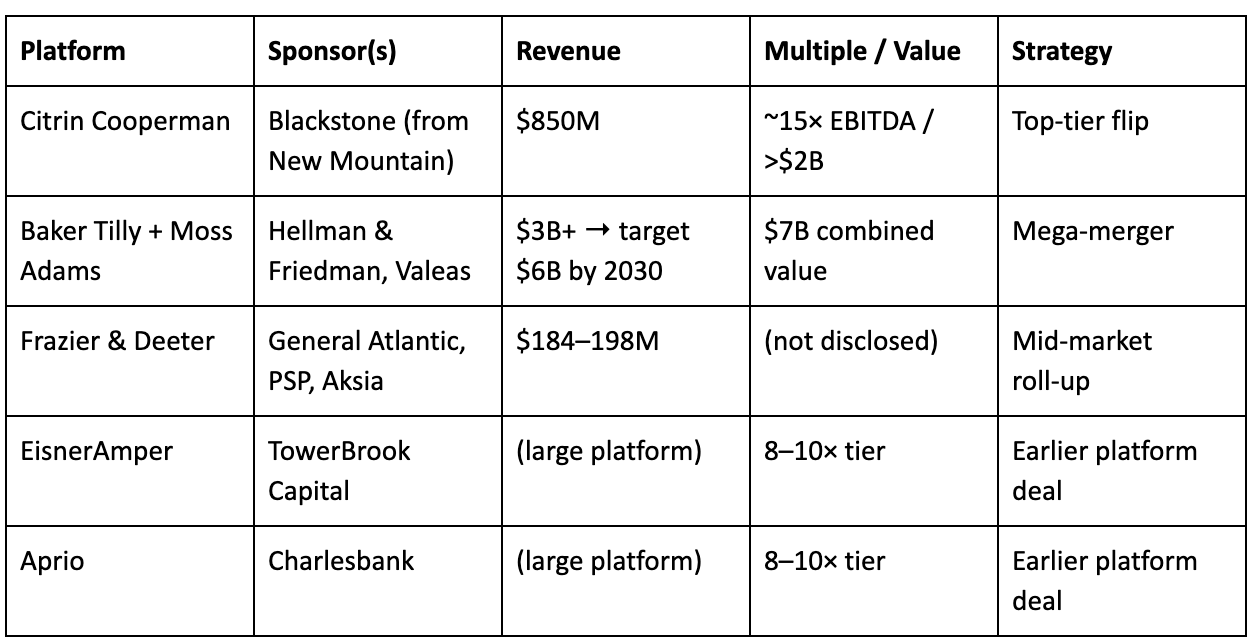
Sources: Capital Brief; Moss Adams; General Atlantic; CPA Trendlines.
For C-suite leaders and portfolio company operators: The professional services category is being repriced in real time, and the firms that will hold their valuations are the ones with quantified leadership stability, integration playbooks, and talent retention infrastructure that hold up under PE scrutiny. LeaderbookAI gives executives and portfolio teams the market signals to stay ahead. See how it works →
Accounting is the leading edge of a wider wave. The same thesis — fragmented incumbent, recurring revenue, talent gap, technology lag — is now playing out across law, consulting, and IT advisory. The pacing is different by sector, but the direction is the same.
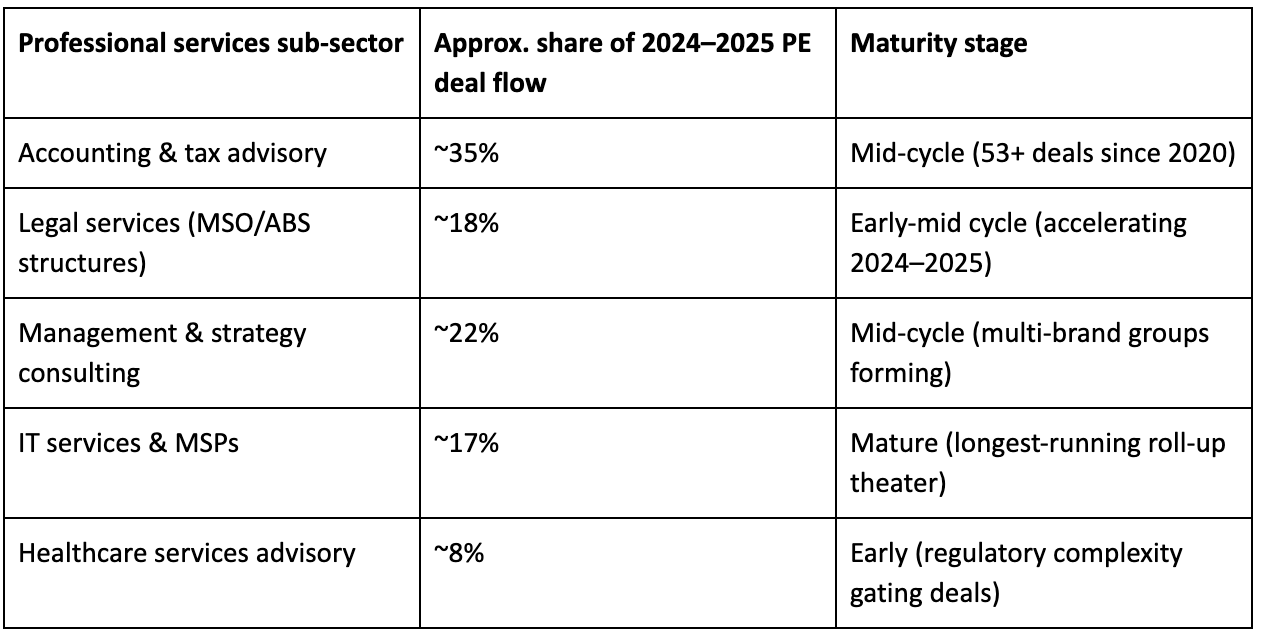
Source: LeaderbookAI synthesis of Cherry Bekaert PE report; Reed Smith on legal services MSOs; PwC US Deals 2026 outlook. Sub-sector shares are directional estimates.
Legal services is the next category to watch. PE interest in legal accelerated materially in 2024 and 2025 around MSO/ABS structures and related legal technology services, with investor interest particularly intense as law firms face mounting pressure to modernize operations and respond to client demands for transparency and efficiency (Reed Smith, 2025). The structural barriers — state bar regulations, partner-equity conversion mechanics — are higher than in accounting, but the unit economics are similarly attractive, and the early platforms are now visible.
Three dynamics will define the next 24 months in this category, and each one is consequential for portfolio executives.
First, the second-flip test. Citrin Cooperman just proved that an accounting platform can be sold from one PE sponsor to another at a step-up in multiple. That single transaction unlocks a credible exit path for every platform deal currently in market. It also raises the bar: the platforms that can’t demonstrate genuine operating leverage — not just revenue from M&A, but margin expansion from integration — will see the bid-ask spread widen at exit. Multiple expansion is no longer guaranteed for any platform; it is earned through measurable integration outcomes.
Second, the AI overlay. The Big Four collectively spent roughly $9 billion on internal AI development and partnerships in recent years; PwC launched its “agent OS” in March 2026; and AI adoption among accounting firms jumped from 9% in 2024 to 41% in 2025, according to the Wolters Kluwer Future Ready Accountant report (Bloomberg Tax; ICAEW, January 2026). For PE-backed mid-market platforms, AI is now table stakes for any defensible exit story. Frazier & Deeter, for example, has deployed Thomson Reuters’ CoCounsel and Blue J for tax research alongside its core CCH Axcess and Caseware stack — a stack that’s typical of well-resourced mid-market platforms now (Vault: Frazier & Deeter profile). The platforms that under-invest in AI will see their multiples compress against tech-enabled peers.
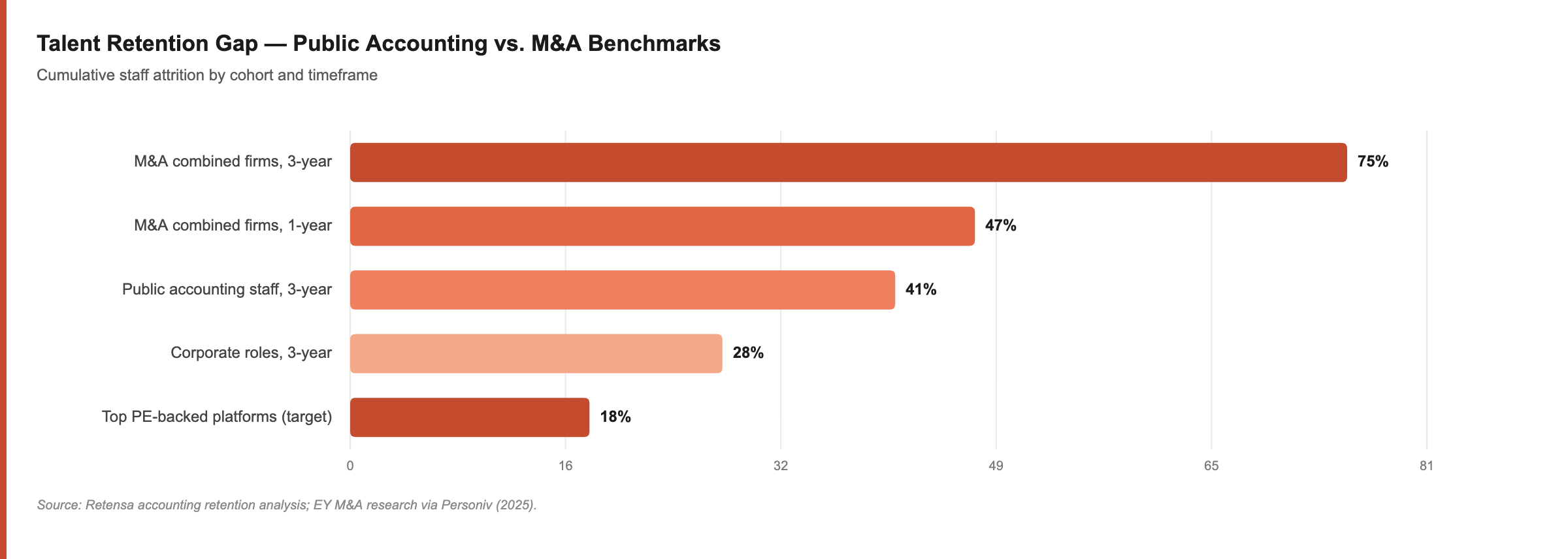
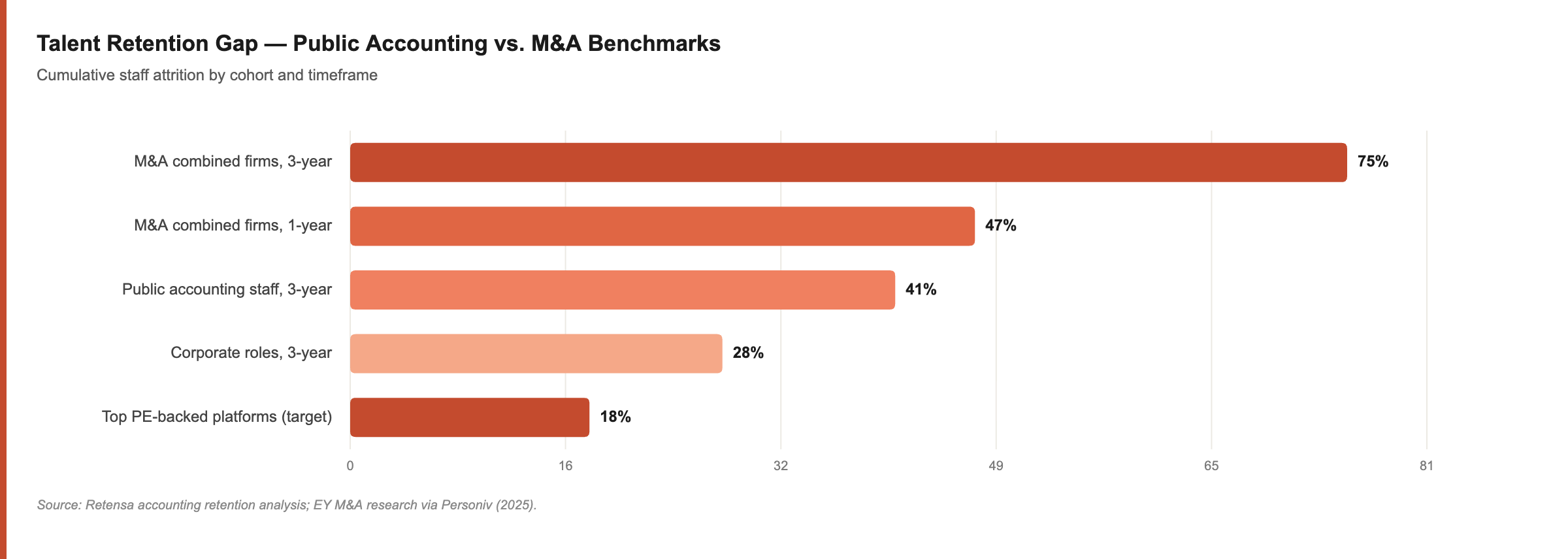
Third, the talent equation. Public accounting firms lose 41% of their staff within three years, against 28% in corporate roles, and the broader CPA pipeline is projected to be 120,000 professionals short by 2027 (Retensa accounting retention analysis). The average employee turnover after an M&A transaction is 47% in year one and 75% within three years (EY M&A retention research, via Personiv). For PE-backed platforms running buy-and-build at scale, the talent integration playbook is the binding constraint. The firms that protect senior client relationships through the integration cycle hold their multiples. The firms that don’t — and there will be many — will discover at exit that the bid disappears when the partners leave.
For executives operating inside a PE-backed professional services platform, or running a firm that’s likely to receive an inbound in the next 18 months, those three dynamics together define the readiness work. The platforms with quantified integration outcomes, a defensible AI position, and measurable senior talent retention will compound. The ones that can’t will get caught in the second-flip test.
1. Your firm is now valued against a benchmark you didn’t ask to be measured against.
Five years ago, the relevant comparable for a regional CPA, law, or consulting practice was the firm next door. Today the relevant comparable is a PE-backed platform with national footprint, integrated technology, multi-state partner economics, and quantified retention metrics. The bid the firm next door gives you is not the bid an institutional buyer would give you — in either direction. Know your category’s current multiple range, where your firm sits inside it, and what specifically moves you up the curve. The data is in market and it isn’t private anymore.
2. Integration playbooks are the actual asset. The brand isn’t.
The Citrin Cooperman flip didn’t price a brand. It priced an integration engine that took $350 million of revenue to $850 million in four years. Brad new equity capital, repriced partner agreements, standardized billing and tech, and pulled regional firms into a coherent operating model. Platforms that can demonstrate that they integrate well — through partner retention, revenue per partner, gross margin expansion in tucked-in offices, and cross-sell rates — clear a 12-15× multiple. Platforms that can’t will end up as expensive holding companies of regional partnerships and will struggle at exit. If you’re running an anchor or mid-market platform, the integration playbook is the only durable strategic asset on the balance sheet.
3. Talent retention is the binding constraint, and it is now quantified.
Across LeaderbookAI’s design partner portfolio, leadership signals were a statistically significant predictor of sales bookings — β = 0.968, p < 0.04. That kind of quantification is now the benchmark institutional buyers expect on the talent side of diligence. Senior partner retention, tenure curves, second-level bench depth, post-deal turnover trajectory — these are no longer qualitative line items in an IC memo. They are scored. If your firm can’t put a defensible number on its senior talent retention through an integration cycle, you’ll find that gap reflected in the bid at exit. The talent conversation that PE firms have had qualitatively for 30 years is structurally over. There is a number for this now.
The strongest acquisitions are built on people before profit.
4. AI investment is no longer optional. It is the floor.
AI adoption among accounting firms moved from 9% to 41% in a single year. The Big Four are operating at a different tier entirely, with $9 billion of cumulative internal AI investment (Bloomberg Tax, 2025). For mid-market platforms, the credible exit story now requires a real AI stack — not just a vendor relationship, but measurable workflow integration across audit, tax, and advisory. Buyers will not pay a top-tier multiple for a platform that has visibly under-invested in technology relative to peers. The AI investment timing question is not “if” but “how fast” and “how well-integrated.”
5. The window for selling at the top of the curve is now, not later.
Multiple expansion is real but not infinite. Industry observers expect a small set of mega-mergers and PE-to-PE flips to keep stretching the top tier through 2027, but the bulk of mid-market platforms will eventually find the multiple curve flattens as the category matures. The platforms that move now — either as buyers consolidating before peer platforms close the same gaps, or as sellers transacting while the sponsor bid is still richly priced — are choosing timing they may not have in 24 months. The decision needs to be in market this year, not under indefinite review.
For executives and portfolio leaders acting on signals like these: LeaderbookAI is built for C-suite leaders and the portfolio companies they oversee — helping teams move from insight to action. Book a demo with the LeaderbookAI team →
This week’s LeaderbookAI podcast goes deeper on exactly what this article covers — with someone who does it for a living.
Jeremy Jones, Managing Partner and CEO at Frazier & Deeter — Jeremy stepped into the Managing Partner and CEO role in January 2026, taking over a top-100 US CPA firm that took a strategic growth investment from General Atlantic in April 2025 and closed two regional acquisitions within seven months.
In this episode, Felicia sits with Jeremy to walk through what it actually looks like to operate a top-100 accounting firm through a PE growth investment, an executive transition, and an acquisition cadence simultaneously. The conversation gets specific about how Frazier & Deeter is thinking about platform integration, partner economics, technology investment, and the talent decisions that determine whether a buy-and-build playbook compounds or stalls.
In this episode:
What changes the day a PE growth investment closes — and what doesn’t
How F&D evaluates a tuck-in acquisition: revenue, retention, geographic fit, integration risk
The partner compensation and equity structure conversations PE-backed CPA firms are actually having
What Jeremy looks for in leadership when he’s underwriting an acquired firm’s senior bench
“Good culture and good people will create fantastic financial performance.” — Jeremy Jones, Managing Partner and CEO, Frazier & Deeter
▶ Listen to Episode 106→ https://leaderbook.ai/podcast
The story of professional services in this cycle is the story of a category that priced itself for 40 years as a partnership and is now being repriced by institutional capital that brought a different question to the table: what is this firm worth as an operating company. The answer turns out to be a lot more than the partnership accounting ever said. Citrin Cooperman at 15× EBITDA, Baker Tilly + Moss Adams at $7 billion of combined value, Frazier & Deeter at a national multi-state platform inside seven months of a growth investment — these are not anomalies. They are early data points in a category-wide repricing that will run through this decade.
The hard part for executives sitting inside the category is that the answer to “what is my firm worth” is no longer set by local comparables or partnership succession math. It is set by the buyer set’s view of integration quality, talent retention through the cycle, and the operating leverage the platform can document. Those are observable, measurable, and increasingly quantified by the people writing the checks. The firms that have those numbers — or can build them — will hold their multiples. The firms that don’t will get reset, and they may not know it’s coming.
For portfolio executives in adjacent categories — law, consulting, IT advisory, healthcare services — the lesson is the playbook is already public. The accounting precedent is now the template. Anchor a platform. Build the integration engine before you scale acquisitions. Retain senior talent through the cycle. Document operating leverage. Invest credibly in technology. Sell at the multiple your operating story can defend, not the multiple your category average suggests. The firms that do this work in 2026 will be the ones writing the next round of $7 billion mergers in 2028. The firms that don’t will be acquired into them at a discount.
The repricing is not coming. It is already here.
LeaderbookAI is an AI platform built for C-suite leaders and the portfolio companies they lead. We help executives develop the judgment and decision-making frameworks for an AI-first world — and give portfolio organizations the market intelligence, leadership coaching, and strategic tools to compete at the speed AI demands.
If this analysis was useful, LeaderbookAI was built for people like you.
Explore LeaderbookAI → Request a demo · leaderbook.ai
Capital Brief — Blackstone Acquires Accounting Firm Citrin Cooperman for $3.2B
Private Equity Wire — Blackstone Leads $2B Deal for Citrin Cooperman
CFO Brew — Citrin Cooperman Deal Is Reportedly Private Equity’s “First Flip” of an Accounting Firm
Blackstone press release — Citrin Cooperman Receives Investment from Blackstone
Moss Adams / Baker Tilly — Strategic Merger Backed by Hellman & Friedman
General Atlantic — Frazier & Deeter Strategic Growth Investment
CPA Practice Advisor — Frazier & Deeter Gets Capital Infusion From General Atlantic
Inside Public Accounting — Frazier & Deeter Accelerates Growth with Strategic Acquisitions
Frazier & Deeter — Jeremy Jones Named Incoming Managing Partner
Cherry Bekaert — Private Equity Report: 2025 Trends and 2026 Outlook
Reed Smith — Private Equity and the Business of Law: MSO and Alternative Structures
Bloomberg Tax — Big Four Firms Embrace AI to Revamp Corporate Service Offerings
Tellen — How Private Equity Uses APS to Acquire US Accounting Firms
Personiv — Accounting Talent Retention (citing EY M&A research)
No posts
Comments
Nothing yet. Say the first thing.
Sign in to join the conversation.