
Fifty-nine percent of PE-backed companies have adopted AI in some form. That sounds like progress until you set it next to the number sitting right beside it: 98% of PE sponsors have formally mandated AI adoption across their portfolios. The gap between those two figures — a nearly 40-point spread between what the top of the fund wants and what is actually running in the business — is the single most important number in revenue technology right now, and almost nobody outside the operating-partner conversation is talking about it.
Layer in a second data point and the picture sharpens further. Only 20% of PE portfolio companies have moved a generative AI use case into production with concrete, measured results, according to Bain’s tracking of the sector. Everyone has a pilot. Almost nobody has a system.
For revenue leaders at PE-backed companies, this isn’t an abstract governance question — it’s the exact tension at the center of LeaderbookAI’s podcast conversation with JD Miller, a 30-year B2B sales veteran and PE operating advisor who has spent the past year interviewing CROs and evaluating more than 150 AI sales vendors across a private equity portfolio. His central finding: the market is flooded with capability, but capability isn’t the constraint. Trust is.
Building a revenue org that’s actually AI-ready — not just AI-mandated? LeaderbookAI helps executives and their portfolio organizations turn market signals like these into decisions and competitive advantage. More on that at the end.
The AI-in-sales category is not a niche anymore. It’s a full-sized software market growing faster than almost anything else in the enterprise stack. Global AI-in-sales spend was valued at $31.2 billion in 2024 and reached $39.4 billion in 2025, a market now expected to compound at roughly 28.7% annually through 2034 — a trajectory that would push the category well past $200 billion within the decade, according to Global Market Insights.
That top-line growth number is exactly why JD Miller’s 150-vendor evaluation project matters more than it sounds. In a market compounding at nearly 30% a year, buyers don’t have the luxury of waiting for consolidation to sort out who’s real. They’re making platform decisions inside a category that’s still actively forming.
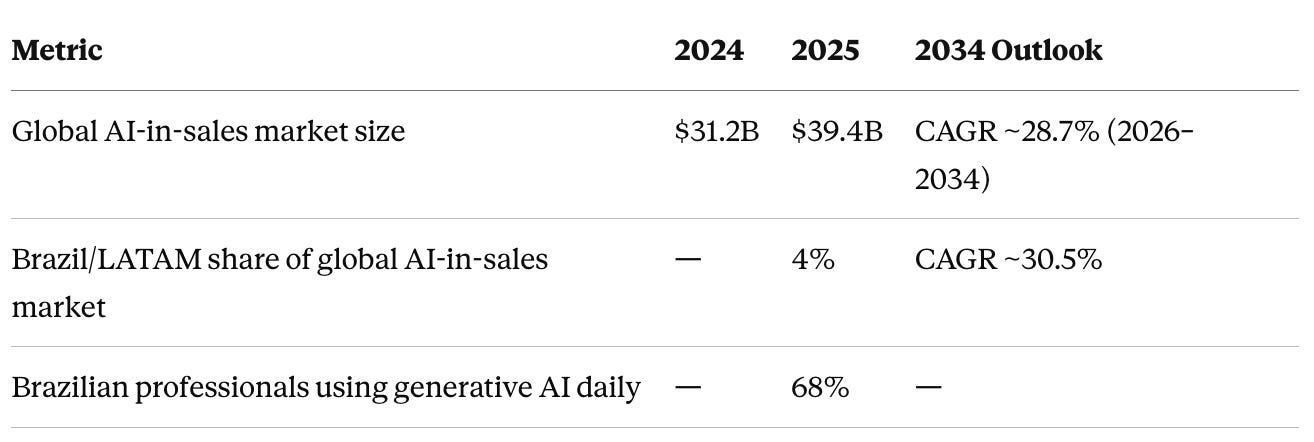
Source: Global Market Insights, AI in Sales Market Report
Underneath that market-level growth, capital is telling an even more specific story about what kind of AI revenue infrastructure investors are willing to pay premium prices for. Between August 2025 and July 2026, pure-play AI sales and marketing startups raised $575 million across 21 disclosed equity rounds — a healthy but disciplined pace, averaging 1.75 deals a month, according to Crunchbase data compiled by New Market Pitch. But that total is heavily concentrated: the top two rounds alone — Hightouch’s $150 million raise at a $2.75 billion valuation and MoEngage’s $100 million growth round — represented 43.48% of all disclosed capital in the category, despite coming from a segment (Customer Data Platforms) that produced only 2 of the 21 deals.
The lesson for portfolio company leaders evaluating vendors: investors are pricing systems that own customer data and activation infrastructure dramatically higher than point-solution tools that generate copy, lists, or one-off recommendations. If your sales stack is a collection of disconnected AI features, you’re buying into the part of the market getting the smallest checks.
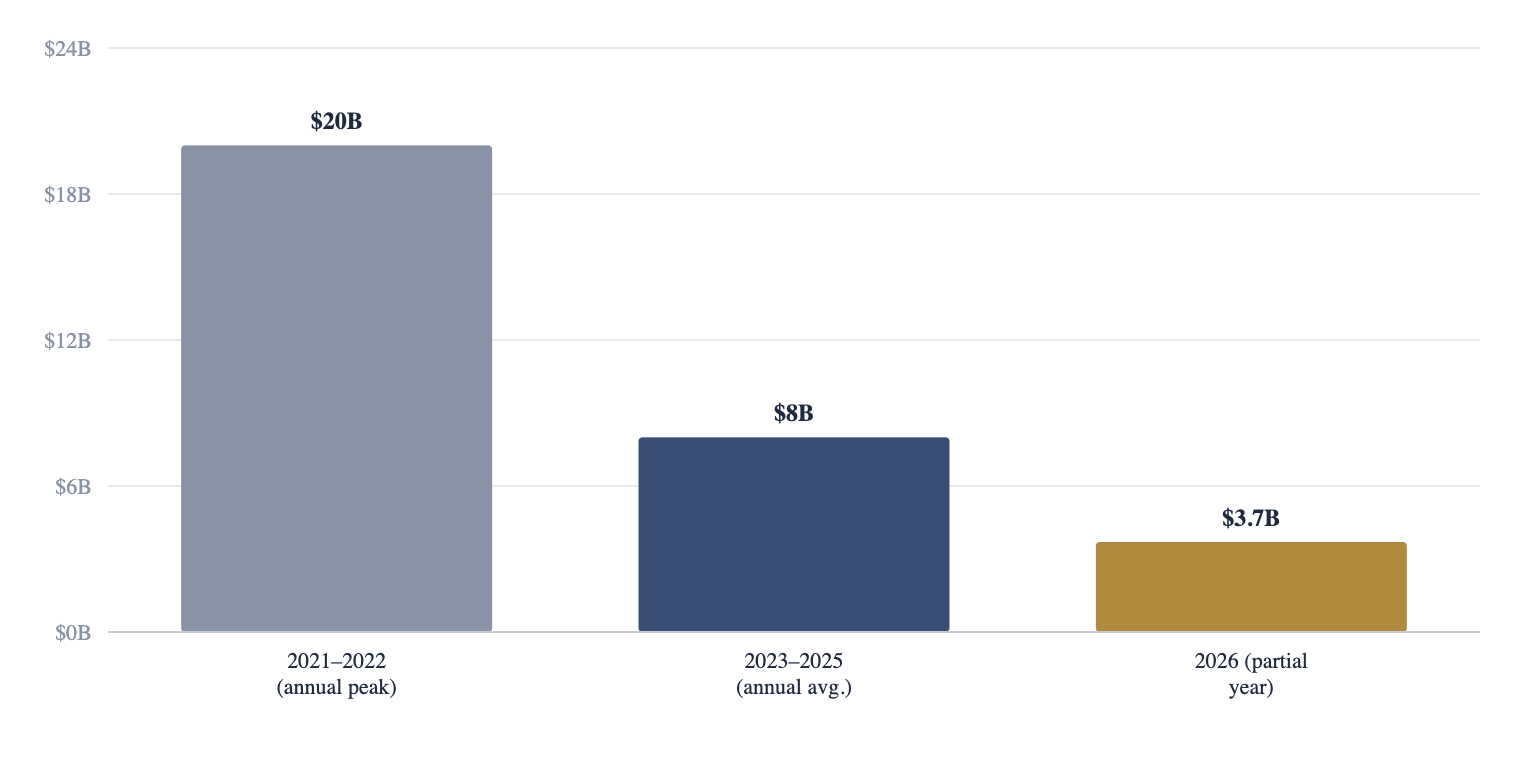
The funding trend line itself is worth sitting with. Venture investment into sales, marketing, and CRM startups peaked above $20 billion annually during 2021–2022, before settling to roughly $8 billion a year across 2023–2025 — and 2026 is tracking to that same steady-state pace, with $3.7 billion raised through the first several months of the year, per PPC Land’s analysis of Crunchbase figures. This isn’t a bubble deflating — it’s a market that already had its hype cycle and is now funding at a more rational, sustained clip. That matters for buyers: the vendors surviving in 2026 have largely already been stress-tested by two funding cycles.
If Section 1 established that the category is large and maturing, this section is about specificity: which types of AI revenue tools are attracting founders and capital, and which are structurally more fundable than others.
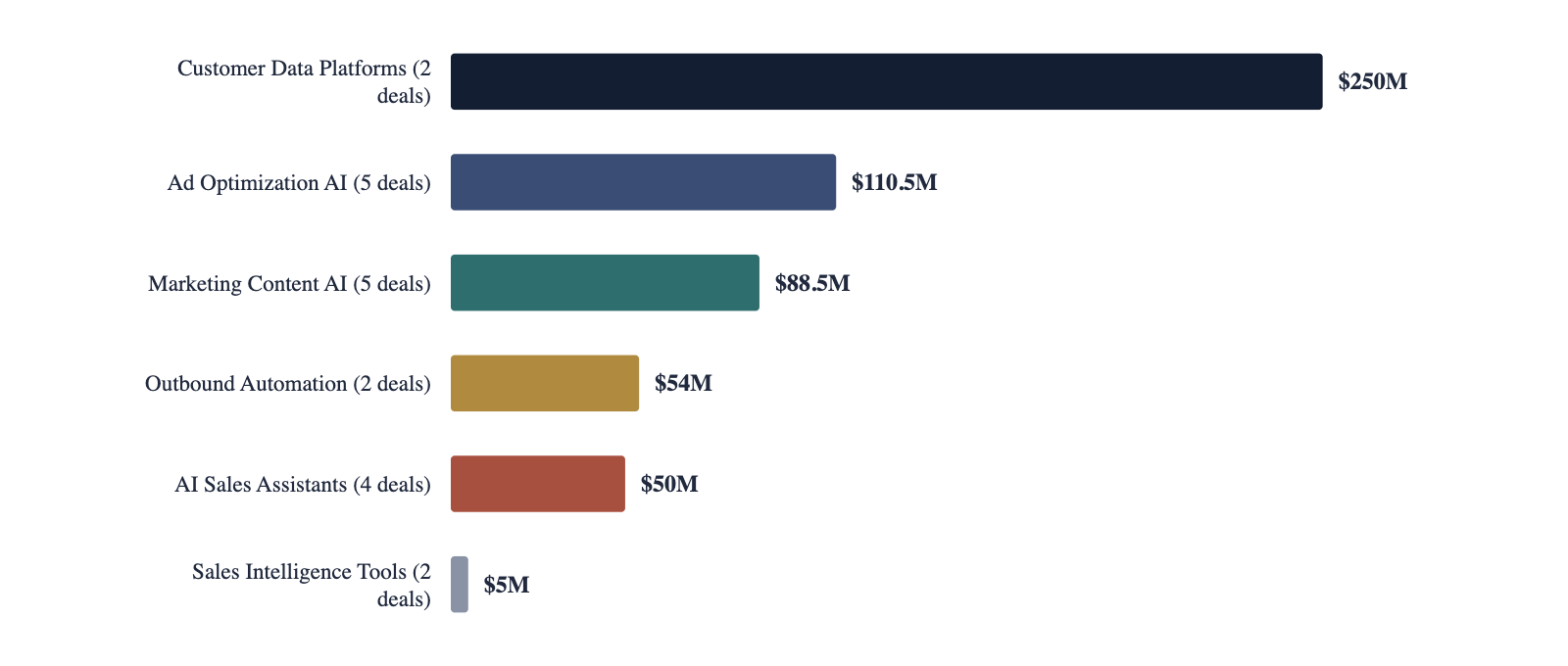
Ad Optimization AI and Marketing Content AI each produced 5 of the 21 disclosed deals over the past year — tied for the most active categories by deal count. AI Sales Assistants (tools like Hyperbound and Simple AI, focused on coaching, roleplay, and voice-agent selling) produced 4 deals. Outbound Automation and Customer Data Platforms produced 2 deals each, and Sales Intelligence Tools produced 2 — though, notably, that last category captured just 0.87% of total disclosed capital despite representing 9.52% of deals, according to New Market Pitch’s funding tracker. Investors are curious about sales intelligence at the formation stage, but they aren’t yet convicted enough to write big checks.
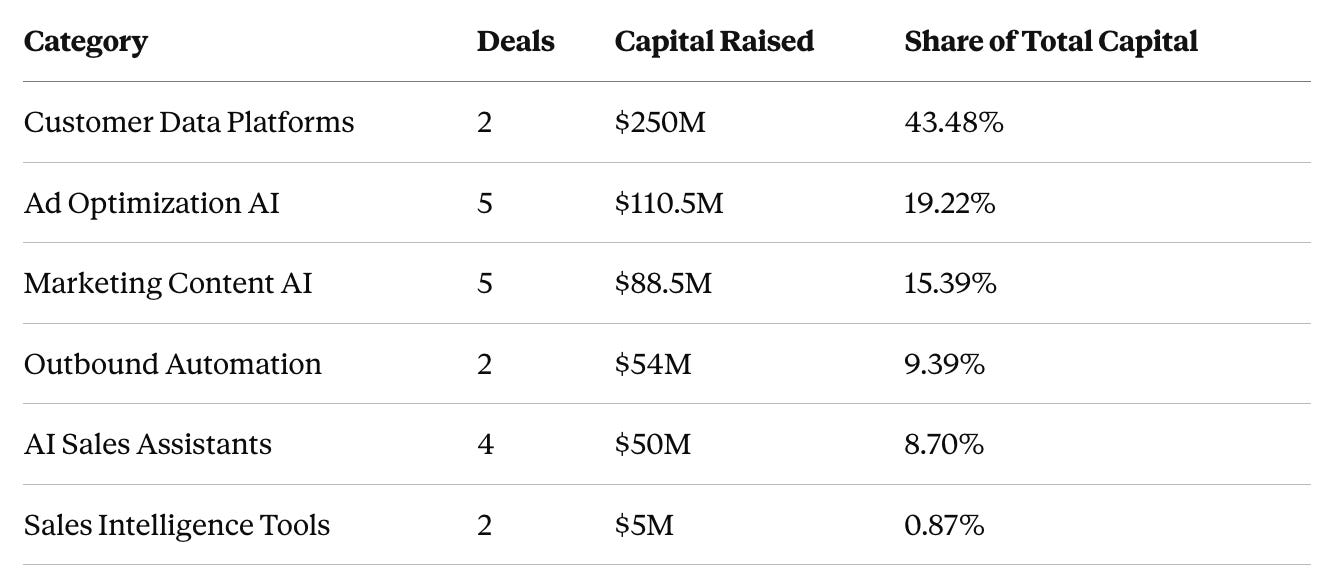
Source: New Market Pitch, AI Sales and Marketing Startup Funding tracker
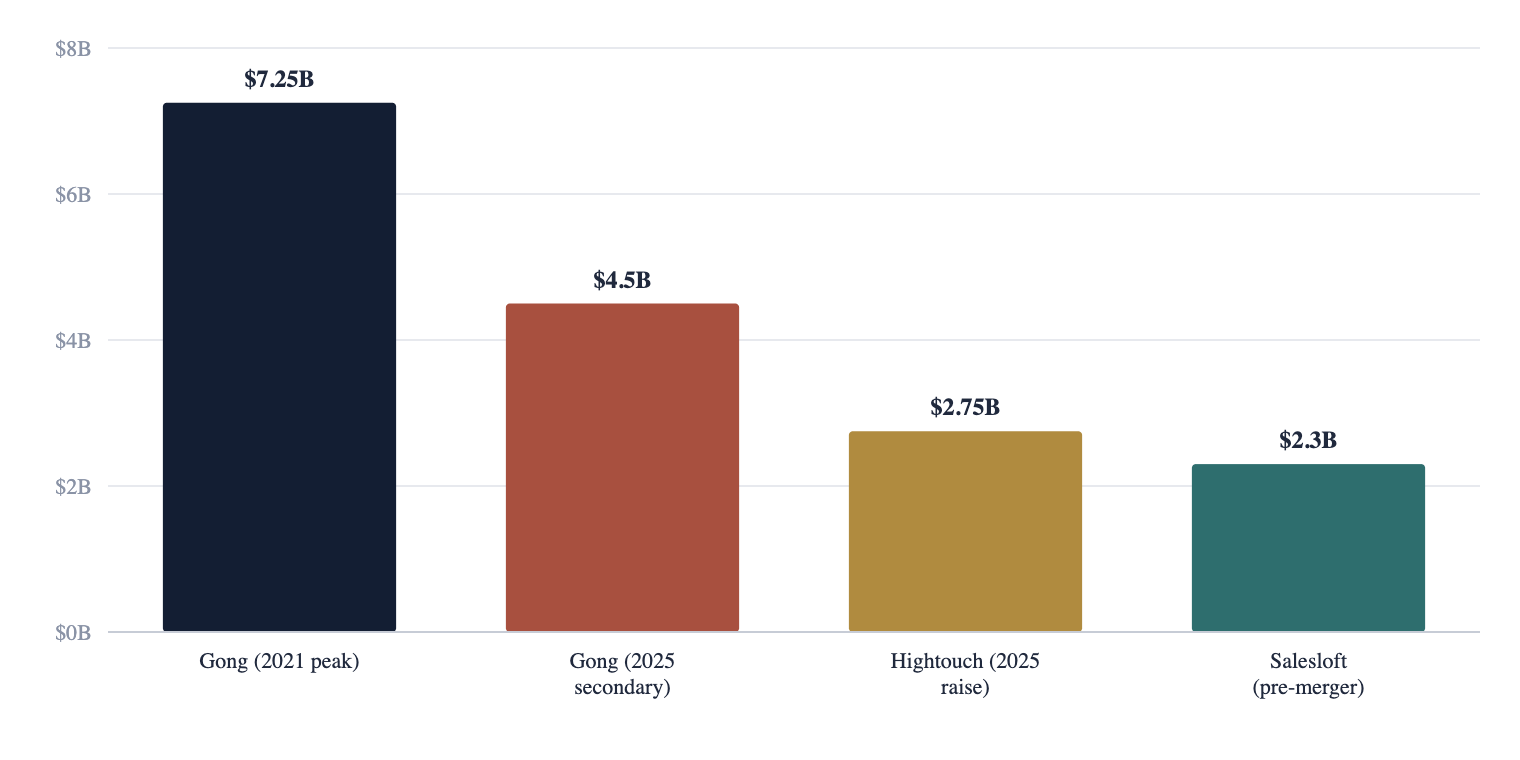
While early-stage capital chases the categories above, the established revenue intelligence and engagement platforms — the tools most PE-backed sales orgs are already running — are consolidating fast. Clari completed its acquisition of Salesloft in December 2025, merging Salesloft’s sales-engagement platform (previously valued near $2.3 billion as a standalone company) with Clari’s forecasting and deal-intelligence suite into a combined entity generating roughly $450 million in ARR and serving more than 5,000 customers, according to reporting on the merger. The combined company cut 76 positions in February 2026 during integration.
Meanwhile Gong, the category-defining revenue intelligence platform, has seen its valuation compress from a 2021 peak of $7.25 billion to roughly $4.5 billion in late-2025 secondary transactions — even as its ARR run rate crossed $500 million on more than 55% year-over-year growth, per Calcalist’s reporting. That divergence — revenue accelerating while valuation multiples compress — is itself a signal: buyers are getting more disciplined about what they’ll pay for AI-labeled revenue software, even from proven category leaders.
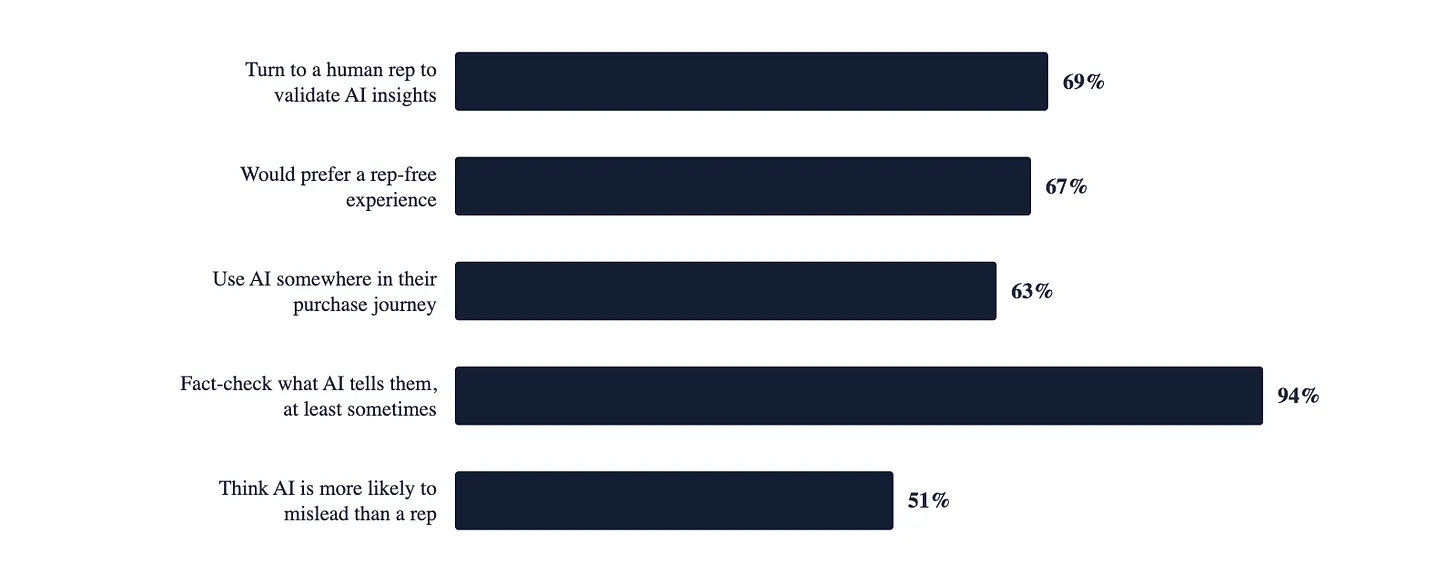
This is where JD Miller’s framework becomes directly relevant to the funding data. Buyers on the other side of every one of these AI-powered sales motions are not passive recipients of automation. Gartner’s May 2026 survey of 645 B2B buyers found that 69% still turn to a human sales rep to validate AI-generated insights, even though 67% say they’d prefer a rep-free buying experience entirely — and 51% of buyers believe they’re more likely to encounter misleading information from generative AI than from a salesperson, versus 49% who say the reverse, per Gartner’s newsroom release. Separately, TrustRadius’s 2026 B2B Buying Disconnect Report found that while 63% of buyers now use AI somewhere in their purchase journey, 94% of them fact-check what it tells them at least some of the time.
That’s the empirical backbone of the point JD makes on this episode: buyers aren’t rejecting AI, they’re using it constantly — but they’re routing every AI-generated claim through a human they trust before they act on it. Sales organizations that treat AI as a replacement for that trust layer, rather than an accelerant to it, are building against the grain of their own buyers’ behavior.
The most consequential data in this week’s research isn’t about vendors at all — it’s about the buyers. Specifically, how ready PE-backed portfolio companies actually are to run the AI systems their sponsors are mandating.
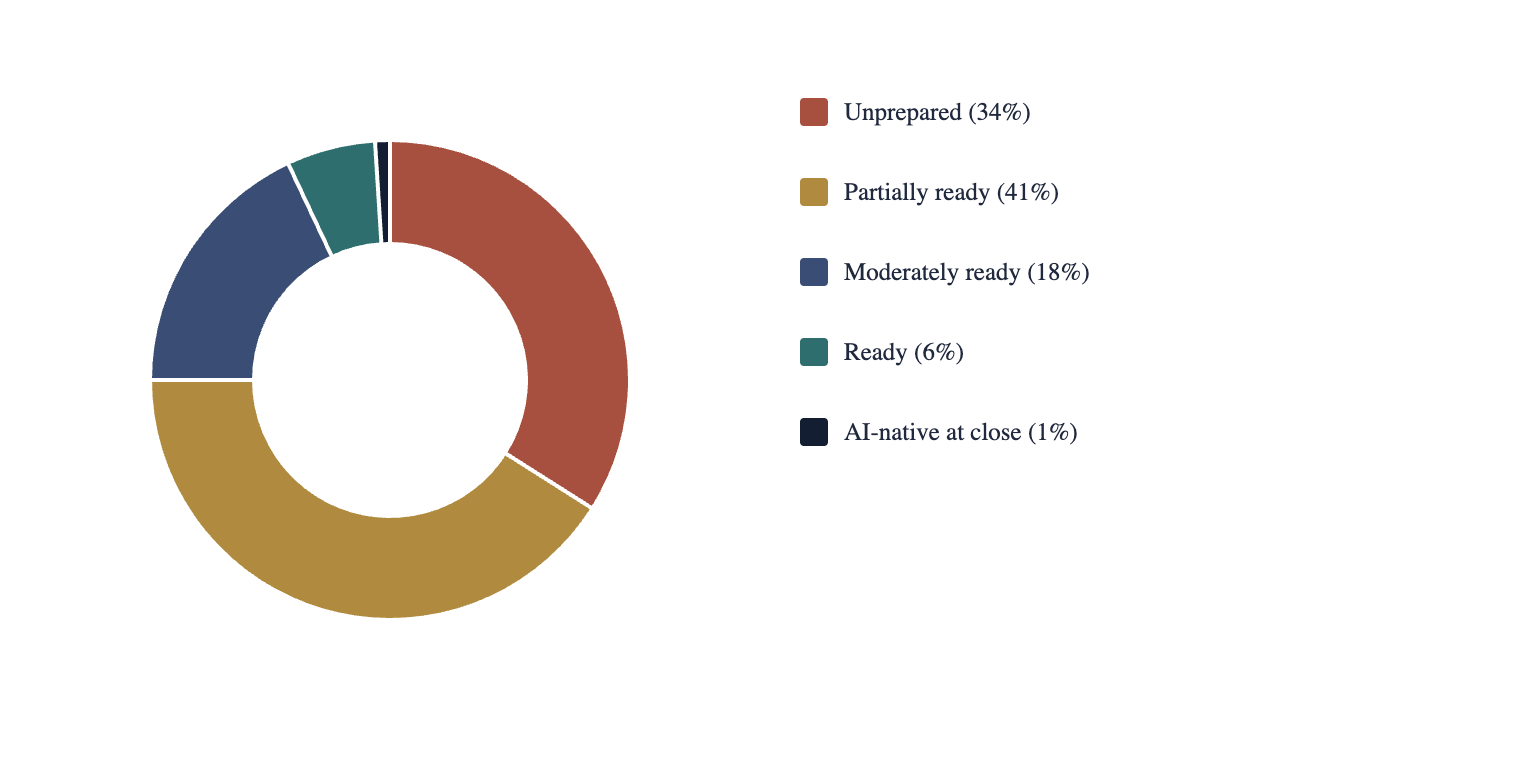
According to Accordion’s 2026 PE AI Adoption Benchmark, conducted with Wakefield Research among 150 AI, data, and technology Operating Partners, 75% of portfolio companies arrive at close either fully unprepared (34%) or only partially ready (41%) for AI deployment. Just 6% are “ready” — clean, integrated data supportive of AI within the first 100 days — and a mere 1% qualify as genuinely AI-native at acquisition.
That data gap is precisely why so many AI sales initiatives inside PE-backed revenue orgs stall before they compound. You cannot layer a forecasting copilot or a conversation-intelligence platform on top of fragmented CRM data and expect the kind of signal quality JD describes — the AI reading a prospect’s public statements and pre-seeding a rep with real points of connection. Garbage in, garbage out applies to revenue data exactly as much as it applies to finance data.
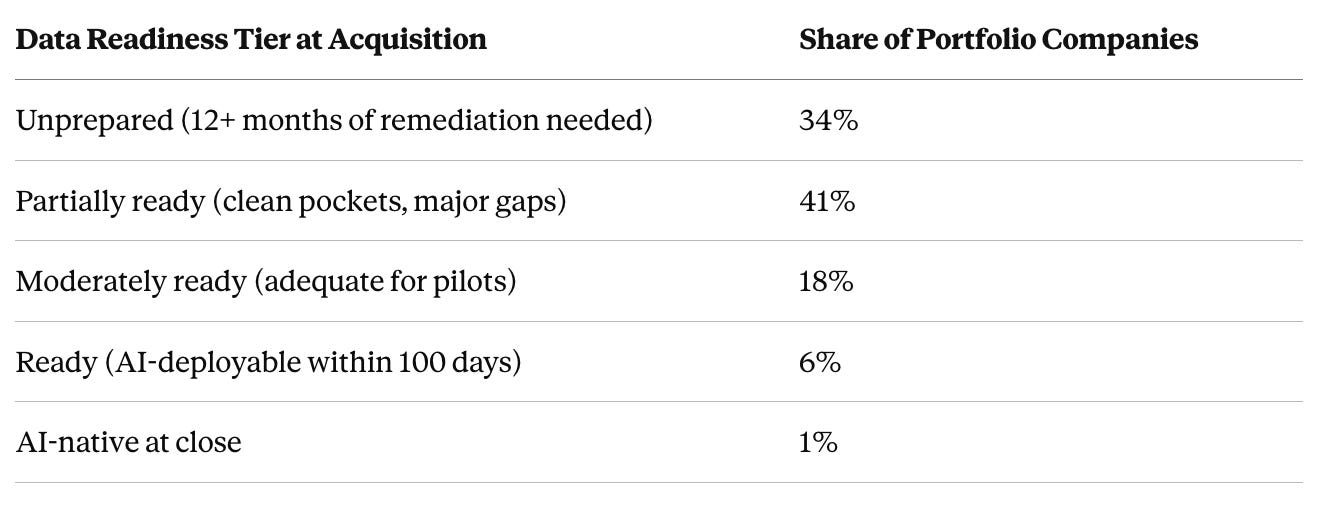
Source: Accordion, The PE AI Adoption Benchmark (2026)
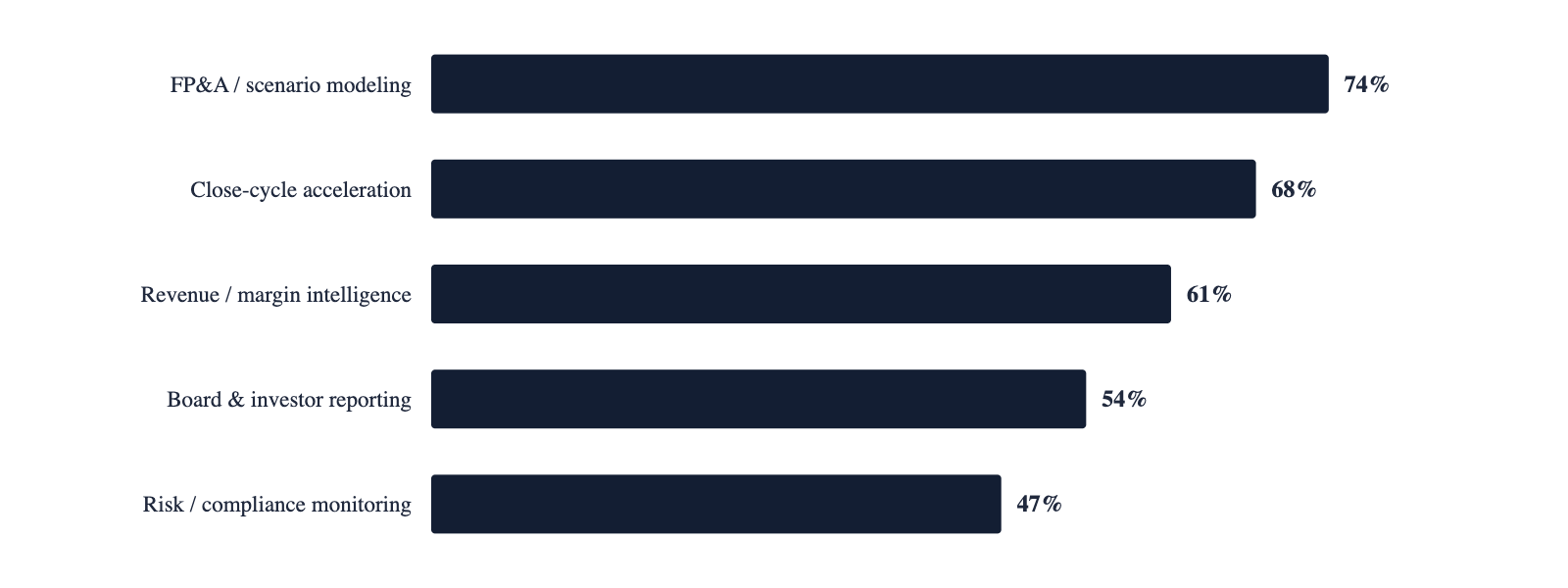
Where do the highest-conviction AI opportunities sit inside PE-backed companies right now? FP&A and scenario modeling top the list at 74% of Operating Partners citing it as a priority opportunity, followed by close-cycle acceleration (68%) and revenue or margin intelligence (61%) — pricing, mix, and commercial finance workflows that sit directly adjacent to the sales motion, per Accordion’s benchmark. Board and investor reporting (54%) and risk/compliance monitoring (47%) round out the top five. Revenue acceleration is also the single most-cited AI priority across the broader PE fund and Operating Partner population, selected by 41% of the 200 leaders surveyed in FTI Consulting’s 2026 Private Equity AI Radar, which also found that 95% of funds report AI initiatives meeting or exceeding their original business case.
That last figure is worth pausing on. Nearly every fund says its AI bets are working — and yet Bain’s separate tracking shows only about 20% of portfolio companies have actually moved a use case into production with measurable results. Both things are true simultaneously, and reconciling them is the job description of a modern CRO. It’s the reason Grant Thornton’s 2026 AI Impact Survey of private equity leaders describes the sector as having “more confidence about their AI strategy than almost any other sector surveyed” while measurable returns lag — a dynamic the report calls the AI proof gap.
Deloitte’s parallel M&A research backs up the conviction side of that gap: 86% of corporate and PE dealmakers already use generative AI in their workflows, 65% of them started within the past year, and 88% of PE firms have put more than $1 million into generative AI investment, with EY projecting two-thirds of firms will direct over a quarter of their technology budget toward AI by year-end. EY also reports that 84% of PE firms have now appointed a Chief AI Officer, according to analysis compiled by Tommaso Maria Ricci. The mandate, the budget, and the governance titles are all in place. What’s missing, per Accordion’s benchmark, is the operational playbook connecting that mandate to what actually happens inside the revenue org day to day.
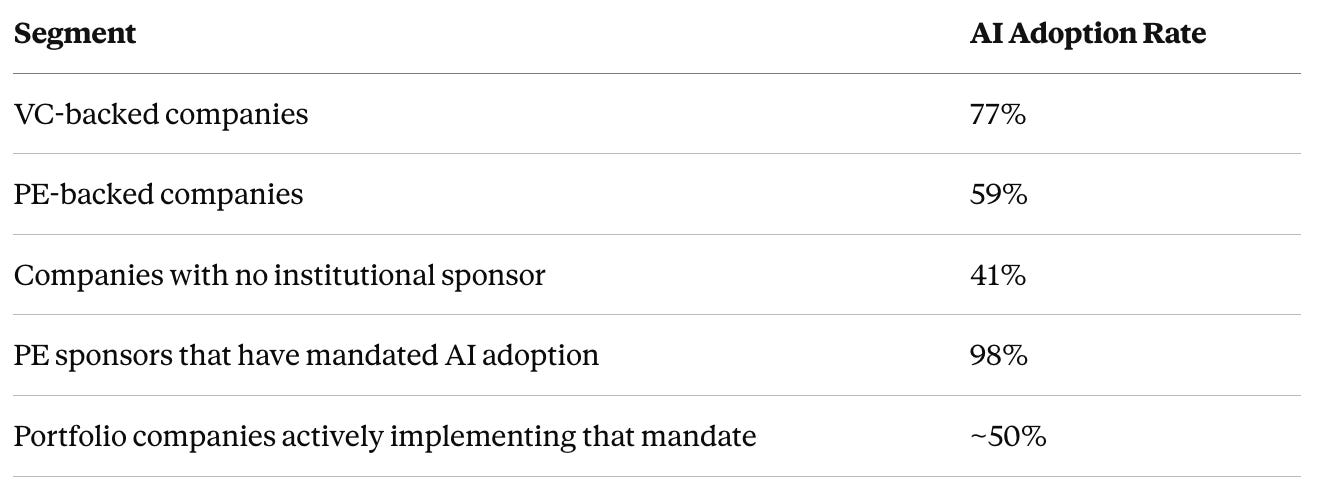
The clearest single way to see JD Miller’s “move fast in the wrong direction” risk in the data: 59% of PE-backed companies have adopted AI in some capacity, compared to 77% of VC-backed companies and 41% of companies with no institutional sponsor at all, per Accordion’s benchmark survey. Private equity is ahead of the general market but meaningfully behind venture — a gap Accordion attributes not to technology access but to mindset: VC-backed teams move fast and experiment, PE-backed teams are more deliberate and operationally cautious.
That caution shows up starkly in the mandate-to-execution pipeline. While 98% of PE sponsors have formally mandated AI adoption across their portfolios, only about half of portfolio companies are actively implementing it — and inside finance functions specifically, fewer than one in three PE-backed CFOs have meaningfully implemented AI, with 68% saying they don’t know where to start.
Segment AI Adoption Rate VC-backed companies 77% PE-backed companies 59% Companies with no institutional sponsor 41% PE sponsors that have mandated AI adoption 98% Portfolio companies actively implementing that mandate ~50%
Source: Accordion, The PE AI Adoption Benchmark (2026)
Geographically, the capital funding this next generation of revenue AI tooling is heavily concentrated. North America captured 15 of 21 disclosed deals and $432 million — 75.13% of all disclosed capital — in the pure-play AI sales and marketing category over the past twelve months. Europe ranked second with $105 million across 3 deals, though that figure is skewed by MoEngage’s single $100 million round; the region’s median deal size was just $4.5 million, a more honest read on the typical early-stage European AI sales startup. Asia-Pacific produced 2 deals worth $20 million, and the Middle East produced a single $18 million round (WINN.AI), according to New Market Pitch’s regional breakdown.
For PE-backed executives running global or multi-region revenue teams, that concentration matters operationally: the deepest bench of AI-native sales and marketing vendors, and the most mature buyer expectations around AI in the sales process, both remain disproportionately North American. Portfolio companies expanding into EMEA or APAC should expect both a thinner vendor market and, per the EU AI Act’s high-risk requirements becoming enforceable August 2, 2026, a materially heavier compliance burden for any AI system touching credit decisions, employment screening, or financial risk assessment inside EU-based operations.
The question every PE-backed CRO eventually has to answer to their board: does any of this AI investment actually show up in the exit multiple? The early answer is “not yet, but soon.” According to Accordion’s benchmark, just 9% of Operating Partners have seen a demonstrable AI premium materialize in a completed transaction. But 44% report that buyers are actively asking about AI-enabled capability during diligence — the premium isn’t priced in yet, but it’s clearly on the table — and a further 33% expect it to show up within two years. Only 14% of respondents say they see no evidence of AI differentiation in any exit process to date.
That timeline lines up with what Private Equity International’s LP Perspectives 2026 Survey found on the fundraising side: 47% of Limited Partners are now closely monitoring GP-level AI adoption, with a third viewing it positively and 46% holding mixed views shaped by governance and risk concerns, per Blott’s compiled PE AI report. AI governance has moved from an operational detail to a fundraising consideration in its own right.
The practical implication for revenue leaders: the exit narrative buyers are starting to reward isn’t “we bought a lot of AI tools.” It’s measurable outcomes connected to EBITDA — forecast accuracy, cycle-time compression, and revenue or margin lift that a buyer’s diligence team can independently verify. Only 38% of Operating Partners currently measure AI’s revenue or margin impact directly; the majority (67%) are still measuring the easier proxy of FTE time saved. The gap between those two numbers is, in effect, the gap between an AI initiative that shows up as a line item once and one that compounds into every future forecasting cycle.
1. The mandate-to-execution gap is your biggest near-term risk, not your biggest opportunity. A 98% sponsor mandate against roughly 50% actual portfolio-level implementation isn’t a rollout problem — it’s a governance vacuum. If your board has mandated AI in the revenue function and you don’t yet have a documented playbook connecting that mandate to specific, measured workflows, you’re accumulating exactly the technical debt and diligence risk Accordion’s Operating Partners describe as “pilot purgatory.”
2. Data readiness is the real gating factor, not vendor selection. With 75% of portfolio companies arriving at close unprepared or only partially ready for AI, the highest-leverage move for most CROs isn’t picking between the 150-plus vendors JD Miller catalogued — it’s fixing the CRM and revenue-data foundation those vendors sit on top of. A best-in-class conversation-intelligence tool layered on fragmented pipeline data will underperform a mediocre tool layered on clean data, every time.
3. Trust is now a measurable line item, not a soft value. With 69% of B2B buyers still routing AI-generated claims through a human rep for validation, and 94% of AI-assisted buyers fact-checking what they’re told, the sales organizations winning right now are the ones that treat AI as a force multiplier for their sellers’ credibility — arming reps with sourced, verified, deal-specific intelligence — rather than as a replacement for the human validation layer buyers are explicitly asking for.
4. Capital is already voting on which architecture wins. Investors paid a 4.57x premium in capital-share-to-deal-share terms for Customer Data Platforms over point solutions in the past year. That’s a direct signal about defensibility: tools that own the data and the workflow compound in value; tools that generate a single output (a list, a script, a piece of copy) get funded, but at a fraction of the multiple. The same logic should govern how CROs prioritize their own internal build-versus-buy decisions.
5. Measurement discipline is what separates a pilot from an exit story. Only 38% of Operating Partners currently connect AI initiatives to revenue or margin outcomes; the rest are still measuring the floor (time saved) rather than the ceiling (EBITDA impact). The 17% of portfolio CFOs who have claimed AI transformation as a genuine strategic mandate — with board visibility and documented outcomes — are, per Accordion, “where the case studies are written.” That’s also, increasingly, where the exit premium gets priced.
For executives and portfolio leaders acting on signals like these: LeaderbookAI is built for C-suite leaders and the portfolio companies they oversee — helping teams move from insight to action. Book a demo with the LeaderbookAI team →
LeaderbookAI’s podcast goes deeper on exactly what this article covers — with someone who does it for a living.
JD Miller, Operating Advisor at Rothschild & Co — a nearly 30-year B2B sales veteran who has been through five private equity exits and spent the past year interviewing CROs and evaluating more than 150 AI sales vendors across a live PE portfolio.
JD sits down with host Felicia Shakiba to unpack why the biggest risk in AI sales adoption isn’t moving too slowly — it’s automating the wrong things too fast. Drawing on his own field research inside PE-backed revenue orgs, JD lays out a three-stage framework for building trust with AI tools before scaling them, and explains why the sales organizations that win with AI are the ones that use it to double down on human relationship-building, not replace it.
In this episode:
Why 63% of American workers hadn’t touched an AI tool as recently as a year ago — and what that means for how fast you can actually roll out new sales tech
JD’s three-tier adoption framework: small experiments → trusted assistance → full automation — and why skipping stage one backfires
A real vendor pitch that pushed territory reassignment from annual to daily — and why JD flagged it as technically possible but organizationally reckless
How private equity’s investment-thesis discipline (name the thesis, measure it, test it, adjust) is exactly the operating model AI adoption in sales requires
“Just because you can doesn’t mean that you should.” — JD Miller, Operating Advisor, Rothschild & Co
The uncomfortable truth sitting underneath every chart in this week’s research is that private equity has already made its decision about AI. Ninety-eight percent of sponsors have mandated it. Eighty-eight percent have written the check. Eighty-four percent have appointed someone to govern it. The conviction is not in question.
What’s still very much in question is execution — and execution, in a revenue organization specifically, runs through something no dashboard fully captures: whether the humans doing the selling and the humans doing the buying trust what the AI in the middle is telling them. JD Miller’s field research across 150-plus vendors and a live PE portfolio arrives at the same place the buyer-side data does independently: the winners aren’t the sales orgs deploying the most AI. They’re the ones sequencing trust correctly — starting with small, low-stakes experiments that build seller confidence, before asking anyone to hand a machine the keys to a customer relationship.
That sequencing problem is exactly why the gap between a 98% mandate and a 50% implementation rate exists, and it’s exactly why closing that gap is now a board-level conversation rather than an IT project. The funds and the CROs who treat it that way in the next 12 to 18 months are the ones who will be writing the exit case studies everyone else studies afterward.
The tools aren’t the bottleneck anymore.
LeaderbookAI is an AI platform built for C-suite leaders and the portfolio companies they lead. We help executives develop the judgment and decision-making frameworks for an AI-first world — and give portfolio organizations the market intelligence, leadership coaching, and strategic tools to compete at the speed AI demands.
If this analysis was useful, LeaderbookAI was built for people like you.
Explore LeaderbookAI → Request a demo · leaderbook.ai
New Market Pitch — AI Sales and Marketing Startup Funding (2026)
PPC Land — AI sales and marketing startups raised $3.7B globally in 2026
Grant Thornton — Private Equity Insights: 2026 AI Impact Survey Report
Tommaso Maria Ricci — AI for Private Equity: Practical 2026 Guide
Calcalist — Gong hits $500 million revenue run rate as AI demand accelerates
Calcalist — Gong’s valuation slips to $4.5 billion in new secondary deal talks
Gartner — Survey Finds 69% of B2B Buyers Turn to Sales Reps to Validate AI-Generated Insights
PRWeb — SalesFuel: Sales Managers Say Fear of Displacement is a Key Barrier to AI Adoption
No posts
Comments
Nothing yet. Say the first thing.
Sign in to join the conversation.