
The last time venture capital went through a structural shift of this magnitude, it was 2009, and mobile software was eating institutional skepticism for breakfast. Today, deep tech — hardware-software convergence, advanced materials, AI-powered XR, and biotech — is doing the same thing to the assumption that the only companies worth backing are the ones that can scale without a lab.
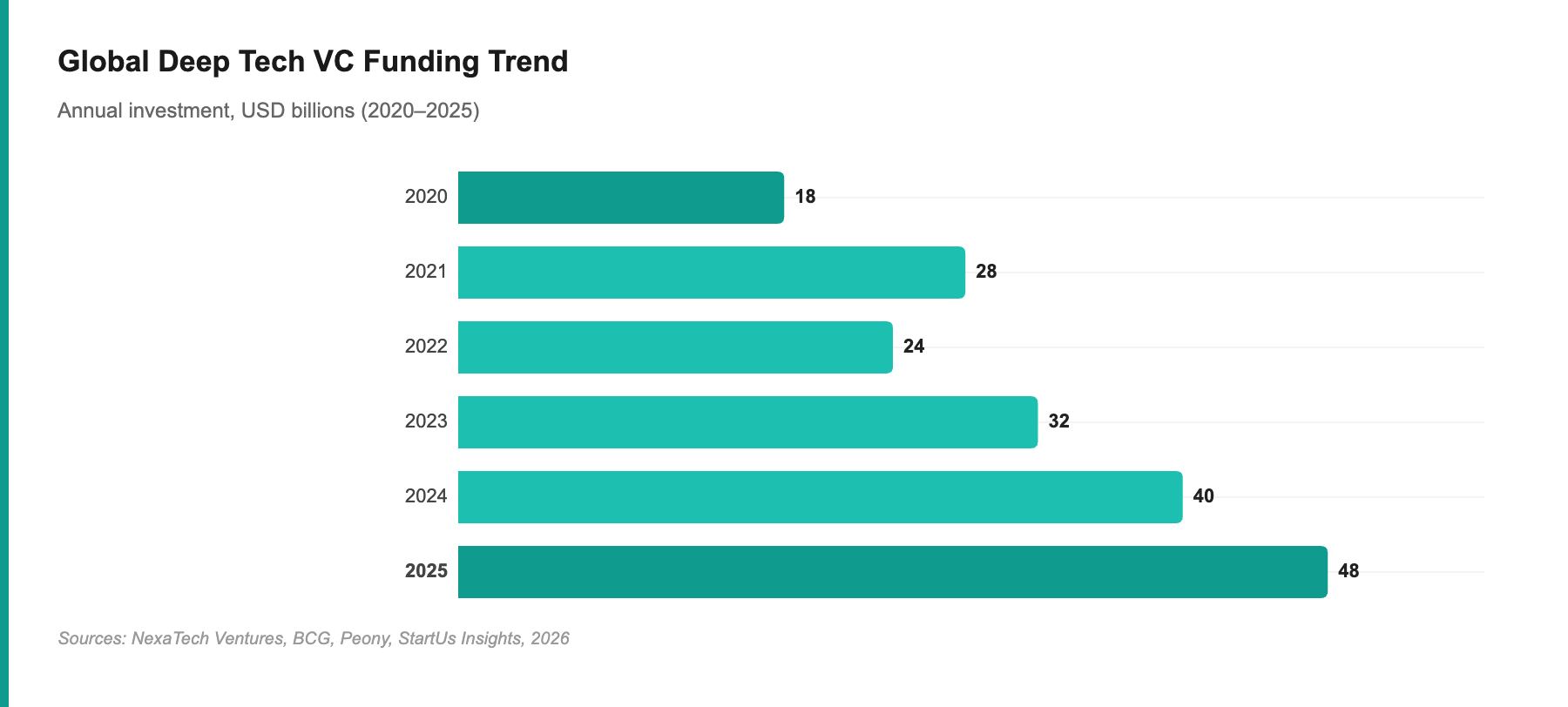
Global deep tech venture investment reached $48 billion in 2025, up from $18 billion in 2020 — a 167% increase in five years. (Source: NexaTech Ventures) Boston Consulting Group estimates deep tech now accounts for roughly 20% of all global VC deployment, double its share from a decade ago. (Source: Peony/BCG) European deep tech VC alone hit $20.3 billion in 2025 — 32% of all European venture capital, an all-time high. (Source: Peony)
The signal isn’t the absolute dollars. It’s the compression of timelines. Mega-rounds — $100 million or more at early stages — are now standard in capital-intensive deep tech fields. And one of the most instructive examples of this compression is a Dubai-based company building computing devices that fit on a human retina.
Are you a C-suite leader or portfolio company operator making capital allocation decisions in an AI-first world? LeaderbookAI helps executives and their portfolio organizations turn market signals like these into decisions and competitive advantage. More on that at the end.
In July 2025, XPANCEO — a four-year-old company with fewer than 100 employees — raised $250 million in a Series A round at a $1.35 billion valuation. (Source: TechFundingNews) The round was led by Opportunity Venture Asia, which had also led the company’s $40 million seed round in 2023, bringing total funding to $290 million across two rounds. (Source: Tracxn)
By any metric, this is a structural outlier. The XPANCEO Series A was the largest Series A ever raised in the MENA region, the largest globally in AR/VR and wearables, and ranks among the top three hardware Series A rounds in history. (Source: Optica/GITEX)
What XPANCEO is building — smart contact lenses that display AR data, monitor biomarkers including blood glucose, and eventually enable night vision — sits at the intersection of four converging markets: smart wearables, AI-powered XR, continuous health monitoring, and next-generation computing interfaces.
Each of those markets is accelerating independently. Together, they create a capital story that PE and venture allocators cannot afford to dismiss as science fiction.
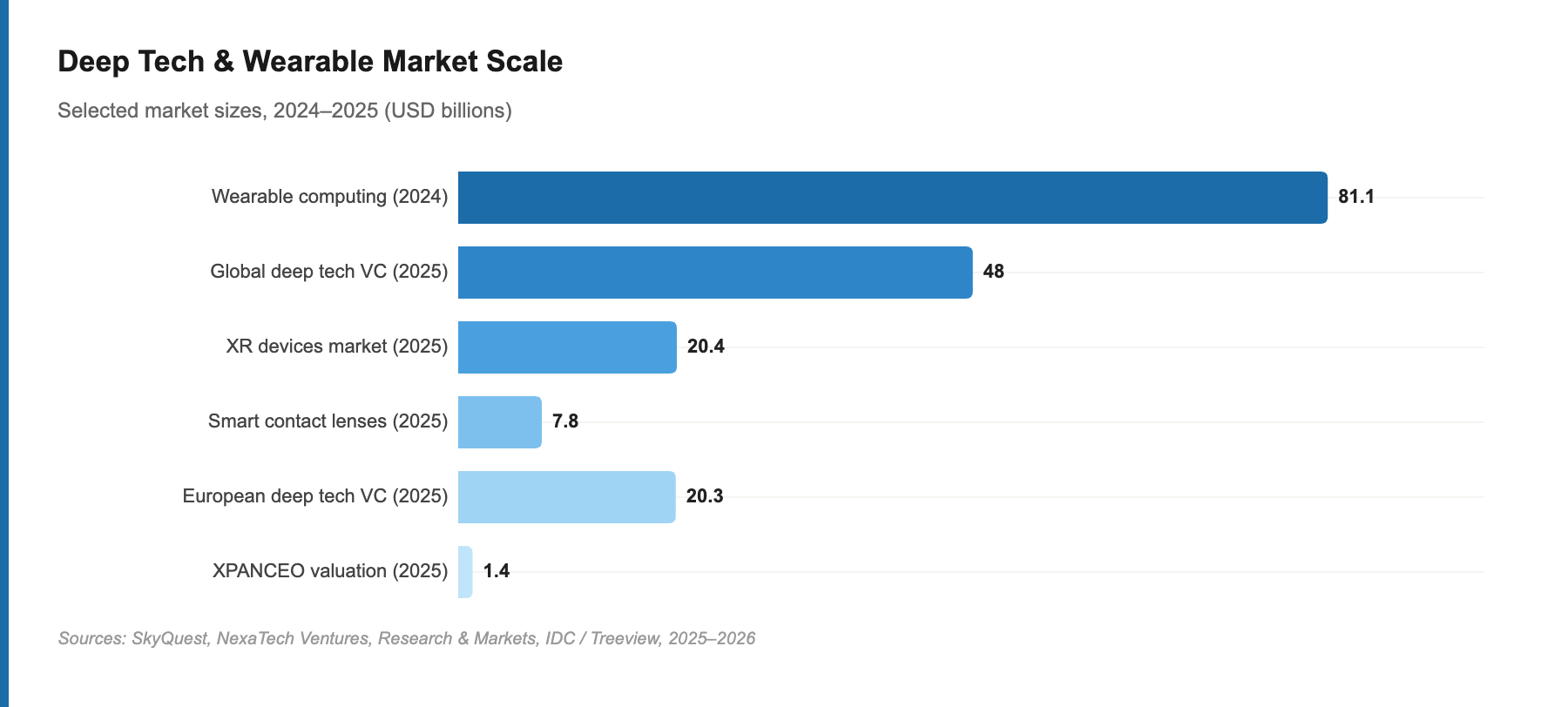
The smart contact lens market alone carries significant ambiguity in analyst estimates — a range that itself tells a story. Depending on methodology, the market is sized anywhere from $604 million (Fortune Business Insights) to $7.8 billion (Research and Markets) for 2025–2026. (Sources: Fortune Business Insights, Research and Markets)
That discrepancy reflects a genuine structural debate: is this a medical device market (narrow, regulated, clinical) or a consumer electronics market (broad, fast-moving, platform-driven)? XPANCEO’s bet — and the thesis behind a $1.35 billion valuation with zero commercial revenue — is that it becomes both, sequentially. Clinical and industrial applications first. Consumer platform later.
The XR market context is cleaner. The global XR device market reached an estimated $20.4 billion in 2025, with device shipments growing 44.4% year over year. (Source: SQ Magazine) IDC forecasts another 33.5% shipment growth in 2026. Smart glasses — not VR headsets — drove the majority of 2025 growth, with Meta’s Ray-Ban collaboration selling more than 2 million units by mid-2025, sales tripling in Q2 alone. (Source: Treeview)
The broader wearable computing market, which encompasses this entire ecosystem, was valued at $81.1 billion in 2024 and is projected to reach $424.8 billion by 2033, growing at a 20.2% CAGR. (Source: SkyQuest)
The money flowing into deep tech hardware is not undisciplined enthusiasm. It follows a pattern. Capital consolidates around three conditions: defensible IP, demonstrated prototype capability, and a market timing thesis the investor can articulate to their own LPs.
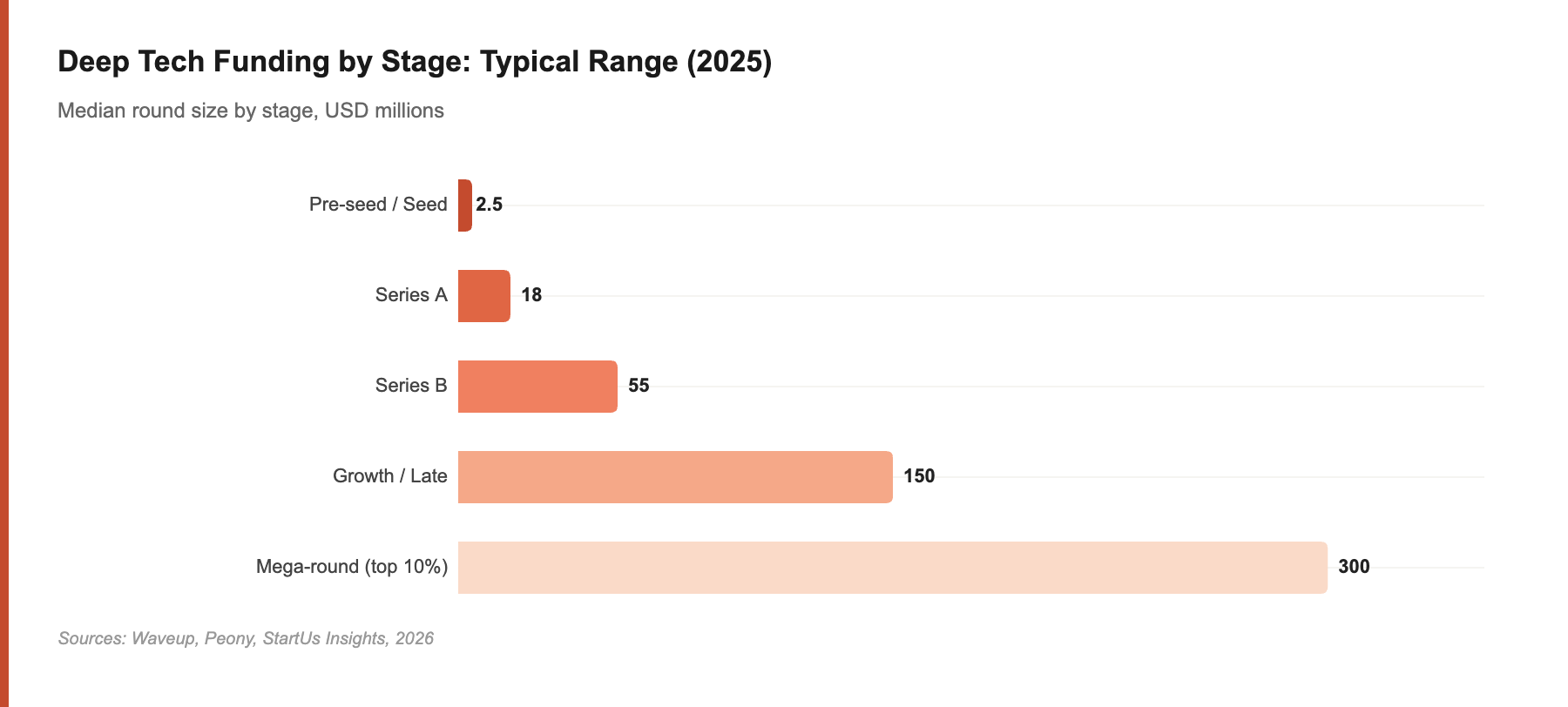
XPANCEO’s fundraising arc illustrates this clearly. The $40 million seed round in 2023 was a conviction bet on the founding team and thesis — Roman Axelrod, the serial entrepreneur, and co-founder Valentyn Volkov, one of the world’s most recognized physicists in nanophotonics and advanced materials. No commercial product. No regulatory approval. A vision and a roadmap.
The $250 million Series A in July 2025 — 24 months later — was something different. By that point, the company had developed 15 working prototypes across multiple functional categories: AR display, wireless power transfer, biomarker sensing, night vision. (Source: Road to VR) Patents were filed. A clinical-trials timeline was in place. The prototype de-risked the technology; the patent portfolio de-risked the competitive position.
By MWC 2026 in Barcelona, XPANCEO was presenting 28+ prototypes across multiple generations and a fully integrated prototype — combining image display, health monitoring, and wireless power — scheduled for public unveiling in early 2027. (Source: Optica/MWC 2026)
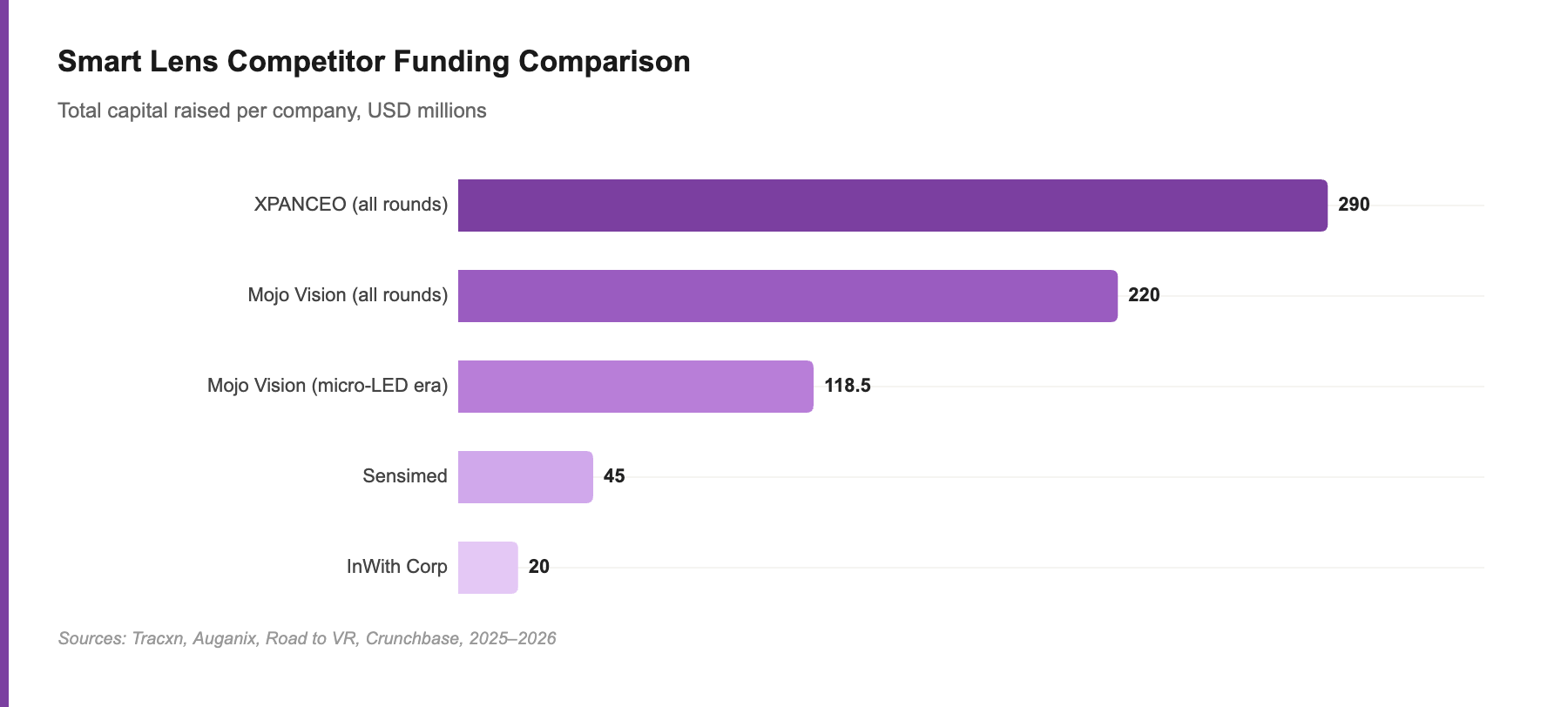
The competitive landscape in smart contact lenses is thin precisely because the barrier to entry is extreme. Mojo Vision — which raised over $200 million for its AR contact lens project — pivoted away from the form factor entirely in 2023 due to funding challenges, refocusing on micro-LED display commercialization for headsets. (Source: Heise) By September 2025, Mojo had raised another $75 million for its display business. (Source: Auganix) XPANCEO is now the only well-capitalized company actively developing a full-stack smart contact lens.
For C-suite leaders and portfolio company operators: The players winning in deep tech hardware share a structural trait: they solved for IP and prototype before fundraising at scale — not the other way around. LeaderbookAI gives executives and portfolio teams the market signals to stay ahead of where capital is moving. See how it works →
The smart contact lens competitive map breaks into three tiers.
Tier 1 — Full-stack AI-powered XR lens: XPANCEO is the only player here with significant capital and active prototype development. The company’s thesis is that the contact lens is the ultimate computing interface — not a peripheral, not a medical device, but the primary hardware layer of the post-phone computing era.
Tier 2 — Medical / clinical monitoring: Sensimed (Switzerland) has an FDA-approved lens for intraocular pressure monitoring in glaucoma patients — the most commercially advanced product in the space. Johnson & Johnson Vision partnered with Mayo Clinic in May 2025 to co-develop biocompatible materials for medical-grade smart lenses. (Source: Emergen Research) These players are building narrow clinical applications with regulatory approval already in hand or in progress.
Tier 3 — Adjacent technologies: Mojo Vision (micro-LED), Innovega (optical overlay systems), and Google/Verily (glucose monitoring, now dormant) represent the prior generation of smart lens investment — each of which either pivoted, stalled, or shifted to adjacent applications.
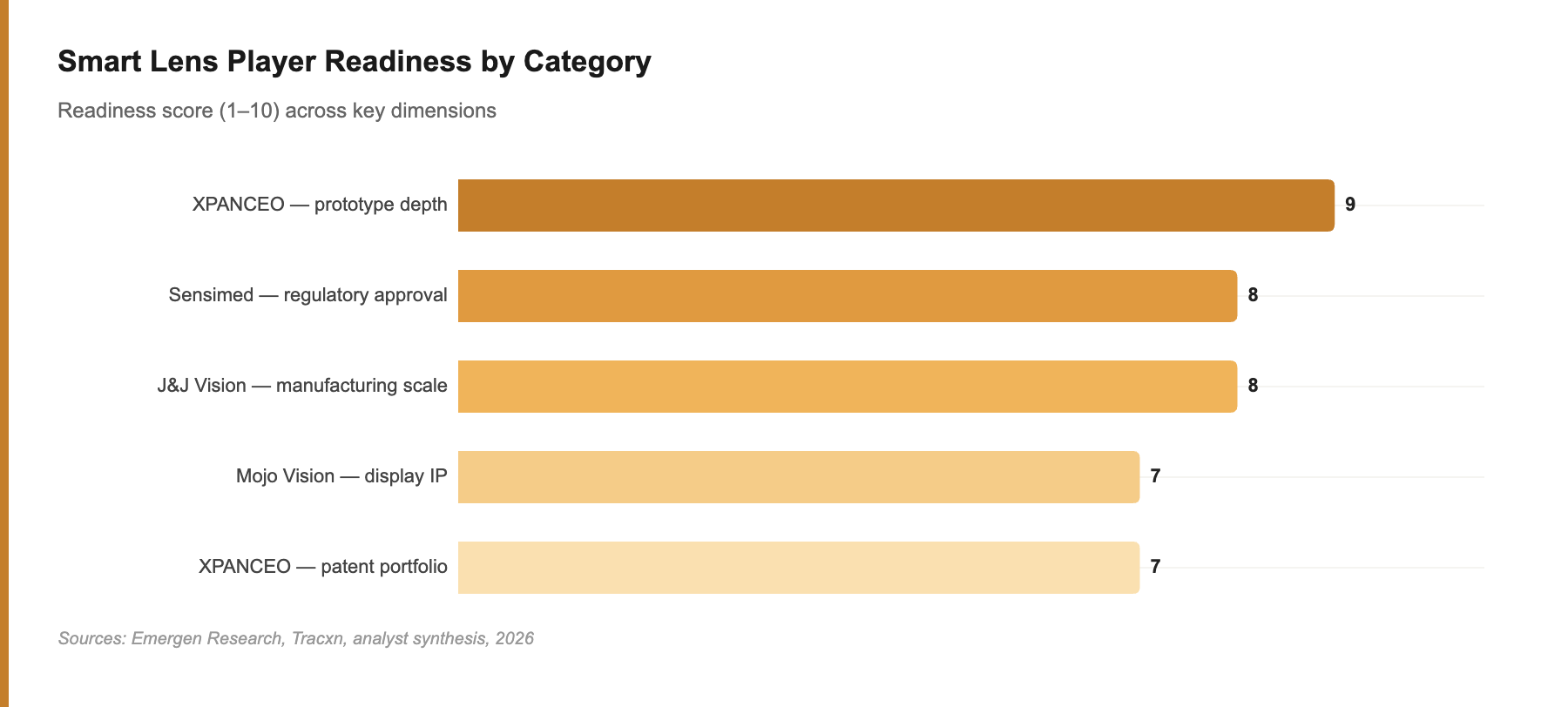
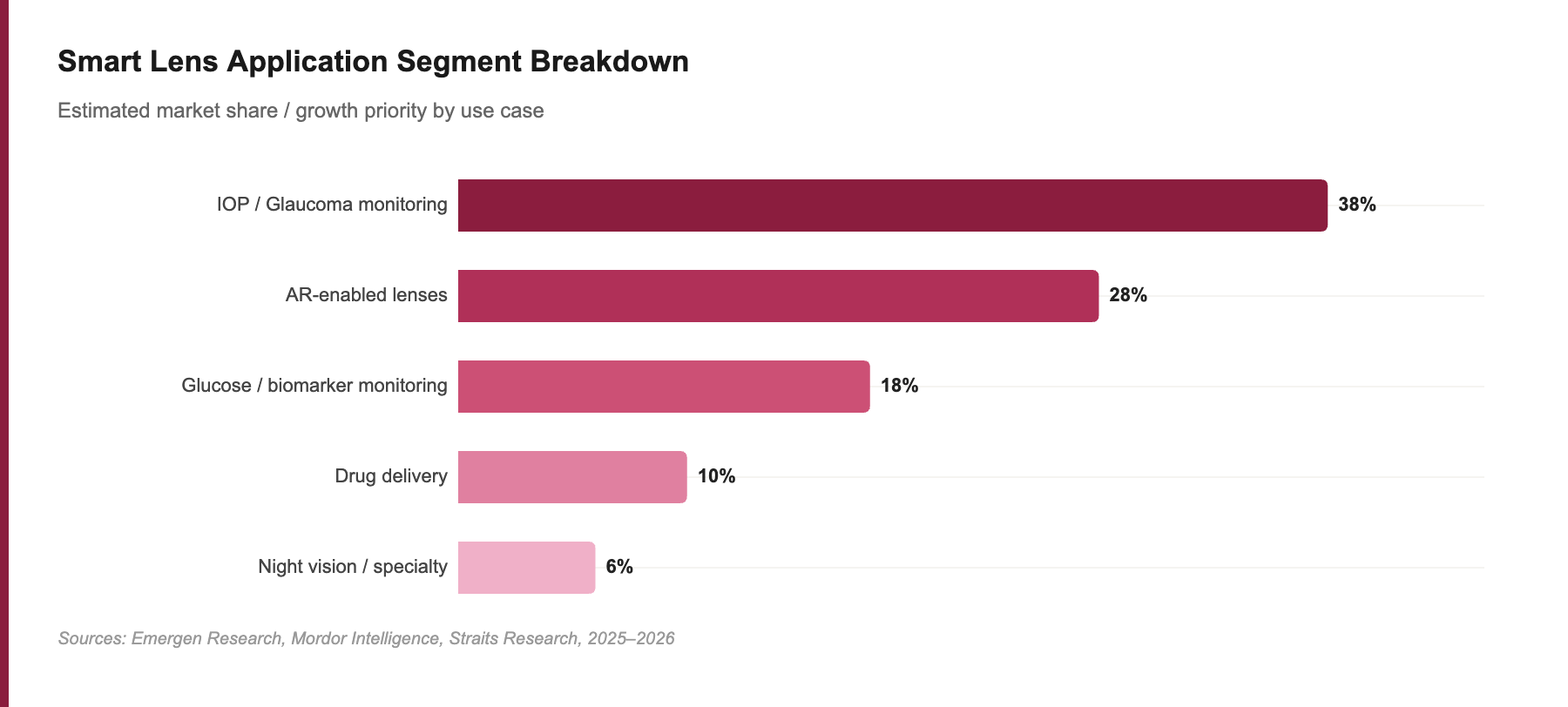
The pattern here matters for portfolio analysis. The medical monitoring lane (Tier 2) has regulatory clarity and a known reimbursement path — intraocular pressure monitoring for the estimated 80 million glaucoma patients worldwide is a solved market. The XR computing lane (Tier 1) has the larger prize but the longer timeline and the more complex regulatory path.
XPANCEO is attempting both, sequentially. Industrial and medical use cases first — hands-free AR for Formula 1 drivers, military applications, surgical settings — then consumer. It’s a defensible sequencing strategy. The question any investor must answer is whether the capital can sustain the timeline.
“I do not want to build next startup, I want to build next generation of computing. I do not want to do anything else with my life, at least now.” — Roman Axelrod, Founder & CEO, XPANCEO
The geography of deep tech investment in 2025–2026 tells a story most Western investors are underweighting.
XPANCEO is Dubai-based. Its $250 million Series A is the largest venture round ever raised in MENA by a considerable margin, and its unicorn status makes it the UAE’s twelfth unicorn. (Source: TechFundingNews) The UAE’s total tech funding climbed to $2 billion in the first nine months of 2025 alone.
MENA is not a peripheral market for deep tech — it’s becoming a capital source for technology that Western VC has historically been too short-cycle in its thinking to sustain.
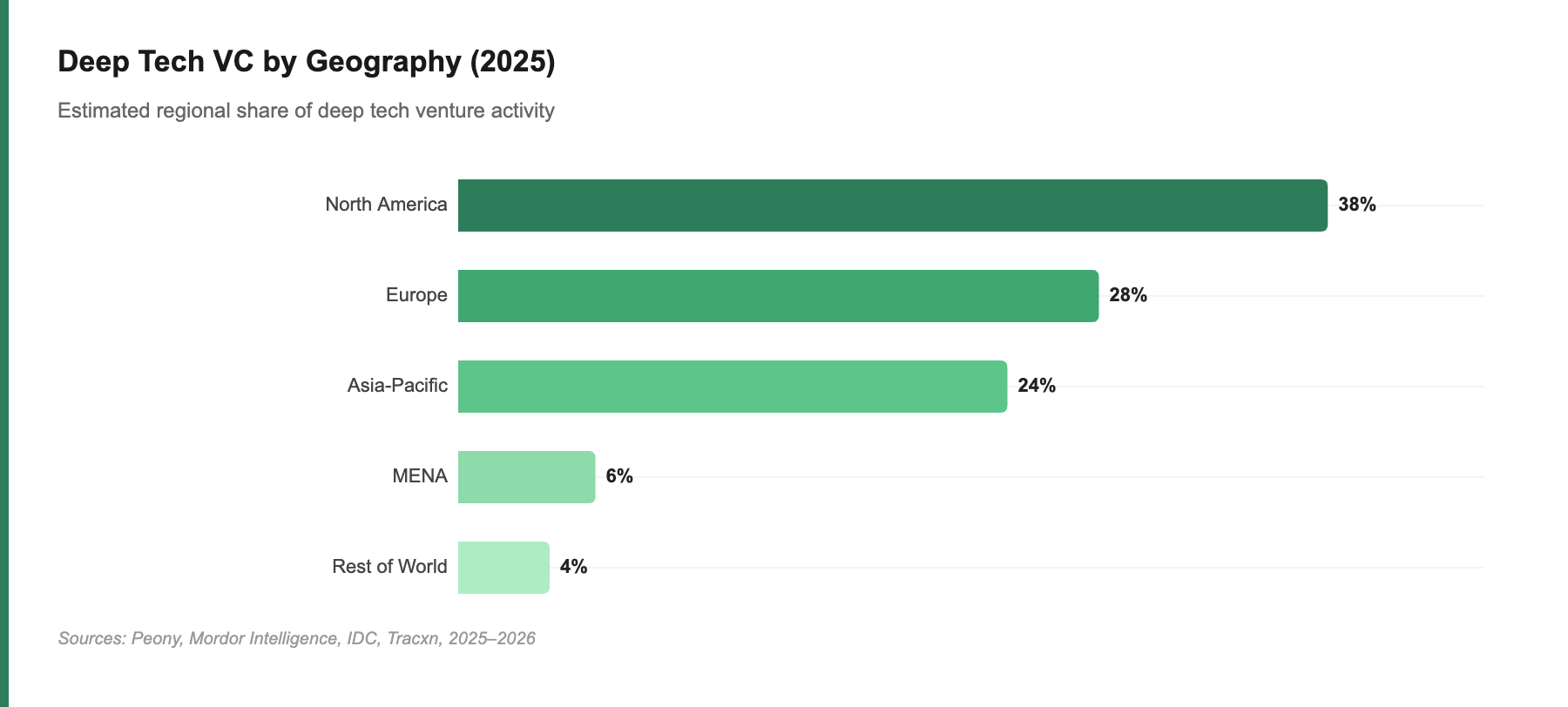
Asia-Pacific’s XR growth rate — 41.2% CAGR through 2031 — is not an accident. Large diabetic populations (continuous glucose monitoring is a massive healthcare need in India and China), strong electronics manufacturing ecosystems, and government investment in digital health infrastructure create compounding advantages. (Source: Mordor Intelligence)
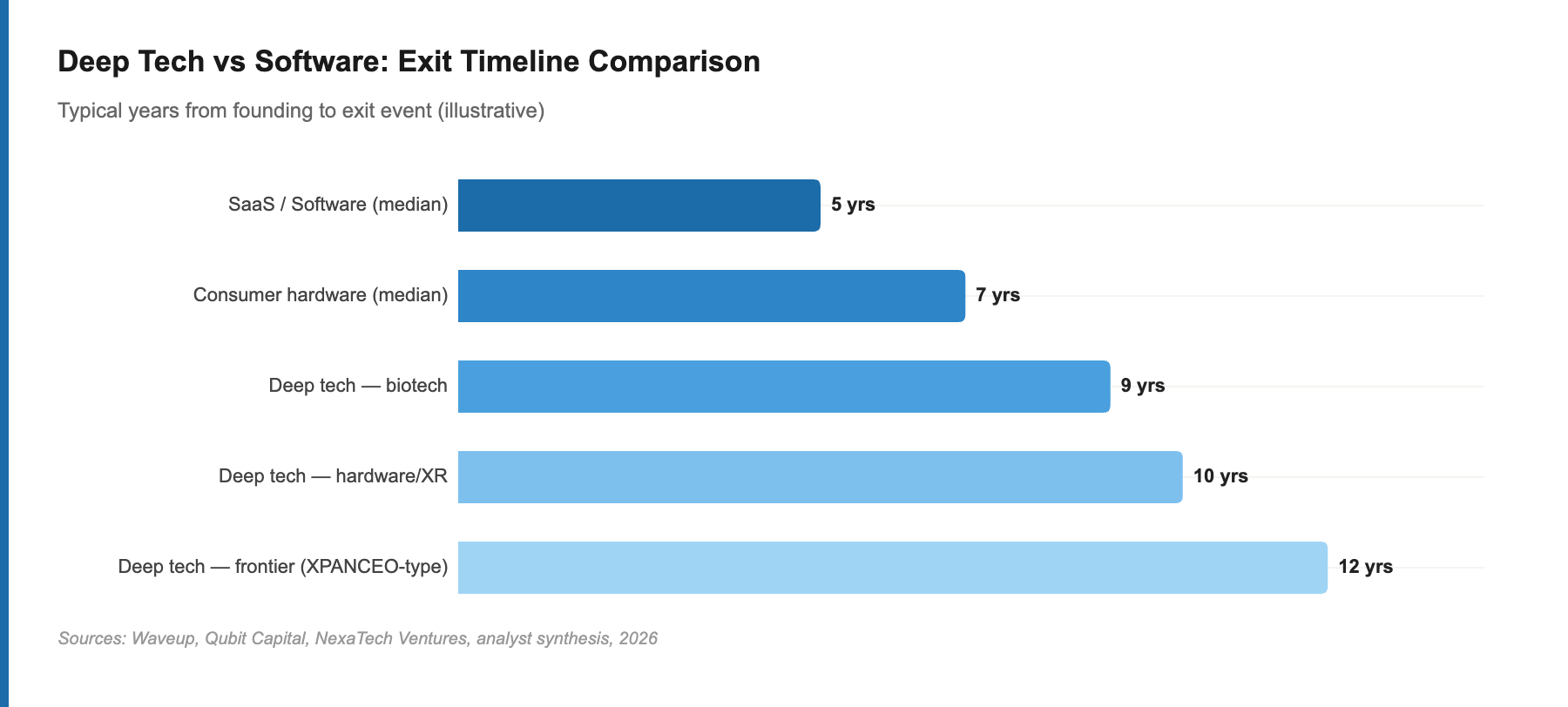
The exit math for deep tech is fundamentally different from software, and it’s important that PE allocators and portfolio operators understand the distinction before drawing false comparisons.
XPANCEO’s integrated prototype is scheduled for public unveiling in early 2027. Clinical trials targeting human approval will run through 2026–2027. Commercial product targeting is 2027–2028 for initial form factors. (Source: The Gadgeteer) This is not a 3-year venture hold. This is a 7–10 year capital commitment with regulatory milestones as the critical path.
The exit scenarios that make sense for this asset class:
Strategic acquisition: The most likely near-term path. The IP portfolio XPANCEO holds — patents across microdisplay, wireless power, biomarker sensing, nanoparticle optics — is inherently attractive to Apple, Google, Samsung, or Meta. Any of the platform companies building next-generation computing interfaces would pay a significant premium for a head start on the form factor. Apple’s reported halt of Vision Pro production in late 2025 and the subsequent search for next-generation form factors makes the acquisition thesis even more credible. (Source: SQ Magazine)
IPO (2029–2031): Contingent on commercial product launch and demonstrated clinical safety data. The comparables — medical device companies with platform IP + consumer electronics potential — trade at significant multiples of revenue. If XPANCEO achieves even 1% penetration of the 250 million contact lens wearers globally, the revenue base supports a public markets thesis.
Platform licensing: XPANCEO’s component technologies — the microdisplay system, the wireless power transfer, the biomarker detection platform — each have standalone licensing value to the larger electronics and healthcare supply chain.
The 2025 capital environment makes clear that investors have priced in the patience required. A $1.35 billion valuation on a pre-revenue company with 28 prototypes and a 2027 commercial target is an explicit bet on technical feasibility, IP defensibility, and market timing.
1. The “hardware graveyard” thesis is dead — and your portfolio assumptions may not have caught up.
For two decades, the conventional wisdom in venture was that hardware kills returns. Long cycles, high capex, thin margins. That calculus has inverted. Global deep tech VC tripled in five years. The $48 billion deployed in 2025 reflects a market that now understands how to structure hardware bets — patents first, prototype second, capital at scale only after de-risking the technology. If your portfolio allocation model still discounts hardware on principle, you are operating on stale assumptions.
2. The bootstrapping-to-mega-round pattern is the new diligence signal.
XPANCEO spent nearly two years bootstrapping before raising external capital. The $40 million seed followed 15+ prototype cycles and multiple patent filings. The $250 million Series A followed demonstrated technical progress across six functional prototype categories. This sequencing — internal conviction → IP → prototype → external capital — is the pattern that separates fundable deep tech from speculative deep tech. As a diligence lens, it works. The companies that raise big before demonstrating technical feasibility are the ones that fail. The ones that demonstrate before asking are the ones worth underwriting.
3. MENA is not a footnote in the global deep tech story — it is a capital source.
The UAE’s production of XPANCEO as its twelfth unicorn, with the largest Series A in the region’s history, is a structural signal about where patient capital for long-cycle deep tech is being deployed. Western PE and VC is not the only game. Sovereign-adjacent funds, family offices in the Gulf, and MENA growth vehicles are actively competing for the same assets — and often with fewer return timeline constraints than institutional LPs in the West demand. Ignoring this geography in deal flow and co-investment strategy is an error.
4. The co-founder model for deep tech is a specific leadership structure — and failing to recognize it is a talent mistake.
XPANCEO’s founding structure — a business operator paired with a world-class scientist — is not a coincidence. It is a template. The Axelrod-Volkov partnership, with one partner responsible for science and one for execution, mirrors the founding structures of the most successful deep tech companies in history. When evaluating deep tech investments, the co-founder dynamic is as important as the technology. A great physicist without an execution partner cannot build a company. A great operator without a world-class scientist cannot build the thing. The pair is the unit of analysis, not the individual.
5. The smart contact lens is not the product — it is the interface for the next computing platform.
This is the framing error most analysts make when evaluating XPANCEO and the broader smart lens category. The contact lens is not a wearable gadget. It is the proposed primary interface for AI-powered XR computing — the layer between human cognition and the next generation of digital infrastructure. If that thesis is correct, the market is not the $7.8 billion smart lens market. It is the multi-trillion-dollar computing platform market. That is the bet Opportunity Venture made twice. It is worth asking whether your portfolio has any exposure to it.
For executives and portfolio leaders acting on signals like these: LeaderbookAI is built for C-suite leaders and the portfolio companies they oversee — helping teams move from insight to action. Book a demo with the LeaderbookAI team →
This week’s LeaderbookAI podcast goes deeper on exactly what this article covers — with the founder who built it.
Roman Axelrod, Founder and CEO of XPANCEO — the man who bootstrapped a deep tech company for two years, convinced a handful of the world’s best physicists to join him, and raised $290 million to build a computer that fits on a human retina.
This conversation is one of the most candid accounts of deep tech leadership available anywhere. Axelrod talks about what it actually cost — financially, personally, organizationally — to build a company that takes years to demonstrate and even longer to commercialize. He doesn’t hedge. He doesn’t sell. He explains exactly what it takes.
In this episode:
Why the family and the investors both told him he was ruining his career — and why he ignored them
How XPANCEO recruits from a talent pool of a few thousand qualified people globally — and why money alone doesn’t close the best ones
What the co-founder relationship in deep tech actually requires, and why the Axelrod-Volkov partnership had to invent its own operating model
Why vision in a deep tech company is not a pitch — it’s an operating requirement
“In case you want to make billions of dollars, literally billions, you should make a traditional startup and not do Deep Tech. Deep Tech is probably the worst way to make a big amount of money.” — Roman Axelrod, Founder and CEO, XPANCEO
The companies that build the next computing platform will not emerge from a pivot or a sprint. They will come from founders who spent years in the dark, running prototype cycles that fail for reasons that have nothing to do with talent, building IP that looks like a cost center until the day it becomes a moat, and persuading world-class people to join a mission that most of their peers thought was impossible.
That is the pattern XPANCEO is following. It is also the pattern behind every major computing transition in history — from the mainframe to the PC to the smartphone. The transition is always slower than the optimists claim and faster than the skeptics allow. The capital is flowing. The prototypes exist. The regulatory path is defined if not yet cleared.
For PE investors, the actionable question is not whether this technology will exist. It is whether your portfolio has any exposure to the companies building it — and whether your diligence frameworks are calibrated to evaluate them fairly. A company with 28 prototypes, $290 million in funding, a filed patent portfolio, and a world-class science team is not a bet on the future. It is a bet on execution.
Execution is what LeaderbookAI is built to assess. The organizations that get this right will not be the ones that got lucky on the technology. They will be the ones that built the leadership and operational infrastructure to survive the timeline.
The timeline, as Roman Axelrod would tell you, is the whole game.
LeaderbookAI is an AI platform built for C-suite leaders and the portfolio companies they lead. We help executives develop the judgment and decision-making frameworks for an AI-first world — and give portfolio organizations the market intelligence, leadership coaching, and strategic tools to compete at the speed AI demands.
If this analysis was useful, LeaderbookAI was built for people like you.
Explore LeaderbookAI → Request a demo · leaderbook.ai
No posts
Comments
Nothing yet. Say the first thing.
Sign in to join the conversation.