
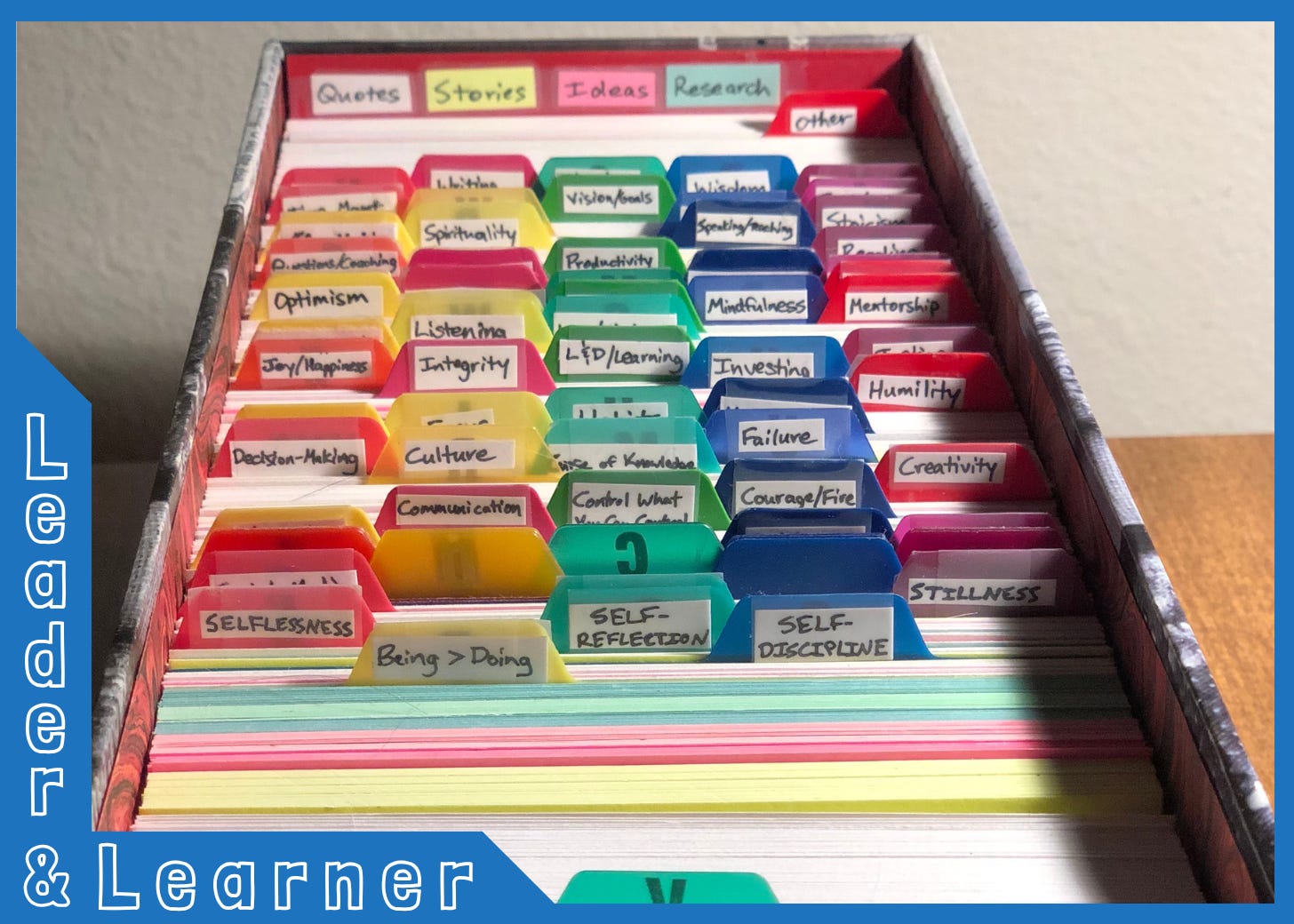
For years, I came across brilliant quotes, stories, data, and ideas that I figured I’d want to reference later, but I had no way to save them.
Months (or years) later, I’d sit down to write an article or prepare a speech, and I drove myself crazy because I knew I had heard the perfect example to include, but I couldn’t find it ANYWHERE.
So frustrating.
This is how I lived for many years, and it drove me nuts. But then, I stumbled across a helpful process called “commonplacing” that forever resolved my issue.
If you’re unfamiliar with the concept, I’ll give you an overview of the basics. And if you’re already familiar with commonplacing, we can compare notes on which tactics have been most helpful.
Commonplacing is the act of compiling knowledge for future reference. Countless people throughout history have created commonplace books to catalog the knowledge they’ve learned from life experience, books, mentors, and peers.
While many people use a physical book for this practice, any cataloging system can serve the same purpose: 3x5 cards, Evernote, Notion, etc.
“Scholars, amateur scientists, aspiring men of letters — just about anyone with intellectual ambition in the seventeenth and eighteenth centuries was likely to keep a commonplace book. In its most customary form, ‘commonplacing,’ as it was called, involved transcribing interesting or inspirational passages from one’s reading, assembling a personalized encyclopedia of quotations.” -Steven Johnson
Many people throughout history have used commonplace books. The practice was widespread in the Middle Ages and the Renaissance, and savvy writers and thinkers still use commonplacing today.
Marcus Aurelius (121–180 AD) kept a commonplace book that was effectively turned into the book Meditations, a core text of Stoic philosophy.
Erasmus (1466–1536) is known as the father of modern commonplacing, popularizing the concept in his book De Copia in 1512. He subdivided his book into categories of virtues and vices, like piety and fidelity.
John Locke (1632–1704) wrote an entire book about the practice: A New Method of Making Common-Place-Books. According to author Nicholas Basbanes, “Locke gave specific advice on how to arrange material by subject and category, using such key topics as love, politics, or religion. Commonplace books, it must be stressed, are not journals, which are chronological and introspective.”
Thomas Jefferson (1743–1826) kept two separate commonplace books: one for legal notes and another for literary ones. He recorded entries in English, Latin, and Greek, primarily noting favorite quotes from books he read.
E.M. Forster (1879–1970) used his commonplace book to record quotes, comments on what he was reading at the time, interesting tidbits he overheard in others’ conversations, and ideas for future novels.
Ronald Reagan (1911–2004) used a notecard system to record stories and jokes to use in speeches. “He had all this stuff he had stored up all these years — all these stories, all these anecdotes,” said Reagan’s speechwriter Ken Khachigan. “He had the Reagan library in his own little file system.”
Ryan Holiday, author of bestsellers like Ego Is The Enemy and Perennial Seller, is a famous modern proponent of commonplacing and has written about his process in blog posts.
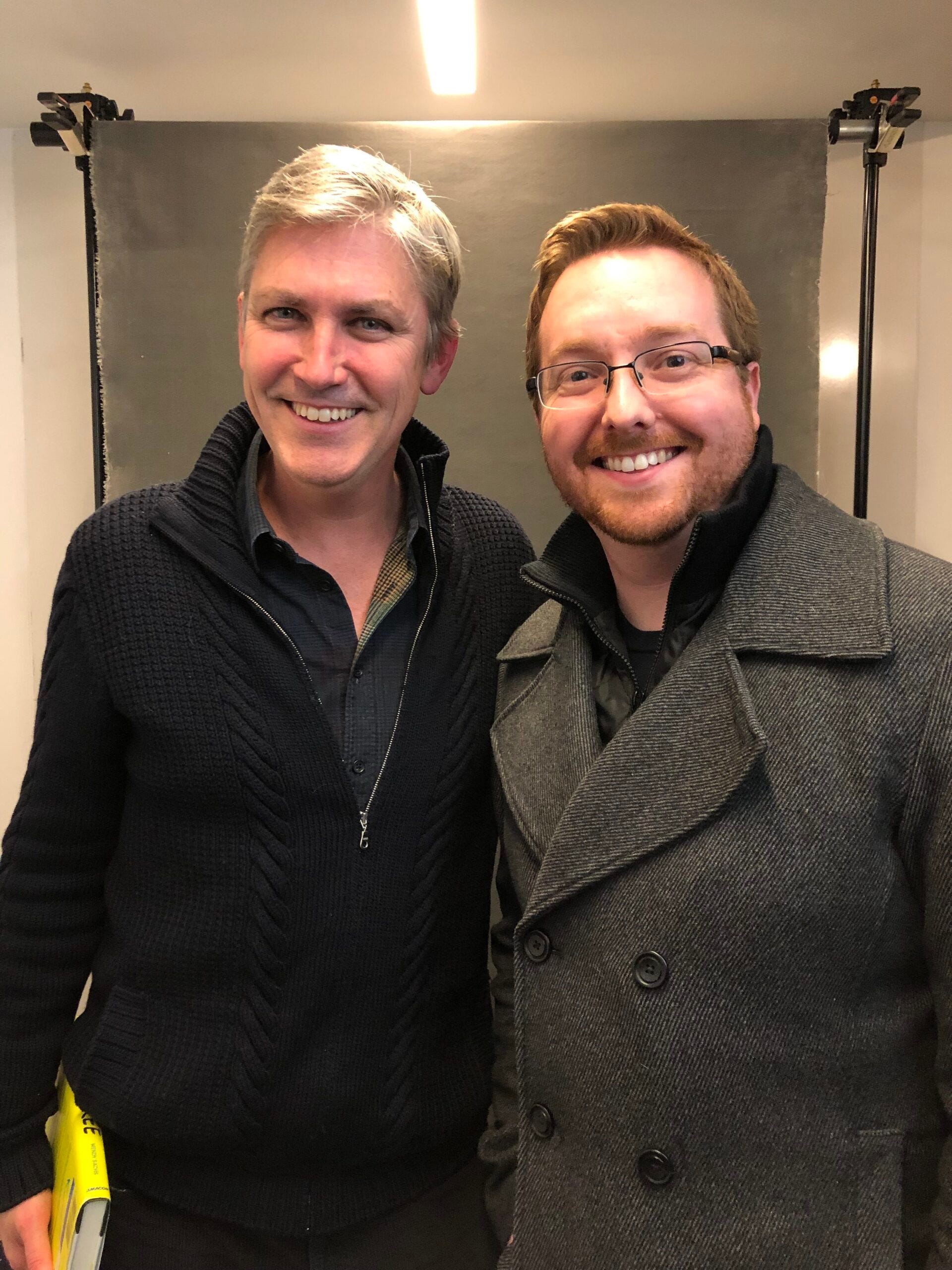
Steven Johnson has written 11 books across a wide variety of topics, including psychology, science, and technology. Years ago, I had the chance to meet Johnson and hear him speak. He credited his prolific writing to commonplacing, saying that he records random notes and musings in a 100,000-word Google Doc.
I adapted my commonplace book from a system used by Ryan Holiday, who adapted his from bestselling author Robert Greene.
I started off using 3x5 notecards for my system, then eventually navigated over to using Obsidian. But for the purposes of this post, I’m focusing on the 3x5 card process because it’s the easiest way to understand and visualize the process.
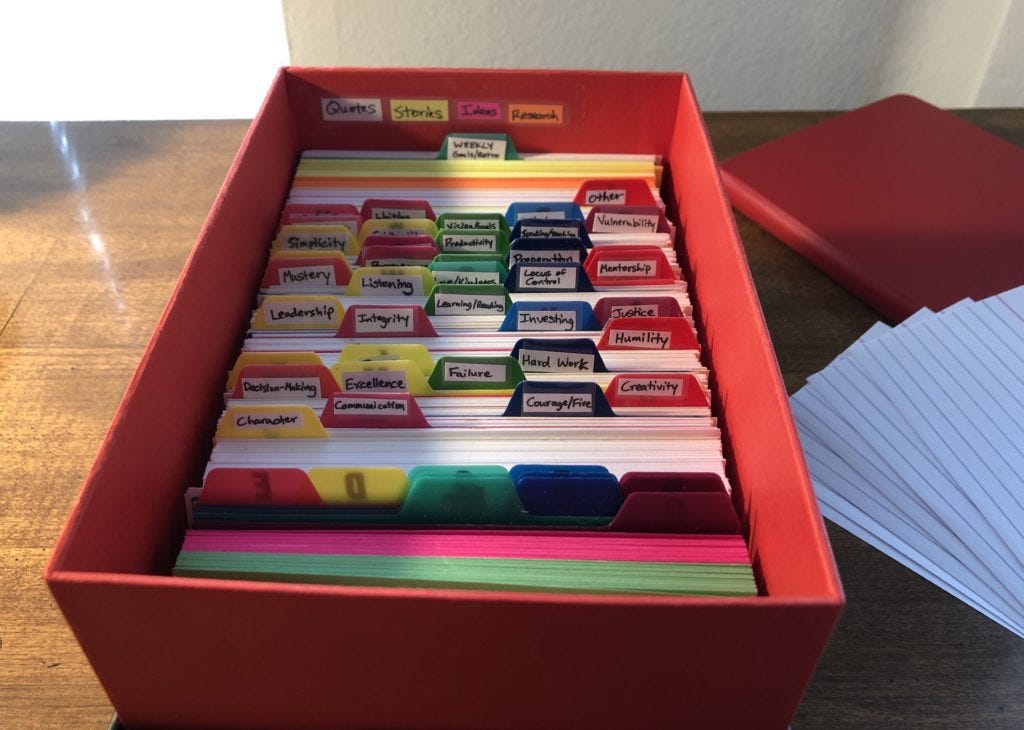
The entire setup for my commonplace book (pictured above) cost about $20. I bought a few packages of 3x5 cards and two batches of index card dividers, then turned an old Beats by Dre headphones box into my storage container.
I use white notecards for quotes (the most common notes I save), yellow for stories, pink for ideas, and orange for research/data.
In the top left corner of each card, I label each card with a category (like “Hard Work” or “Writing”), then sort the cards by category with the 3x5 notecard dividers.
For example, when I read the book How Will You Measure Your Life?, I stumbled across this gem that I wanted to remember later:
“If you want to help other people, be a manager. If done well, management is among the most noble of professions.” -Christensen, Allworth, & Dillon
After stumbling across this quote, I wrote it on a white 3x5 card and labeled it with the category “Leadership/Management,” then filed it away in that section of my box.
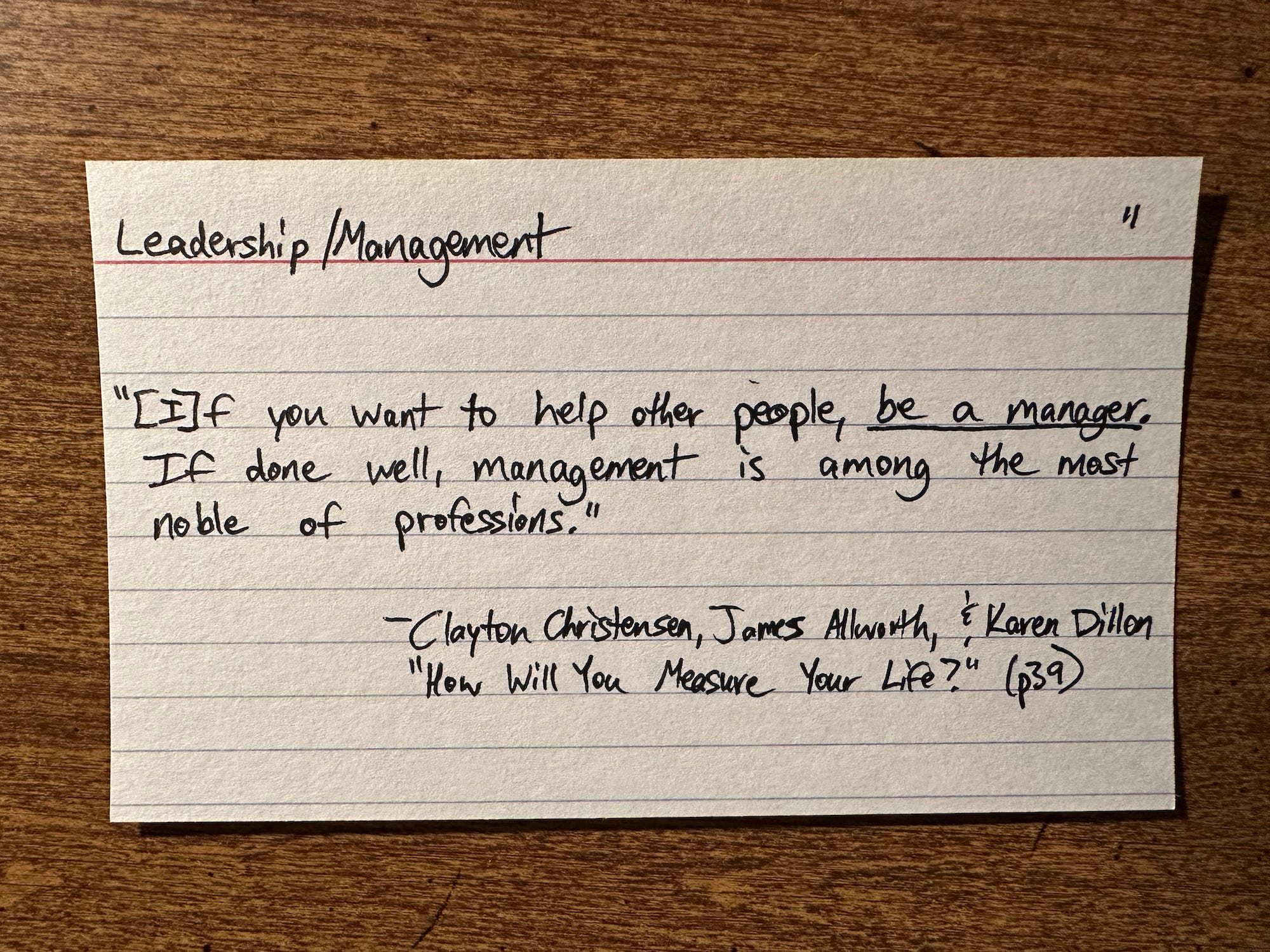
Later, when I was looking for the right quote to open the first chapter of my book for new managers, I just grabbed the stack of cards about leadership and quickly found this quote. It was a perfect fit.
If you’re a teacher, author, pastor, politician, speechwriter, trainer, journalist, or any other role who frequently has to tell stories, present lectures, build presentations, or write articles, you need a way to catalog the ideas you find.
After using a commonplace book for the better part of a decade, I’ve seen time and again how necessary it is to record these ideas. Doing so allows me to access hundreds of quotes and stories I otherwise would have forgotten.
Rather than poring through marginalia in old books to find useful quotes, I have my primary notes about a topic in a common place. When I’m writing articles, this process eliminates hours of research and helps me write much faster.
For some articles, my commonplace book has cut my writing time in half. Same for some of the talks and presentations I’ve given.
Creating a commonplace book has revolutionized my writing, thinking, and speaking. I’m confident it will help you too. Give it a shot and let me know how it goes!
Comments
Nothing yet. Say the first thing.
Sign in to join the conversation.