
We - as a society - are spending unheard of amounts of money on AI. As we have discussed in prior posts, the AI infrastructure buildout is already large enough to qualify as a historical capital supercycle. Measured as a share of GDP, AI sits in the same family as prior U.S. infrastructure supercycles.
Today, we are going to take a look at railroads in the 1870s. Investment in railroads was enormous. It peaked at 7.7% of US GDP. AI currently sits at 1.6%, which is less, but still in the top ten.
The 1870s might seem like a long time ago and railroad buildouts may seem irrelevant to us today, but (1) infrastructure supercycles in the modern era are few and far between, so we can certainly learn something from trains, and (2) trains are cool.
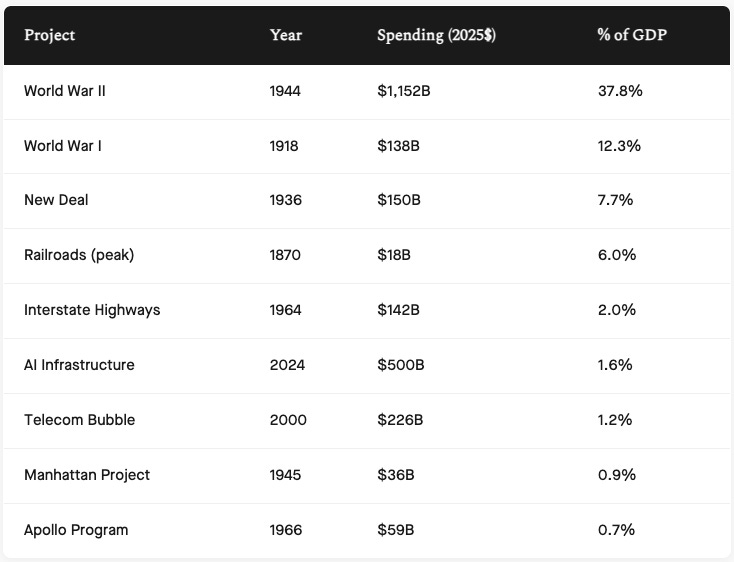
(Table source: Thomasz Tunguz, VC).
The relevant comparison for railroads and AI is not technology type, but capital intensity relative to the size of the economy. Railroads, electrification, highways, and telecom all share the same pattern: rapid scaling of a foundational network, followed by saturation and consolidation. It’s likely that AI will follow the same pattern that railroads did.
Railroads: a major infrastructural investment that paved the way for a modern economy in the USA
The railroad expansion in 19th-century America was driven by a combination of industrial demand, territorial expansion, and financial innovation. The federal government supported land grants and favorable regulatory conditions, while private capital—domestic and European—financed construction at scale. Railroads were treated as both infrastructure and financial assets, which made them unusually attractive to investors relative to the productive capacity of the early industrial economy.
Railroad capital formation expanded from a relatively small base in the 1860s to a dominant share of national productive investment by the end of the century. In 1860, railroad securities were worth $1.8 billion USD; less 40 years later, they had quintupled to $10.6 billion USD (1987).
The result was aggressive network expansion across multiple competing firms, often building parallel lines between the same endpoints. This was not coordinated planning; it was competitive overcapacity. Each company rationally expanded its own network to capture routes, but collectively the system produced redundancy.
Overbuild took a specific form:
Multiple rail lines serving identical corridors
Excess station infrastructure in low-demand regions
Debt-financed expansion ahead of realized freight demand
Price competition that reduced profitability across operators
By the late 19th century, the system stabilized through consolidation. Larger railroad trusts absorbed weaker operators, standardized routes, and rationalized capacity. Financial restructuring followed physical overexpansion.
At its peak, railroad capitalization exceeded federal government debt, making private infrastructure markets larger than sovereign borrowing capacity. That inversion of scale is one of the clearest signals of a capital supercycle.
What we can learn from trains in the AI era
The structural takeaway is that network infrastructure tends to overshoot demand during its expansion phase. The mechanism is consistent: distributed private actors optimize locally, but collectively produce redundant capacity.
AI infrastructure shows the same early indicators:
Capital concentration in a small number of large builders
Parallel expansion of compute clusters across competing firms
Investment driven by strategic positioning rather than near-term utilization
Railroads suggest that this phase does not correct through demand matching alone. It resolves through consolidation and pricing power rebalancing after capacity exceeds efficient utilization. The critical variable is not whether overbuild happens, but how long it persists before coordination and consolidation reduce redundancy.
The railroad cycle is a historical template for how large-scale infrastructure investment ends when private capital builds faster than the underlying economic system can absorb it. AI is likely heading in that direction in the next 1-2 decades. We aren’t anywhere near the point where supply has exceeded demand, but we are likely to get there eventually. When that happens, expect consolidation (M&A, here we come!)
Unrelated fun fact about trains: Rotary Snow Plow trains exist. They clear tracks with a huge fan at the front of the train. Here’s a video of one at Donner Pass a few years ago.
No posts
Comments
Nothing yet. Say the first thing.
Sign in to join the conversation.