

Capital is flooding into IT infrastructure at a scale rarely seen outside of wartime mobilizations or nation-building projects. Major players are investing huge amounts: Microsoft ($140B), Google ($92B), and Meta ($71B) are some of the largest examples, and Open AI has announced plans to spend $295B in 2030 alone. Almost all of this is driven by the need to support the burgeoning demand for AI.
What’s going on here? The IT infrastructure landscape is fundamentally reshaping, and the scope is in-line with historical investment supercycles, including railroads, highways, and telecommunications, each of which represented spending worth 1-6% of GDP at the time.
When investment climbs toward multiple percentage points of GDP, the economy reorganizes. Using the prior examples: railroads compressed distance, highways rewired commerce, and telecommunications transformed productivity.
AI infrastructure now shows early signs of following the same pattern of high investment volumes prolonged over several years. While we are past the “is this a bubble?” questioning stage, we are still just at the beginning.
For context, here’s a table showing where AI sits compared to other investment supercycles (source: Thomasz Tunguz, VC). We can see that AI Infra sits just above “Telecom Bubble” and just below “Interstate Highways” in terms of spending as a percent of US GDP.
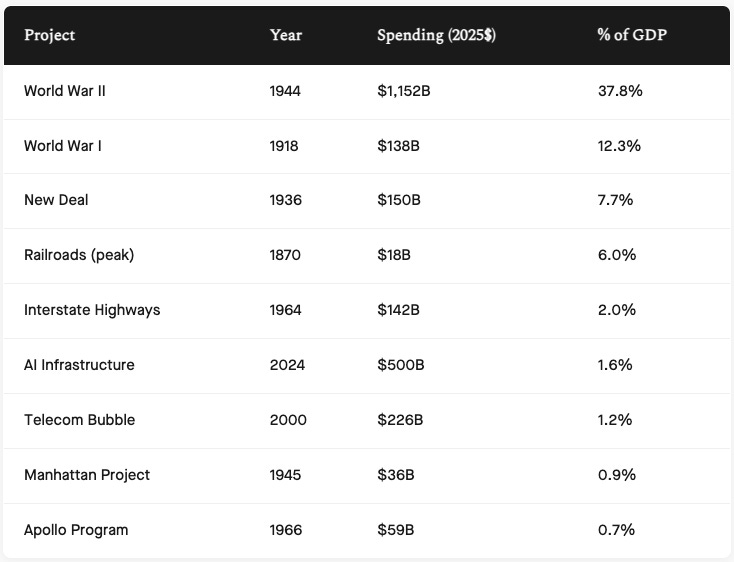
So what does this mean in terms of where we are in the investment supercycle? AI is already past speculative-bubble territory, but still well below the threshold historically associated with nation-building systems. If spending approached railroad intensity, it would require roughly $2.1 trillion annually, a 320% increase from today’s levels. S
While we are early in the investment cycle, we’ve seen that this investment is likely to be sustained for many years, as evidenced by the forward commitments from hyperscalers mentioned above. According to McKinsey, AI-focused data centers are likely account for over $5 trillion in infrastructure investment by 2030, and total data center spend will reach almost $7 trillion in capital expenditures.
Analysts estimate AI capex could grow between 20% annually to 50% annually, over the next few years, underscoring the dependency of broader market growth on continued investment. While ranges like this are often associated with significant forecasting uncertainty (e.g., bubble-like characteristics), infrastructure investments follow a somewhat predictable pattern that lasts at least the better part of a decade.
The implications follow directly from how infrastructure cycles behave.
First, this investment cycle will be prolonged. Data centers, semiconductor fabs, and power generation operate on multi-year construction timelines, which naturally extend spending waves once they begin.
Second, some degree of overbuild is historically typical, and we should expect to see that here, too. Railroads overexpanded, fiber networks overshot demand, and yet both ultimately underpinned decades of growth.
Finally, the scale of committed capital makes a rapid pullback unlikely; companies are already dedicating as much as 45–57% of revenue to infrastructure, levels described as historically unthinkable. The forward-looking statements made by the major hyperscalers indicate a commitment to brick-and-mortar infrastructure. Unlike other investment types (e.g, the metaverse), brick-and-mortar is much harder to just … spin down.
Put differently: the debate should shift from “Is this a bubble?” to “How long does the buildout last?” The evidence points toward at least a four-to-six-year investment cycle, supported by trillion-dollar forecasts, double-digit capex growth, and balance sheets already aligned around compute capacity. Supercycles rarely end because participants lose enthusiasm—they end when the physical network is finally built. AI infrastructure is nowhere close to that point today.
No posts
Comments
Nothing yet. Say the first thing.
Sign in to join the conversation.