

If economics is the study of choice, what drives our choices?
If markets run on a multitude of transactions, what drives a transaction?
Lionel Robbins defined economics as “…the study of the use of scarce resources which have alternative uses.”
Practically speaking, the allocation of resources takes place through exchanges or trades. So, what’s at the heart of trading? Every trade comes down to three simple sentences:
“I have something you want. You have something I want. Let’s make a deal.”
Economists call this the mutual coincidence of wants. Where this coincidence exists, trades can happen immediately, without intermediaries. This is what drives trades in a board game as well as transactions in real life.
Even if you’re not an avid player of board games, you have probably heard of Settlers of Catan. In this game, players race to develop settlements and cities upon natural resource-producing tiles. Catan is really about economics. Players receive natural resources that generate at random, but because a single player cannot produce all the resources necessary to win, players are incentivized to trade with one another for resources they lack.
In Catan, trades take the shape of “I want wheat but am situated on a quarry which only produces stone. You want stone but only produce wheat. Thus, trading would be mutually beneficial.”
I bring up this example not only because Catan is a great game about economics, but because it is a simplified version of how the world worked for much of human history.
In ancient times, the stakes for trading were much higher than victory points on a coffee table. There were no government welfare programs in ancient times. Then, as now, people had to obtain resources to survive, and the only way to get resources was to offer other resources in exchange1. Trading and bartering was how business got done for thousands of years. Your tradeable resources were determined by your family, your profession, your geography, etc.
If you were among the poorest in society, or if you were a victim of circumstances beyond your control, you could easily find yourself in the position of being traded in exchange for resources.
Imagine yourself in ancient times. Maybe you’re a sheep farmer. If you want bread for your family, you propose to the town baker a trade of one sheep for five loaves of bread. Simple enough, right?

Well, what if the baker says his loaves of bread are worth more than one mangy sheep, and demands more? What if the baker is a card-carrying member of ancient PeTA, and only accepts dried figs in exchange for bread?
These issues in bartering and trading arise from the fact that there is no universal, objective value on sheep or bread. Clearly, the baker believes his bread is worth more than your valuation, and you cannot come to an agreement on what these resources are worth. As a result, an immediate trade cannot take place.
Now, imagine there is a third resource in short supply, maybe cinnamon (not available in Catan). The scarcer a resource is, the more valuable it becomes (see also: The Layman’s Guide to Supply and Demand). Because of this, you, the baker, and everyone else in our simplified example regard cinnamon as a valuable commodity. Now there is a resource everyone agrees is valuable that facilitates trading and immediate asset conversion.
Even if you personally don’t care for cinnamon, you realize it can get you farther in a market than sheep because everyone else wants it. Are loaves of bread worth one sheep? It depends on who you ask. Now, in the spice-backed economy, saying “five loaves of bread is worth one ounce of cinnamon” has real meaning.
This is roughly how currency began to take shape in ancient civilizations. Scarce resources like precious metals, rare gems, seashells, and spices served as predecessors to standardized currencies. These commodities were typically valued by their weight. Once Rome began minting currency, their coins had both intrinsic value for their material (gold or silver) and legal value enforced by a government (i.e., people had to recognize coins as valuable because the government said so).

Later, currencies with no intrinsic value represented a claim to standard resources or commodities. Paper, for example, is not intrinsically valuable. But when a piece of paper is also a certificate of deposit that can be exchanged for valuable assets, it becomes practically equivalent to the assets themselves. This idea continued into what we now know as bills. Until 1933, American dollar bills could be traded for gold and bullion.
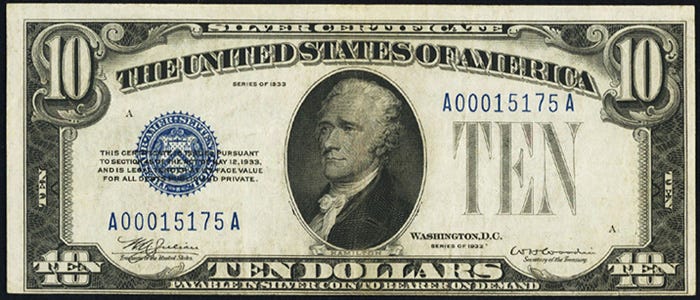
(image via AntiqueBanknotes.com)
Currency is something that is recognized by all trading parties as valuable, or worth having. This makes the coincidence of wants much more common than it would be without standardized currency. So, instead of trying to collide with another party where a mutual coincidence of wants exists, or bartering over the real value of resources, carrying money enables you to trade with just about anyone, anywhere, at any time.
Services can also be exchanged for other goods/services.
No posts
Comments
Nothing yet. Say the first thing.
Sign in to join the conversation.