
Hi friends,
Welcome to week two of posts from the archive, out from behind the paywall for a little time while I take a short holiday with my family. This is a post I wrote in the first year of being on Substack, so very few people read it if I’m honest!, but it, along with part one octopus womb, are among those I am most proud of, and still think about the ideas I raise in both.
I’d really love to hear if anything resonated for you in these two pieces, so feel free to pop me a DM, hit reply or comment below.
Back to normal service next week, speak to you all then,
Layla x
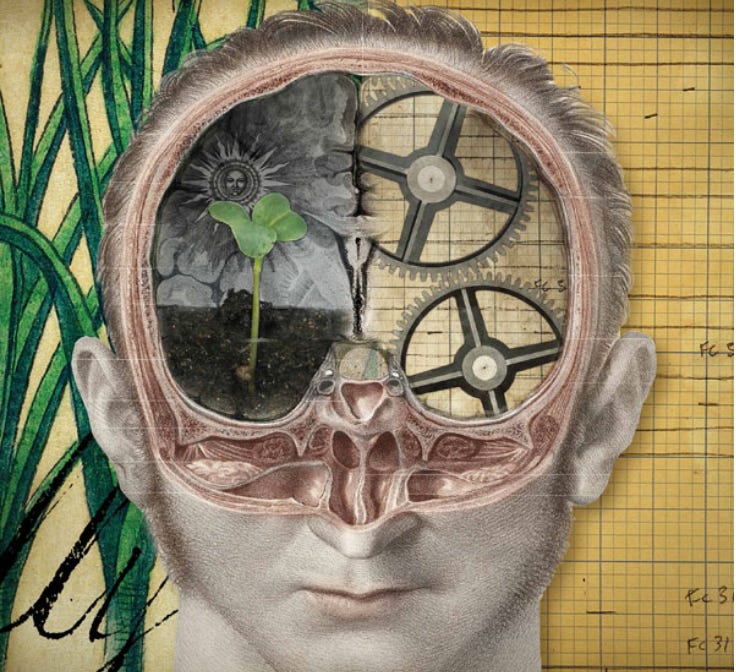
In the early years after the birth of my first child, life felt very much out of my control. Time moved in eddies and spurts rather than in straight lines. Night and day blurred. Not much made logical sense – why was my son awake at 3am one night, and not the night before? Why did my friends baby sleep and mine just howled and howled? Getting dressed, eating, showering were not things I could do without the help of someone else to hold and mind my high-needs son. I had very little autonomy. Life, time, who I thought I was, shattered. In an attempt to manage the sense of spiralling free fall I felt, for lack of much explanation or support, I grasped onto routines and structures and methods and formulas to try and make sense of this brave new world. In the hazy middle-of-the-night gaps and thin places I inhabited I often scrolled on my phone - saying yes, no, that goes there. Buy this, share this, click here. And I was encouraged in these behaviours by the books I was introduced to (No Cry Sleep Solution, 10 Steps to Wean Your Child, Sleep Training manuals), the social media I accessed and the care providers I encountered (‘babies love routine’, ‘plan your meals’, ‘keep lists’).
From the vantage point I have now, twelve years later, I can see that this was my left brain struggling to gain control in a free-fall situation. Trying to categorise and streamline my mothering, my son, my new born self. Trying to fit everything into tidy little boxes. Shoehorn everything in. It was the only way I knew to save myself from drowning. It was the way the world had taught me to survive and to function.
In his seminal book The Master and His Emissary, neuroscientist and psychiatrist Dr. Iain Mc Gilchrist proposes that it is not just me, but rather the whole of Western civilisation that has grown to place far too much value and emphasis on the ways of the left hemisphere.
Mc Gilchrist explains that both left and right hemispheres are vital to our functioning in the world but that for good evolutionary reasons the two pay attention to the world in two quite different ways. The left hemisphere helps us to grab things, to manipulate and categorise them (think hunter-gatherer seeking out prey), but not really to understand what it is we are grabbing or manipulating in a wider context. It necessarily reaches for immediate solutions (that’s a rabbit, that’s a stone, that’s a deer), casts aside anything that does not make logical sense, or that does not fit with what it thinks it knows.
It is with the right hemisphere that we find meaning in the world, that we invite depth and profundity and context. It is with the right hemisphere that we understand humour, poetry, fables, narratives, rituals. It allows for the unique case, it permits the and yet.
We have evolved to have both hemispheres functioning well, reading a situation in these two different ways. A hunter needs simultaneously to select and focus on his prey, and an ability to survey where he is, what the environment he is in is like, what is unique about this moment in time.
The issue in our modern day society though, is that we have gradually neglected the more synthetic, contradictory, bigger picture, nebulous ways of the right hemisphere. We have zoomed in and in, we have categorised and compartmentalised and separated out to an almost pathological degree. And it is destroying us.
Even our physical environment often favours a left brain style of thinking. Since the Industrial Revolution the internal structures of the left hemisphere have been externalised in our world. Our cities are grid systems, we have created myriad mechanical objects that are produced on a factory line and which we can fix and interfere with. We are able to and are encouraged to click and purchase and possess endless items. We are encouraged to follow a routine with our children, to train them to sleep alone. We are often educated in a mechanistic, rote manner. We are sold ways to optimise our time, fill the gaps of our lives, eliminate boredom. For so many of us, so much of our world has been created by the left brain – in both the physical and online world – and we are encouraged to use this side of us to navigate everything about our lives.
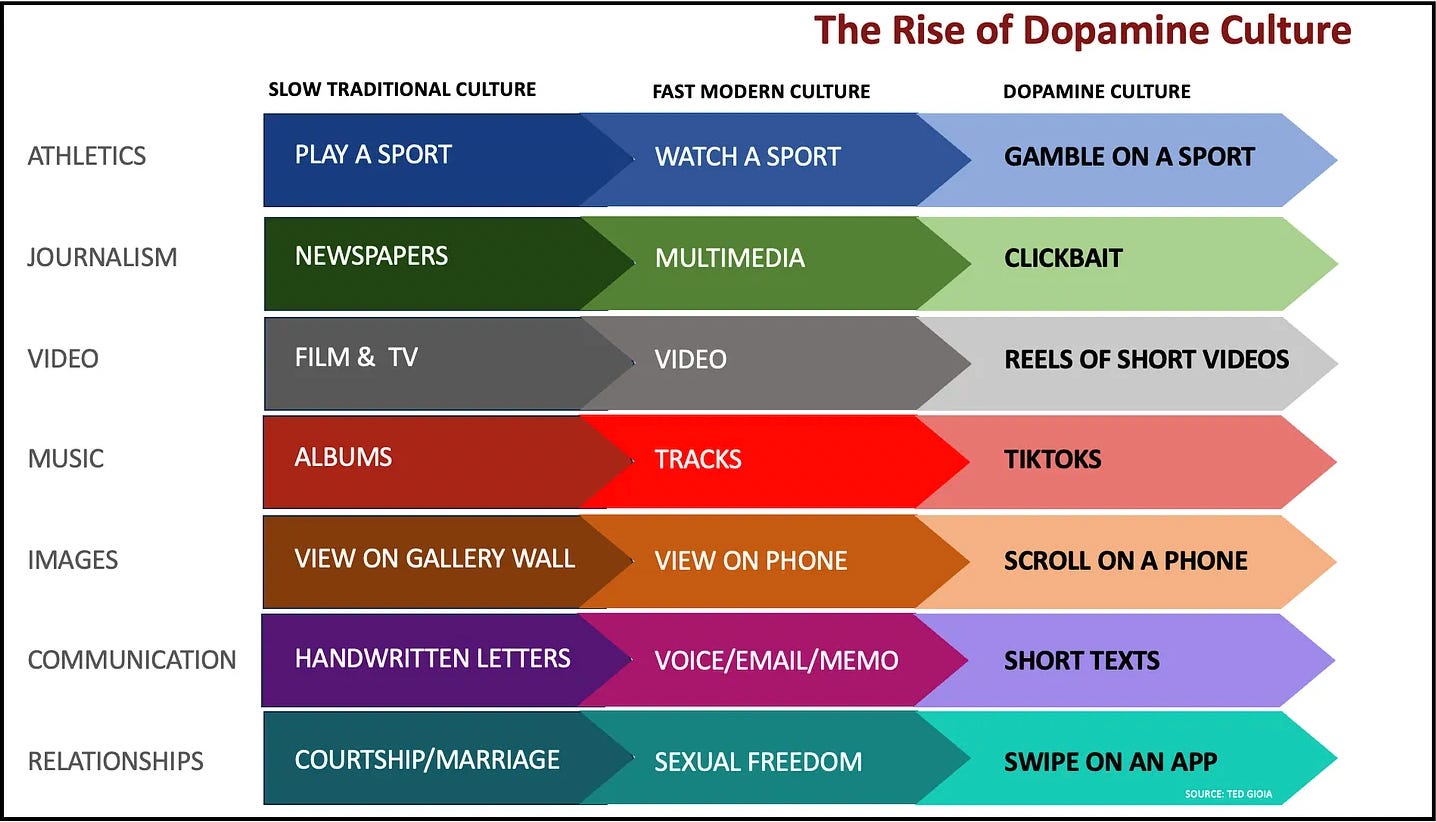
When you start looking around, you begin to see left-brain dominant behaviours everywhere. This article on dopamine culture by Ted Gioia is a perfect illustration – our society’s extreme addiction to short, definable, categorisable sound bites, with little awareness of the bigger picture or context of these behaviours. Naomi Klein’s latest book Doppelganger, too, could be read as a 350 page series of examples of left brain behaviour gone mad - the extremes and paranoia of both the far right and what Klein terms the ‘far-out’, the inability of either side to accept nuance, to allow that there might be contradiction, variation, ambivalence, degrees.
It can all start to feel quite depressing. McGilchrist refers to the left hemisphere functioning on its own as ‘deluded’ and it can often feel that way navigating our world today. The proliferation of conspiracy theories. The fracturing of and division of political beliefs. Hyper-individualism. The ability to look at an entire population and say they deserve to be obliterated. All of it is left brain behaviour gone mad.
But there is, I feel, hope. When we shift our frame from how the left brain is dominating our immediate society and start to look at how the right brain can and does perceive the world there is something so exciting and eye opening and encouraging about the potential that lies therein. And, just like with the examples of left-brain madness being visible everywhere, there are also myriad right-brain glimmers of hope available too.
The right brain, for example, sees and seeks out connection and entanglement. It sees the value and the wisdom in it. Just this week on Substack I read an incredibly generous piece by Kerri ní Dochartaigh writing on Ruth Allen’s new book Weathering. The piece by Kerri was an act of open hearted generosity and interconnection, weaving together other writers speaking into the same space. On her very own publication day Ruth chose to write a piece about 10 other women writing about rocks and geology rather that wax lyrical about her own work. These might seem like small examples, but this same energy, this same favouring of connection and gathering and community over individualism can be used to make massive reform. I love the example of former BBC journalist Carrie Gracie who succeeded in exposing a massive equal pay scandal at the BBC, not by going it alone, but by coming together with other women suffering from the gender pay gap within the corporation and fighting together. They made choices their lawyers advised strongly against; they volunteered information about their salaries to each other; higher status women went on the record so that their more vulnerable colleagues didn’t have to; stars went with lesser known employees to grievance hearings; they formed a WhatsApp group to crowd-source solutions to legal hurdles1. This is right brain thinking, with a left-brain application – it is the right brain as Master and the left brain acting rightly as its Emissary. And it created massive change.
Much of how we can nurture more right brain thinking can be understood through the lens of attention. Mc Gilchrist explains that attention is how our world comes into being for us. What we attend to, but even more importantly how we attend to it changes what we discover and observe in the world.
If I imagine the world as mechanical, I will notice all the things about my environment that confirms that the world is made of machines. All other characteristics will retreat. If I regard my environment as inanimate, I will observe all the things about my world that support this way of seeing. But if I start to shift this awareness and reframe my attention, if I start, for example, to consider my environment as an animate one, I will start to have this confirmed to me in what I observe. My environment will begin to be a reciprocal place. Our attention can transform our reality, and the reality of those around us. Rick Rubin, in his book The Creative Act: A Way of Being writes:
Though we can’t change what it is that we are noticing, we can change our ability to notice.
We can expand our awareness and narrow it, experience it with our eyes open or closed. […]
The universe is only as large as our perception of it. When we cultivate our awareness, we are expanding the universe.
This expands the scope, not just of the material at our disposal to create from, but of the life we get to live.
There is something alchemical about this idea - that the universe does not exist except in the form that we choose to perceive it, that our attention, and the quality of it, can change our world.
Wouldn't it be a lovely headline?
"Life is Beautiful" on the New York Times
writes Rufus Wainwright in his gorgeous song Oh What a World. Can you imagine?! It brings tears thinking of it.
This is not about ignoring the horror and injustice around us. It is, in fact, about drawing that horror close. Feeling deeply the interconnection that means that there is no such thing as other people’s children. But also seeing the beauty in those who come together to declare this truth. It is about choosing to step towards something, choosing to believe in and observe our embeddedness in beauty and wildness. It is about allowing in those moments when you stare blankly at a wall, when you look out the window of a moving car, when you feel bored standing in a supermarket queue.
Thinking about this recently has really transformed how I engage with so much in my day to day life. When I look at the window at my garden do I choose to look at the mess of the tattered, sodden grass that has grown too long, or do I look beyond that to the tulip about to burst, the halo of white petals on the bush. When my child is telling me a story and I’m cooking dinner, trying to get something else done do I nod and half listen or hunker down and look him in the eye as he explains his dreams and plans and ideas? When I do the latter my world transforms from a place of tasks and ragged things into one of potential, creativity and growth. The dinner still needs making, the grass still needs cutting, but there is so much more richness around these tasks. We still need to engage with the headlines in our newspapers and the horror on our feeds, but we can also actively seek out evidence of a new future arising.
We can also believe in the possibility that one day we might open a newspaper to see
LIFE
IS
BEAUTIFUL
splashed across the front page.
Want to read more? You might like PART One, also out from behind the paywall for the next week:
octopus womb
·
March 24, 2024
In April 2020, at the age of forty one, I had a hysterectomy. It had been a long time coming. I’d been told at age thirty, after I’d had two big operations to remove aggressive fibroids from in, on and around my uterus, that I would probably need to have my womb removed at some later stage. The surgeries I had back then…
Comments
Nothing yet. Say the first thing.
Sign in to join the conversation.