
I. Introduction1
We live in an interesting age. An age in which the highly touted promises of technology are rivaled only by the dire warnings of threats posed by technology. It seems that for every vaccine touted as a miracle, there is an engineered virus that threatens a pandemic of existential scope; that for every energy source we unlock to improve humanity’s standard of living, there is a potential for an adverse environmental impact of epic proportions. We seem to constantly be on the verge of realizing a technological utopia while simultaneously at the edge of an extinction-level catastrophe.
We are faced with conflicting messages and rapid, often chaotic, challenges to traditional knowledge and long-held truths. How can we as Christians apply a Christian worldview to assess the diverse claims of technology that we daily face, keeping in mind that a Christian worldview is focused on pleasing God? (Romans 12:1–2.)
Technology, broadly, is know-how applied to manipulate our environment. It is a form of knowing related to, but not coextensive with, what we commonly call “science.”2 By manipulating the environment, we exhibit some knowledge of the environment. For example, a successful technology exhibits that we know how to manipulate that aspect of material reality addressed by the technology. But knowing how to manipulate a thing does not necessarily require or imply a knowledge that corresponds to the reality of the thing. For example, knowing how to manipulate the human immune system to better withstand a pathogen does not require or display significant knowledge of the immune system. Thus, people understood that controlled exposure to a disease could increase subsequent resistance to the disease centuries before any understanding of germ theory’s viruses and bacteria, modern immunology’s systemization of the human immune system into acquired and innate immune systems, or modern genetic engineering’s ability to program a human’s cells to generate epitopes or foreign proteins that are native to a pathogen in order to program the human immune system to respond to the pathogen. Technology, then, involves manipulating nature but does not presuppose or require or display a fundamental understanding of nature.
When assessing the truth of a particular technological claim (the touted promise of the specific manipulation of the environment), there are several points to consider:
First, one must understand the particular aspect of the environment targeted by the technology.
Second, one must consider whether the technology will in fact manipulate the targeted environment as promised.
Third, one must project the costs and benefits of the technology, including side effects and across all time horizons.
Ultimately, and what should be of primary importance to Christians, one must consider whether the technology is pleasing to God.
This technological assessment inherently involves theological issues. For example, each of these above-recited points can invoke issues related to Creation, the doctrine of God, anthropology (the doctrine of humans), and soteriology (the doctrine of salvation). These issues are for the Church. They should be important to and for every confessing Christian.
Often, however, technology is culturally presented as adjacent to theology or as a replacement for theology. For example, technicism is a worldview centered on the belief that technical innovation is inherently good, and that humans have the autonomous ability and right to manipulate the environment and thereby improve it.3 In this view, resistance to select (or any) technology is something that needs to be overcome through, e.g., persuasion, education, or legislation (and exercise of the power of the state to enforce legislation).
I propose a church-wide effort across the various Christian traditions to define and implement a plan to equip Christians with discernment on controversial technological issues. This work is meant to prompt this effort by inspiring dialogue that is not limited to academia. I present a snapshot of my ongoing journey through some issues from my cultural perspective, as a curious layman who sees a pressing need for open and transparent discussion of important and controversial issues. My hope is that the discussion will accommodate diverse views on controversial topics.
I propose four overarching principles:
Every technology has a theological aspect.
A critical, transparent, open, and inclusive discussion of controversial and important issues is imperative to a just (God-pleasing) society.
Quelling participation in discussion of controversial and important issues using authority-based power disparities is antithetical to a God-pleasing society.
Blindly deferring to “experts” may indicate a reckless disregard for truth, and a high regard for truth is a necessary foundation of a God-pleasing society.
II. Examples of Technology That Raise Theological Questions
II.A. Abortion
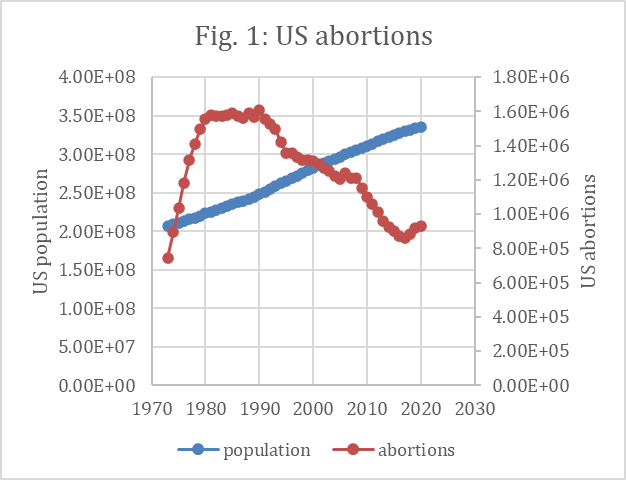
Technology. One way in which we (in the West) routinely manipulate the human environment is to purposefully terminate pregnancies. According to the Guttmacher Institute, the number of reported legal yearly abortions in the United States dramatically rose in the decade following the Roe v. Wade4 decision in January 1973. Abortions quickly rose to reach a decade-long plateau of roughly 1.5 million terminations per year. Then, beginning in about 1990, they began to slowly decline to about 750,000 terminations per year in 2020.5 From 1973 through 2021—in the U.S. alone—there were about 63 million reported legal terminations, for a yearly average of about 1.3 million. For context, the U.S. population over those years ranged from about 200 million to 330 million, with a yearly average of about 270 million.6 (See Fig. 1.)
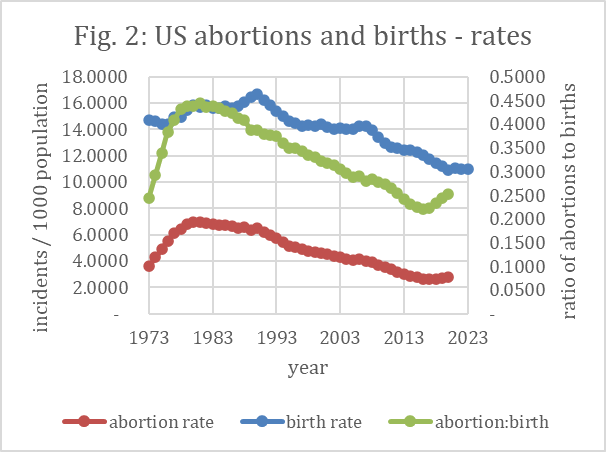
In this time frame, the number of abortions per 1000 population ranged from about 3.6 to 7.0, the number of live births per 1000 population ranged from about 10.9 to 16.7, and the ratio of (legal, reported) abortions to live births ranged from about 22% to 44% (22 abortions / 100 live births to 44 abortions / 100 live births). (See Fig. 2.)
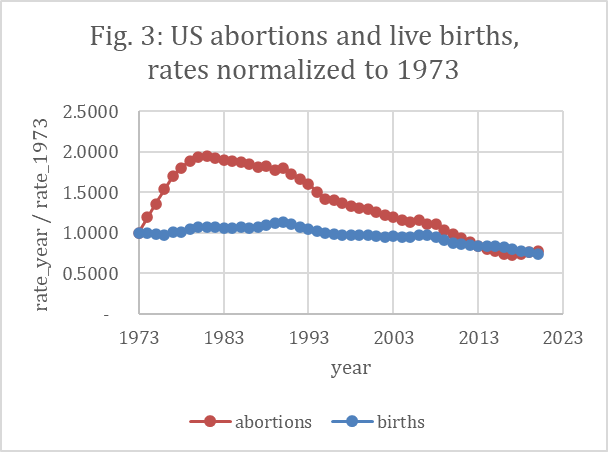
As of 2020, both the abortion rate and birth rate were below their 1973 values. Proportionally, we are terminating fewer pregnancies, but we are also becoming pregnant less often. For some reason, we in the US are becoming less fertile. (See Fig. 3.)
Liberty. Abortion is often lauded for improving individual autonomy and liberty. For example, Jones et al. state: “Abortion helps women, transgender men, and gender non-binary individuals with the capacity to become pregnant to control their fertility, thereby maintaining autonomy over their bodies and the trajectory of their lives.”7 In other words, abortion liberates a pregnant person from the burden of pregnancy.
In Roe, a 7-2 U.S. Supreme Court held that a woman’s right to privacy under the U.S. Constitution, foundational to autonomy, protected her right to terminate her pregnancy: “the [14th Amendment’s] right of personal privacy includes the abortion decision.”8 The Court reasoned that that the preborn does not qualify for contrary constitutional protections as the preborn is not a “person.” Per the Court, “the word ‘person,’ as used in the Fourteenth Amendment, does not include the unborn.”9 Indeed, the Court rejected that the unborn is even necessarily a “life” while recognizing the theological nature of such a determination:
There has always been strong support for the view that life does not begin until live birth. This was the belief of the Stoics. It appears to be the predominant, though not the unanimous, attitude of the Jewish faith. It may be taken to represent also the position of a large segment of the Protestant community, insofar as that can be ascertained; organized groups that have taken a formal position on the abortion issue have generally regarded abortion as a matter for the conscience of the individual and her family. As we have noted, the common law found greater significance in quickening. Physicians and their scientific colleagues have regarded that event with less interest and have tended to focus either upon conception, upon live birth, or upon the interim point at which the fetus becomes “viable,” that is, potentially able to live outside the mother's womb, albeit with artificial aid. Viability is usually placed at about seven months (28 weeks) but may occur earlier, even at 24 weeks. The Aristotelian theory of “mediate animation,” that held sway throughout the Middle Ages and the Renaissance in Europe, continued to be official Roman Catholic dogma until the 19th century, despite opposition to this “ensoulment” theory from those in the Church who would recognize the existence of life from the moment of conception. The latter is now, of course, the official belief of the Catholic Church. As one brief amicus discloses, this is a view strongly held by many non-Catholics as well, and by many physicians. Substantial problems for precise definition of this view are posed, however, by new embryological data that purport to indicate that conception is a “process” over time, rather than an event, and by new medical techniques such as menstrual extraction, the “morning-after” pill, implantation of embryos, artificial insemination, and even artificial wombs.10
U.S. historical jurisprudence, according to the Roe Court, is “consistent with the view that the fetus, at most, represents only the potentiality of life.”11 The conclusion that a human fetus is neither a person nor a life is inherently theological.
Even though the Roe Court determined that the unborn were neither persons nor life, it held that the society (via the state) had an “important and legitimate interest in protecting the potentiality of human life”12 and thus the state retained some ability to regulate this technology:
(a) For the stage prior to approximately the end of the first trimester, the abortion decision and its effectuation must be left to the medical judgment of the pregnant woman’s attending physician.
(b) For the stage subsequent to approximately the end of the first trimester, the State, in promoting its interest in the health of the mother, may, if it chooses, regulate the abortion procedure in ways that are reasonably related to maternal health.
(c) For the stage subsequent to viability [of the preborn as a human person], the State in promoting its interest in the potentiality of human life may, if it chooses, regulate, and even proscribe, abortion except where it is necessary, in appropriate medical judgment, for the preservation of the life or health of the mother.13
In June 1992, a fragmented U.S. Supreme Court modified the Roe framework governing abortion but continued to justify abortion on the grounds of “liberty.”14 The Court again recognized that the nature of human liberty itself is inherently theological. The Court presupposed that humans are self-defining rather than defined by God:
At the heart of liberty is the right to define one’s own concept of existence, of meaning, of the universe, and of the mystery of human life. Beliefs about these matters could not define the attributes of personhood were they formed under compulsion of the State.
… Abortion is a unique act. It is an act fraught with consequences for others: for the woman who must live with the implications of her decision; for the persons who perform and assist in the procedure; for the spouse, family, and society which must confront the knowledge that these procedures exist, procedures some deem nothing short of an act of violence against innocent human life; and, depending on one's beliefs, for the life or potential life that is aborted. Though abortion is conduct, it does not follow that the State is entitled to proscribe it in all instances. That is because the liberty of the woman is at stake in a sense unique to the human condition and so unique to the law. The mother who carries a child to full term is subject to anxieties, to physical constraints, to pain that only she must bear. That these sacrifices have from the beginning of the human race been endured by woman with a pride that ennobles her in the eyes of others and gives to the infant a bond of love cannot alone be grounds for the State to insist she make the sacrifice. Her suffering is too intimate and personal for the State to insist, without more, upon its own vision of the woman's role, however dominant that vision has been in the course of our history and our culture. The destiny of the woman must be shaped to a large extent on her own conception of her spiritual imperatives and her place in society.15
A woman’s pregnancy is a woman’s suffering, and abortion is the technological means by which she is liberated from this suffering. For Christians, this should call to mind God’s judgment of Eve for her disobedience in Eden as recounted in Genesis 3:16: “To the woman [God] said, ‘I will greatly increase your labor pains; with pain you will give birth to children.’” Per Casey, abortion technology can liberate one from God’s judgment by enabling one to avoid labor and birth pains.
Indeed, Casey viewed this liberty right so important that any state action that “has the effect of placing a substantial obstacle in the path of a woman's choice [to abort] cannot be considered a permissible means of serving its legitimate ends” of protecting the “potential life” of the preborn.16 For example, state law requiring a woman to notify her husband before aborting her pregnancy is a substantial obstacle. Notably,
Many [women] may fear devastating forms of psychological abuse from their husbands, including verbal harassment, threats of future violence, the destruction of possessions, physical confinement to the home, the withdrawal of financial support, or the disclosure of the abortion to family and friends. …
The spousal notification requirement … does not merely make abortions a little more difficult or expensive to obtain; for many women, it will impose a substantial obstacle. We must not blind ourselves to the fact that the significant number of women who fear for their safety and the safety of their children are likely to be deterred from procuring an abortion as surely as if the Commonwealth had outlawed abortion in all cases.17
According to Casey, in assessing the technology to liberate a woman from her pregnancy (abortion) we should not give much weight, or in some circumstances any weight at all, to the costs inherent to the technology that are borne by other than the pregnant woman, such as those borne by the father. Especially if accounting those costs may impede the liberty of abortion. Again, this should call to mind God’s judgment of Eve in Genesis 3:16: “To the woman [God] said, … You will want to control your husband, but he will dominate you.’” Per Casey, a pregnant woman’s liberty requires that she be free of the influence (or rule) of her husband when deciding whether to abort.
In June 2020, a 6-3 U.S. Supreme Court overturned the Roe and Casey precedents, holding that the U.S. Constitution is silent as to a woman’s right to terminate her pregnancy.18 Dobbs noted that, in the U.S., abortion had been a historically disfavored technology:
At common law, abortion was criminal in at least some stages of pregnancy and was regarded as unlawful and could have very serious consequences at all stages. American law followed the common law until a wave of statutory restrictions in the 1800s expanded criminal liability for abortions. By the time of the adoption of the Fourteenth Amendment, three-quarters of the States had made abortion a crime at any stage of pregnancy, and the remaining States would soon follow.19
This disfavor reflected the view that abortion was “homicide” or “murder” or “manslaughter,” at least after “quickening” (the first movement of the fetus).20 Thus, a preborn was considered a human person, not just potential, from the moment it moved in the womb or earlier. According to Dobbs, in assessing the technology to liberate a woman from her pregnancy (abortion), historically we collectively considered the inherently linked cost of terminating the life of a human person. For Christians, this holding should bring to mind the Noahic covenant, which includes God’s instruction that “Whoever sheds human blood, by other humans must his blood be shed; for in God’s image God has made humankind.” (Gen. 8:6.)
Medical Advance. Another benefit of abortion is the medical advances it enables (or claims to enable). According to some, “Fetal tissue is uniquely valuable to medical researchers - useful for developing treatments and better understanding diseases like HIV, Parkinson's, and COVID-19.”21 The AMA states that “Research with human fetal tissue [] has led to the development of a number of important research and medical advances, such as the development of polio vaccine. Fetal tissue has also been used to study the mechanism of viral infections and to diagnose viral infections and inherited diseases.”22 Such research “uses tissue derived from induced abortion of pregnancies at or after the ninth week” and is credited with “major advances in human health, including the virtual elimination of such childhood scourges as polio, measles and rubella in the United States.”23 As stated by a prominent American bioethicist:
Every child who’s been spared the risks and misery of chickenpox, rubella, or polio can thank the Nobel Prize recipients and other scientists who used such tissue in research yielding the vaccines that protect us …. Any discussion of the ethics of fetal tissue research must begin with its unimpeachable claim to have saved the lives and health of millions of people.24
Indeed, according to the U.S. District Court for the District of Columbia, fetal tissue for research has significant commercial value:
Advanced Biosciences Resources (“ABR”) partnered with Planned Parenthood and other abortion providers to dismember fetuses and sell their parts for research. It sold second-trimester livers and thymi for hundreds of dollars apiece. The same for brains, eyes, and lungs. After tacking on fees for services like shipping and cleaning, ABR could collect over $2,000 on a single fetus it purchased from Planned Parenthood for $60. The federal government participated in this potentially illicit trade for years.25
Apparently, the health and commercial benefits of abortion to the public at large should be considered when assessing the technology. For Christians who view abortion as against God’s will (evil), this should raise the theological issue of whether it is just to use evil to achieve good. Perhaps Christ’s teaching on false prophets is applicable: “A good tree is not able to bear bad fruit, nor a bad tree to bear good fruit.” (Matt. 7:18.) If abortion is a “bad tree” can the medical science and products that stem from abortion truly be “good fruit”?
Theological Issues. There are a number of theological issues raised by abortion, but there does not seem to be a consistent and coherent stance on this among those who claim Christ’s name. For example:
Does God proscribe abortion?
Some Christians claim that abortion is not prohibited, or not until late in the pregnancy. For instance, in her 2013 book Disunity in Christ (required reading in some seminaries), Christina Cleveland seems to dismiss the issues of “abortion and homosexuality” as “two issues that Jesus didn’t even mention once, mind you.”26 Gordon Dunstan, an Anglican theologian, pragmatically argued that abortion was not wrong from the moment of conception because the unborn was not a person at least at the early stages of pregnancy and because scientific research on the unborn has significant value:
The [Christian] tradition attempted to grade the protection accorded to the nascent human being according to the stages of its development. …
Uterine life must be protected at some point. If we put that point too early, forbidding observation and experimental use of pre-implantation embryos in the early stages of cell division, we shall inhibit much useful research of potential human benefit, including the improvement of the chances of successful pregnancy, for lack of which many extra embryos are sacrificed at present. Embryologists themselves search for means of determining a point beyond which experiment would be intolerable; they would relate that point to the beginning of the development of the nervous system, anticipating the capacity of the fetus for sensitivity or awareness—words used by Dante, as we have seen, as characteristic of the fetus so grown as to warrant the attribution of a rational, human soul.27
Others claim avoidance of abortion is critical to discipleship. For instance, the Didache, a first- or second-century Christian text, begins “There are two Ways, one of Life and one of Death, and there is a great difference between the two Ways” and instructs disciples (perhaps catechumens): “thou shalt not procure abortion, nor commit infanticide.”28 David Jones, a Catholic bioethicist, counters Dunstan’s argument, arguing that “The earliest Christian witnesses and the churches of the east generally regard the destruction of the human embryo as homicide.”29
A 2022 survey by Pew Research Center suggests a church divided on abortion.30 The survey indicates that roughly 60% of all U.S. adults hold that abortion should be legal in all or most cases.31 Roughly 45% of U.S. adults who identify as Protestant and 56% of U.S. adults who identify as Catholic held this position.32 A 2014 study by Pew Research indicates U.S. adults of particular Christian traditions then supported legal abortion in all or most cases as follows: Protestant 44%, Catholic 48%, Orthodox 53%.33 Even within denominations, the church is split. For example, 46% of U.S. adults who identify as LCMS congregants and 54% of U.S. adults who identify as PCA congregants supported legal abortion in all or most cases.34 The official positions of these denominations are as follows: “The Lutheran Church—Missouri Synod believes that abortion is contrary to God's Word and ‘is not a moral option, except as a tragically unavoidable byproduct of medical procedures necessary to prevent the death of another human being, viz., the mother’ (1979 Res. 3-02A).”35 The PCA “believe[s] the intentional killing of an unborn child is a violation of God's command and authority.”36 Though 56% of Catholics surveyed for the 2022 report support legal abortion and 48% in the 2014 report, the Catholic church officially states: “Human life must be respected and protected absolutely from the moment of conception. … Since the first century the Church has affirmed the moral evil of every procured abortion. … Formal cooperation in an abortion constitutes a grave offense.”37
While the civil legality of abortion is somewhat distinct from the church’s moral view of abortion, the disunity in church positions on the legality, even within traditions that clearly teach abortion is homicide, suggests a divergence of worldview on core theological issues related to technology. This divergence across traditions and across time suggests that we have not achieved a “unity of faith” on this issue. Rather, we appear to be “carried about by every wind of teaching” as if we are not properly equipped as disciples of Christ. (Eph. 4:14.)
Is medical knowledge derived from abortion inherently tainted?
Some Christians claim that medical advances due to abortion-based research are fine, presumably God-pleasing. For example, as described above, the Anglican theologian Gordon Dunstan justified research performed on the unborn, even live ones so long as they were sufficiently insensitive and unaware, with the benefits of the resulting scientific advances.38 Christian Life Resources, a pro-life group, argues that the medical benefits derived from abortion are not tainted, in part because: “The fetal cells used in vaccine development and other research were derived from aborted children whose bodies were destined to go out with hospital waste.”39 The Catholic Pontifical Academy for Life notes the evil of abortion, but articulates a balancing act in deriving benefits from that evil. For example, “the use of vaccines whose production is connected with procured abortion constitutes at least a mediate remote passive material cooperation to the abortion, and … contributes in the creation of a generalized social consensus to the operation of the pharmaceutical industries which produce them in an immoral way.” Nevertheless, the Pontifical Academy for Life finds a reason “to accept the use of these vaccines in the presence of the danger of favouring the spread of the pathological agent [the vaccine targets].”40
Other Christians articulate significant costs that outweigh any benefits from medical advances derived from abortion. For example, Kyle McKenna argues:
Each medical benefit or scientific advance from the use of fetal tissue from elective abortions desensitizes beneficiaries, scientists, and doctors to the original evil act that produced these cells. Aborted fetal tissues used in laboratories are minimized to merely human cells, and the human beings whose lives were taken to provide those cells become irrelevant and with time forgotten. Of greatest concern is that desensitization ultimately leads to scandal by erroneously validating elective abortions for a greater good. Without careful oversight, the fetus could become, like fetal tissue cell lines, merely cells, cultured within the uterus for scientific exploration. All people of good conscience have the responsibility to voice opposition to the use of fetal tissue from elective abortions in order to promote development of alternatives, affirm the value of all human life, and limit scandal.41
Lutherans for Life similarly notes that “[d]esirable ends, no matter how good in themselves, can never justify an evil means (Romans 3:8)” and states that it “opposes both the producing of vaccines from aborted fetal tissue and the procuring of aborted fetal tissue for any similar experimentation.”42 Recently, a group of Catholic Bishops argued that abortion-derived medical knowledge and products, such as vaccines, are inherently tainted:
Using vaccines made from the cells of murdered unborn children contradicts a “maximum determination” to defend unborn life. …
The crime of abortion is so monstrous that any kind of concatenation with this crime, even a very remote one, is immoral and cannot be accepted under any circumstances by a Catholic once he has become fully aware of it. One who uses these vaccines must realize that his body is benefitting from the “fruits” (although steps removed through a series of chemical processes) of one of mankind’s greatest crimes.
Any link to the abortion process, even the most remote and implicit, will cast a shadow over the Church’s duty to bear unwavering witness to the truth that abortion must be utterly rejected. The ends cannot justify the means.…
What else can a vaccine derived from fetal cell lines be other than a violation of the God-given Order of Creation?43
As on the issue of abortion itself, the church is divided on the issue of the whether knowledge derived from abortion may be a good fruit, even assuming that there are material benefits flowing from that knowledge. And there seems to be little official skepticism as to the claims of these benefits. It appears we take as gospel truth the cultural claims regarding the benefits of abortion-derived knowledge. Perhaps the church should critically assess these claims, including across time. Perhaps the church should assess the claimed benefits of abortion to society in light of analogous teaching from Scripture regarding the fruits of child sacrifice:
Say, ‘Listen to what the LORD says, you kings of Judah and citizens of Jerusalem! The LORD God of Israel who rules over all says, “I will bring a disaster on this place that will make the ears of everyone who hears about it ring! I will do so because these people have rejected me and have defiled this place. They have offered sacrifices in it to other gods which neither they nor their ancestors nor the kings of Judah knew anything about. They have filled it with the blood of innocent children. (Jer. 19:3–4.)
Thus says the Lord God, Because your lust was poured out and your nakedness uncovered in your whorings with your lovers, and with all your abominable idols, and because of the blood of your children that you gave to them, therefore, behold, I will gather all your lovers with whom you took pleasure, all those you loved and all those you hated. I will gather them against you from every side and will uncover your nakedness to them, that they may see all your nakedness. And I will judge you as women who commit adultery and shed blood are judged, and bring upon you the blood of wrath and jealousy. (Eze. 16:36–38.)
II.B. Transhumanism Technology.
Another example of how we manipulate our environment is to change the nature of humanity itself. “[T]ranshumanism uses reason, advanced technology, and science to creatively transform human nature.”44 As one transhumanist advocacy group states, transhumanism entails the “use of technology and evidence-based science to expand human capabilities. We want people to be better than well.”45 Through manipulation of the human, by, e.g., surgery or gene therapy, transhumanism promises to make people better than well, to transcend our biological natures:
Technologies that support longevity and mitigate the disease of aging by curing disease and repairing injury have accelerated to a point in which they also can increase human performance outside the realms of what is considered to be “normal” for humans. These technologies are referred to as emerging and exponential and include artificial intelligence, nanotechnology, nanomedicine, biotechnology, stem cells, and gene therapy, for example. Other technologies that could extend and expand human capabilities outside physiology include AI, robotics, and brain-computer integration, which form the domain of bionics, memory transfer, and could be used for developing whole body prosthetics.
…
Regenerative medicine, stem cell therapies, smart prosthetics, genetic engineering, nanomedicine, cryonics, nootropics, neuropharmacology, have already [overcome biological determinism].46
Liberty. Perhaps the most common benefit of transhumanist technology is that it enables us to overcome human limitations, it liberates us from ourselves. For example, over a decade ago, transhumanist advocates proclaimed that
sex-reassignment hormones and surgery already allow people to – albeit painfully and not completely – transcend biological gender. But tissue engineering and somatic gene therapies promise much less painful and more complete sex re-assignment (BBC, 2007). Using gene therapies we will be able to ramp up testosterone or estrogen production, and selectively suppress sex-linked genetic traits, making hormone treatments unnecessary (Hughes, 2006). Once we have perfected tissue cloning and genetic engineering - within the next two decades - we will be able to craft new, fully functional breasts and sexual organs for transsexuals.
…
We are unlikely to stop with just the cosmetic enhancement of genitals and swapping of genitals for those of the sex. Tissue engineering and nanoneural interfaces suggest that it would be possible to have a penis with the responsiveness of a clitoris, or some entirely new sexual organ.47
Transhumanism promises to not only liberate us from the male or female category into which we are born, it promises to free us from the biological male/female binary itself. For Christians, this should call to mind the anthropological teaching of the creation narrative in Genesis: ”God created humankind in his own image, in the image of God he created them, male and female he created them.” (Gen. 1:27.)
This promise of liberty to transcend nature is so powerful that impediments, such as parental notification regarding a minor’s decision to transcend birth gender, are garnering cultural disfavor. For example, the U.S. District Court for the District of Maryland recently considered schoolboard guidelines that state:
Prior to contacting a student's parent/guardian, the principal or identified staff member should speak with the student to ascertain the level of support the student either receives or anticipates receiving from home. … Disclosing [the transgender status of the child] to … their parents/guardians … may violate privacy laws. … The fact that students choose to disclose their status to staff members or other students does not authorize school staff members to disclose a student’s status to others, including parents/guardians and other school staff members.48
Parents of minor children challenged the guidelines, claiming a Constitutional right to be notified of a child’s transcendent self-identity. The court dismissed, with prejudice, the parental challenge to these guidelines at the pleading stage of the lawsuit and opined that
[i]f the Guidelines mandated parental disclosure as the Plaintiff Parents urge, their primary purpose of providing transgender and gender nonconforming students with a safe and supportive school environment would be defeated. A transgender child could hardly feel safe in an environment where expressing their gender identity resulted in the automatic disclosure to their parents, regardless of their own wishes or the consequences of the disclosure.49
The parents did not have the right to be notified that their minor child transcended biological gender at school as such notice would impede the child’s liberty to transcend gender. On appeal, the U.S. Court of Appeals for the Fourth Circuit determined the parents did not have standing to challenge this parental-preclusion guideline as the parents did not allege that any “information is being withheld from them under the Parental Preclusion Policy” or that “they suspect their children might be considering gender transition or have a heightened risk of doing so.”50 The parents’ allegation that "for all they know, some of their own children could be … [or] might soon be” part of the school’s gender transitioning program was not sufficient for a court to consider the challenge.51 A parent can not challenge a guideline that prevents disclosure of a minor child’s gender-transition until the parent can allege that such information is being withheld:
the Supreme Court's Clapper decision and our Wikimedia Foundation v. National Security Agency, 857 F.3d 193 (4th Cir. 2017), decision tell us that we do not toss out the injury requirement because the government hides information. Those cases dealt with challenges to government surveillance, which the government keeps secret. Even though that hindered plaintiffs' ability to determine whether they had been injured, both Clapper and Wikimedia found no Article III standing for plaintiffs who could not allege an imminent or substantially likely harm. Thus, the fact that the Montgomery County Board of Education permits its schools to keep information about its students' gender support plans and related gender-identity issues from their parents, while perhaps repugnant as a matter of policy, does not create standing.52
The government may hide information that might be used to impede efforts to liberate humans from biological constraints and thereby transcend nature.
Theological Issues. There are a number of theological issues raised by transhumanism that are deserving of critical discussion. For example:
Are humans inherently male or female?
As with abortion, there is no unity in the Christian view on transgenderism and transsexualism. A 2017 Pew Research report suggests that among U.S. adults, only 68% of Protestants and 51% of Catholics held that gender is determined by sex at birth.53 A 2022 Report indicates 75% of Protestants and 62% of Catholics hold this view.54 In the 2022 Report, only 34% of Protestants and 14% of Catholics held that their religious beliefs greatly influenced their view about whether gender is determined by sex at birth.55
Formal teaching on this is sparse, and it varies. The LCMS teaches “From the standpoint of our bodies—which is the only objective means of determining who is male or female—we have a God-given identity that is either masculine or feminine. One is a man or a woman because that is what the body given by God indicates.”56 The ELCA, in contrast, “believe[s] God creates humanity in diversity … [that] encompasses a wide variety of experiences, identities, and expressions, including sex (human biology), gender (how humans understand and express themselves), and sexuality (sexual attraction).”57 The Catholic church teaches “Everyone, man and woman, should acknowledge and accept his sexual identity. Physical, moral, and spiritual difference and complementarity are oriented toward the goods of marriage and the flourishing of family life. the harmony of the couple and of society depends in part on the way in which the complementarity, needs, and mutual support between the sexes are lived out.”58 James Anderson, a Reformed theologian, argues:
God, as the author of creation, defines his creation. God, as the creator of humankind, defines what it means to be human. We simply do not get to define what we are or who we are!
…
God did not intend sexuality and gender to be fluid and expressed on a continuum. Indeed, the assumption throughout the Bible is that there are two sexes, male and female, and the primary determiner of a person’s sex is physiology. We’re embodied beings and our sexuality is expressed through our bodies.
…
that something is scientifically possible doesn’t mean it is ethically permissible.59
This is a complicated issue of increasing cultural import. Perhaps the church should do more to equip its members to assess technology for transcending the female-male binary.
At what point does modifying the human violate the image of God?
Christian positions on transhumanism more broadly appear to vary in much the same way they do on transgenderism. Some Christian groups embrace transhumanism. For example, the Christian Transhumanist Association holds that “science and technology [are] tangible expressions of our God-given impulse to explore and discover and as a natural outgrowth of being created in the image of God.”60 In this view, Christians “should use science and technology to make the world (including humanity) better.”61 Others reject that Christianity and transhumanism are in any way compatible. For example, W.J. Smith argues that “the transhumanist worldview and the Christian faith are incompatible. One cannot be a ‘Christian transhumanist’—any more than one can be a Christian Buddhist or Christian Muslim.”62 He notes, for example:
Transhumanism is materialistic. Christianity is theistic. Transhumanism is utopian. Christianity sees the fallen world realistically. Transhumanism perceives immortality as something that can be achieved by men. Christianity identifies eternal salvation as the mercy of a loving God. Its eschatology focuses on God’s promises, not upon advanced scientific applications.
Ultimately, there is little church guidance on transhumanism broadly.
II.C. Climate Engineering Technology.
Also referred to as geoengineering and climate intervention, climate engineering is “deliberate, large-scale manipulation of the earth system with the intention of mitigating the effects of climate change.”63 This includes techniques such a carbon sequestration and solar radiation management.64 According to a 2014 bibliographic survey, “[t]he US National Centre for Atmospheric Research is the most published organization in climate engineering research as a whole with 30 publications,” with a focus (21 publications) on solar radiation management.65
Solar radiation management, or solar geoengineering, includes techniques for reducing the amount of sunlight that warms the earth such as:
Stratospheric Aerosol Injection (SAI) is a strategy for increasing the number of small reflective particles (aerosols) in the stratosphere in order to increase the reflection of incoming sunlight.
Marine Cloud Brightening (MCB) is a strategy for adding particles to the lower atmosphere (near the surface) in order to increase the reflectivity of low-lying clouds over particular regions of the oceans.
Cirrus Cloud Thinning (CCT) is a strategy for modifying the properties of high-altitude ice clouds, increasing the atmosphere’s transparency to outgoing thermal radiation.66
The amount of sunlight that reaches us can be reduced by injecting chemicals (e.g., SO2, SO4, H2S, Al2O3, TiO2) into the atmosphere.
Carbon sequestration includes techniques for the removal of carbon dioxide from the atmosphere such as:
First, reducing deforestation and promoting forest growth globally could sequester an estimated 1.3 GT [carbon/year] in biomass …
Second, because agriculture has led to the loss of about one-half (55–78 GT) of stored soil C from tilled lands, improved agricultural and plantation management could restore an estimated 0.4–1.1 GT [carbon/year] ….
Third, …[a]pproximately 0.65 GT [carbon/year] could be sequestered with amendments of biochar to agricultural soils worldwide.…
Fourth, … fertilizing the ocean with scarce elements such as iron can promote growth of algal blooms and subsequent deep-sea sequestration of biomass, potentially storing 0.7–2.3 GT [carbon/year].67
The amount of carbon dioxide in the atmosphere may be reduced by modifying agricultural practices (e.g., by reducing land used for agriculture) or increasing algae growth in the oceans. For example, the U.S. government established a Conservation Reserve Program (CRP) whereby the government pays farmers to idle agricultural land for 10 to 15 years.68 Per the USDA
CRP is one of the world’s largest voluntary conservation programs, with an established track record of preserving topsoil, sequestering carbon, reducing nitrogen runoff and providing healthy habitat for wildlife.
In exchange for a yearly rental payment, agricultural producers enrolled in the program agree to remove environmentally sensitive land from production and plant species that will improve environmental health and quality.
…
Earlier this year, USDA announced updates to CRP including higher payment rates, new incentives for environmental practices, and a more targeted focus on the program’s role in climate change mitigation. This included a new Climate-Smart Practice Incentive for CRP general and continuous signups that aims to increase carbon sequestration and reduce greenhouse gas emissions.69
Survival of the Species. The main, and perhaps only, proposed benefit of climate engineering is the continued habitability of our world. As stated by the National Academy of Science, Engineering, and Medicine,
Without decisive action and rapid stabilization of global temperature, risks from a changing climate will increase in the future, with potentially catastrophic consequences. Limiting future warming to substantially less than 2°C above preindustrial levels requires dramatic decreases in the emissions of all greenhouse gases (GHGs) from human activity, with net emissions of carbon dioxide (CO2) falling to zero in the second half of the 21st century.70
As stated by President Biden of the United States, if we fail to address the climate crisis, the planet may become uninhabitable:
There is little time left to avoid setting the world on a dangerous, potentially catastrophic, climate trajectory. …
It is the policy of my Administration that climate considerations shall be an essential element of United States foreign policy and national security. The United States will work with other countries and partners, both bilaterally and multilaterally, to put the world on a sustainable climate pathway.
…
Even as our Nation emerges from profound public health and economic crises borne of a pandemic, we face a climate crisis that threatens our people and communities, public health and economy, and, starkly, our ability to live on planet Earth.71
Apparently, our very existence is at stake.
Theological Issues. The theological issues raised by climate engineering include, among others, issues related to the Cultural Mandate and the Great Commandment. For example,
What are the bounds of man’s dominion provided in Genesis 1:26–28?
Does man decide when man has been too fruitful and multiplied too much in response to God’s command of Genesis 1:28?
Does loving one’s neighbor require one to risk the present food supply with the hope that doing so will prolong God’s material creation?
This is, perhaps, a new and emerging field of concern. There is little data on how the church views or should view this technology.
III. Can a technology be inherently evil?
I propose that a particular modification of the environment can be inherently evil and thus any Christian assessment of technology must consider whether the technology is inherently evil.
Man’s application of knowledge to manipulate the environment is a fairly common theme in Scripture. And often, perhaps most often, this is portrayed as evil when pursued without a clear mandate from God. Specifically, it seems that manipulating the environment so as to override or supplant God, including acting without regard to God, is inherently evil. And this seems as much about function as about intent, meaning good intent does not excuse manipulation of the environment that is otherwise evil.
III.A. Technology and the Three Falls of Man
There are three falls described in Genesis: (1) the fall of Adam and Eve and the Expulsion, (2) the fall of Cain and the Flood, and (3) the fall of Babel and the Confusion and Dispersion. Each can be linked to an application of knowledge to manipulate the environment.
a. The First Fall – Adam and Eve and the Forbidden Fruit
In the beginning, Adam and Eve understood that by partaking of the forbidden fruit they would modify themselves to transcend the limits God had placed upon them:
Now the serpent was more shrewd than any of the wild animals that the LORD God had made. He said to the woman, “Is it really true that God said, ‘You must not eat from any tree of the orchard’?” The woman said to the serpent, “We may eat of the fruit from the trees of the orchard; but concerning the fruit of the tree that is in the middle of the orchard God said, ‘You must not eat from it, and you must not touch it, or else you will die.’” The serpent said to the woman, “Surely you will not die, for God knows that when you eat from [the tree in the middle of the orchard] your eyes will open and you will be like divine beings who know good and evil.” When the woman saw that the tree produced fruit that was good for food, was attractive to the eye, and was desirable for making one wise, she took some of its fruit and ate it. She also gave some of it to her husband who was with her, and he ate it. Then the eyes of both of them opened, and they knew they were naked; so they sewed fig leaves together and made coverings for themselves. (Gen. 3:4–7.)
It is not that fruit itself was evil (contrary to the will of God). After all, God created it and declared it good. (Gen. 1:11–12.) In the story of this original sin, use of the fruit to transform humanity was evil even though Eve (and presumably Adam) lacked specific intent to do evil—she was tricked by the serpent to think she was doing good. Regardless of their specific intent, it is clear that Adam and Eve did evil by using the fruit to transform themselves when God had forbidden this:
And the Lord God said, “Who told you that you were naked? Did you eat from the tree that I commanded you not to eat from?” The man said, “The woman whom you gave me, she gave me some fruit from the tree and I ate it.” So the Lord God said to the woman, “What is this you have done?” And the woman replied, “The serpent tricked me, and I ate.”
The LORD God said to the serpent, “Because you have done this, cursed are you above all the wild beasts and all the living creatures of the field! On your belly you will crawl and dust you will eat all the days of your life.And I will put hostility between you and the woman and between your offspring and her offspring; her offspring will attack your head, and you will attack her offspring’s heel.”
To the woman he said, “I will greatly increase your labor pains; with pain you will give birth to children. You will want to control your husband, but he will dominate you.” But to Adam he said, “Because you obeyed your wife and ate from the tree about which I commanded you, ‘You must not eat from it,’ cursed is the ground thanks to you; in painful toil you will eat of it all the days of your life. It will produce thorns and thistles for you, but you will eat the grain of the field. By the sweat of your brow you will eat food until you return to the ground, for out of it you were taken; for you are dust, and to dust you will return.” (Gen. 3:11–19.)
Adam and Eve were tricked into implementing technology thinking it good but were nevertheless culpable for this evil act—they were evicted from Eden:
And the LORD God said, “Now that the man has become like one of us, knowing good and evil, he must not be allowed to stretch out his hand and take also from the tree of life and eat, and live forever.” So the LORD God expelled him from the orchard in Eden to cultivate the ground from which he had been taken. When he drove the man out, he placed on the eastern side of the orchard in Eden angelic sentries who used the flame of a whirling sword to guard the way to the tree of life. (Gen. 3:22–24.)
As judgment, mankind was expelled from Eden so that it would not further modify itself by partaking of fruit that was not before forbidden.
It is important to note that man’s (Adam and Eve’s) modification of God’s creation through the forbidden fruit was evil despite the Cultural Mandate. God had granted man dominion:
Then God said, “Let us make humankind in our image, after our likeness, so they may rule over the fish of the sea and the birds of the air, over the cattle, and over all the earth, and over all the creatures that move on the earth.” … Rule over the fish of the sea and the birds of the air and every creature that moves on the ground.” (Gen. 1:26–28.)
That man’s modification of himself was sinful indicates that God’s grant of dominion is not unconstrained.
b. The Second Fall – Cain’s Line and the Flood
The issue of technology is also present in the story of Cain. Cain’s brother Abel nurtured God’s creation, he “took care of the flocks.” (Gen. 4:2.)72 Cain modified God’s creation, he “cultivated the ground” to produce fruit. (Gen.4:2–3.)73 Perhaps Cain’s standing before God was somehow conditioned on his performance as a cultivator, on how he modified the ground and produced fruit:
At the designated time Cain brought some of the fruit of the ground for an offering to the LORD. But Abel brought some of the firstborn of his flock—even the fattest of them. And the LORD was pleased with Abel and his offering, but with Cain and his offering he was not pleased. So Cain became very angry, and his expression was downcast. Then the LORD said to Cain, “Why are you angry, and why is your expression downcast? Is it not true that if you do what is right, you will be fine? But if you do not do what is right, sin is crouching at the door. It desires to dominate you, but you must subdue it.” (Gen. 4:3–7.)
Sin dominated Cain and he murdered Abel. As a result, his ability to cultivate the ground was taken away:
But the LORD said, “What have you done? The voice of your brother’s blood is crying out to me from the ground! So now, you are banished from the ground, which has opened its mouth to receive your brother’s blood from your hand. When you try to cultivate the ground it will no longer yield its best for you. You will be a homeless wanderer on the earth.” (Gen. 4:11–12.)
Cain went out from the presence of the Lord and again modified his environment by building a city apart from God, perhaps the first city. (Gen. 4:16–17.) Cain’s progeny is associated with a variety of technologies: Jabal introduced animal husbandry (Gen. 4:20); Jubal introduced use of the harp and flute (Gen. 4:21); Tubal-Cain introduced metallurgy (Gen. 4:22). None of Cain’s lineage is associated with a positive relationship with God; if they are associated with anything other than familial relations, it is technology, polygamy, and murder. (Gen. 4:17–24). In contrast, none of Adam’s progeny from Seth through Noah is associated with any technology or sin, but rather with worship of God. (Gen. 4:25 – 5:32.) In Seth’s line, Enoch and Noah stand out: Enoch because he “walked with God, and then he disappeared because God took him away” (Gen. 5:24) and Noah because he “will bring us comfort from our labor and from the painful toil of our hands because of the ground that the LORD has cursed” (Gen. 5:29).
In the time of Noah, “Nephilim were on the earth” and “the LORD saw that the wickedness of humankind had become great on the earth. Every inclination of the thoughts of their minds was only evil all the time.” (Gen. 6:4–5). Then God sent the flood to cleanse the earth. (Gen. 6:6 – 8:14.) Noah built an ark pursuant to God’s instructions, and Noah and seven of his family (along with various animals) took shelter in the ark and were delivered from the flood. (Gen. 6:13–19, 7:7–23; 1 Peter 4:19–20.)
The ark, technology deployed by a righteous man (Noah) at the instruction of God, was a means of salvation. Perhaps the technology of Cain’s line, with its genesis in rebellion and separation from God, was a means of damnation that led to the flood.74 Perhaps this suggests that technology devised to render man independent of God is inherently evil.
c. The Third Fall – Nimrod and the Tower of Babel
After the flood, Nimrod, of Ham’s line,75 established Babel (prototypical Babylon) and other civilizations in the land of Shinar. (Gen. 10:6–12.) The genealogy of Noah (Gen. 10) lists Noah’s progeny and the associated nations. In this list, Nimrod stands out:
Nimrod; he began to be a valiant warrior on the earth. He was a mighty hunter before the LORD. (That is why it is said, “Like Nimrod, a mighty hunter before the LORD.”) The primary regions of his kingdom were Babel, Erech, Akkad, and Calneh in the land of Shinar. From that land he went to Assyria, where he built Nineveh, Rehoboth-Ir, Calah, and Resen, which is between Nineveh and the great city Calah. (Gen. 10:8–12.)
He is described as mighty (גִּבּוֹר), the same descriptor given to the Nephilim (Gen. 6:4) who appear to be related to the pre-flood dominance of evil (Gen. 6:5) and the flood (Gen. 6:6–17).
The people of Shinar at Babel, Nimrod’s people, employed a technology—a tower—in an apparent attempt to reach heaven and thereby achieve both cultural status and its attendant protection:
The whole earth had a common language and a common vocabulary. When the people moved eastward, they found a plain in Shinar and settled there. Then they said to one another, “Come, let’s make bricks and bake them thoroughly.” (They had brick instead of stone and tar instead of mortar.) Then they said, “Come, let’s build ourselves a city and a tower with its top in the heavens so that we may make a name for ourselves. Otherwise we will be scattered across the face of the entire earth.” But the Lord came down to see the city and the tower that the people had started building. And the Lord said, “If as one people all sharing a common language they have begun to do this, then nothing they plan to do will be beyond them. Come, let’s go down and confuse their language so they won’t be able to understand each other.” So the Lord scattered them from there across the face of the entire earth, and they stopped building the city. That is why its name was called Babel—because there the Lord confused the language of the entire world, and from there the Lord scattered them across the face of the entire earth. (Gen. 11:1–9.)
The tower of Babel is analogous to the forbidden fruit. Adam and Eve used the forbidden fruit to transcend their natures and become like God, knowing good and evil. (Gen. 3:5.) They were then expelled from Eden so that they would not use the fruit of the tree of life to transform themselves to live forever. (Gen.3:22–23.) The people of Babel (Nimrod’s people) attempted to use the tower to collectively transform themselves to higher status, perhaps to be like God (reach heaven) or establish heaven on earth.76 They were then rendered unable to understand each other and were scattered so as to limit any further transformation. God limited their technology in response to their use of technology to become like, or supplant, God.
III.B. Expressly Prohibited Technology
One technology of the Ancient Near East, idolatry, is specifically prohibited in Scripture. In the Ancient Near East, idols were more than representations, they were specially constructed and deployed to house or instantiate a spirit being (a god) and were a vehicle by which to commune with the being, e.g., via sacrifice of food or incense.77 God prohibits such technology:
The LORD spoke to Moses: “Speak to the whole congregation of the Israelites and tell them, ‘You must be holy because I, the LORD your God, am holy. Each of you must respect his mother and his father, and you must keep my Sabbaths. I am the LORD your God. Do not turn to idols, and you must not make for yourselves gods of cast metal. I am the LORD your God. (Lev. 19:1–4.)
‘You must not make for yourselves idols, so you must not set up for yourselves a carved image or a pillar, and you must not place a sculpted stone in your land to bow down before it, for I am the Lord your God. (Lev. 26:1.)
Violation of this prohibition is part of the cause of the Assyrian and Babylonian captivities, in which those under the Mosaic Covenant were dispossessed of the Promised Land. In the Assyrian dispersion, the people were dispossessed of the Northern Kingdom (Israel) which land was never redeemed.78 In the Babylonian dispersion, the people were dispossessed of the Southern Kingdom of Judah which land was redeemed for a time through God’s grace (via Cyrus of Persia).79 Employing prohibited technology can exact a high cost.
III.C. Technology in the Revelation to John
There is a suggestion in the book of Revelation of technology that is evil due to its source. Specifically, the image of the beast and the mark of the beast. The image appears to be an idol to instantiate the beast from the sea for the worship of the apostate. The mark functions as an identifier of allegiance or obedience and to exclude unmarked people from the economy.
[The beast from the earth] performed momentous signs, even making fire come down from heaven in front of people and, by the signs he was permitted to perform on behalf of the beast, he deceived those who live on the earth. He told those who live on the earth to make an image to the beast who had been wounded by the sword, but still lived. The second beast was empowered to give life to the image of the first beast so that it could speak, and could cause all those who did not worship the image of the beast to be killed. He also caused everyone (small and great, rich and poor, free and slave) to obtain a mark on their right hand or on their forehead. Thus no one was allowed to buy or sell things unless he bore the mark of the beast—that is, his name or his number. This calls for wisdom: Let the one who has insight calculate the beast’s number, for it is man’s number, and his number is 666. (Rev. 13:13–18.)
Employing these technologies comes at a significant cost:
A third angel followed the first two, declaring in a loud voice: “If anyone worships the beast and his image, and takes the mark on his forehead or his hand, that person will also drink of the wine of God’s anger that has been mixed undiluted in the cup of his wrath, and he will be tortured with fire and sulfur in front of the holy angels and in front of the Lamb. And the smoke from their torture will go up forever and ever, and those who worship the beast and his image will have no rest day or night, along with anyone who receives the mark of his name.” This requires the steadfast endurance of the saints—those who obey God’s commandments and hold to their faith in Jesus. (Rev. 14:9–12.)
So the first angel went and poured out his bowl on the earth. Then ugly and painful sores appeared on the people who had the mark of the beast and who worshiped his image. (Rev. 16:2.)
IV. Can a technology based on deception be good?
I propose that any technology derived or deployed on deception is inherently evil and should be avoided. Specifically, I propose that Scripture teaches: (1) God is truth without deception and therefore striving for truth-seeking and discernment is essential to the disciple, (2) deception is the evil fruit of Satan and use of deception is for the sons of Satan, not for the sons of God, (3) man’s manipulation of the environment based on deception is inherently evil, a fruit of Satan. For example, as described in Rev. 13:13–18 (quoted above), generating and deploying the image and mark of the beast is premised on deception. This deception taints (or tainted) those who succumb (or succumbed) to these technological innovations. (Rev. 14:9–11, 16:2, 19:20.)
This is an area that deserves more discussion within the church, though, and deep engagement by teachers and theologians of the church. For instance, how should one treat an advocated medicine if it appears that the problem targeted by the medicine is artificially inflated (deception), the benefit provided by the medicine is artificially inflated (deception), or the cost of using the medicine is hidden (deception)? Does it matter if an honest and transparent cost-benefit analysis actually supports using the medicine and that deception was used only to overcome irrational reluctance in the unenlightened or dissident classes? Does it matter if the authors of the deception stand to be enriched if the medicine is adopted?
This is a ripe question. As expressed above in the discussion of abortion and transhumanism, there is a powerful cultural will to hide or suppress information the disclosure of which might impede adoption of a technology. Klaus Schwab, founder and executive chairman of the influential World Economic Forum, prophesies a fourth industrial revolution that fuses technological advances “across the physical, digital and biological domains.”80 The progress of this revolution depends on “the extent to which society embraces technological innovation.”81 Thus, Schwab argues for:
leadership … [directed to] the need to rethink our economic, social and political systems to respond to the fourth industrial revolution[; and]
a consistent, positive and common narrative that outlines the opportunities and challenges of the fourth industrial revolution, a narrative that is essential if we are to empower a diverse set of individuals and communities and avoid a popular backlash against the fundamental changes under way.82
Indeed, argues Schwab, failure to control the narrative regarding the technology risks violence:
The fourth industrial revolution, which tests so many of our fundamental assumptions, may exacerbate the tensions that exist between deeply religious societies defending their fundamental values and those whose beliefs are shaped by a more secular worldview. The greatest danger to global cooperation and stability may come from radical groups fighting progress with extreme, ideologically motivated violence.83
Is it possible that the narrative involves more than the suppression of information that might slow or stall technology (as has seemingly been the practice for years, perhaps many decades, at least with respect to abortion, gender-transitioning of minors, and government surveillance)? Is it possible that the narrative involves further deception on some level to ensure a peaceful acceptance of technological progress? And does this matter, theologically?
IV.A. Love of Truth
Christians should strive for truth in all things because God is truth. Scripture repeatedly and emphatically teaches the import of truth for the people of God. For example (all emphasis added):
The LORD abhors a person who lies, but those who deal truthfully are his delight. (Prov. 12:22.)
The Lord says, ‘I have returned to Zion and will live within Jerusalem. Now Jerusalem will be called “truthful city,” “mountain of the LORD who rules over all,” “holy mountain.”’ … These are the things you must do: Speak the truth, each of you, to one another. Practice true and righteous judgment in your courts. … The LORD who rules over all says, ‘The fast of the fourth, fifth, seventh, and tenth months will become joyful and happy, pleasant feasts for the house of Judah, so love truth and peace.’ (Zec. 8:3–19.)
Now the Word became flesh and took up residence among us. We saw his glory—the glory of the one and only, full of grace and truth, who came from the Father. … For the law was given through Moses, but grace and truth came about through Jesus Christ. (John 1:14–17.)
But a time is coming—and now is here—when the true worshipers will worship the Father in spirit and truth, for the Father seeks such people to be his worshipers. God is spirit, and the people who worship him must worship in spirit and truth. (John 4:23–24.)
So they said to him, “Who are you?” Jesus replied, “What I have told you from the beginning. I have many things to say and to judge about you, but the Father who sent me is truthful, and the things I have heard from him I speak to the world.” … Then Jesus said to those Judeans who had believed him, “If you continue to follow my teaching, you are really my disciples and you will know the truth, and the truth will set you free.” (John 8:25–32.)
Thomas said, “Lord, we don’t know where you are going. How can we know the way?” Jesus replied, “I am the way, and the truth, and the life. No one comes to the Father except through me.” (John 14:6.)
[Jesus said] “If you love me, you will obey my commandments. Then I will ask the Father, and he will give you another Advocate to be with you forever—the Spirit of truth, whom the world cannot accept, because it does not see him or know him. But you know him, because he resides with you and will be in you. (John 14:15–17.)
But I tell you the truth, it is to your advantage that I am going away. For if I do not go away, the Advocate will not come to you, but if I go, I will send him to you. … But when he, the Spirit of truth, comes, he will guide you into all truth. For he will not speak on his own authority, but will speak whatever he hears, and will tell you what is to come. He will glorify me, because he will receive from me what is mine and will tell it to you. (John 16:7–14.)
Then Pilate said, ‘So you are a king!’ Jesus replied, “You say that I am a king. For this reason I was born, and for this reason I came into the world—to testify to the truth. Everyone who belongs to the truth listens to my voice.” Pilate asked, “What is truth? (John 18:37–38.)
From Paul, a slave of God and apostle of Jesus Christ, to further the faith of God’s chosen ones and the knowledge of the truth that is in keeping with godliness, in hope of eternal life, which God, who does not lie, promised before the ages began. (Titus 1:1–2.)
In the same way God wanted to demonstrate more clearly to the heirs of the promise that his purpose was unchangeable, and so he intervened with an oath, so that we who have found refuge in him may find strong encouragement to hold fast to the hope set before us through two unchangeable things, since it is impossible for God to lie. (Heb. 6:17–18.)
It seems clear that as disciples of Christ, to follow the way of Christ, we must seek and reflect truth at all times.
IV.B. Danger of Deception
Christians should also be wary of, and flee, deception. Deception—untruth—is the way of evil and darkness, not the way of God and light. Indeed, Scripture teaches not only the dangers of embracing untruth, but also the imperative to expose untruth. For example (all emphasis added):
The LORD says, “These people are like soldiers who have readied their bows. Their tongues are always ready to shoot out lies. They have become powerful in the land, but they have not done so by honest means. Indeed, they do one evil thing after another and do not pay attention to me. Everyone must be on his guard around his friends. He must not even trust any of his relatives. For every one of them will find some way to cheat him. And all of his friends will tell lies about him. One friend deceives another and no one tells the truth. These people have trained themselves to tell lies. They do wrong and are unable to repent. They do one act of violence after another, and one deceitful thing after another. They refuse to pay attention to me,” says the LORD. Therefore the LORD who rules over all says, “I will now purify them in the fires of affliction and test them. The wickedness of my dear people has left me no choice. What else can I do? Their tongues are like deadly arrows. They are always telling lies. Friendly words for their neighbors come from their mouths. But their minds are thinking up ways to trap them. I will certainly punish them for doing such things!” says the LORD. “I will certainly bring retribution on such a nation as this!” (Jer. 9:3–9.)
For everyone who does evil deeds hates the light and does not come to the light, so that their deeds will not be exposed. But the one who practices the truth comes to the light, so that it may be plainly evident that his deeds have been done in God. (John 3:20–21.)
You people are doing the deeds of your father.” Then they said to Jesus, “We were not born as a result of immorality! We have only one Father, God himself.” Jesus replied, “If God were your Father, you would love me, for I have come from God and am now here. I have not come on my own initiative, but he sent me. Why don’t you understand what I am saying? It is because you cannot accept my teaching. You people are from your father the devil, and you want to do what your father desires. He was a murderer from the beginning, and does not uphold the truth, because there is no truth in him. Whenever he lies, he speaks according to his own nature, because he is a liar and the father of lies. But because I am telling you the truth, you do not believe me. (John 8:41–45.)
For the wrath of God is revealed from heaven against all ungodliness and unrighteousness of people who suppress the truth by their unrighteousness, because what can be known about God is plain to them, because God has made it plain to them. … They exchanged the truth of God for a lie and worshiped and served the creation rather than the Creator, who is blessed forever! Amen. (Rom. 1:18–25.)
Do not lie to one another since you have put off the old man with its practices and have been clothed with the new man that is being renewed in knowledge according to the image of the one who created it. (Col 3:9-10.)
So we are no longer to be children, tossed back and forth by waves and carried about by every wind of teaching by the trickery of people who craftily carry out their deceitful schemes. But practicing the truth in love, we will in all things grow up into Christ, who is the head. (Eph. 4:14–15.)
You were taught with reference to your former way of life to lay aside the old man who is being corrupted in accordance with deceitful desires, to be renewed in the spirit of your mind, and to put on the new man who has been created in God’s image—in righteousness and holiness that comes from truth. Therefore, having laid aside falsehood, each one of you speak the truth with his neighbor, for we are members of one another. (Eph. 4:22–25.)
Let nobody deceive you with empty words, for because of these things God’s wrath comes on the sons of disobedience. Therefore do not be partakers with them, for you were at one time darkness, but now you are light in the Lord. Walk as children of the light—for the fruit of the light consists in all goodness, righteousness, and truth—trying to learn what is pleasing to the Lord. Do not participate in the unfruitful deeds of darkness, but rather expose them. For the things they do in secret are shameful even to mention. (Eph. 5:6–12.)
Now this is the gospel message we have heard from him and announce to you: God is light, and in him there is no darkness at all. If we say we have fellowship with him and yet keep on walking in the darkness, we are lying and not practicing the truth. (1 John 1:5–6.)
So [the angel] took me away in the Spirit to a huge, majestic mountain and showed me the holy city, Jerusalem, descending out of heaven from God. … [The nations] will bring the grandeur and the wealth of the nations into it, but nothing ritually unclean will ever enter into it, nor anyone who does what is detestable or practices falsehood, but only those whose names are written in the Lamb’s book of life. (Rev. 21:10–27.)
Blessed are those who wash their robes so they can have access to the tree of life and can enter into the [eschatological Jerusalem] by the gates. Outside are the dogs and the sorcerers and the sexually immoral, and the murderers, and the idolaters and everyone who loves and practices falsehood! (Rev. 22:14–15.)
Indeed, truth is one of our main defenses against our spiritual enemies, and deceit is the enemies’ primary attack:
For our struggle is not against flesh and blood, but against the rulers, against the powers, against the world rulers of this darkness, against the spiritual forces of evil in the heavens. For this reason, take up the full armor of God so that you may be able to stand your ground on the evil day, and having done everything, to stand. Stand firm therefore, by fastening the belt of truth around your waist, by putting on the breastplate of righteousness, by fitting your feet with the preparation that comes from the good news of peace, and in all of this, by taking up the shield of faith with which you can extinguish all the flaming arrows of the evil one. (Eph. 6:12–16.)
Now the Spirit explicitly says that in the later times some will desert the faith and occupy themselves with deceiving spirits and demonic teachings, influenced by the hypocrisy of liars whose consciences are seared. (1 Tim. 4:1–2.)
[The beast from the earth] performed momentous signs, even making fire come down from heaven in front of people and, by the signs he was permitted to perform on behalf of the beast, he deceived those who live on the earth. He told those who live on the earth to make an image to the beast who had been wounded by the sword, but still lived. (Rev. 13:13–14.)
The angel then threw [Satan] into the abyss and locked and sealed it so that he could not deceive the nations until the one thousand years were finished. (After these things he must be released for a brief period of time.) … Now when the thousand years are finished, Satan will be released from his prison and will go out to deceive the nations at the four corners of the earth, Gog and Magog, to bring them together for the battle. (Rev. 20:3–8.)
IV.C. Can deception be used with a good intent?
There are Christians who support the use of deception so long as those engaging in deception are doing so with the intent of advancing God’s kingdom. Is this proper?
For example, in his fourth-century (~390 AD) Treatise Concerning the Christian Priesthood, John Chrysostom argued in favor of deception for a good cause. Chrysostom is considered by many as one of the heroes of the faith, and he is widely lauded as a Saint in both the Eastern and Western traditions of Christianity. At one time, he was the Archbishop of Constantinople. In the Treatise, he recounted an experience with an especially close friend (Basil) who had similar interests and status to Chrysostom’s. Despite their similarities, Chrysostom believed Basil had a temperament suited to the priesthood whereas Chrysostom did not believe he himself was then suited for the priesthood. When Chrysostom learned that he and Basil were to be “advanced to the dignity of the episcopate” he was “seized with alarm and perplexity.” Chrysostom considered himself unworthy.84 He was able to avoid being made a priest. But due to Chrysostom’s deception, Basil was not able to avoid being made a priest. Chrysostom was complicit in Basil’s advancement to the priesthood: he deceived Basil so that Basil would submit to priesthood. Chrysostom justified his deceit, declaring that he “did it for the benefit of [Basil] who wast deceived, and of those to whom I surrendered [Basil] by means of this deceit.”85 Chrysostom argued that deception is not inherently evil but that, as in this case, it can be good if done with the right intention.86 In this instance, Chrysostom had a high view of the priesthood and saw Basil as ideally suited to it.87 The deception was good as it furthered the good of making Basil a priest (though it appears Basil may have chosen otherwise if not deceived by Chrysostom).
Chrysostom variously analogized his deception to that used by a military leader against his enemy in order to win a battle or by a physician against his patient to ensure compliance with the physician’s prescribed course.88 As scriptural support for his position, he cited Michal’s deceit of her father Saul to save David (1 Sam 19:12-18) and Jonathan’s subsequent deceit of his father Saul to preserve David (1 Sam 20:11).89 Ultimately, Chrysostom stated a proposition that I have difficulty reconciling with the clear teaching of Scripture:
For great is the value of deceit, provided it be not introduced with a mischievous intention. In fact action of this kind ought not to be called deceit, but rather a kind of good management, cleverness and skill, capable of finding out ways where resources fail, and making up for the defects of the mind. … For that man would fairly deserve to be called a deceiver who made an unrighteous use of the practice, not one who did so with a salutary purpose. And often it is necessary to deceive, and to do the greatest benefits by means of this device, whereas he who has gone by a straight course has done great mischief to the person whom he has not deceived.90
Chrysostom elsewhere seemed to support a different view. In his homily on Matthew 7:1, he stated: “every good tree bringeth forth good fruit, but the corrupt tree bringeth forth evil fruit. A good tree cannot bring forth evil fruit, neither can a corrupt tree bring forth good fruit.”91 It is unclear how deception is anything other than an evil tree, delivering only evil fruit, and tainting all that it touches.
Christians should have an open and transparent discussion on whether and when the use of deception is justified. For example, is deception warranted to promote the adoption of means to save the planet, or humanity, or a chosen subset of humanity through preservation or transformation?
V. How do we discern truth in the promises of technology?
I propose one overarching principle should guide one’s assessment of any technological promise: whether the technology, considered completely, pleases God. That is to say, every aspect of the technology, stated and unstated and across all time horizons, should please God.
Scripture is clear that, as disciples, we should strive to please God. We should purposefully seek God’s will in all things. For example, pleasing God requires mental testing of issues:
Therefore I exhort you, brothers and sisters, by the mercies of God, to present your bodies as a sacrifice—alive, holy, and pleasing to God—which is your reasonable service. Do not be conformed to this present world, but be transformed by the renewing of your mind, so that you may test and approve what is the will of God—what is good and well-pleasing and perfect. (Rom. 12:1–2.)
Pleasing God requires that we take care to adopt and employ a Christian worldview (universally), and to be wary of those who have a different worldview:
So I say this, and insist in the Lord, that you no longer live as the Gentiles do, in the futility of their thinking. They are darkened in their understanding, being alienated from the life of God because of the ignorance that is in them due to the hardness of their hearts. Because they are callous, they have given themselves over to indecency for the practice of every kind of impurity with greediness. … You were taught with reference to your former way of life to lay aside the old man who is being corrupted in accordance with deceitful desires, to be renewed in the spirit of your mind, and to put on the new man who has been created in God’s image—in righteousness and holiness that comes from truth. (Eph. 4:17–24)
For you can be confident of this one thing: that no person who is immoral, impure, or greedy (such a person is an idolater) has any inheritance in the kingdom of Christ and God. Let nobody deceive you with empty words, for because of these things God’s wrath comes on the sons of disobedience. Therefore do not be partakers with them, for you were at one time darkness, but now you are light in the Lord. Walk as children of the light—for the fruit of the light consists in all goodness, righteousness, and truth—trying to learn what is pleasing to the Lord. Do not participate in the unfruitful deeds of darkness, but rather expose them. For the things they do in secret are shameful even to mention. But all things being exposed by the light are made evident. For everything made evident is light, and for this reason it says: “Awake, O sleeper! Rise from the dead, and Christ will shine on you!” (Eph. 5:5–14.)
Pleasing God requires that we put our faith in God, not the world:
Now faith is being sure of what we hope for, being convinced of what we do not see. … By faith Enoch was taken up so that he did not see death, and he was not to be found because God took him up. For before his removal he had been commended as having pleased God. Now without faith it is impossible to please him, for the one who approaches God must believe that he exists and that he rewards those who seek him. (Heb. 11:1–6.)
For those who live according to the flesh have their outlook shaped by the things of the flesh, but those who live according to the Spirit have their outlook shaped by the things of the Spirit. For the outlook of the flesh is death, but the outlook of the Spirit is life and peace, because the outlook of the flesh is hostile to God, for it does not submit to the law of God, nor is it able to do so. Those who are in the flesh cannot please God. (Rom. 8:5–8.)92
Thus, even if worldly reasoning strongly indicates that a particular modification of our environment is beneficial, or even existentially essential, such is not dispositive. We must test such reasoning against God’s will and revelation, from a Christian worldview—which is not strictly material and is inherently, though not exclusively, eschatological (focused on the end times).
V.A. The Precautionary Principle and Wisdom
Scripture suggests a cautious approach to technology.
One way to assess a technology is its duration. The longer a particular technology has been employed, the more we know about its impact, its costs and benefits in the moment and across time. If we have been manipulating our environment in a particular way for centuries or millennia, we likely know the results it achieves and the costs it imposes. In Christian societies, we also likely have had time to reflect on the theological aspects, from both clerical and lay perspectives. Thus, we are to learn from those who went before. This is biblical:
These words I am commanding you today must be kept in mind, and you must teach them to your children and speak of them as you sit in your house, as you walk along the road, as you lie down, and as you get up. (Deut. 6:6–7.)
Listen, children, to a father’s instruction, and pay attention so that you may gain discernment. (Prov. 4:1.)
A wise son hears his father’s instruction, but a scoffer does not listen to rebuke. (Prov. 13:1 (ESV).)
Assessing technologies with a short track record or narrow scope is different. A traditional approach to new technologies is that of hesitancy and caution, encompassed by aphorisms such as “if it ain’t broke, don’t fix it”; “an ounce of prevention is worth a pound of cure”; and “better safe than sorry.” In its extreme, this approach may be critiqued as luddism93 and can stand in opposition to progress, perhaps even prevent us from realizing a technological utopia94.
A cautious approach to technology has been somewhat formalized, and variously formulated, as the “precautionary principle.” This approach stands in contrast to an approach where technology is implemented and problems are addressed as, and only if, they arise.95 For example, one European formulation states:
The precautionary principle is an approach to risk management, where, if it is possible that a given policy or action might cause harm to the public or the environment and if there is still no scientific agreement on the issue, the policy or action in question should not be carried out. However, the policy or action may be reviewed when more scientific information becomes available. The principle is set out in Article 191 of the Treaty on the Functioning of the European Union (TFEU).96
The UN has articulated the principle as:
11. Activities which might have an impact on nature shall be controlled, and the best available technologies that minimize significant risks to nature or other adverse effects shall be used; in particular: (a) Activities which are likely to cause irreversible damage to nature shall be avoided; (b) Activities which are likely to pose a significant risk to nature shall be preceded by an exhaustive examination; their proponents shall demonstrate that expected benefits outweigh potential damage to nature, and where potential adverse effects are not fully understood, the activities should not proceed; (c) Activities which may disturb nature shall be preceded by assessment of their consequences, and environmental impact studies of development projects shall be conducted sufficiently in advance, and if they are to be undertaken, such activities shall be planned and carried out so as to minimize potential adverse effects ….97
Under the principle, the greater the risk, the greater the caution. And the proponent of the technology is burdened with a broad cost/benefit analysis (encompassing externalities).
The essence of the precautionary principle is found in Scripture:
It is dangerous to have zeal without knowledge, and the one who acts hastily makes poor choices. (Prov. 19:2.)
The plans of the diligent lead only to plenty, but everyone who is hasty comes only to poverty. (Prov. 21:5.)
Establish your work outside and get your fields ready; afterward build your house. (Prov. 24:27.)
A shrewd person sees danger and hides himself, but the naive keep right on going and suffer for it. (Prov. 27:12.)
For which of you, wanting to build a tower, doesn’t sit down first and compute the cost to see if he has enough money to complete it? Otherwise, when he has laid a foundation and is not able to finish the tower, all who see it will begin to make fun of him. They will say, ‘This man began to build and was not able to finish!’ Or what king, going out to confront another king in battle, will not sit down first and determine whether he is able with ten thousand to oppose the one coming against him with twenty thousand? If he cannot succeed, he will send a representative while the other is still a long way off and ask for terms of peace. (Luke 14:28–32.)
V.B. Deference to Culture
Perhaps the most common approach to assessing technology is to defer to culture, to follow the lead of institutions, experts, and influencers. But if culture is employing a worldview that is not Christian, not only would it be foolish to follow culture, it would be dangerous. (See the opening discussion on pleasing God.) Even within a Christian worldview, man is finite and our knowledge, and our ability to know, is inherently limited.
a. Mammon
One of the main reasons to be skeptical about cultural claims of technology is conflicts of interest. Scripture teaches the issue of conflicts: “No one can serve two masters, for either he will hate the one and love the other, or he will be devoted to the one and despise the other. You cannot serve God and money [Mammon].” (Matt. 6:24.) Thus, proponents of a particular technology may stand to gain in a way that does not capture externalities. They may disproportionately reap benefits from the technology while shifting the costs to others.
We often see Mammon dominate proponents of technology. For example, pharmaceutical giant GlaxoSmithKline (GSK) was a proponent of a pharmaceutical product. In 2012, it came to light that GSK falsely represented the product’s safety profile to regulators and the public:
GSK agreed to plead guilty to a three-count criminal information, including two counts of introducing misbranded drugs, Paxil and Wellbutrin, into interstate commerce and one count of failing to report safety data about the drug Avandia to the Food and Drug Administration (FDA). Under the terms of the plea agreement, GSK will pay a total of $1 billion, including a criminal fine of $956,814,400 and forfeiture in the amount of $43,185,600. …
GSK will also pay $2 billion to resolve its civil liabilities with the federal government under the False Claims Act, as well as the states. The civil settlement resolves claims relating to Paxil, Wellbutrin and Avandia, as well as additional drugs, and also resolves pricing fraud allegations.98
With respect to the criminal plea agreement, it appears that GSK withheld information that would slow the adoption of its technology:
The United States alleges that, between 2001 and 2007, GSK failed to include certain safety data about Avandia, a diabetes drug, in reports to the FDA that are meant to allow the FDA to determine if a drug continues to be safe for its approved indications and to spot drug safety trends. The missing information included data regarding certain post-marketing studies, as well as data regarding two studies undertaken in response to European regulators’ concerns about the cardiovascular safety of Avandia. Since 2007, the FDA has added two black box warnings to the Avandia label to alert physicians about the potential increased risk of (1) congestive heart failure, and (2) myocardial infarction (heart attack). GSK has agreed to plead guilty to failing to report data to the FDA and has agreed to pay a criminal fine in the amount of $242,612,800 for its unlawful conduct concerning Avandia.99
With respect to civil settlement, it appears that GSK deceived the experts to promote its technology:
In its civil settlement agreement, the United States alleges that GSK promoted Avandia to physicians and other health care providers with false and misleading representations about Avandia’s safety profile, causing false claims to be submitted to federal health care programs. Specifically, the United States alleges that GSK stated that Avandia had a positive cholesterol profile despite having no well-controlled studies to support that message. The United States also alleges that the company sponsored programs suggesting cardiovascular benefits from Avandia therapy despite warnings on the FDA-approved label regarding cardiovascular risks. GSK has agreed to pay $657 million relating to false claims arising from misrepresentations about Avandia. The federal share of this settlement is $508 million and the state share is $149 million.100
In another example (from 2009) of a pharmaceutical company serving Mammon, not God, Pfizer settled criminal and civil claims for fraudulently promoting its pharmaceutical products by misrepresenting efficacy of the technology and paying kickbacks to experts to induce adoption of the technology:
Pfizer promoted the sale of Bextra for several uses and dosages that the FDA specifically declined to approve due to safety concerns. The company will pay a criminal fine of $1.195 billion, the largest criminal fine ever imposed in the United States for any matter. …
In addition, Pfizer has agreed to pay $1 billion to resolve allegations under the civil False Claims Act that the company illegally promoted four drugs – Bextra; Geodon, an anti-psychotic drug; Zyvox, an antibiotic; and Lyrica, an anti-epileptic drug – and caused false claims to be submitted to government health care programs for uses that were not medically accepted indications and therefore not covered by those programs. The civil settlement also resolves allegations that Pfizer paid kickbacks to health care providers to induce them to prescribe these, as well as other, drugs.101
In yet another example (from 2013), Johnson & Johnson also paid over $2.2 billion to settle criminal and civil claims for its deceptive promotion of it pharmaceutical products by misrepresenting the technology’s impact and paying kickbacks to experts to induce adoption of the technology.102
When assessing technology based on cultural claims, we would do well to remember what Scripture—and history—teach about conflicts, and the heart of man.
b. Human Epistemology - Limits of Knowledge
Another reason to be skeptical of claims regarding any technology is that our ability to test and assess any technology is limited by our natures, and nature itself. We are finite and our knowledge is inherently limited. For instance, Scripture counsels humility, and awareness that we, and our understanding, are contingent on the Lord’s will:
If the Lord does not build a house, then those who build it work in vain. If the Lord does not guard a city, then the watchman stands guard in vain. It is vain for you to rise early, come home late, and work so hard for your food. Yes, he can provide for those whom he loves even when they sleep. Yes, sons are a gift from the Lord, the fruit of the womb is a reward. (Psalm 127:1–3.)
Trust in the LORD with all your heart, and do not rely on your own understanding. (Prov. 3:5.)
Send your grain overseas, for after many days you will get a return. Divide your merchandise among seven or even eight investments, for you do not know what calamity may happen on earth. If the clouds are full of rain, they will empty themselves on the earth, and whether a tree falls to the south or to the north, the tree will lie wherever it falls. He who watches the wind will not sow, and he who observes the clouds will not reap. Just as you do not know the path of the wind, or how the bones form in the womb of a pregnant woman, so you do not know the work of God who makes everything. Sow your seed in the morning, and do not stop working until the evening; for you do not know which activity will succeed—whether this one or that one, or whether both will prosper equally. (Ecc. 11:1–6.)
No one can serve two masters, for either he will hate the one and love the other, or he will be devoted to the one and despise the other. You cannot serve God and money. “Therefore I tell you, do not worry about your life, what you will eat or drink, or about your body, what you will wear. Isn’t there more to life than food and more to the body than clothing? Look at the birds in the sky: They do not sow, or reap, or gather into barns, yet your heavenly Father feeds them. Aren’t you more valuable than they are? And which of you by worrying can add even one hour to his life? Why do you worry about clothing? Think about how the flowers of the field grow; they do not work or spin. Yet I tell you that not even Solomon in all his glory was clothed like one of these! And if this is how God clothes the wild grass, which is here today and tomorrow is tossed into the fire to heat the oven, won’t he clothe you even more, you people of little faith? So then, don’t worry saying, ‘What will we eat?’ or ‘What will we drink?’ or ‘What will we wear?’ For the unconverted pursue these things, and your heavenly Father knows that you need them. But above all pursue his kingdom and righteousness, and all these things will be given to you as well. So then, do not worry about tomorrow, for tomorrow will worry about itself. Today has enough trouble of its own. (Matt. 6:24–34.)
Come now, you who say, “Today or tomorrow we will go into this or that town and spend a year there and do business and make a profit.” You do not know about tomorrow. What is your life like? For you are a puff of smoke that appears for a short time and then vanishes. You ought to say instead, “If the Lord is willing, then we will live and do this or that.” But as it is, you boast in your arrogance. All such boasting is evil. (James 4:13–16.)
Thus, whatever we do to create or assess technology should be done humbly, and with the fear of the Lord, for Scripture teaches:
And [God] said to mankind, “The fear of the Lord—that is wisdom, and to turn away from evil is understanding.” (Job 28:28.)
The fear of the Lord is the beginning of knowledge; fools despise wisdom and instruction. (Prov. 1:7 (ESV).)
The fear of the Lord is to hate evil; I hate arrogant pride and the evil way and perverse utterances. (Prov. 8:13.)
The beginning of wisdom is to fear the Lord, and acknowledging the Holy One is understanding. (Prov. 9:10.)
The fear of the Lord provides wise instruction, and before honor comes humility. (Prov. 15:33.)
With this in mind, we should understand the cultural means of assessing the material impact of technology are riddled with uncertainty. These means typically can be characterized as replication, extrapolation, and statistical inference. Each of these related approaches has strengths and weaknesses as an explanatory or predictive tool.
In the context of assessing a technology, replication refers the ability to reproduce the results of a measurement of technological impact (how the environment is changed from an initial state to another).103 Repeated measurements of the impact of a technology, assuming they agree, lends confidence to one’s understanding of the technology. The more times something is reproduced, the more we can be confident that the technology will yield similar results in future applications. One issue with a replication assessment is that it is limited to what is measured. For example, if one measures only one parameter of the environment (say, the level of a particular antibody in a test subject’s blood) then there is no way to comparatively assess the impact on other parameters (say, the level of inflammation in a test subject’s organ tissue). Similarly, if the measurement is limited in time (say, the antibody levels are assessed only over a few weeks), then there is no way to comparatively assess the impact at other times (the antibody levels over months or years). This problem of replicability is exacerbated by complexity: comprehensive measurements of complex systems are difficult or impossible even at one point in time and reproducing base conditions of a complex system to replicate a measurement is similarly difficult.104 Individual humans, populations of humans, and planetary ecosystems are incredibly complex.
Extrapolation, in the context of assessing technology, refers to estimating the impact on an environment or parameter that is outside of a known domain.105 For example, one might estimate how a chemical may effect one species based on (replicated) measurements of how it effects a different species, or how that chemical may effect a population (or ecosystem) based on (replicated) measurement of how the chemical effects individuals.106 Extrapolation is less certain in complex systems and when the relation between the base measured parameter(s) and the extrapolated parameter(s) is not well understood, such as estimating the biological impact on one species from another (e.g., from animal models to humans) or estimating an epidemiological impact on a population based on individual data.107
Statistical inference uses sample data to infer information about a population from which the sample was taken.108 For example, one might infer what percentage of a population might be harmed by a contemplated medical intervention based on the percentage of test subjects who were harmed in a trial. If the sample is representative of the population and 25% of the trial participants experienced an adverse event, one might infer that 25% of the population will experience an adverse event.
Statistical inference is plagued by issues such as accuracy and bias. Sample data that is inaccurate will lead to inaccurate inferences. For example, if the measurement of adverse events in a pharmaceutical trial fails to detect some adverse events for lack of monitoring or sensitivity, then any inference of population-level adverse events based on the trial statistics will be inaccurate. Sample data may also be biased and thereby lead to improper inferences. For example, the participants in a pharmaceutical trial may be less likely to experience an adverse event than those in the population, perhaps because those in the trial are disproportionately young or healthy or not pregnant. Or the trial may be of insufficient duration to capture adverse events that tend to occur later in time. In such cases, inferences of adverse events in the general population or over the long term that are based on the trial statistics will be inaccurate.109
In assessing cultural claims about technology, we should consider the maturity of the technology, the complexity of the technology and the targeted environment, whether the claims are predictive (as opposed to explanatory), and whether statistical claims are properly formulated and applied. Predictive statements about immature highly complex technology should be treated with a high level of skepticism. Even more so if the predictions are premised on weak or improper statistical claims.
VI. Conclusion
Technology, know-how applied to manipulate the environment, is not a panacea. Some technologies may provide a net benefit while others do more harm than good. Some may be beneficial in the short term but cause long-term harms (and vice versa). Some may benefit a segment of humanity while harming other segments. The church, individually and collectively, should be equipped to assess technologies. Specifically, we should be equipped to assess whether the promise of a technology is true and whether the technology is pleasing to God.
The issue of technology, and the truth in technological claims, is growing in importance. The scale of technology is already large, and it is rapidly increasing. We are rolling out new technologies at a break-neck pace. The potential impact of the technology ranges from the catastrophic to the utopian. And many of the problems targeted by a technology are taking on an existential nature. The problems of climate and food and plague and racism are thought by many to threaten the entire human species, and potentially the planet itself. And many think that the technology to address these problems must be employed rapidly and universally or it will not work.
Assessing the benefits and harms of a particular technology can be difficult, even when restricting the assessment to the material realm and assuming full and accurate information. Rarely do we have full and accurate information. People lie and make mistakes. And predictions based on past experience are inherently uncertain, both biblically and scientifically.
In the Christian worldview, the environment is both spiritual and material, and it is eternally contingent on God. Thus, when we assess technology we must assess the truth of the claims regarding the problem and the solution with an eye to both the material and spiritual realms, the visible and the invisible, with an eschatological outlook, and with a biblical understanding of anthropology.
In all things, including technology, we must seek to please God. Ultimately, both the institutional church and the faithful disciple of Christ would benefit from a rubric for assessing the promises of particular technologies from a Christian worldview. The goal is to equip Christians to discern whether cultural claims are Godly, and to resist when deception is levied by culture (an increasingly anti-Christian culture). We need tools to help us determine what environmental change the technology promises, whether it does or will actually make that change, whether the change is beneficial considering other changes and costs of the technology, and—ultimately—whether the change is pleasing to God.
All citations to Scripture herein are to the New English Translation (NET) unless otherwise noted. This version, with translator notes, is available at https://netbible.org/bible/Genesis+1.
410 U.S. 113 (1973), overruled Dobbs v. Jackson Women's Health Org., 142 S. Ct. 2228 (2022).
Planned Parenthood v. Casey, 505 U.S. 833 (1992).
Dobbs v. Jackson Women's Health Org., 142 S. Ct. 2228, 2242 (2022) (“We hold that Roe and Casey must be overruled. The Constitution makes no reference to abortion, and no such right is implicitly protected by any constitutional provision, including the one on which the defenders of Roe and Casey now chiefly rely—the Due Process Clause of the Fourteenth Amendment.”); id. at 2279 (“We therefore hold that the Constitution does not confer a right to abortion. Roe and Casey must be overruled, and the authority to regulate abortion must be returned to the people and their elected representatives.”).
Id. at 14 (quoting Charo RA, Fetal Tissue Fallout, New England Journal of Medicine 373(3):890–891 (2015); see also Farnsworth, J., Development of Vaccines From Aborted Babies at 1–4 (May 2011), https://proposed.epm.org/static/uploads/downloads
/Vaccines_Using_Tissue_from_Aborted_Babies.pdf (noting the role of abortion in the development and production of various vaccines, including the “chickenpox vaccine, rubella vaccine, hepatitis A vaccine, the polio portion of Pentacel (a combination shot for DTaP +Polio+ HiB), rabies vaccine, smallpox vaccine, and the shingles vaccine”).
Judicial Watch, Inc. v. United States HHS, 525 F. Supp. 3d 90, 93 (D.D.C. 2021); see also id. at 101 (showing fee schedule for “fetal cadaverous procurement” and other aborted-fetus processing).
In Clement I, P., Ignatius, S., Bishop of Antioch, Polycarp, S., Bishop of Smyrna, & Lake, K. (1912–1913). The Apostolic Fathers (K. Lake, Ed.; Vol. 1, pp. 305–309, 311–313). Harvard University Press.
Dunstan at 43. Dunstan refers to research on “embryos.” Id. “Embryo” is the term for the preborn until the 10th week of pregnancy. NIH, Fetal Development, National Library of Medicine, https://medlineplus.gov/ency/article/002398.htm (last visited Oct. 5, 2023) (“At the end of the 10th week of pregnancy, your baby is no longer an embryo. It is now a fetus, the stage of development up until birth”).
Shatzer, J., Transhumanism and The Image Of God: Today’s Technology And The Future Of Christian Discipleship at 41 (2019, IVP Academic).
John & Jane Parents 1 v. Montgomery Cty. Bd. of Educ., 622 F. Supp. 3d 118, 125–26 (D. Md. 2022).
John & Jane Parents 1 v. Montgomery Cty. Bd. of Educ., 78 F.4th 622, 629–30 (4th Cir. 2023).
National Academy of Science, Engineering, and Medicine, Reflecting Sunlight: Recommendations for Solar Geoengineering Research and Research Governance at 2 (2021), http://nap.nationalacademies.org/25762.
The Hebrew רעה carries a sense of tending and feeding and protecting, the work of a shepherd. See Logos Word Study רעה.
In at least some Second-Temple traditions, the flood was associated with various technologies taught by fallen angels. See, e.g., 1 Enoch 6:1 –8:4, 9:6, 10:1–8, in Brannan, R., Penner, K. M., Loken, I., Aubrey, M., & Hoogendyk, I., eds. (2012). The Lexham English Septuagint. Lexham Press. For example, 1 Enoch provides:
Then they took for themselves women, each of them choosing a woman for themselves. They began to go to them and defile them. And they taught them sorcery [magical medicines] and enchantments and cutting of roots and explained herbs to them. … Azael taught the humans to make swords and weapons, shields and breastplates—the lessons of the angels; and they showed to them their mining and craftsmanship, anklets and adornment, powders and painted eyes, and all kinds of chosen stones and dying. … Then the Most High, the Great Holy One, spoke about these things; and he sent Istrael to the son of Lemech and said: “Say to him on behalf of my name, ‘Hide yourself,’ and reveal to him the end that is coming, that the whole earth is destroyed, and a flood is about to happen among all the earth and utterly destroy everything that is in it. … And the whole earth was destroyed and laid waste by the works of Azael’s teaching. Ascribe to him all sins.” Id. at 7.1, 8:1, 10:1–8.
Ham stood in rebellion to Noah. (Gen. 9:20–25.)
Walton, J.H., Ancient Near Eastern Thought and the Old Testament at 79–83 (2d ed. 2018) (noting that the tower of Babel was likely a ziggurat and the likely function of a ziggurat was to establish a path for gods to come to earth).
See, e.g., Curtis, E. M., Idol, Idolatry, in The Anchor Yale Bible Dictionary at 376–78, (D. N. Freedman (Ed.), 1992); Gruber, M. I., Azabbim, in Dictionary Of Deities And Demons In The Bible at 127 (K. van der Toorn, B. Becking, & P. W. van der Horst (Eds.), 2nd extensively rev. ed., 1999); Walton, J.H., Ancient Near Eastern Thought and the Old Testament at 73–77 (2d ed. 2018).
See, e.g., 2 Kings 17:6–12:
In the ninth year of Hoshea’s reign, the king of Assyria captured Samaria and deported the people of Israel to Assyria. He settled them in Halah, along the Habor (the river of Gozan), and in the cities of the Medes.
This happened because the Israelites sinned against the LORD their God, who brought them up from the land of Egypt and freed them from the power of Pharaoh king of Egypt. They worshiped other gods; they observed the practices of the nations whom the LORD had driven out from before Israel, and followed the example of the kings of Israel. The Israelites said things about the LORD their God that were not right. They built high places in all their cities, from the watchtower to the fortress. They set up sacred pillars and Asherah poles on every high hill and under every green tree. They burned incense on all the high places just like the nations whom the LORD had driven away from before them. Their evil practices made the LORD angry. They worshiped the disgusting idols in blatant disregard of the LORD’s command.
See, e.g., Is. 10:11 (“As I have done to Samaria and its idols, so I will do to Jerusalem and its idols.”) and Jer. 7:30–34:
The LORD says, “I have rejected them because the people of Judah have done what I consider evil. They have set up their disgusting idols in the temple which I have claimed for my own and have defiled it. They have also built places of worship in a place called Topheth in the Valley of Ben Hinnom so that they can sacrifice their sons and daughters by fire. That is something I never commanded them to do! Indeed, it never even entered my mind to command such a thing! So, watch out!” says the LORD. “The time will soon come when people will no longer call those places Topheth or the Valley of Ben Hinnom. But they will call that valley the Valley of Slaughter and they will bury so many people in Topheth they will run out of room. Then the dead bodies of these people will be left on the ground for the birds and wild animals to eat. There will not be any survivors to scare them away. I will put an end to the sounds of joy and gladness, or the glad celebration of brides and grooms throughout the towns of Judah and the streets of Jerusalem. For the whole land will become a desolate wasteland.”
Schwab, K., The Fourth Industrial Revolution at 8–9 (2016) (Penguin Random House UK).
John Chrysostom, Treatise concerning the Christian Priesthood. In P. Schaff (Ed.), & W. R. W. Stephens (Trans.), Saint Chrysostom: On the Priesthood, Ascetic Treatises, Select Homilies and Letters, Homilies on the Statues (Vol. 9, p. 35) (1889). Christian Literature Company. The bulk of the work is Chrysostom's persuasive articulation to the important of the priesthood, and the high character and skill properly necessary to be a priest.
Living according to the flesh entails a worldly, materialistic, outlook. See, e.g., Farley, L. R., The Epistle to the Romans: A Gospel for All at 97 (2002 Ancient Faith Publishing) (“Those who are according to the flesh know only the fleshly, physical existence. They live in enslavement to their own sensual desires and selfishness; they mind (Gr. phroneo) and are absorbed in the things of the flesh. Their whole world, their entire focus, is in things that will perish, such as money, sensual gratification, reputation, wealth.”); Luther, M. Luther’s works, vol. 25: Lectures on Romans at 68 (1999 J. J. Pelikan, H. C. Oswald, & H. T. Lehmann, Eds. Concordia Publishing House) (“For those who live according to the flesh, in the native state, not yet born again in the Spirit through Baptism or repentance, set their minds on the things of the flesh, that is, the good things of creation; that is, such things are pleasing to them and seem good to them, and therefore they do not ‘agree that the Law of God is good’ (Rom. 7:16), but set their minds and feelings on other things.”).
See Reproducibility of Scientific Results, Stanford Encyclopedia of Philosophy, https://plato.stanford.edu/entries/scientific-reproducibility/ (last visited Oct. 9, 2023); National Academy of Science, Reproducibility and Replicability in Science at 6, 71–103 (2019), available at https://nap.nationalacademies.org/catalog/25303/reproducibility-and-replicability-in-science; Davey, R., What is the Replication Crisis?, New Medical Life Sciences, https://www.news-medical.net/life-sciences/What-is-the-Replication-Crisis.aspx (last visited Oct. 9, 2023).
NAS (2019) at 11–12, 86–90.
Forbes, V.E. et al., The Extrapolation Problem and How Population Modeling Can Help, 27 Environmental Toxicology and Chemistry 1987–1994, at 1989 (2008)), available at https://doi.org/10.1897/08-029.1.
For a various academic critiques of statistical inference methods in practice, see, Ioannidis, J., Why Most Published Research Findings are False, PLoS Medicine 2(8):e124 (2005), available at https://doi.org/10.1371/journal.pmed.0020124; Ioannidis, J. et al., Why Most Clinical Research Is Not Useful, PLoS Medicine 13(6):e1002049 (2016), available at https://doi.org/10.1371/journal.pmed.1002049; Ioannidis, J. et al., How to Survive the Medical Misinformation Mess, European Journal of Clinical Investigation 47:795–802 (2017), available at https://doi.org/10.1111/eci.12834; Hanin, L., Why Statistical Inference From Clinical Trials is Likely to Generate False and Irreproducible Results, BMC Medical Research Methodology 17:127 (2017), available at https://doi.org/10.1186/s12874-017-0399-0.
No posts
Comments
Nothing yet. Say the first thing.
Sign in to join the conversation.