Further thoughts on David Hockney, and in particular his iPhone drawings, along with a consideration of the decades across which he and the late Robert Irwin used to vie for Ren’s soul.
Following on from last week’s celebration of David Hockney, who recently passed at the age of 88, a deeper dive into one of his most beguiling passions, the sudden eruption of an enthusiasm for iPhone drawing, back in 2008-9, as surveyed, back at the time, in a piece Ren contributed the New York Review of Books:
After two decades of regularly finding himself caught up in all sorts of seemingly extraneous side-passions (photocollages, operatic stage design, fax extravaganzas, homemade photocopier print runs, a controversial revisionist art-historical investigation, and a watercolor idyll), David Hockney, now age seventy-two, has finally taken to painting once again, doing so, over the past three or four years, with a vividness and a sheer productivity perhaps never before seen in his career. This recent body of work consists almost entirely of seasonal landscapes of the rolling hills, hedgerows, tree stands, valley wolds, and farm fields surrounding the somewhat déclassé onetime summer seaside resort of Bridlington, England, on the North Sea coast, where he now lives. Some are intimately scaled but many are among the largest, most ambitious canvases of his entire career.
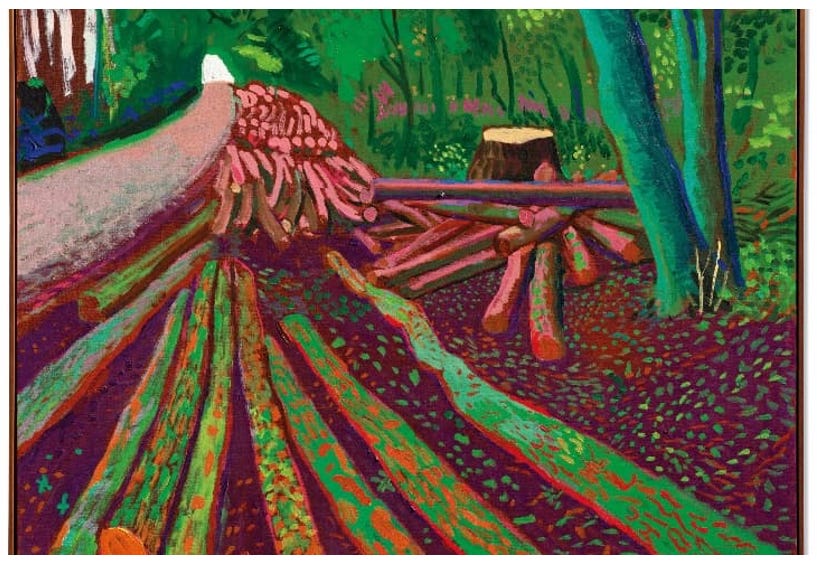
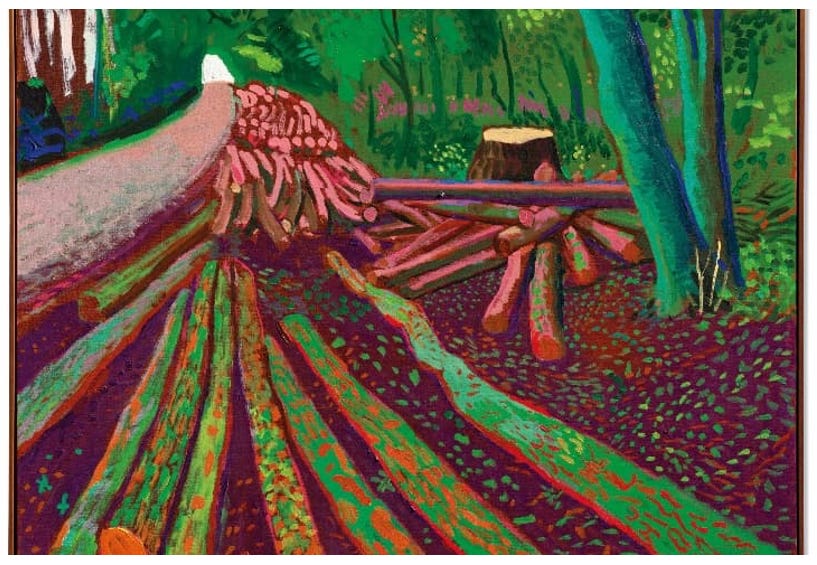
More Woldgate Timber (2009).
The paintings have been widely exhibited—in London (at the Tate and the Royal Academy), in Los Angeles, a broad overview in a small museum in Germany this past summer—though not yet in New York, a situation that will be rectified in late October by a major show, his first there in ten years, slated to take up both the uptown and downtown spaces at PaceWildenstein.
The buildup toward these shows has found Hockney busier than ever (he is still in the process of completing a dozen fresh canvases as I write), but not so busy that he hasn’t managed to become fascinated by yet another new (and virtually diametrically opposite) technology, one that he is pursuing with almost as much verve and fascination: drawing on his iPhone.
Hockney first became interested in iPhones about a year ago (he grabbed the one I happened to be using right out of my hands). He thereupon acquired one of his own and began using it as a high-powered reference tool, searching out paintings on the Web and cropping appropriate details as part of the occasional polemics or appreciations with which he is wont to shower his friends.
But soon he discovered one of those newfangled iPhone applications, entitled Brushes, which allows the user digitally to smear, or draw, or fingerpaint (it’s not yet entirely clear what the proper verb should be for this novel activity), to create highly sophisticated full-color images directly on the device’s screen, and then to archive or send them out by e-mail. Essentially, the Brushes application gives the user a full color-wheel spectrum, from which he can choose a specific color. He can then modify that color’s hue along a range of darker to lighter, and go on to fill in the entire backdrop of the screen in that color, or else fashion subsequent brushstrokes, variously narrower or thicker, and more or less transparent, according to need, by dragging his finger across the screen, progressively layering the emerging image with as many such daubings as he desires.
Over the past six months, Hockney has fashioned literally hundreds, probably over a thousand, such images, often sending out four or five a day to a group of about a dozen friends, and not really caring what happens to them after that. (He assumes the friends pass them along through the digital ether.) These are, mind you, not second-generation digital copies of images that exist in some other medium: their digital expression constitutes the sole (albeit multiple) original of the image.
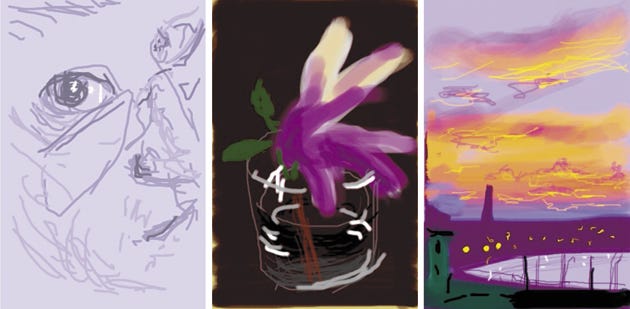
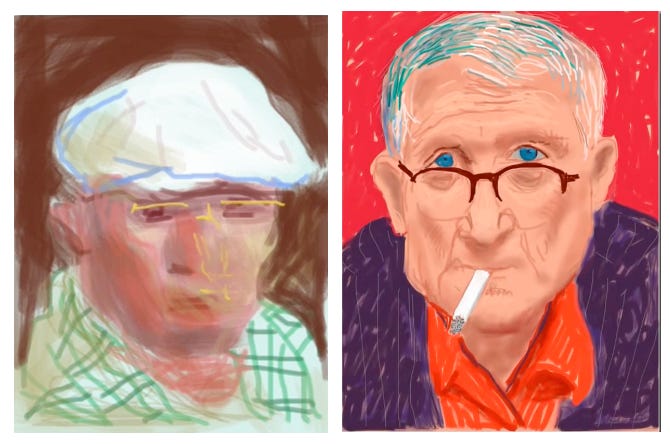
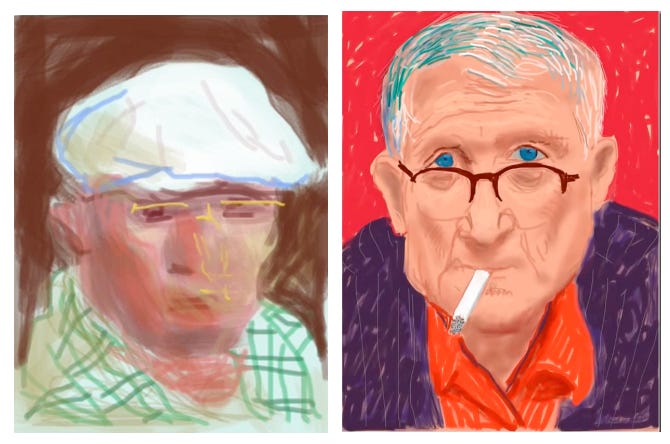
The flood of images has more or less resolved itself into three streams. To begin with, portraits, and mainly self-portraits at that—perhaps playing on the way that an iPhone’s blackened screen, when off, already functions as a sort of Claude Lorrain–style darkened glass, reflecting back a ghostly image of the user’s face.
(Intriguingly, the reflected face in the blackened screen is approximately twice the size of the same face if one turns the iPhone around to snap a photographic self-portrait. “But that’s how it always is with photography,” Hockney points out. “It inevitably pushes the world away. That’s just one of its many problems.” Hockney’s drawings, as it were, bring the face back to full scale.)
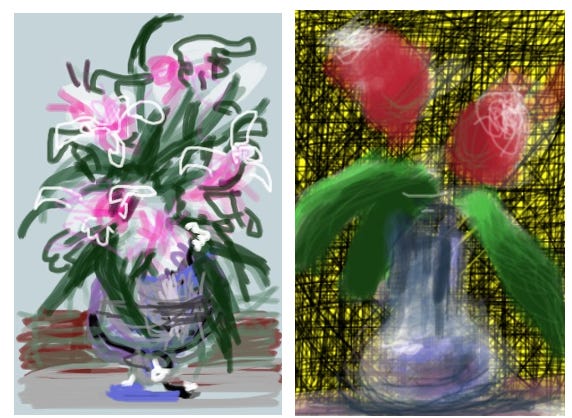
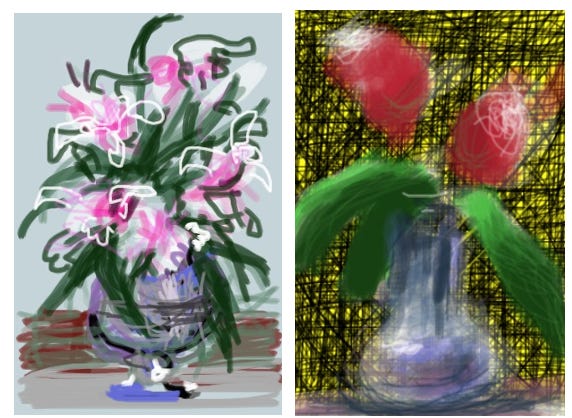
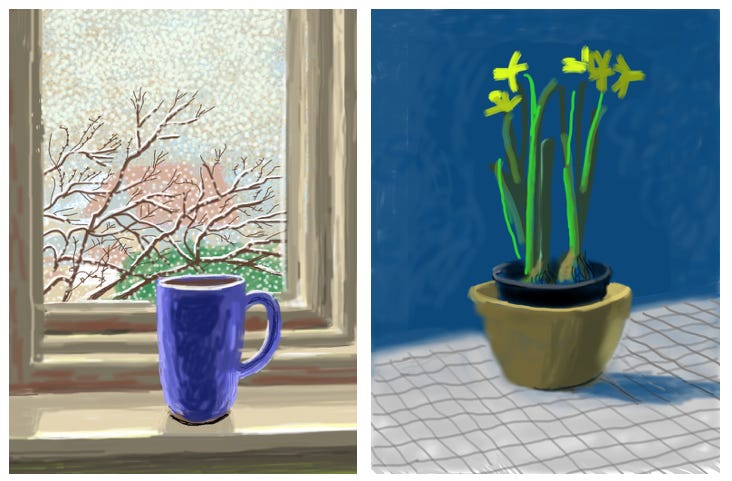
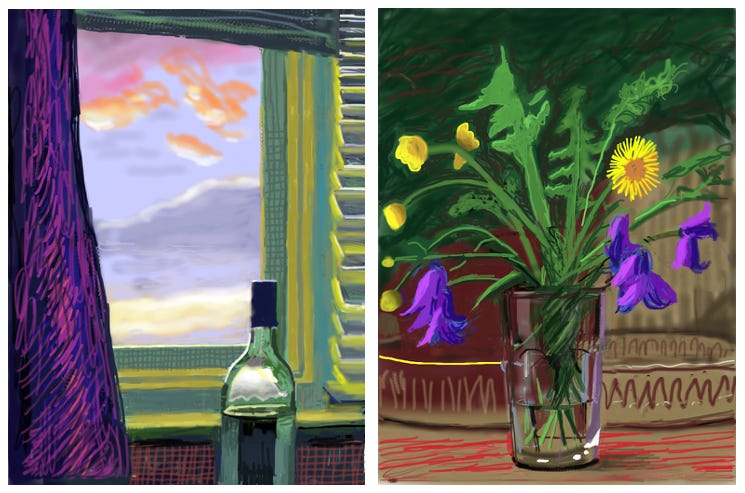
Early on, however, Hockney became much more interested in bunches of cut flowers and plants ranged in brick pots, ceramic vases, and glass jars.
These became the occasion for his extensive investigations into the types of effects possible in this new medium. “Although the actual drawing, when I do it, goes quite quickly,” he explains, “some days it might be preceded by hours and hours of thinking through just how one might achieve a certain play of light, texture, or color.” Indeed, the range of results is dazzlingly various, colorful, and instantaneously evocative.
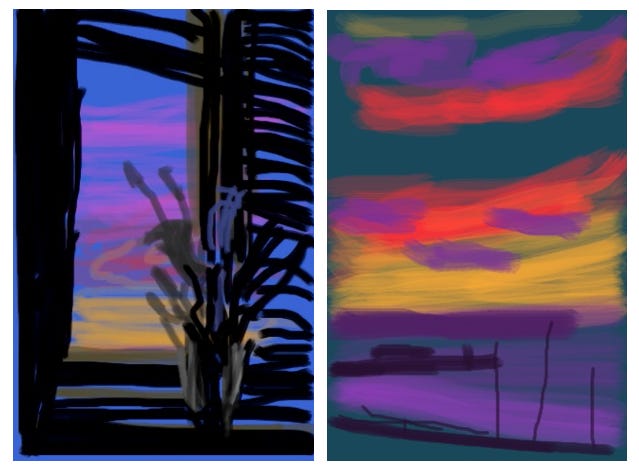
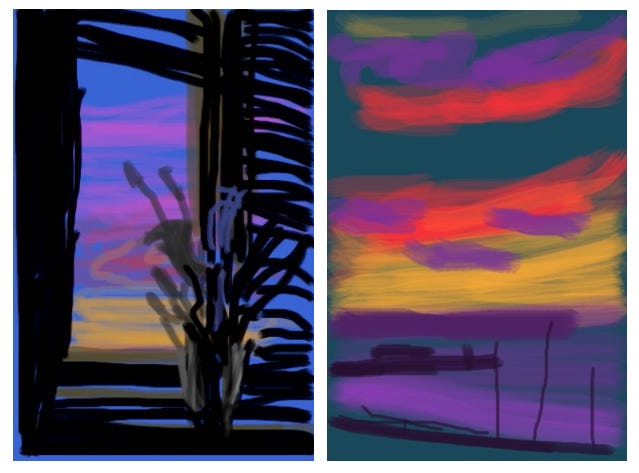
Increasingly, over the past several months, it is the summer dawn, rising over the seabay outside his bedroom window, that has been capturing Hockney’s attention. “I’ve always wanted to be able to paint the dawn,” Hockney explains. “After all, what clearer, more luminous light are we ever afforded? Especially here where the light comes rising over the sea, just the opposite of my old California haunts. But in the old days one never could, because, of course, ordinarily it would be too dark to see the paints; or else, if you turned on a light so as to be able to see them, you’d lose the subtle gathering tones of the coming sun. But with an iPhone, I don’t even have to get out of bed, I just reach for the device, turn it on, start mixing and matching the colors, laying in the evolving scene.”
He has now accomplished dozens of such sequential studies, sending them out in real time, so that his friends in America wake to their own account of the Bridlington dawn—two, five, sometimes as many as eight successive versions, sent out minutes apart, one after the next.
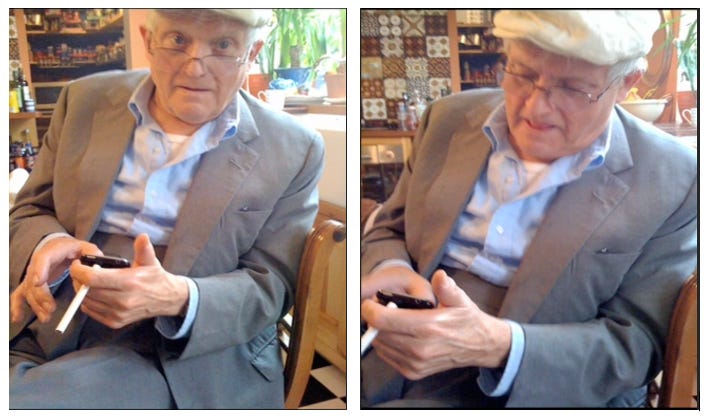
I’ve noticed that most users of the Brushes application tend to trace out their brushstrokes with their pointer finger. (The screen measures changes in electrical charge, and can be operated only with a conductive object—like a finger—rather than a pen-like stylus.) But, as I discovered on a recent visit, Hockney limits his contact with the screen exclusively to the pad of his thumb. “The thing is,” Hockney explains, “if you are using your pointer or other fingers, you actually have to be working from your elbow. Only the thumb has the opposable joint which allows you to move over the screen with maximum speed and agility, and the screen is exactly the right size, you can easily reach every corner with your thumb.” He goes on to note how people used to worry that computers would one day render us “all thumbs,” but it’s incredible the dexterity, the expressive range, lodged in “these not-so-simple thumbs of ours.”
Hockney, who has carried small notebooks in his pockets since his student days, along with pencils, crayons, pastel sticks, ink pens, and watercolor bottles—and smudged clean-up rags—is used to working small, but he delights in the simplicity of this new medium: “It’s always there in my pocket, there’s no thrashing about, scrambling for the right color. One can set to work immediately, there’s this wonderful impromptu quality, this freshness, to the activity; and when it’s over, best of all, there’s no mess, no clean-up. You just turn off the machine. Or, even better, you hit Send, and your little cohort of friends around the world gets to experience a similar immediacy. There’s something, finally, very intimate about the whole process.”
I asked Hockney whether he’d mind my sharing some of these images with a wider audience across a printed medium, and he said, not really, he more or less assumed that the pictures would one by one find their way into the world. “Though it is worth noting,” he adds, lighting one of his perennial cigarettes, “that the images always look better on the screen than on the page. After all, this is a medium of pure light, not ink or pigment, if anything more akin to a stained glass window than an illustration on paper.”
He continues: “It’s all part of the urge toward figuration. You look out at the world and you’re called to make gestures in response. And that’s a primordial calling: goes all the way back to the cave painters. May even have preceded language. People are always asking me about my ancestors, and I say, Well, there must have been a cave painter back there somewhere. Him scratching away on his cave wall, me dragging my thumb over this iPhone’s screen. It’s all part of the same passion.”
He laughs, stubs out his cigarette, snaps off the iPhone, and heads back over to a vast set of painted canvases arrayed against the far wall of his hangarlike studio: a view of a forest road lined with felled trees, a gridded combine of fifteen canvases, three high and five long. He daubs a long paintbrush with fresh creamy glops of paint, and begins working from his shoulder. “People from the village,” he says, craning back over that shoulder, “come up to me and tease me, ‘We hear you’ve started drawing on your telephone.’ And I tell them, ‘Well, no, actually, it’s just that occasionally I speak on my sketch pad.’”
NOTE: The NYRB online piece was accompanied by a short video in which I elaborated on some of the themes raised in the article with imagery to match. It culminated in a sequence in which Hockney began portraying me on his Iphone while I captured him doing so on my own. And you can watch the whole thing HERE.
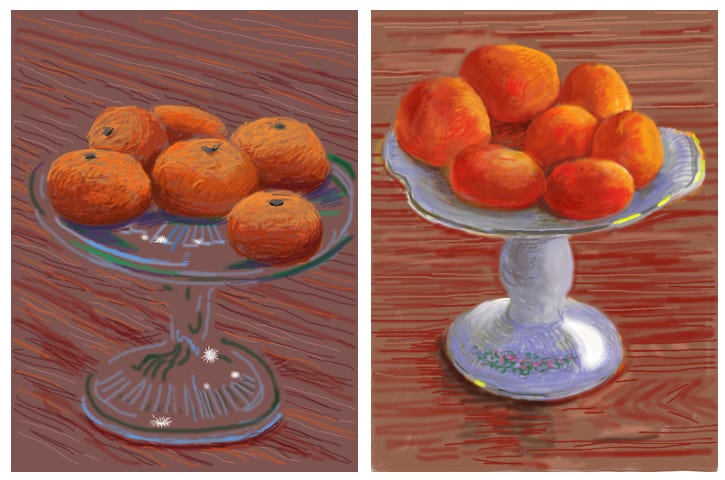
Although I touched on this aspect of things in that NYRB article, in retrospect I really didn’t give enough prominence to the remarkable way in which David was perfecting his treatment of textures and sheens across this new glass-based medium of the iPhone and presently the iPad during those first several months of his interaction with this new technology. Or so I found myself thinking the past few days, going back over the stash I still have in my own phone from that halcyon period.
And so what follows are some instances of same, not in exact chronological order (though I do wish someone—Apple? Taschen? the Hockney studio themselves—would mount such a show, and on iPhones and iPads arrayed along walls in a darkened succession of rooms, not the on-paper blow-ups or oversize book versions that so far have characterized the dissemination of these sorts of images), but rather thematically, as it were. Though, again, these all proliferated over a period of a few months back in 2008-9.
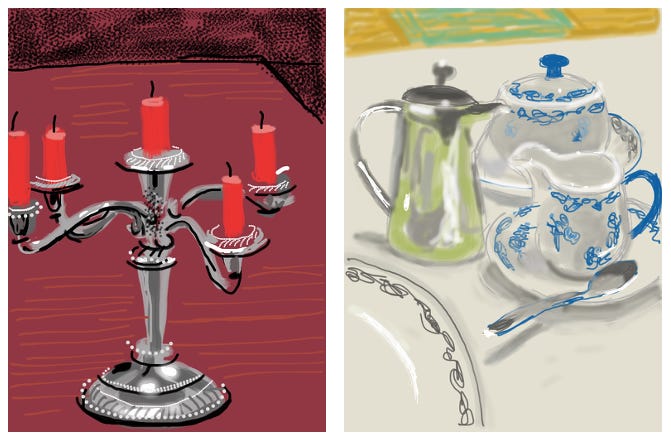
Thus, for example, how does one render glass, or for that matter porcelain?
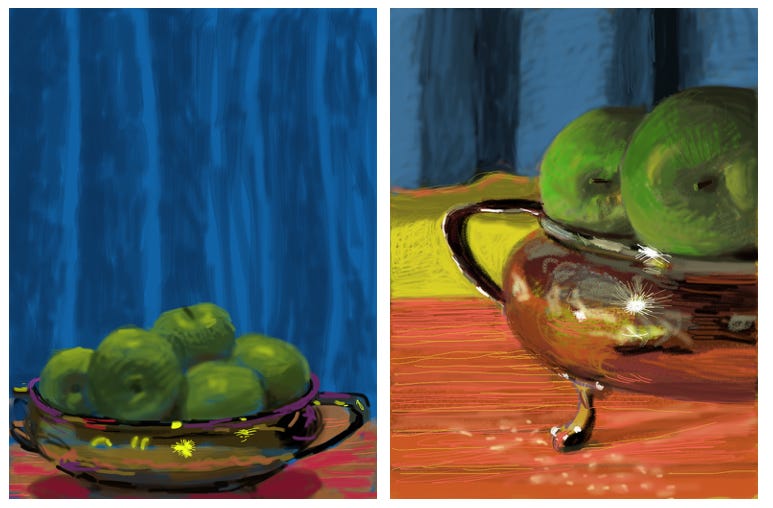
Or, for that matter, silver or pewter or chrome?(Note, not by laying silver as a color of its own)
Or the mattelike quality of clay or pottery?
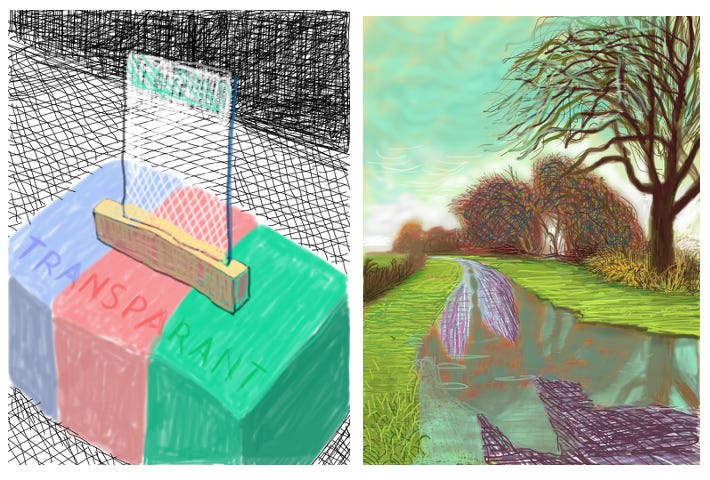
Or arguably even more amazing, transparency itself, or the sheen of reflection, as elaborated across just such an already transparent, reflective surface?
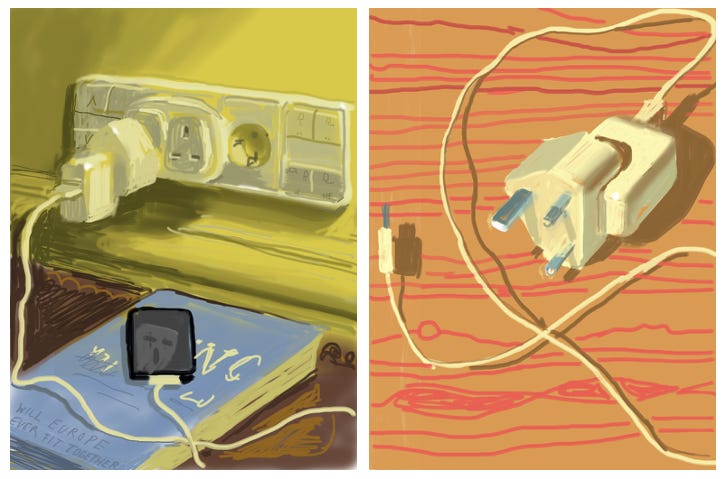
And what of the creaminess of plastic (talk about a process’s meta self-awareness)?
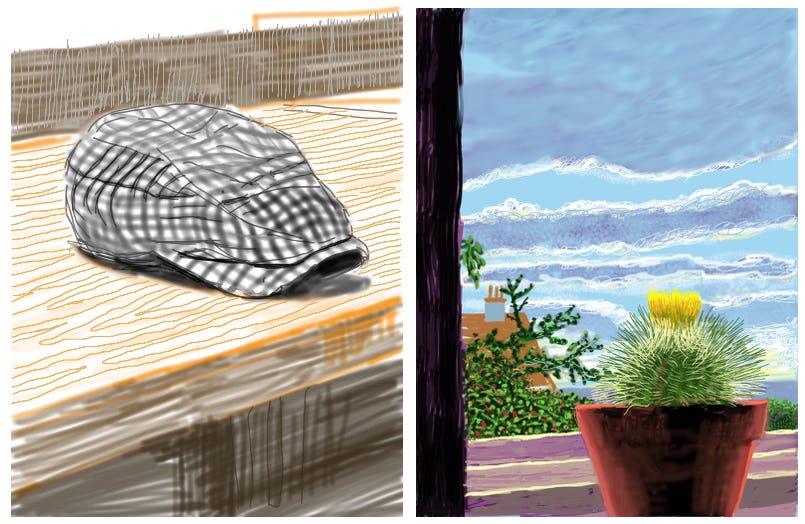
Or the softness of a cloth cap, versus the spikiness of a potted cactus?
The magic of light passing through glass and water (as captured, again, on glass)…
…or the punctum of a reflected gleam as set against the sheen of appleskin?
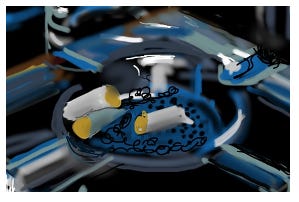
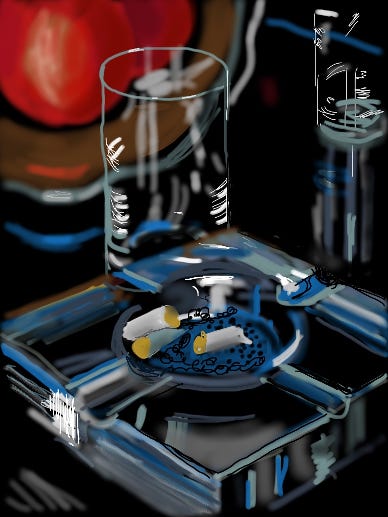
And perhaps most astonishing of all, arguably the masterpiece of the entire series, glass on glass on glass, nighttime as clear as day—with, naturally, pride of place being given to a display of used cigarette butts in a gleaming ashtray (butts which look for all the world, come to think of it, like the felled trees, emblems of mortality, proliferating simultaneously on his large painted canvases, with which we began).
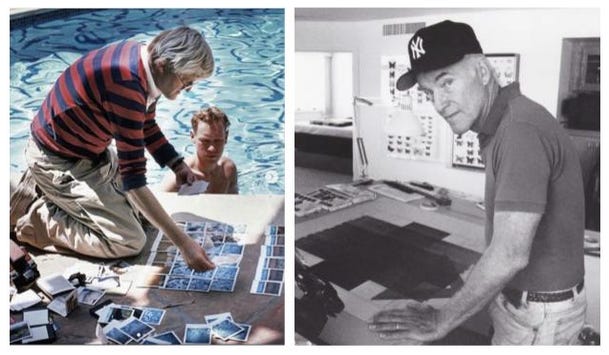
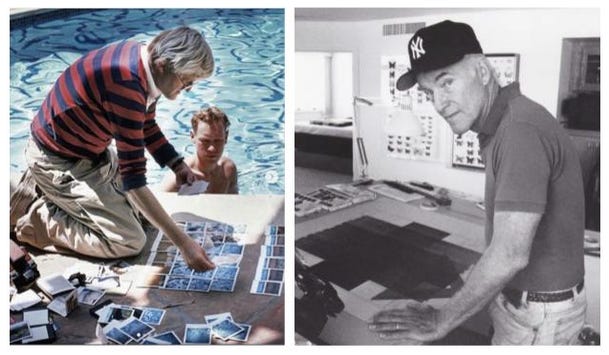
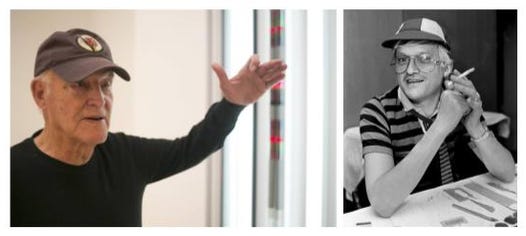
And now both of them, two of the main interlocutors, subjects and friends of the first half of my own writerly career, have passed: Bob Irwin, as veterans of this Cabinet will remember, at age 95, back in the fall of 2023 (see here and here)—and now, as we first noted last week, David Hockney at the age of 88. Two more dissimilar individuals could hardly be imagined, or two more alike, as I tried to bring out back in 2008 (the same period, it occurs to me, covered in the iPhone passion piece above) in an article in The Believer, as I was bringing out my braided contrapuntal conversational biographies of the two with University of California Press. Incredibly, the two never met, but for almost forty years (deeply aware of each other by way of my successive writings about each of them), they vied for my soul—a battle to be the site of which proved one of the great privileges of my life.
But here is how the landscape of that ever-evolvingtussle looked back in 2008:
The Believer Nov.-Dec. 2008
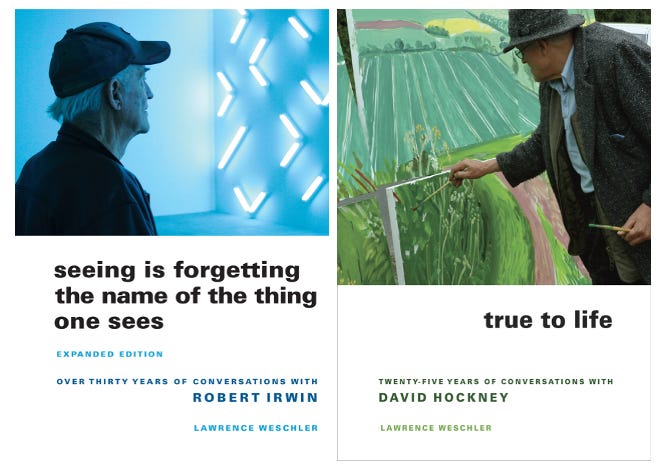
Back in 1982, I published my first book, a midlife portrait of the California “light and space” artist Robert Irwin, entitled Seeing Is Forgetting the Name of the Thing One Sees, a title that paradoxically, in that instance, said it all. Which is to say that the book surveyed all the things that Robert Irwin, sequentially over a period of about two decades (1958–1978), had had to bracket out of his practice—figure, image, line (which is to say, associations of any kind), focus, any made or permanent object, signature, and presently even exhibition itself—before he was able to arrive at what he’d come to comprehend as the true subject of art: the sheer wonder of perception itself or, as he sometimes parsed matters, all the marvel inherent in our “perceiving ourselves perceiving.”
Shortly after that book’s publication I got a call from another artist famously associated with California, David Hockney, a painter I’d never met but one whose work I naturally knew well. He invited me up to the Hollywood Hills home into which he’d recently moved, and, after cordially offering me tea and making me feel quite at ease, he began by telling me he’d recently finished reading my book about Irwin, and though he disagreed with almost every single thing in it, still, he couldn’t get it out of his head, such that he thought it might be a good idea to discuss the thing with me.
“I’ve never met Irwin,” he noted, “though I’ve of course been quite aware of his work, as what artist, especially here in L.A., wouldn’t be.” Already then, Irwin was regarded as one of the most significant artists and thinkers on artistic practice anywhere in the country, at least among fellow artists (though his reputation was considerably less well established among the public at large); within a few months he would become the first visual artist to be awarded one of the MacArthur Foundation’s so-called genius awards. “I mean,” Hockney continued, “I’ve observed his progress, though at times that was by no means easy, and for the longest time I felt that his position on the photographing of his work”—a flat prohibition, as it happens (which is one of the principal reasons he was so much less well known among the public at large)—“was pretty preposterous, and somewhat fetishistic.” Irwin for his part accounted for that absolute injunction by arguing that a photograph could capture everything that the work was not about (which is to say its image) and nothing that it was (which is to say its presence), so why bother?
Hockney paused and took a drag on a cigarette before going on to completely confound me: “The thing is,” he now said, “with time I’ve come to see that Irwin was right about that ban on photographing his work; I wish I’d imposed a similar ban regarding my own from the outset.” (This from an artist whose work was more photographed and more ubiquitously visible in the world than that of just about anybody else, with the possible exception of Andy Warhol!) “I mean, no one can come upon one of my paintings in a museum, say, and simply see it; instead they see the poster in their college dorm or the dentist’s office or the jacket on the book they are reading, all sorts of second-rate mediations getting in the way of experiencing the work as if from scratch.”
Our conversation went on from there, and gradually Hockney proceeded to lay out the profound divergence from Irwin he nevertheless felt, which essentially came down to a radical disagreement over the true significance of the cubist achievement and how one ought to be required to proceed as an artist if one were going to take that achievement seriously (both artists considered cubism to constitute the decisive, seminal movement of our age, and both considered its work to be far from over).
For Irwin, cubism represents the culmination of a five-hundred-year-long process of flattening, as it were, in the subject deemed worthy of artistic attention (from Christ, to this king, to this burgher, to his maid, to her red shawl, to the color red, to the process of seeing the color red); and if one were to take seriously its greatest achievement—which is to say the so-called marriage of figure and ground—one couldn’t very well go on making paintings, which would necessarily have to read as figures to the wall’s ground, thereby undermining the whole point of the artistic project.Many critics of the Hilton Kramer variety saw despairing nihilism in Irwin’s minimalist abnegation of traditional artistic practice, but to be clear: Irwin wasn’t suggesting that everything in the art world level out to a groundlike zen backdrop; on the contrary, he was advocating a way of being in the outside world in which everything all around would now get tended to (or at the very least be seen as being worthy of being tended to) with the same sort of heightened attention one used to only lavish on the figure in a work of art (hence his eventual progression out of the Point Zero he seemed to have attained around the time of the publication of my first edition of his midlife biography in 1982, on through to such improbably maximalist projects as the Central Gardens at the Getty or the overall design for DIA Beacon, which were to consume his ensuing years).
Even so, Hockney emphatically disagreed with Irwin’s characterization of the cubist challenge, already insisting to me just a few weeks later (for in the meantime he’d invited me to start visiting more regularly so that I might compose a text for a planned coffee-table book surveying the photocollage cameraworks series on which he’d only just embarked), “No! Cubism was precisely about saving the possibility of figuration, this ages-old need of human beings, going all the way back to Lascaux, to render the world in two dimensions, and saving that possibility at the moment of its greatest crisis, what with the onslaught of photography with all its false claims to be able to accomplish such figuration better and more objectively. It was about asserting all the things photography couldn’t capture: time, multiple vantages, and the sense of lived and living experience.”For his part, critics often got Hockney all wrong as well, misinterpreting the intensity of the ways he would presently be engaging photography (taking literally hundreds of thousands of photos) as a celebration of the photographic over the painterly, and specifically the post-optical painterly (for in the meantime he’d come to feel that the Old Masters themselves had been in thrall to a similar optical aesthetic)—when in fact all along he’d been engaged in a rigorous critique of photography and the optical as “all right,” in his words, “if you don’t mind looking at the world from the point of view of a paralyzed Cyclops, for a split second, but that’s not how the world is really like.”
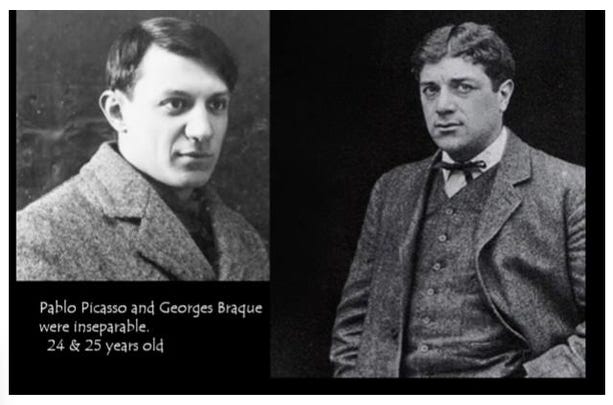
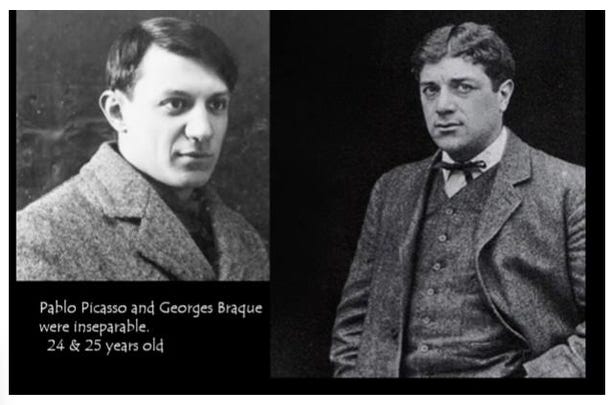
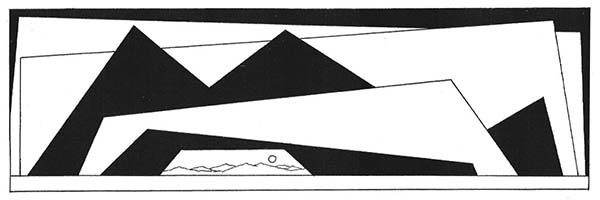
Hockney that day back in 1982 went on to acknowledge that ever-greater degrees of abstraction had indeed constituted one possible path out of cubism. But he for one was sure that Picasso and Braque must have been talking to each other one day back in, say, 1907 or 1908, and realized that such a progression could only lead into a dead end or, as he put it, “an empty room”—and they didn’t need to pursue the matter in order to prove it: it was just obvious.
That last comment seemed a direct dig at Irwin (who for his part disagreed completely—I know, because he subsequently told me so, characterizing Picasso and Braque’s failure to pursue such a path as a sheer failure of nerve), and in a sense that entire first Hockney essay of mine (as it appeared in its entirely in the eventual book, or, before that, in somewhat condensed form as it did inThe New Yorker) could be read as Hockney’s refutation of the earlier Irwin book (as it had also appeared in The New Yorker). Just as the essay I subsequently wrote for the 1993 Irwin retrospective at the Museum of Contemporary Art in Los Angeles would come to stand quite consciously as, among other things, Irwin’s refutation of my intervening Hockney writings.
Indeed, for some twenty-five years now, whenever I have written about one or the other of these two giants of contemporary art (arguably the two most significant artists to come out of the late twentieth-century California art milieu), the other one has called to tell me, “Wrong, wrong, wrong” or words to that effect (in Irwin’s case it was usually a characteristically peremptory “Bullshit!”). The two have never met or conversed in person (straddling that Southern California scene like Schoenberg and Stravinsky before them, each seemingly oblivious of the other’s existence though in fact deeply seized by the work); instead they have been carrying on this quite vivid argument for over two decades, through me, as it were.
Such that now, as I am simultaneously releasing two books in parallel editions—the one a massively expanded and updated version of that original Irwin biography, encompassing thirty years of conversations with him, and the other gathering together twenty-five years of my writings about Hockney—I am not unaware that the reader will be invited to explore the two texts not just as surveys of their respective subjects but in active counterpoint and virtual dialog with each other: an argument shuffling from chapter to chapter between the two books.
I should perhaps myself note, however, the way that curiously, while the two artists have been engaged in entirely different artistic enterprises—undergirded, they would argue, by entirely opposite readings of history—many of Hockney’s and Irwin’s core concerns have come to seem, at least to me, almost entirely identical: the emphasis, for instance, on the critique of photography, the countervailing celebration of the human quality of looking and experience, the focus on the centrality of the observer, the vitality of the periphery, the interpenetrations of art and science, the dialogue of immanence.
Hockney recently embarked on an extended series of lush landscape paintings documenting the changing seasons in the beloved Eastern Yorkshire of his youth. And, granted, what could possibly seem more retrograde from Irwin’s point of view? (“You get me all wrong,” Irwin once said to me with regard to Hockney, before concluding, witheringly, “I’ve always thought him a first-rate practitioner.”) But what in turn is one to make of Hockney’s recent characterization to me of those deliriously colorful nature studies, devoid of any human presence, as figure paintings. Figure, I asked David, taking the bait, what figure? There’s no figure in those paintings. “You,” Hockney replied triumphantly, “you, the viewer, are the figure.” And one can’t imagine Irwin’s having parsed things any plainer.
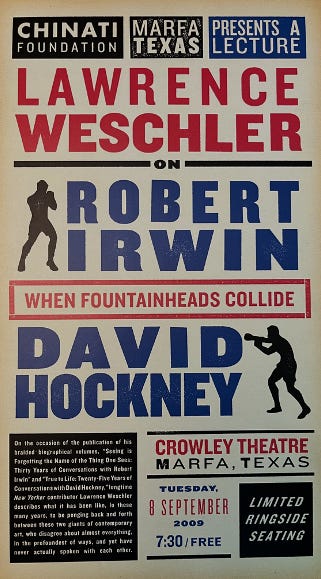
In the months after those two books came out, I spoke in all sorts of venues, none more challenging, perhaps, than Marfa, Texas, for the audience there (in an art scene founded by Donald Judd) was almost uniquely pro-Irwin (and decidedly so). Indeed, my hosts there had plastered the town with a marvelous poster, tapping into the iconography of Mexican wrestling
which David ended up liking when I showed it to him (though Bob was not the least bit amused). However, I think that in the end, the Marfans came to see that David might be more interesting than they first imagined, just as in other venues, diehard old-fashioned figuristas came to see that Bob might have something to say to them as well.
May both of them now rest in well-earned peace—or keep on keeping on in their heavenly disputations over cigarettes and Coca-Cola: a prospect before which I am one wide smile…
ANIMAL MITCHELL Cartoons by David Stanford, from the Animal Mitchell archive. You can order a four-booklet Animal Mitchell starter kit here. And please check out Weekly Strip.
Feel free to get in touch: animalmitchellpublications@gmail.com
NOTE: For those of you who can’t afford a paid subscription right now, you can still access a free option by clicking HERE and selecting the option on the far right.
Thank you for giving Wondercabinet some of your reading time! We welcome not only your public comments (button above), but also any feedback you may care to send us directly: weschlerswondercabinet@gmail.com.


Comments
Nothing yet. Say the first thing.
Sign in to join the conversation.