
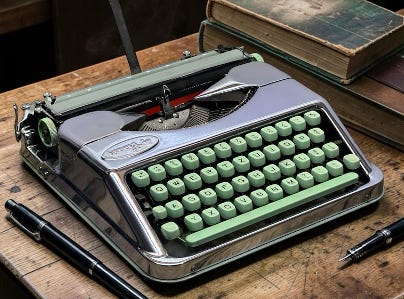
A midsummer’s bagatelle as Ren looks back five decades at an early screenplay treatment of his, about talking apes, bickering grad students and a lapsed-academic detective, produced under duress and in thrall to trickster-artist Ed Kienholz. Plus Barbet Schroeder’s Koko: A Talking Gorilla.
I’m not quite sure what has had me recalling this little screenplay treatment from my own mid-twenties back in the late seventies. Obviously it grows in part out of our last issue before the break which in turn grew out of my engagement with Ed Kienholz’s Five Car Stud lynching tableau—and by way of that back through my earlier engagements with the same artist as conveyed across such prior issues of this Cabinet as numbers 86, and 87 and 87A, where, as some of you will recall, I recounted how I first began interacting with Kienholz, the great and often quite discombobulating assemblage artist, during the mid-seventies when the UCLA Oral History Program sent me up to the compound in Hope, Idaho to which he and his new wife Nancy Reddin and their respective kids had relatively recently repaired in flight from LA (actually on a peninsula on the far end of that Idaho hamlet jutting into the nearby lake which they’d taken to calling “Beyond Hope”) in order to record his recollections of his own lively adventures and artistic production up to that point.
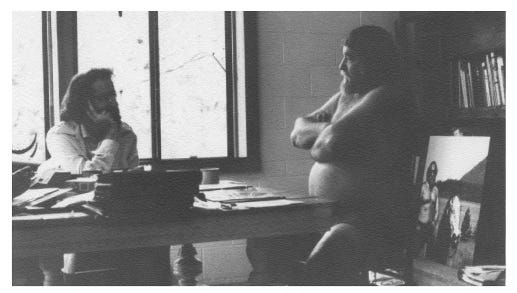
Which was never going to be an easy task: he was always a sly trickster of a narrator, not just in terms of the stories he told but also with regard to the feints and trials which he relished putting me through as I endeavored to collect them. So there’s that, and then too the advent of AI and the various conversations I’ve been having of late about its possible claims to incipient consciousness, which in turn has had me looking back on earlier surmises on the development of theory of mind in infants, toddlers, and monkeys, as in that reprise issue 114. And then, too, there was the discovery just the other day that the son of one of my dear writer friends has decided to take up an unexpected new life as a private detective.
Anyway, the point is that a year or so after I’d first taped that week’s worth of interviews with Ed, I’d returned to Hope to go over the five-hundred page transcript I’d in the meantime edited into near-final shape. And Ed greeted me cheerfully—“Ah, it’s about time, what took you so long?”—and guided me down to one of the outlying cabins into which he intended to lodge me, whereupon he informed me that we could get to the transcript later but that what he needed right now were treatments for three genre movies—a Western, a World War II saga, and a detective story—and he was going to keep me holed up there in that cabin, sending down meals on a timely basis but refusing any other interaction, until I had completed them. I tried to laugh it off—“Good one, Ed!”—but he stared me down grimly: he was dead serious.
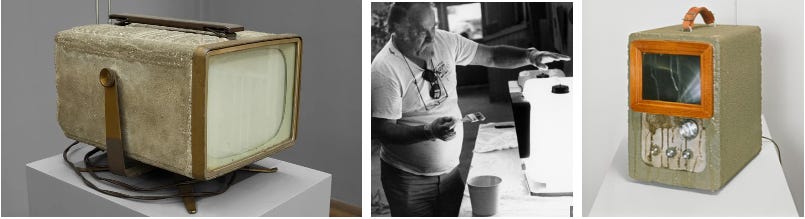
He explained that he was in the process of creating a new edition of cement television sets (an ongoing theme in his work going way back) and in this case he was intending to slot a tape player into the cement block’s rear which would continuously run a loop of garbled soundtracks of such fare (sound effects, ominous music, muffled dialog), and that, he claimed, he didn’t want to just lift samples off his own TV’s late shows, he wanted his cement TVs to feature original fare, only he was no good at creating such fictions (he was very good at creating atmospheric tableaux of frozen scenes from such fictions, he acknowledged when I challenged him on that last point, just not the surrounding stories, which is where I, the big deal would-be writer was going to come in). I protested that I was no good at fiction myself (see our issue 113A), but he would have none of it. There was the desk and the ream of paper, I had my little Baby Hermes portable typewriter with me as usual, didn’t I? (I did.) “So, get to work, I’ll have dinner sent down in a few hours.”
Which indeed is how I ended up spending the next few days. (I wish I could say that this was wildly uncharacteristic behavior on his part, but it wasn’t. Another time he’d peremptorily shut down the interview till we went out on the lake and he, at the helm of his little motor skiff, got to drag me around on water skis, despite my insistence that I had no idea how to waterski, which I didn’t. The result was not pretty: hilariously so, to hear him guffawing up there at the wheel of the speedboat. Yet another time, things came to a halt till I accompanied him on a short and terrifying hunting expedition. He loved toughening me up. And so forth.)
Anyway, somehow I produced a little Western tale, of which I have no memory whatsoever, and then a war epic, drawing on a story my uncle once told me about having spent Christmas 1944 in recently liberated Strasbourg, trying to fake out the recently retreated Germans on the other side of the river as to the actual number of allied troops they had there in the city by dressing local residents up in surplus uniforms and having them march up and down the river embankment in stout formations, which in fact did sort of work, for a while anyway.
But then, for some reason, I really did get into the detective story. This must have all been around 1978, now that I think back on things and google through contemporary chronologies. Because just before heading up to Hope I must have seen the German filmmaker Barbet Schroeder’s only-just-released documentary Koko: A Talking Gorilla, about the Stanford primatologist Penny Patterson’s allegedly surprisingly successful attempts to teach a young gorilla American Sign Language. And this would as well have been right around the time that a highly esteemed tenured Haverford Kierkegaard scholar named Josiah Thompson, whose work and career I had been following for some years myself (in particular how he’d taken an extended leave from that collegiate sinecure to pursue a deep forensic dive into the Warren Commission’s account of the Kennedy assassination, emerging with arguably the best book on the subject) suddenly announced that he was abandoning academia altogether to become a private detective in San Francisco (about which he in turn subsequently published a quite marvelous memoir).
Anyway, all that must have been sloshing around somewhere in my brainpan as, a few days later, I emerged with the following little treatment. Again, I make no claims on my own behalf to any degree of competence as a fictionero, nor do I even know if Ed did in fact end up producing audio-fueled versions of his cement TVs (he may have just been pulling my chain, as I say, that would not have been unlike him)—but for what it’s worth, here is that would-be effort (a full five decades before this season’s blockbuster, The Sheep Detective!):
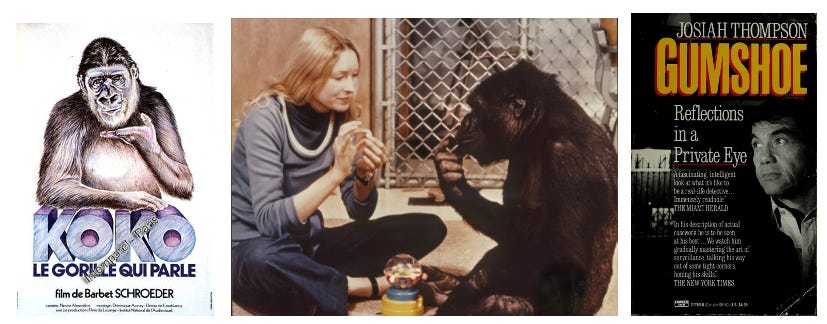
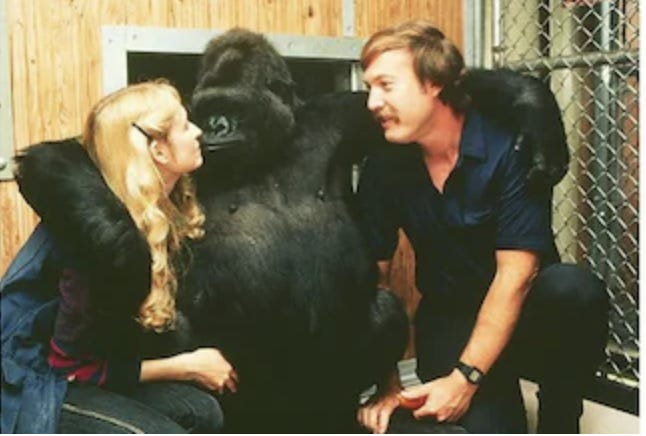
The scene is a primate study lab at Stanford University in the present. There, a group of animal behavior scientists is at work on some pathbreaking research into the intelligence and language-acquiring capabilities of gorillas. They are basically furthering work already attempted with chimpanzees, teaching the apes standard American sign-language for the deaf, and monitoring their progress. The results are shaping up as fairly astounding: the gorillas not only attain vocabularies in the hundreds of words, but they also display extraordinary capacities for memory, reasoning, etc., and they have even comprehended the usefulness of language to the extent that they use it to lie! Their I.Q.s have been measured on the appropriate human indices as in the nineties; they have demonstrated a capacity to comprehend such concepts as good and bad. Etc. So far, all of this is true. What we propose to do with it, however, is completely fictional.
INTRODUCTORIES
As the film opens, three scientists are working together with three gorillas. The scientists are Nora Simon, Josh Young, and Mary Parker (the film will generally develop from Nora’s point of view). Two of the gorillas, Fay and Ray, have been at the center for years already; the third, Bottom, just arrived the day before (his shipping cage is still in the corner of the workspace) and the three scientists are trying to acclimatize this “green ape” (a particular species—Bottom is two months old and was captured in the wild, in Africa, and air-shipped over) to its new surroundings. The custodian, Wiley, is just finishing his night’s work, sweeping up, bantering playfully with the scientists. Through that banter, all of this information seeps out, as does the fact that there is a certain tension between the scientists, particularly between Nora and Josh. Josh is bitterly jealous of Nora’s public reputation; he has all kinds of academic grudges against her; there’s some sort of race-to-publish tension floating about as well. Mary also has certain gripes that make her pretty unpleasant company (these aren’t quite as clear to me at this stage). At any rate, the atmosphere is bristling with intellectual and interpersonal tension.
In walks Nick Sorenson, a San Francisco detective (and one-time Leibniz scholar), accompanied by his secretary-assistant Silvia Kersten. The two of them are down in Palo Alto investigating a case, and Silvia has dragged her boss over to have lunch with her former college room mate, Nora. From the start there are romantic sparks between Nick and Nora…
To access the rest of the short(ish) treatment in its original Hermes Baby typescript, click HERE.
Say what you will about that screenplay treatment, it will nevertheless perhaps have served some purpose if it in turn leads you back to Schroeder’s wonderfully evocative (and resurgently ever-so-relevant) 1978 documentary, which you can find for sure on the Criterion Channel, though much to my surprise, for the time being anyway, it also seems to be accessible online for free in its entirety (if only until somebody notices)…
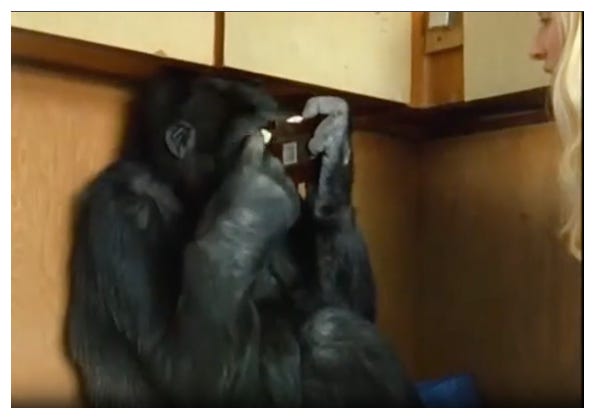
…by clicking HERE.
ANIMAL MITCHELL Cartoons by David Stanford, from the Animal Mitchell archive. You can order a four-booklet Animal Mitchell starter kit here. And please check out Weekly Strip.
Feel free to get in touch: animalmitchellpublications@gmail.com
NOTE: For those of you who can’t afford a paid subscription right now, you can still access a free option by clicking HERE and selecting the option on the far right.
Thank you for giving Wondercabinet some of your reading time! We welcome not only your public comments (button above), but also any feedback you may care to send us directly: weschlerswondercabinet@gmail.com.
Here’s a shortcut to the COMPLETE WONDERCABINET ARCHIVE.
No posts
Comments
Nothing yet. Say the first thing.
Sign in to join the conversation.