
It was hardly a surprise when, in her memorable testimony before the House Judiciary Committee, then-Attorney General Pam Bondi, one of the many blondes that Donald Trump has dumped, defended her selective release of the Epstein files by resorting to deflection. But that she did so by shouting to her interrogators that they should be thanking Trump for pushing the Dow Jones Industrials past the 50,000 mark rather than implying that her unfairly maligned boss might be a pedophile quickly became meme food.
But what was significant about Bondi’s rant was that a 50,000 Dow was clearly the administration’s sales pitch of choice to persuade Americans that Trump had ushered in an era of glorious national prosperity…best ever in human history. Trump also seized on the roaring stock market as confirmation that, despite the usual blizzard of scurrilous attacks by the liberal media, Americans were living better than ever before.
Financial markets are certainly booming. Although shortly after Bondi’s testimony, the Dow dropped a few thousand points, it soon rebounded and is now even higher than before. Both the Nasdaq and the S&P have also reached ethereal levels and consumer spending, although it recently underwent a small drop, remains robust.
And so, Trump’s touting of a vibrant economy has some truth to it. (In Trump’s case, even a grain of truth is a refreshing change.) As Bondi claimed, many retirement accounts are indeed benefitting from increased market value, as are investors.
Evidence of abundance, at least at the top-end, is easy to find. Sales of luxury goods have returned to pre-pandemic levels and many businesses have attempted to capitalize on Americans’ growing wealth by offering a variety of incentives for those willing to pay for them. Airlines, for example, are creating lounges more exclusive than the standard first-class variety, which have often become overcrowded because more and more people are willing to pay exorbitant prices to escape economy class.
But while a growing number of well-off consumers can painlessly part with an increased share of their disposable income to insulate themselves from contact with those below them on the economic ladder, for the vast majority of Americans, even a soupçon of luxury creates a pinch. To take a family of four to a major league baseball game in most cities can cost as much as $500 for tickets and only a modest amount of food and drink. Theater tickets or passes to events like Comic-Con are often more than a mortgage payment. And don’t even think about attending a World Cup game. Then there are the increased costs of necessities, such as food, clothing, and energy. That explains why the spike in gasoline prices engendered by Trump’s war with Iran has created a disproportionate ripple effect.
While costs are increasing far more than the aggregate inflation numbers would indicate, American consumers, fed by Mr. Immediate Gratification himself, are continuing to buy, ignoring the disincentives to do so. Buried beneath the overall spending number is that consumers are incurring costs higher than their income can match and the gap is growing. Already, the personal savings rate has plunged to an historic low because individuals and families cannot maintain their previous standard of living without dipping into those savings.
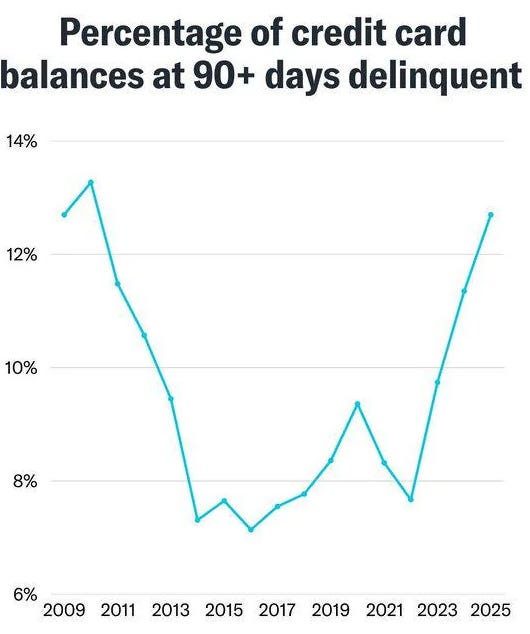
Or they can buy on credit, which many have chosen to do. The national credit card balance for second quarter 2026 was a staggering $1.25 trillion. And these bills are not always being paid. In first quarter 2026, the 90-day severe delinquency rate for credit card accounts rose to a 15 year high of 13.1%. This compares with 12.7% in the previous quarter and a long-term average of only 9.2%, meaning the current quarter is almost 50% higher than normal.
The breakdown of delinquency levels buttresses the notion that many Americans either cannot or will not stop spending. Low-income zip codes have a 90-day rate of more than 20%, while in the highest-income zip codes, it is a mere 7.3%. There was an age differential as well, with delinquencies for younger borrowers almost double those for 50 and older.
Debtor delinquencies have been felt in other sectors. While high-end mortgages are holding up, the overall delinquency rate at the end of first quarter 2026 grew to 4.44%, and foreclosure filings across the United States reached 228,000 from January to June, up 21% from the year before and 28% from two years ago. The delinquencies and foreclosures, as with credit cards, were concentrated at the lower end of the economic spectrum. Student and auto loan arrears have also increased markedly.
Conventional wisdom holds that the health of the United States economy rests on consumer spending and when one drops, the other will as well. That is why the Biden administration’s decision to ignore inflationary pressures toward the end of the pandemic so that Americans could get back to work and begin to spend again was the right one, even though it likely cost Democrats the White House. The Federal Reserve bears a good deal of blame for the outcome. Once unemployment came down and spending went up, Jerome Powell, a would-be Paul Volcker, was simply too slow to react to the burst of demand.
Kevin Warsh is now faced with what appears to be a similar problem, but is actually the reverse. Powell needed to discourage excessive spending by Americans who suddenly had cash in their pockets; Warsh needs to discourage spending by Americans who do not.
That the stock market continues to soar, even in the face of increasing inflation, war, tariffs, and general uncertainty, is due only in part to overheated consumer spending. There is a sense of euphoria on Wall Street surrounding the expectation of an AI-fueled technology boom that will do nothing less than remake human civilization. That some of the changes might bring crisis rather than opulence has not been factored in by investors who refuse to be dissuaded from the conviction that they are participants in a gold rush.
From a political standpoint, however, the hardening division between what are two distinct American economies presents an opportunity for whichever political party can most exploit it. That leaves Republicans, because they are the party in power, at a disadvantage. In addition, nothing reflects the tenuousness of the lower economy more than Trump’s abysmal approval ratings.
A generation ago, Republicans were the party of the rich and Democrats were the party of the working-class. That division has flipped. Democrats now have a unique opportunity to begin to flip it back.
Let’s hope they are up to it.
No posts
Comments
Nothing yet. Say the first thing.
Sign in to join the conversation.