

The reason you are seeing a red flower instead of a witty image is because two weeks ago, when I posted a photograph of Spalding Gray, Substack deleted it for infringement of a copyright. I was warned that future trespasses of this sort could result in losing my Substack account. Since my Facebook account was recently hacked and my identity was stolen, I cannot risk making a mistake here. For the time being, I will use photos I’ve taken or Substack has generated. Sorry. I have loved art directing the posts.
A moment ago, I was feeling blue. I was feeling I can’t find my shoes. I was thinking about Dolly Parton. No, I wasn’t. I was thinking about a dream I had early this morning, in which a detective comes to my apartment and my blood goes cold as I wonder which of my crimes he’s there for. As I sat on the couch, I asked myself, How are you going to look out at the world instead of inside yourself?
Honestly, I was asking myself this question while surfing through some old files of mine when I came across a quote from Hegel, written in 1805 in Lectures on The Philosophy of History. He writes: “The history of the world is none other than the progress of the consciousness of freedom.” It cheered me right up. A weight lifted off me and the feather of my soul grew lighter. I don’t have a soul. It’s a metaphor.
I went to the kitchen to heat my tea. Richard was sitting in a corner with his tea. I told him about Hegel. He said, “Hegel is well known for cheering people right up.” We talked about how Dolly put the world ahead of herself. All the stories about Dolly are that she was generous. I said, “I think Dolly would have been generous, even if she weren’t rich.”
Then I told him about the dream. I said, “We’ve come back to the apartment, and you tell me a detective is in the hall waiting to speak to me. I must have been about to pee. My pants are around my knees, and I go into the hall that way. I look at the detective. His weight is on one foot. He looks like the actor in Furious, the thug boyfriend played by Jake Lacy, who has a face asking to be punched. I’m runing through the reasons the detective could be coming for me, and then a voice from outside me that is also inside me says, Wake up. You don’t need to be there.”
I got out of bed, still wrapped in the dream. It had been stirred, I think, by having my Facebook account hacked and my identity stolen two weeks ago. In reality, I was the target of a crime, not the criminal, but the feeling of being the criminal was so strong in the dream, I couldn’t shake it. I can’t now, as I’m writing. It’s the insight that drives every movie made by Alfred Hitchcock and the reason his films are so resonant—that the victim of a crime is also in some ways a criminal. Think of Strangers on a Train as a core example. The targets, once preyed upon, immediately feel guilty about some actions and feelings they believe will be uncovered. It’s the insight in every story Kafka wrote as well, and both Hitchcock and Kafka are basically comic artists.
Over the course of my life, people have said to me, “You look guilty.” What was I thinking when they said this? That I was not a good friend? That I had stolen something or wanted to steal something that didn’t belong to me . . . for example a man here and there? There are other possibilities. Did I deserve to be hacked? Did I do something on Facebook to be cut off from all communication with the site?
What would Dolly do in a moment of feeling blue? She would sing, and out of her mouth would come a sound so sweet it wouldn’t seem possible a body could do that, unless it was a bird, and a bird couldn’t play with harmonies like Dolly could or laugh and sing at the same time.
When I read the quote from Hegel—“The history of the world is none other than the progress of the consciousness of freedom.”—the word freedom is what nudged me past the brain-taste of the dream. It’s such a gorgeous idea at a time when the entire country feels hacked. The whole thing. I know what Hegel meant. He was thinking about the French Revolution and how the French Revolution, in over-riding the Divine Right of Kings, became a template ever after for people defying metaphysical authorities. Every time I think, people can determine the course of their lives, I feel a hit of helium go through me. The Divine Right of Kings, off you go. The American Revolution. The Russian Revolution. Racial segregation, off you go. Sexism . . . persistent and also a show like Furious, now airing on Hulu, the most feminist show, maybe, I’ve ever seen.
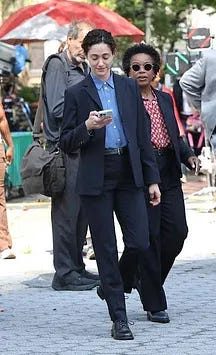
A movie or streaming show fails the Bechdel test when the women characters, if they speak to each other at all (because there is more than one), talk only about men. Furious joins a gleaming pantheon of works in which the women characters pass the inverse of the Bechdel test: They never talk about men, except to reference them as Can you fucking believe this?“ There are eight episodes. So far seven have aired. When scene partners Emmy Rossum and Quincy Tyler Bernstine are in the frame, we are looking at bonding of the brilliant, funny, tender, and I got your back, you crazy lunatic variety. That bonding is at the center of the show and is what makes it great.
A friend of mine is waiting for results of a medical test, and I find myself waiting, too. Not long ago, another friend said, “When do we let go?” She didn’t mean let go of a kite. I don’t know what she meant. I said, “I don’t want to let go of anything.” Do you remember the way you became a kite when you flew a kite?
Yesterday, a third friend and I said to each other, “I love you.” When I said, “I love you,” I meant other things don’t stand in the way. I don’t remember when I stopped caring what people meant by the word love. This friend and I, I’ll call her K. No, I changed my mind. It might remind you of Joseph K. I’ll call her Beauty. The thing I love about Beauty is she has a generous heart. Maybe not on the order of Dolly’s, but somewhere on the spectrum.
When Beauty and I said to each other, “I love you,” I was a kite, and I was thinking about another series I was watching, where a bunch of women spend a weekend together in a house on Nantucket Island. One of them is waiting for the results of a medical test, and no one is nasty to each other, and everyone is thinking, Fuck it, we’re only alive for a short time, and there will never be a good time to let go.
Thanks to all the brilliant and tender subscribers, who are being real comrades at this time and helping keep Everything is Personal afloat. Huge kiss.
With the loss of my Facebook account—deleted by hackers on August 11 and leaving no way for me to regain an account there—gone, too, is the stack’s primary source for attracting new subscribers. That leaves you, dear friends of Stackland, who have been reading with interest and loyalty and have not yet taken a turn at becoming a paid subscriber.
If you used to read me on Facebook, please find me on the “Notes” feed!
A paid subscription right now is inexpensive—there is a 50% discount—and there are benefits you can read about in the section below.
There is no paywall. There has never been a paywall. I’d rather have your good will than pressure you to continue reading. xxL
This is a benefit for paid subscribers to either my stack or Richard’s, Every Twenty Minutes.
The Zooms have become joyous community gatherings, where you get to ask questions in real time to various actual humans.
You don’t need to be a writer to come and have fun. Often, we host guest artists. This Saturday, R and I will be outlining the process of writing dramatic narrative for any genre of prose. For example, what people sometimes call my writing about film and streaming shows—that is, criticism—I call dramatic narrative.
Dramatic narrative tells a story geared to arousing emotions and thoughts in the reader. This is different from writing that makes a claim, argues a position, debates interpretations, establishes itself as an authority, functions as a bible with knowledge of the truth, or offers to sell you a bridge cheap that connects Manhattan to Brooklyn.
If you come, all will be revealed about how you can adapt your methods to this form and add a new tool to your toolkit. RSVP to me: lauriestone@substack.com

LAURIE & RICHARD on writing DRAMATIC NARRATIVE in any prose genre: To RSVP: lauriestone@substack.com.
To attend one event or receive one recording, with no future payment obligation, you can buy a “coffee” for $4 at ko-fi.com/lauriestone
The BREAKOUT SESSION following the Zoom conversation about DRAMATIC NARRATIVE is on SUNDAY AUGUST 30, from 3 to 4:15 EST. There is a cap of 10 at each breakout. You are invited to share a piece of your own writing of around 400 words. The SLAM readings are thrilling impovs—we make a work together larger than the parts! The fee is $30. To sign up please email me at: lauriestone@substack.com.
with Steven Dunn, with Margo Jefferson and Elizabeth Kendall, with Francine Prose, with David Cale that includes a reading from his hit solo theater piece Blue Cowboy, with poet David Daniel, with Daisy Alioto, publisher of Dirt, and others, please email me at: lauriestone@substack.com.
If you would like to book time to talk one-on-one about a project you are working on or for guidance in gaining confidence and freedom in your writing practice, please email me at: lauriestone@substack.com.
If you would like to book time to talk one-on-one about STARTING AND GROWING a Substack publication, please email me at: lauriestone@substack.com. I can help you through the software, choosing a title, art design, and ways to gain readers.
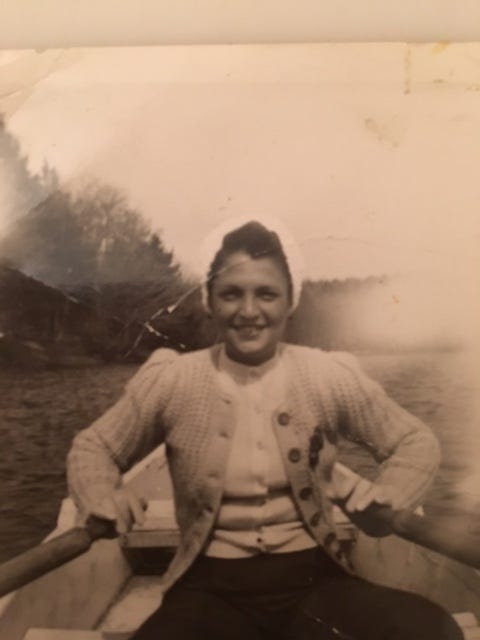
Dear Mom,
Today you are 101. You still look good. Don’t know how you do it. I mean, the cheekbones out to the Steppes of Central Asia. I translate your Yiddish for Richard. He says he doesn’t know why the flow of Yiddish is speeding up in me. He can say oy pretty well. He’s English, and they have their own oy. Ours is a bad step off the sidewalk. Theirs is, Get off my bar stool. It’s easy to miss the dead. I missed you when you were alive. You used to send me postcards at camp. One a day. Sometimes, they would arrive in a batch and tell a story about my goldfish or the gladiolas I’d planted. You wrapped some flowers in aluminum foil and mailed them to me. It was very you.
Comments
Nothing yet. Say the first thing.
Sign in to join the conversation.