
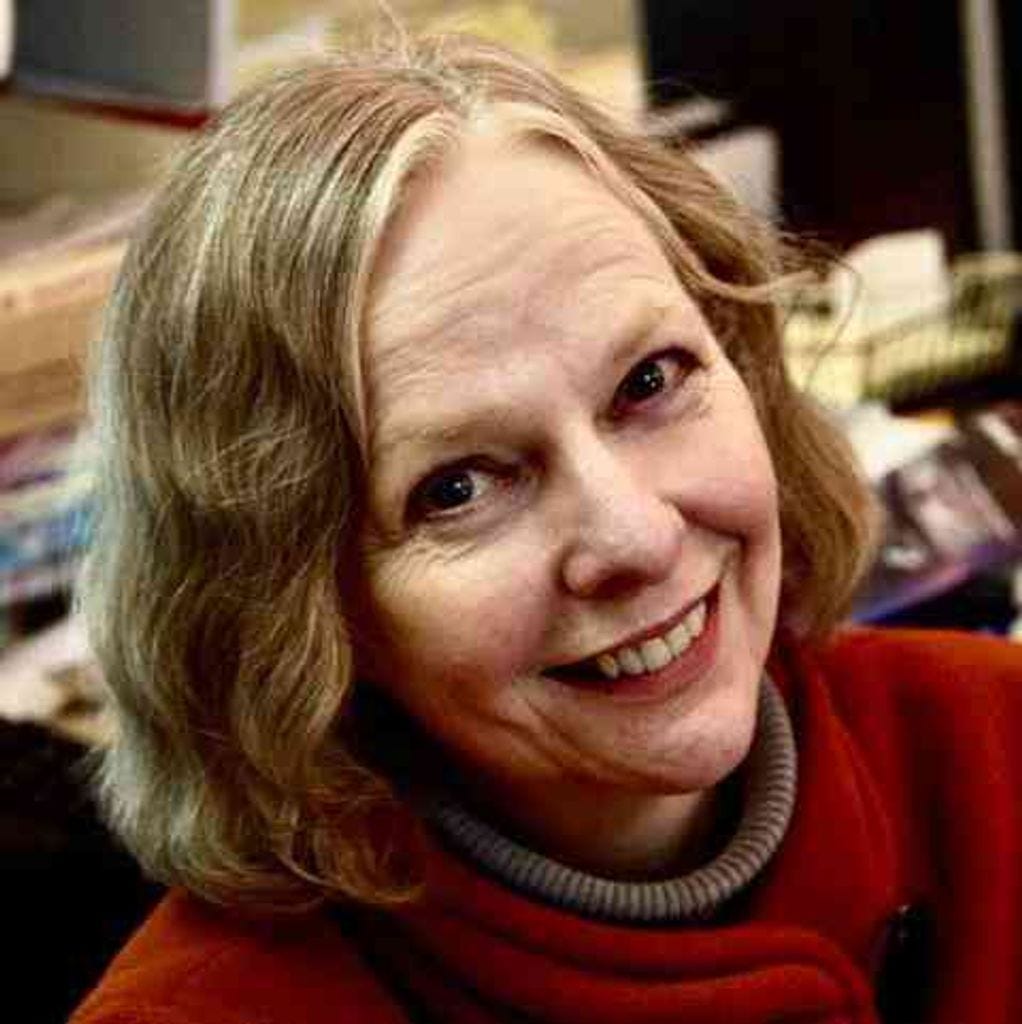
ON FRIDAY, RICHARD AND I WENT TO A PARTY FOR G, not far from our house in upstate New York. G and I were writers at the Village Voice, and we both wrote about theater, among other things. Erika Munk ran the theater section from 1978 until 1990, and one time Erika invited G and me to her place in the Hamptons. Erika was very smart. She had a spiky temperament that was a violin. You know how the notes can slide into sweetness. There was something wild and maternal in her at the same time. By maternal, maybe I mean the in-charge aspect of her. She is ten years older than me, and I am ten years older than G. In the Hamptons that time, maybe our ages were 27, 37, and 47. Now we are 70, 80, and 90.
Two things stand out from the visit to the Hamptons. I think there was going to be a swim. Maybe there was water at Erika’s place. In any case, G stripped off her clothes. She had the most beautiful body you can imagine, one of those perfect asses with no crease at the top of the thighs, gorgeous breasts, just a body that was “amaze, amaze, amaze” (to quote Rocky, the extraterrestrial in Project Hail Mary). G was a boyish girl. It was part of her sexiness, and you had no idea, looking at her in clothes, what was underneath them. I like thinking of G’s perfect body because sometimes a memory is a gift that goes in two directions.
The other thing that stands out is Erika gave me a pair of orangey colored capri pants I Ioved so much I wore them all the time for years and years. I wish I had a picture of me in them. I wore them until the fabric got so thin it shredded, for all practical purposes. Had the capri pants belonged to Erika? Her daughter? They were very slim fitting, no pockets, and I thought I looked great in them. You know how much you love an item you think you look great in. Especially if someone has given it to you right off their back, in effect.
At G’s party the other day, I met a fabulous woman I’ll call Kay. We sat on the deck of G’s house, looking at the pond below. G had gone for a swim and was sitting wrapped in a big towel with another group of guests. The thing about G that has not changed a centimeter or a molecule is her generosity. The food, from a posh place in Hudson, was amaze, amaze, amaze. Included was a platter of fried chicken. The giant pieces, with their crispy, golden edges, rose up, larger not only than all the other food on the table but all other food, period.
Kay was a feminist. I was a thirsty horse finding water. During our conversation, we talked about female friendship and the way women friends marry each other and then sometimes get divorced. I told Kay the divorces were not taking as sharp a toll on me as they had in the past. What we were running our hand-brains through was the way women measure themselves against each other. Where do I stand in comparison to you? In the derby of life, am I running as fast out of the starting gate, or will I finish strong while you drop back? Who are you to me? My mother, my sister, my daughter, my lover, my friend, my frenemy? All of these things—sometimes simultaneously. Can I try on your clothes?
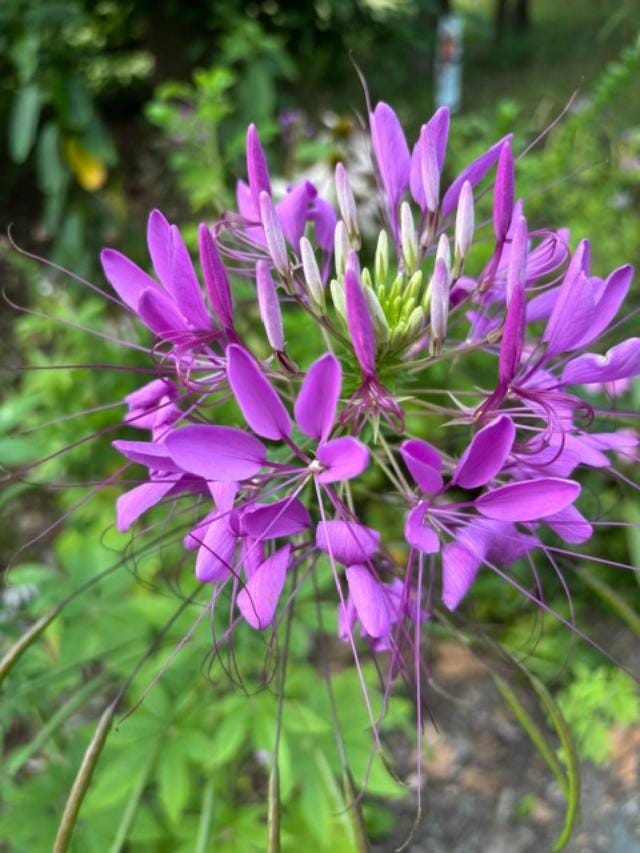
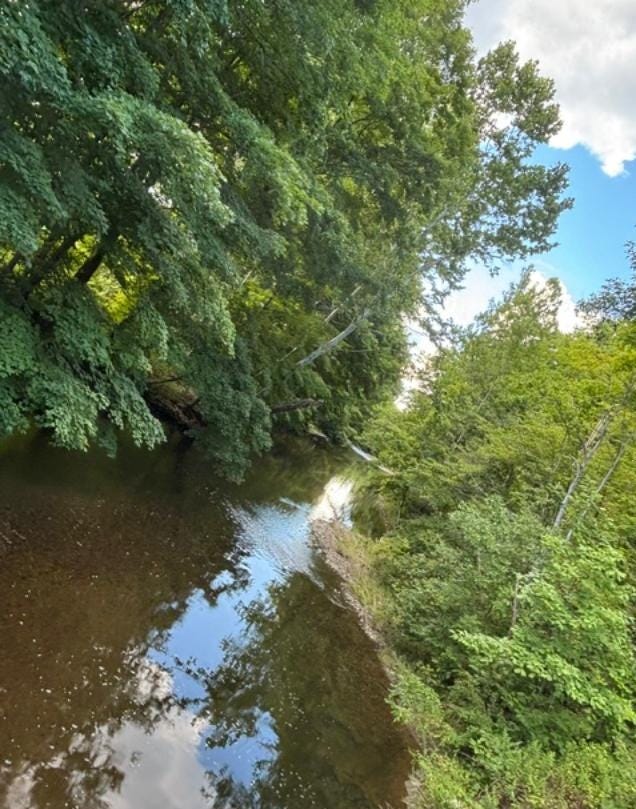
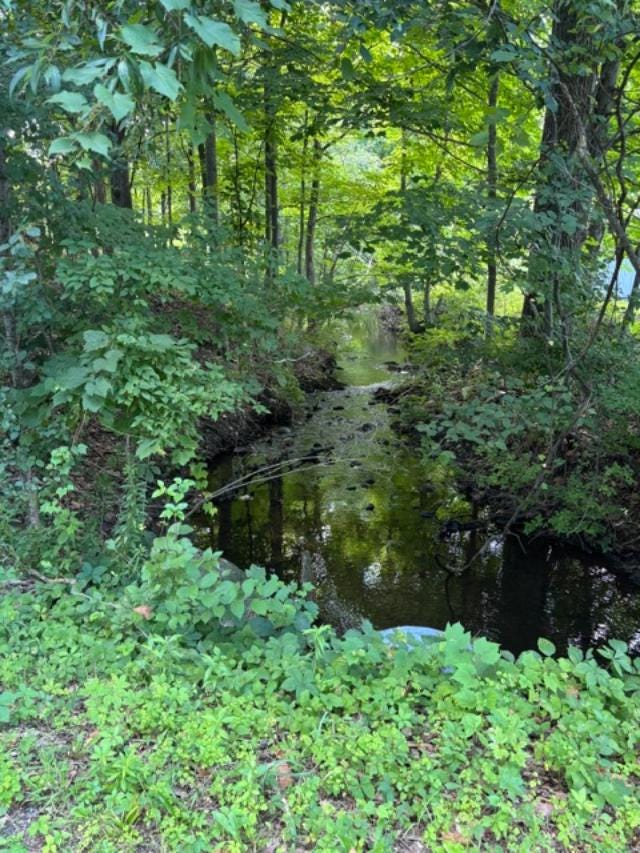
Yesterday, Richard and I walked on our road instead of in town. We took pictures of flowers, streams, birds, and the sky. I did it on purpose, so whatever I wrote today I would have my own images to post. In my last piece, about Spalding Gray, I accidentally stepped on someone’s copyrighted image of him. The photo was deleted, and I was warned by Substack not to do it again. Oy. Anyway, as we walked along, and as we talked about the party and the memory of the capri pants, I thought, Write a piece about different times girls gave each other clothes. Write about each gift as the love letter is was.
When my friend Lana could no longer afford her apartment in Manhattan, she gave me the shelves and storage units from her walk-in closet. This meant I had to renovate the closet in my bedroom. My friend Lily stood beside me as I yanked items off hangers and jammed them into shopping bags. She was taking them to the school in Harlem where she worked as a psychologist.
This was 2002, but I still had clothes from the 1970s. Into one of Lily’s bags went a three-piece white suit like the one worn by John Travolta in Saturday Night Fever. Robert (the man I lived with at the time) and I had had matching versions. Who did we think we were? Scott and Zelda Fitzgerald? Shoved into the back were gifts from a man named Sammy, who had dumped me a few years earlier. I offered the gifts to Lily. She was tall with short dark hair. She didn’t have a boyfriend then and neither did I.
Among the gifts from Sammy was a black lace bra. Before I met Lily, she’d had a cancerous lump removed from one of her breasts, and although she had described the surgery, I had not seen her naked. She took off her bra and stood before me with her chin up. A divot of breast tissue was missing from her left breast, but it looked fine. It made me feel close to her, and I thought I would remember the moment, even if we drifted apart. She said she felt disfigured. I said she was lovely. She was a leggy beauty. The Sammy bra was strapless and as Lily fastened it around her, the sting of the man went out of me a little.
One summer, I was visiting Lana in Hudson. This was decades before I’d move there. Part of the reason we moved there was Lana. Lana and I were at the farm where she had a share, and she asked me to collect corn, tossing over a canvas bag. A sign above the bin said, “Take 12.” Lana said, “Take 13.” She volunteered at the farm. The extra ear, maybe, was a tribute she felt she deserved.
I picked out the fattest ears of corn I could find. Lana was having people to dinner, and she would make everyone eat corn. When I looked at corn, I thought about getting fat and sliding toward lonely old age.
Lana gathered lettuce, tomatoes, cucumbers, and string beans. I pointed to a crate of pumpkin colored squash with warty rinds like the shins of old men. Lana said she didn’t eat winter squash in summer. I didn’t argue. I felt flexible compared to Lana. It was one of the reasons I liked her.
Back home, she cooked the corn and set it on the table. She poured gray salt into a little bowl. The salt came in a box with a picture of a moody sea. I picked out an ear of corn and bit into it. I had never tasted anything so sweet and crunchy. I sprinkled on gray salt. How had corn come to taste so good? Lana smiled. I was making her happy. We’d first met at summer camp when she was eight and I was five. Forty or so years later, we’d found each other again in New York.
She was wearing loose, white pants and an open shirt over a camisole. Her hair reached her shoulders. She always had a good dye job. She had been stunningly beautiful as a kid, and she still is now.
As I was helping Lana clear up, I said, “Let’s hug. Let’s enjoy each other while we can.” I was thinking we were lucky to be healthy. I pulled her close and thought that friendships, like vegetables, had peak seasons. Before I left, she opened her closet and pulled out things she wasn’t going to wear anymore. On this visit, she gave me a fabulous purple t-shirt from Agnès B. She said, “These days, I’m only wearing white and black.”
A few months later, I wore the t-shirt to a gig at Woodmere Academy, my old school, where I had been invited to address the students. I had felt nervous going back there. I’m not sure why. I was the guest of Susan, who taught English. She told me she had once worked for Joe Papp, who ran the Public Theater, and I got a flash of Papp’s thatch of dark hair and Jewish-uncle grasp, holding the city in his fist like a thick corned beef sandwich. In Lana’s French t-shirt, I felt pretty, and some of her confidence seeped into me. I told Susan’s students, “Do what you love, even if it scares you.” It was something I was telling myself, as a bunch of good parts of my life came together.

M. Mark was editor of the Voice Literary Supplement from 1982 until 1997, and I wrote for her throughout that time. She was a brilliant editor. What does that mean? She was tuned into the music of your voice, your choices of words, your inventions of grammar. If I used a whole sentence as a noun inside another sentence, she understood it was a form of comedy, it was a form of dramatizing a thought rather than reducing it or summarizing it with adjectives and abstract nouns. The Voice was a place you could write like you talked. That’s why it was called the Voice.
She would take you to lunch at The Union Square Café and the Gotham Bar and Grill. It felt like being run-aways with a magical credit card. For dessert at Gotham, she would order chef Portale’s signature profiteroles, a pyramid of fat choux pastries, stuffed with ice cream under a pour of hot fudge. What did we talk about? Sex, books, gossip, what’s next. We were members of “No More Nice Girls,” “Take Back the Future,” and “Feminist Futures,” groups organized by Ann Snitow. We were happy feminist sheep who would follow Ann to any demonstration.
When M’s mom died, she went back to Iowa to sort out her mother’s things. She returned with a present for me—one of her mother’s scarfs. She said, “When I saw the animal print, I immediately thought of you.” It’s a scarf you can pull up over your head, like a silky hood, and with sun glasses, you look like Grace Kelley in a white convertible not wanting your hair to blow in the wind.
M died last year. When I learned this, I had to lean against a wall. We were the same age. The reason she was called M. is that she was named Marsha, and even before she left the hospital, her parents decided they didn’t like the name and couldn’t get it changed on the birth certificate.
Writers for the Voice are whales in the vast ocean of everywhere else, and we call to each other, “Can you still hear me?” A kind of intimacy was aroused there that has no name. You can see it and taste it and feel it as soon as you remember a person there you loved.
On Tuesday morning, I woke up to the news FACEBOOK had deleted my account with no explanation and no means of appeal. It’s looking like what happened is that someone hacked into my account, and meta deleted the account. I was asked to prove my identity with my driver’s licenses, but the machinery of cancelation, I believe, was already grinding along. I had 5000 “friends.” I had a laboratory for writing pieces and testing them. I wrote in an intimate way to people I had built up long relationships with. Facebook was also my primary pool for subscribers.
Here is the best thing about writing here: No one can censor, or cancel, or rephrase, or delete a word I write.
I will be writing more on Substack “Notes.” If you used to read me on Facebook, please find me on the feed! I am also sometimes a ghost in Richard’s Facebook. I don’t want to say more on electronica . . . just go to Facebook and search for Richard Toon.
As the pool of potential subscribers is now gone, I’m hoping that you—LOYAL READERS WHO STILL INTERACT HERE FOR FREE—will upgrade to paid and step in. It’s inexpensive, and there are benefits. Readers tell me this stack is unique. Think of the research and hours involved in producing a piece like last week’s on Spalding Gray. I can continue only with paid support.
There is now a 50% discount for new subscribers and gift subscriptions, meaning a year is $25 with all benefits and a month is $2.50. There is no paywall. There has never been a paywall. There will never be a paywall. I don’t like them.
LAURIE & RICHARD on writing DRAMATIC NARRATIVE in any prose genre: To RSVP: lauriestone@substack.com.
To attend one event or receive one recording, with no future payment obligation, you can buy a “coffee” for $4 at ko-fi.com/lauriestone
The BREAKOUT SESSION following the Zoom conversation about DRAMATIC NARRATIVE is on SUNDAY AUGUST 30, from 3 to 4:15 EST. There is a cap of 10 at each breakout. You are invited to share a piece of your own writing of around 400 words. The SLAM readings are thrilling impovs—we make a work together larger than the parts! The fee is $30. To sign up please email me at: lauriestone@substack.com.
with Steven Dunn, with Margo Jefferson and Elizabeth Kendall, with Francine Prose, with David Cale that includes a reading from his hit solo theater piece Blue Cowboy, with poet David Daniel, with Daisy Alioto, publisher of Dirt, and others, please email me at: lauriestone@substack.com.
If you would like to book time to talk one-on-one about a project you are working on or for guidance in gaining confidence and freedom in your writing practice, please email me at: lauriestone@substack.com.
If you would like to book time to talk one-on-one about STARTING AND GROWING a Substack publication, please email me at: lauriestone@substack.com. I can help you through the software, choosing a title, art design, and ways to gain readers.
THIS TIME I REALIZE I have been teaching two classes at a college or a university I have forgotten about. What were the days I was supposed to teach? What has happened to the students? Where is the classroom? In sleep, I can feel adrenalin as a thin red line moving through me.
Sometimes this dream is I have decided to finish my PhD and have enrolled in classes that are required. I have forgotten all about it. I don’t know the days the classes meet. I don’t know what will happen to the degree. I have read none of the books assigned.
One way to look at these dreams is I am no longer interested in some things I made the wrong decisions about. I never wanted to do any of these things. The adrenalin that moves as a thin red line is from the way I evaded these obligations, which was by forgetting. Who forgets an obligation that feels suited to a different character? It’s such an interesting evasion because it’s so out of character to who I think I am. By “I,” I mean me, the Laurie writing. As I write this sentence, I’m thinking maybe I am wrong about myself. Maybe it’s not so out of character.
Comments
Nothing yet. Say the first thing.
Sign in to join the conversation.