
There’s a book I often return to that sits at the intersection of detective fiction and cognitive science. Mastermind: How to Think Like Sherlock Holmes by Maria Konnikova maps two modes of thinking she calls the Watson System and the Holmes System. Watson is intuitive, emotional, and reactive; he takes in a scene and arrives at the most available explanation. Holmes is more slow and methodical and casts a vast perceptive net. After taking a scenario in with all his senses, he resists the seduction of the obvious by hypothesizing, testing, and revising before reaching a solid theory.
It’s easy to default into Watson-mode much of the time. It’s efficient and automatic because our brain is a predictive machine that favors speed. Some pattern-recognition is at play but the limitation lies in the hasty reactive conclusion and a passivity that lets bias creep in. When left unchecked, our intake and perception process can become the self-referencing system I wrote about in this article on perception, Not-So-Popular Art. We see what we expect to see, filtered through what we’ve experienced before. We confirm an already fixed belief, mistaking the familiar for the complete and complex picture.
I love to play with the Holmes approach. I know I’m not alone in this. Otherwise, why would true crime dramas and forensic cold case mysteries intrigue us so much? Another curious parallel is how often I’ve worked with art and design students who vascillated between pursuing an art degree or studying forensic science. After all, keen observation, exploring sensory and material details, and identifying obscure associations are key parts of the innovative artist’s job description too.
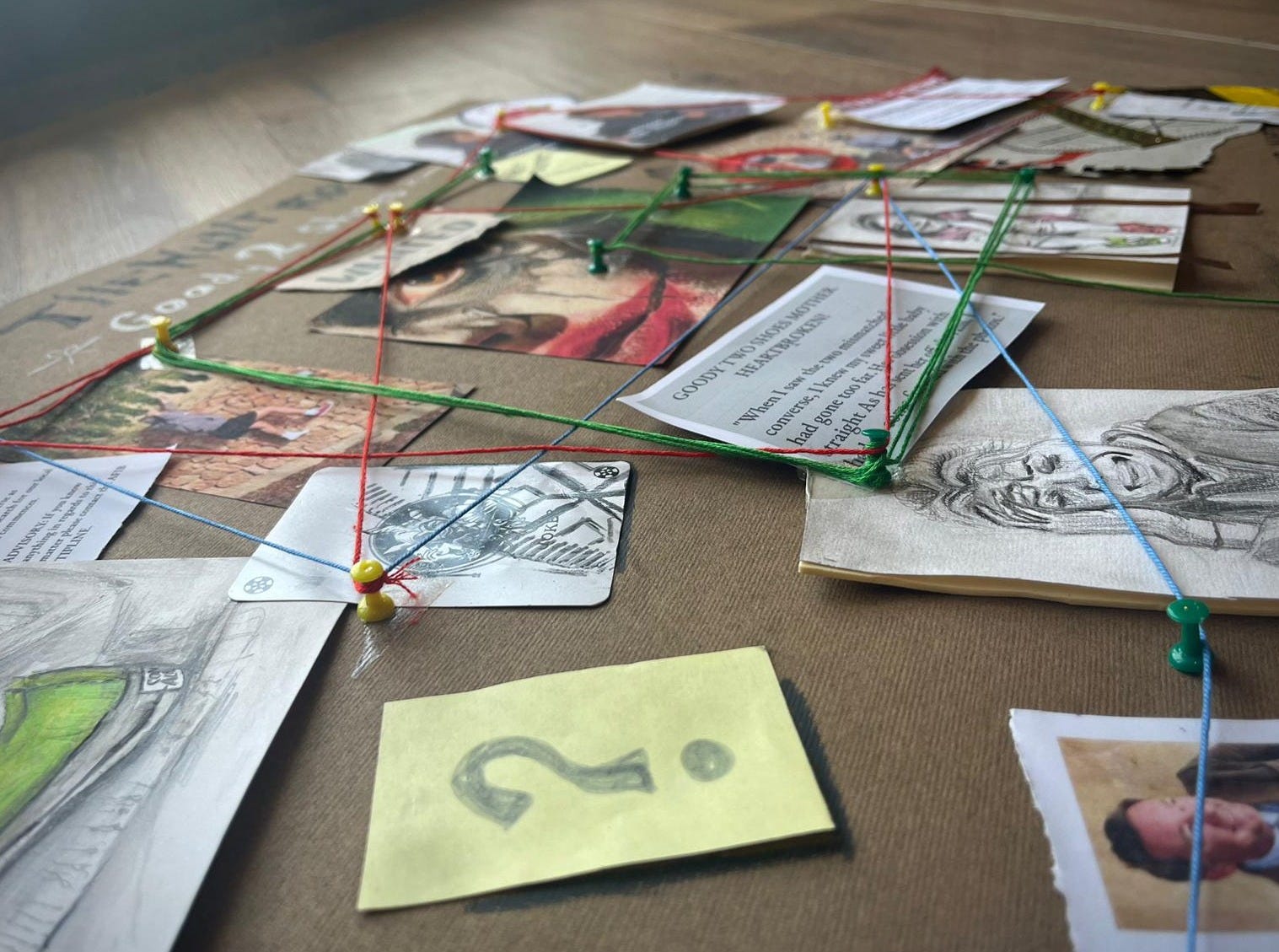
I don’t think we all can or want to be Holmes-esque all the time. The ideal I imagine is one that bridges the linear and the associative. A weave of Watson’s intuition and Holme’s metacognitive method ultimately creates a braid of discovery from divergent to emergent to convergent cognitive processes. The aim is to integrate the seemingly random with the empirical.
I am certainly not the first person to point out that the scientific process and the creative process have many correlations. Both seek to find a new solution that makes the intangible more tangible. This cohesion may begin with our internal mapping but expands exponentially when done in community. Why do you think Holmes kept Watson close? The two enriched each other, relied on one another.
In the spirit of such community building, I’ll share three specific PERCEPTION practices for developing Creative Awareness through your internal states, your environment, and the perspectives of others.
Perception expands when we broaden our horizon of attention. My article Blindspots and Vanishing Points elaborates on developing the capacity to identify reference points on multiple planes, to experience full-fledged perception.
Second Attention is the ancient spiritual practice that registers essential energetic qualities of day to day phenomena. ‘First attention’ includes conscious thought, language, and measurable reality. Whereas Second Attention implies a vast, and multiplicitous reception of clues, often intangible ones. Sounds mystical. It is. And this depth and breadth of perception is accessible through some simple practices.
Meditation, visualization, and breathing practices are useful training grounds for Second Attention. The practice helps us to create a gap between experience and reaction by imposing a momentary detachment from thought and feeling.
Our breath and our thoughts are both autonomous - they happen to us. The are both also under our decisive influence. We can learn to control both in order to shift perception, reduce anxiety and tension, and to relax or energize the body-mind.
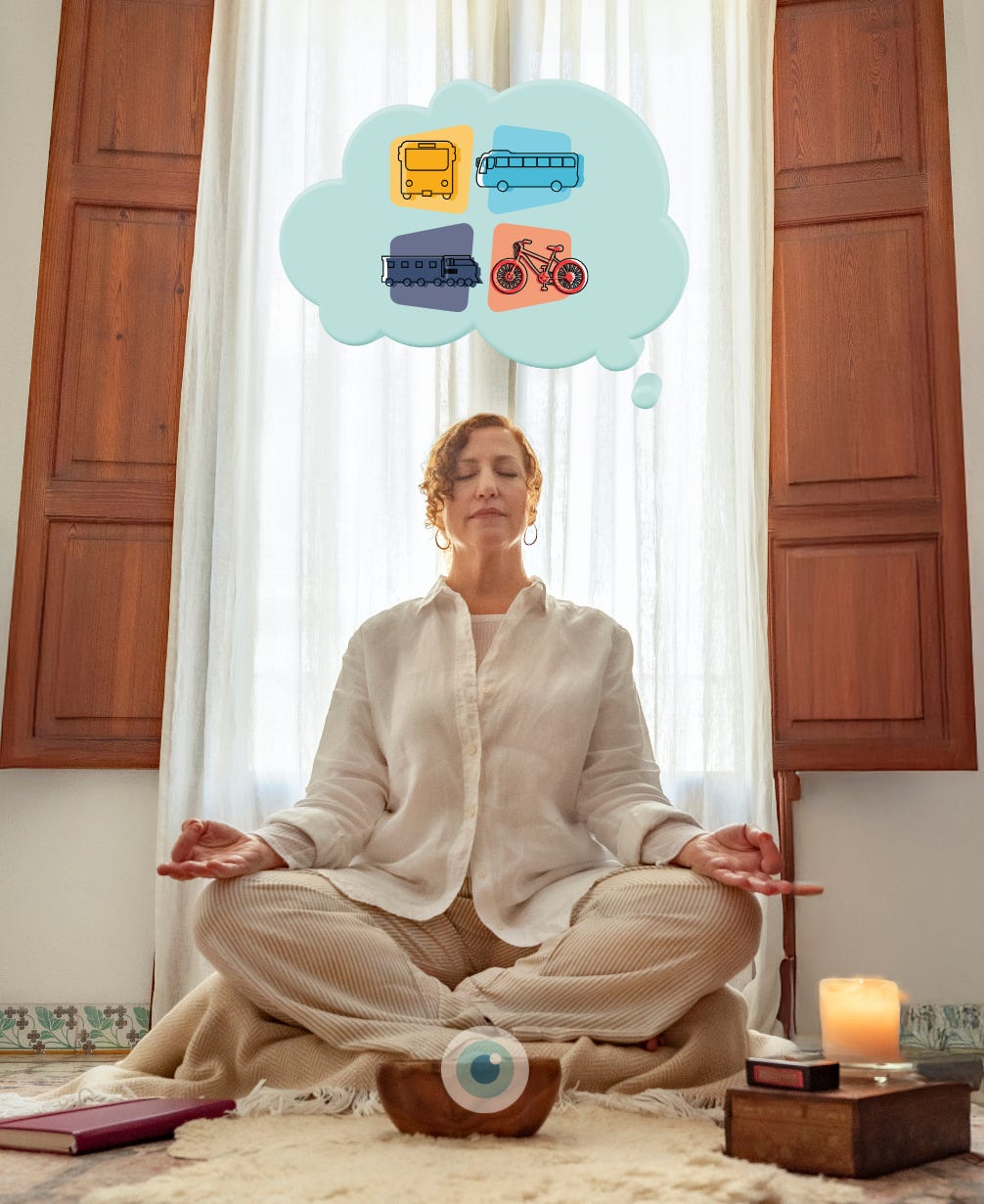
Here is an easy method you can use to quiet mental babble. It’s great for beginners and can be done secretively!
I recommend about 5 minutes of priming the breath pattern followed by another 5 to 10 minutes of the visualization and topic attribution.
Location / Positioning:
You can do this anywhere, seated upright or lying down with legs and arms straight, alongside the body.
Eyes / Breath:
Gently close the eyes or hold them one-tenth open, gazing down at the tip of your nose.
For the first 4 cycles of breath, inhale and exhale deeply through the nose, slowing down and extending the duration of the intake and release of breath.
Complete another 4 cycles while you mentally say:
(on the in-breath) I am breathing in; (on the out-breath) I am breathing out
(on the in-breath) Calm; (on the out-breath) Ease
Next, maintain a casual and steady breath through the nose, now with the closed eyes directed towards the space between your eyebrows.
Watching Mental Traffic Pass By
Keeping the eyes closed or nearly closed, maintain a gentle but mindful breath pattern and allow the normal traffic of thoughts to arise.
You are an observer seated on a park bench and the thoughts that arrive are vehicles on the highway passing by. Your task now is to notice the nature of these thoughts.
Assign them general topics, like JUDGEMENT, HOPE, INSECURITY, ANTICIPATION, CURIOSITY, ASSUMPTION ... the characteristic list may get long but you will find there are a handful that arrive in heavy rotation.
The point is to detach from the contents of the emotional vehicle - the details and emotions wrapped up in the carrier thought.
As you assign emotional characteristics, use visualization to assign colors and sizes to the thought categories. Maybe annoying reminders from your to-do list are yellow smart cars, and insecurity about an upcoming event are a rusty green pick-up truck, etcétera.
Note the repetition. As they pass, say mentally, “Yep, there goes another ANGRY red 18-wheeler - I don’t need to hop on that wagon!” Smile and let it be on it’s way.
Just let them pass. All green lights. No traffic jams. You don’t need to deal with or resolve any concrete situation or thought pattern in this very moment.
You can level-up this practice by introducing new and better makes and models into the convoy - “Oh, hello champagne-gold OPTIMISTIC hybrid convertible - I see you!” Smile and let this one pass too, also knowing it will return. All things must pass.
Does this practice make actual situations you are contending with disappear? Not exactly. You will find that intentional objectification creates a safe distance from the thought physically and psychologically. That is what we are going for here - making space between stimulus and response, keeping reactivity at bay long enough to let the nervous system regulate with the rhythm of an expansive breath.
Take a walk in a familiar area, free of earbuds. Go out like a wanderer in a new place, a state of mind I elaborate on in the article Being the Lost Cartographer.
Before you leave, pick a category to hunt.
Examples:
architectural details above eye level
anything red
evidence of repair
something that surprises you
other ...
When you’re hunting to gather something specific, your field of vision expands automatically. You start noticing new things, and some that you’ve never noticed but possibly have there all along.
Do this for 30 to 60 minutes. Try to gather at least ten references on your thematic hit-list. Level-up this simple activity by photographing your sightings and later on, have a scroll through your film roll later on and see if you can find a common thread of the images. These are hints at themes meandering your subconscious. Consider what they reveal about what you are paying attention to these days, without judgement - just curiosity.
“Laurie talks too much.”
This was an uncomfortable bit of feedback I once received in an anonymous student questionnaire given by the school leadership team. Ok, this was definitely not the first time I had heard this in my life, but in the context of teaching, where I deeply value what I can offer to my students, it stung. I resolved to pay closer attention to when and why I was talking too much in the classroom.
I quickly noticed it was happening in my weekly one-to-one student meetings. I realized I wanted to save them from the discomfort of the pause before answering a question. That quiet space is where the reflection happens - and I was robbing them of that. Another tendency I had, instead of gathering information openly, was to offer a student a selection of possible responses before they could think and answer.
Around this same time I was supervising a student teacher. I noticed in her one-on-one meetings she left long - sometimes uncomfortable - gaps of silence. By resisting interjections she was gently prompting the student to arrive at a response on their own time. I made it a practice to stop feeding potential (and maybe off-base) answers, to listen longer, and to convert my more didactic statements into open-ended questions.
Learning from my student and then from my student-teacher helped me to become a much better teacher. Years later this lesson on simple inquiry and subtle listening became infused into my coaching practice. This compassionate inquiry is one of the most powerful perceptual tools available to any leader, teacher, or creative collaborator.
I recommend Michael Bungay Stanier’s book The Coaching Habit: Say Less, Ask More, and Change the way you Lead Forever for anyone who does relational work. His questions are so straightforward and so effective! For example, here’s a discussion starter with anyone who comes to you for guidance:
“What’s your biggest challenge right now.” After listening as long as it takes for the response, follow with (mic drop) “What else?” I know the subtitle of this article is ‘Resist the seduction of the obvious,’ but this question sequence is too good to resist! This book is a fast read, so I won’t spoil the nuances of these conversation starters with you here.
All three practices flex your perceptive agility in the dimensions of your self, your circle, and your world. They are accessible and impactful entry points for cultivating your Creative Awareness. These practices work best with repetition and iteration.
Where to start? Pick the one that bristles you the most, the one you might want to avoid. That’s probably the one that exposes an area of need for your Perceptive capacities. Maybe the Watson in you will want faster results, to fill the silence quickly, or to hop on the first bandwagon out of all this awkward learning!
I promise, if you allow the Holmes in you to linger and get mischievous with your curiosity and patience, the rewards will be illuminating.
Comments
Nothing yet. Say the first thing.
Sign in to join the conversation.