
Unpopular opinion.
The forever home is a lie.
(I know. I’m going out on a limb here because every second interior designer seems to be out there promising timeless homes for forever living and I’ve been quietly sitting in the corner like… are we all just pretending this is a thing?)
Because I don’t believe in it.
And I think we need to talk about it.
I get why we say it.
Clients are investing a huge amount of time, energy and money into their homes.
Of course they want to believe it will last. Of course we want to reassure them.
“Forever home” sounds safe.
Grounded.
Responsible.
It suggests permanence in a world that feels increasingly… not that.
It also helps justify the cost. Because if this home is going to serve you forever, then the investment makes perfect sense.
Designers love this word.
Timeless.
It implies that a space somehow exists outside of time.
Untouched by trends.
Unaffected by culture.
Immune to the passing of decades.
Which… is a beautiful idea. But also, not entirely true. Because every design, no matter how refined is shaped by the moment it was created in.
The materials we use.
The layouts we prioritise.
The way we live.
All of it reflects now.
Even the most “timeless” interiors are quietly participating in trends. They’re just better at hiding it.
Sometimes a home doesn’t “last.” And we think the design failed. But often it’s not a design problem.
It’s an us problem.
We change. Our lives change. Our priorities shift in ways we couldn’t possibly predict.
I lived in a two-bedroom apartment in South Yarra for ten years and it was crummy yet perfect. We were in our twenties and we went out for dinner constantly because there was barely a kitchen to speak of.
There definitely wasn’t a dining table. And that was fine, actually it was more than fine - it was fun.
Trying to imagine my family of five living there now is… laughable. The apartment didn’t fail. It just belonged to a different version of me.
I’ve worked on many so-called “forever homes.”
And ten years later…? A lot of those clients don’t live there anymore.
Not because the homes weren’t beautiful but because life moved on.
Children grew up and left. Large homes started to feel too big. Too quiet.
Pools and gardens became maintenance instead of joy. Travel became a priority and suddenly, an apartment — one you can lock and leave — makes far more sense.
The home didn’t fail.
It just stopped matching the life.
I think it comes down to this:
We want stability.
We want to believe that we can design something once and have it carry us through every version of ourselves. But when you really think about it…
It’s quite rare that one home can hold:
Your twenties self
Your parenting years
Your empty nest phase
Your later life
That’s a lot to ask of a floorplan.
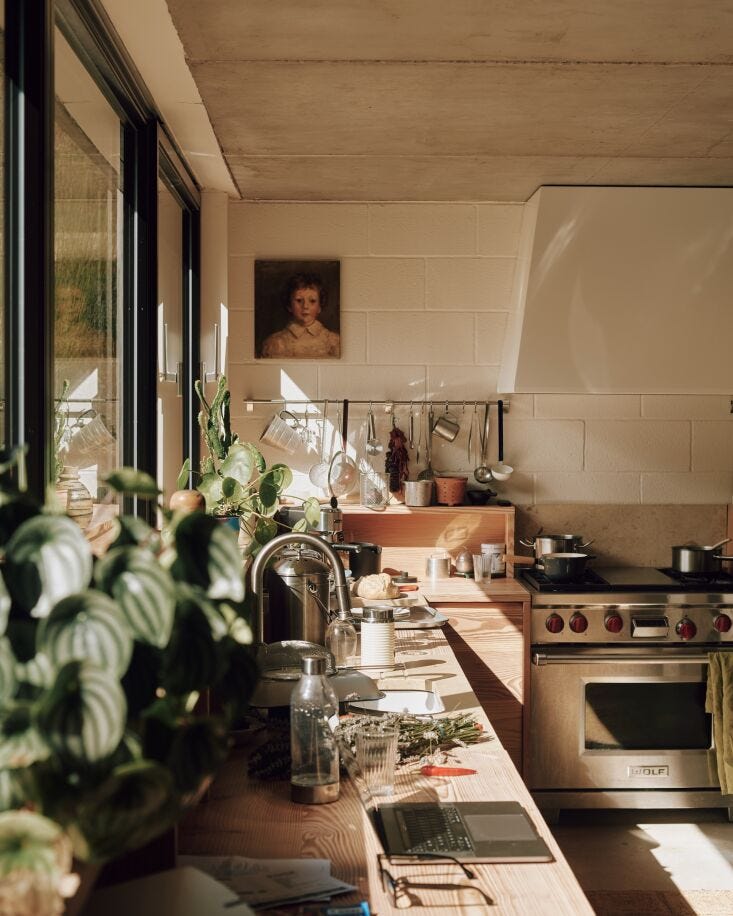
Why are we striving to create spaces that don’t change…
When we do?
“Timeless” has become one of those words that sounds impressive but is actually a little… hollow. Because a home that truly reflects you will inevitably change as you change.
And that’s not a flaw.
That’s the whole point.
Instead of asking:
Will this home last forever?
What if we asked:
Does this home support how I live right now?
Because that’s where the magic is.
Designing for your current life.
Your current routines.
Your current desires.
Paint the room.
Buy the comfortable armchair.
Hang the art.
Plant the garden.
Personalise your space.
Do it now.
Not when everything is “perfect.”
Not when you’re sure it will last forever.
Because it won’t.
And that’s okay.
I recently listened to Alain de Botton speak about homeson the Homing podcast, and he said he would feel sorry for anyone who lived in the same house their entire life.
At the time I remember thinking, well that’s a bit dramatic.
But I think I understand what he meant.
A life well lived is one that evolves.
And our homes should be allowed to evolve with us.
So no.
I don’t believe in the forever home.
But I do believe in a home that feels right, right now.
And that feels like a much more interesting place to start.
No posts
Comments
Nothing yet. Say the first thing.
Sign in to join the conversation.