
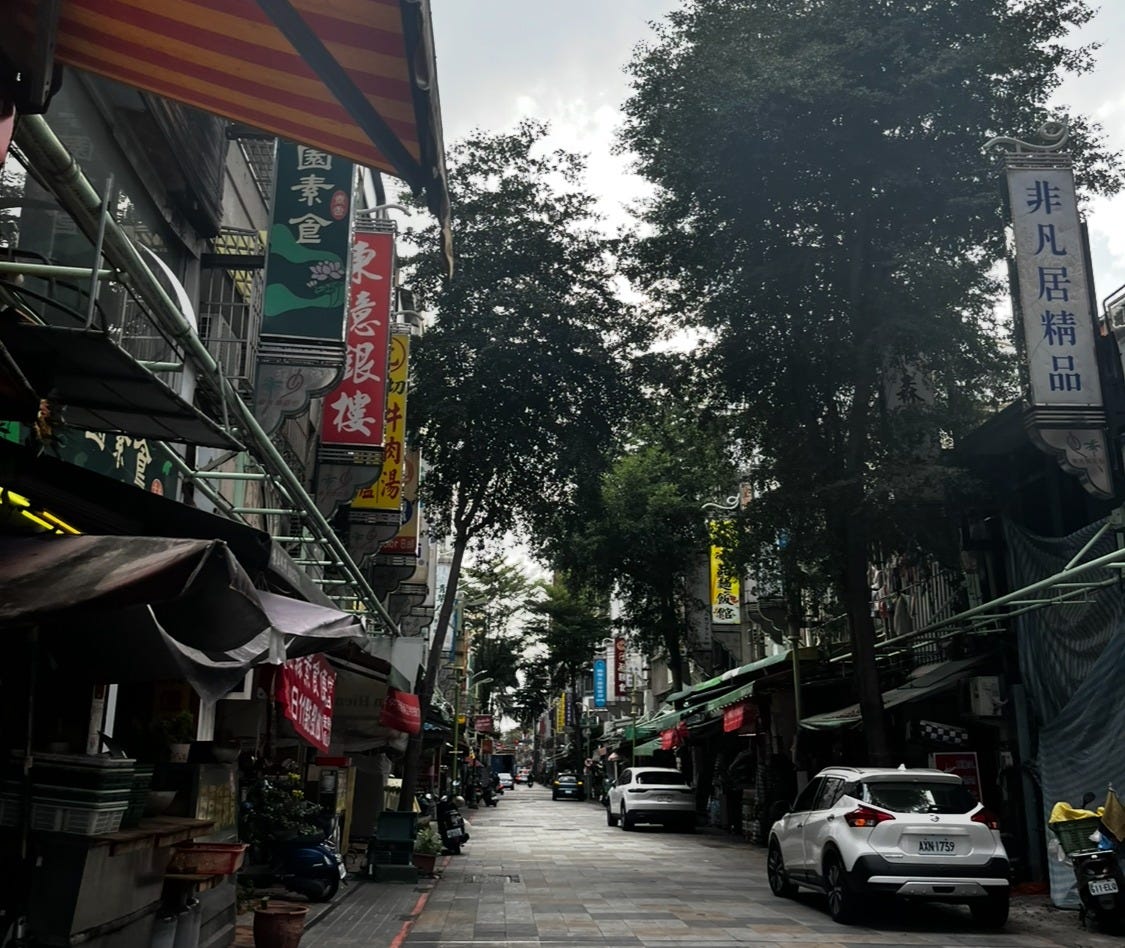
Walking through the streets of Taiwan back in June, I forgot how brutally humid it gets here. After a few years living between Canada and other places, I’ve gotten used to strolling 20 minutes or more without thinking twice, but in Taiwan’s summer heat, it felt like stepping into a steam room.
In a very sweaty moment of regret, I thought: I’ll grab a YouBike, get a breeze going.
(Quick context: YouBike is a privately run bike-sharing service in Taiwan, similar to BIXI in Montréal or Bike Share Toronto. It’s closely tied to public transit and subsidised in many cities. Most locals use an EasyCard, a contactless transit card, to rent and return bikes.)
I walked up to the station, expecting things to work the way they used to. Before, you’d tap your EasyCard on the docking station to rent and return it. Next to it, there was usually a kiosk where you could register your card, check insurance status, and read instructions if you weren’t sure how it worked.
This time? No kiosk. No signage. And the dock was just a metal rack. I eventually noticed a tiny scanner on the bike itself, which I hadn’t seen before. I tapped my card. Nothing. Turns out you now have to pre-register your EasyCard through the YouBike app before it works.
The only clue was a crumpled QR code stuck inside the bike’s basket which is almost impossible to notice unless you were looking for it.
So I stood there in the heat, struggling with a slow connection, fumbling through app registration. At one point, I almost gave up.
When I finally got moving, the breeze helped, but what stuck with me was the absurdity of the situation. I’m someone who's used to apps and systems like this, and I still spent over 20 minutes trying to figure it out. What about my mum? My grandma? Tourists? New immigrants? People who don’t have the latest phone or unlimited data?
You could argue they’re not the “target audience,” but why should that mean they’re excluded from something as basic as a shared bike system?
That moment made me think of something my aunt mentioned when I visited our village. A few older relatives had started asking their kids or grandkids to help fill up their vechicles with gas. Not because they couldn’t drive, but because the local station had switched to credit card–only self-service. No cash, no help, no explanation.
For some, that kind of upgrade is barely noticeable. For others, it’s the end of independence.
The other day as well, I went out for lunch with my grandma. The restaurant had switched to QR code ordering. I helped her place the order, but in the middle of it, i hear her mumbling:
“Can older people even eat out on their own anymore?”
This is someone who does use a smartphone and often goes out solo. But still, low-contrast codes, tiny buttons, confusing interfaces, it’s a lot. Taiwan might not be as hyper-digitised as other countries (yet), but the shift is clearly happening. And I started noticing how often these so-called conveniences come with assumptions.
If your phone’s new enough.
If your vision’s good enough.
If someone’s nearby to help.
These systems are often designed around a default user, a young, able-bodied, tech-literate person with a smartphone and data plan. When that’s the baseline, everyone else is left to catch up or opt out.
Designers often talk about accessibility, but what I kept running into was a lack of real usability. Even when people want to adapt, like my grandma, or the many elders who’ve quietly asked me to help them scan this, click that, figure out where to tap, it’s not about resistance. It’s about being left out of the design conversation in the first place.
And it’s not just about older people. It’s about anyone who doesn’t fit into the imagined “average user.”
Digitisation itself isn’t the issue. The issue is how abruptly it’s often introduced without transition, without human support, without acknowledging that learning a new system takes time.
It’s the feeling of: boom, the system’s updated. Figure it out yourself.
A well-designed system isn’t just one that works once you’ve learned it. It’s one that helps you learn it in the first place.
These systems are often designed around a default user: a young, able-bodied, tech-literate person with a smartphone and a data plan. When that’s the baseline, everyone else is left to catch up or opt out.
Designers often talk about accessibility, but what I kept running into was a lack of real usability. Even when people want to adapt (like my grandma, or the many elders who’ve quietly asked me to help them scan this, click that, figure out where to tap) it’s not about resistance. It’s about being left out of the design conversation in the first place.
And it’s not just about older people. It’s about anyone who doesn’t fit into the imagined “average user.”
It also made me think of DeBÍ TiRAR MáS FOTos, a short by Bad Bunny that critiques gentrification and tech-fueled “progress.” Who decides what’s worth upgrading? Who benefits? And who gets displaced, even in subtle, everyday ways?
Of course, nothing is ever that simple. These systems need to be financially viable to survive long term. It’s easy to say “capitalism,” but the truth is: there are layers behind every design decision. Resources, politics, scale, cost, maintenance. Naturally, services are built to cater to the biggest or most profitable demographic.
That’s what makes this a wicked problem1—a messy, systemic issue with no one-size-fits-all fix. And yet, it shows up in the smallest moments: at the gas station, at the bike rack, at a lunch outing.
Individually, they don’t seem like a big deal. But when they pile up, they shape who gets to move through the world with ease, and who has to ask for help just to get around.
I don’t have a solution. But I’m writing this down as a reminder:
If we only design for what feels intuitive to us,
we risk leaving a lot of people out.
Maybe noticing is where better design begins.
Wicked Problems: A term coined by design theorists Horst Rittel and Melvin Webber in the 1970s. It refers to complex problems that are difficult to define or solve, often tangled up with social systems. Attempts to solve them can create new problems elsewhere—which is why they require ongoing reflection, not just clever fixes.
No posts
Comments
Nothing yet. Say the first thing.
Sign in to join the conversation.