
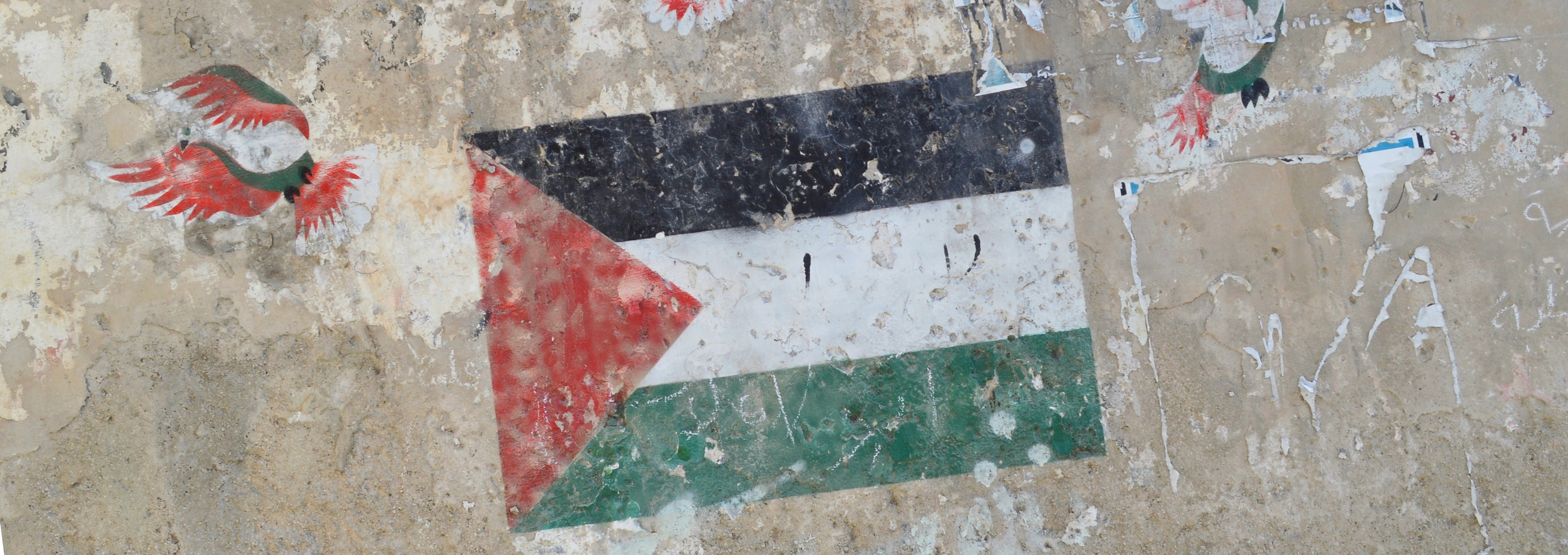
In September of this year, my husband and I gathered in Chicago with pastors, theologians, thought leaders, and other Jesus people at Church at the Crossroads: a conference meant to address what might be the most pressing question facing the church today.
“What kind of church will we be in the face of genocide?”
I wrote a recap of the conference; you can find it on Baptist News Global.1 It’s highly centered on the words of the Palestinians who spoke at the conference, as well as the non-Palestinian speakers (like Jemar Tisby, PhD, Lisa Sharon Harper, Shane Claiborne, Brian Zahnd, and Ruth Padilla DeBorst) who stood in solidarity with them.
Attending the three–day gathering felt like standing at the fault line of history, listening as Palestinian Christians told the truth the global church has spent decades refusing to hear. Rev. Dr. Munther Isaac, Lamma Mansour, Anton Deik, and others spoke on behalf of a people carrying over 76 years of generational memory in their bones. Together, they named what is happening in Palestine, not as a distant geopolitical crisis, but as the moral compass of the world.
Their testimonies spanned generations: from the 1948 Nakba that killed or displaced 800,000 Palestinians and shattered families (like Deik’s), to the present-day bombardment, starvation, and erasure of their descendants. This conference was meant to be an intervention, a call to repentance, and a plea to stop confusing the kingdom of God with the machinery of Empire.
I echo that call and plea here.
In 1948, only three years after the liberation of Nazi concentration camps, the State of Israel was declared. Its birth was marked by the unbearable truth that the end of the Holocaust did not mean the end of the world’s antisemitism. Jewish survivors, stateless and shattered, were crowded into barbed-wire camps, some managed by America.
An American official named Earl G. Harrison reported on the camps, saying, “As matters stand, we appear to be treating the Jews as the Nazis treated them except that we do not exterminate them.” The cruelty shown toward Jewish survivors was not coincidental, and it revealed a pervasive antisemitism that extended even to those in charge of the camps.
After reading Harrison’s report, General George S. Patton (then overseeing the Displaced Persons camps in Bavaria) wrote in his diary, “Harrison and his ilk believe that the Displaced Person is a human being, which he is not, and this applies particularly to the Jews who are lower than animals.”
In 1948, at President Truman’s urging, Congress sought to revise immigration laws to admit more Displaced Persons into the US after the war. The proposal met fierce resistance from some lawmakers, including Texas Congressman Ed Gossett, who referred to refugees as “the refuse of Europe.”
His office was soon inundated with letters supporting his antisemitic statements, illustrating how pervasive antisemitism ran in America. Against this backdrop, Congress passed an immigration bill that imposed strict limits designed to curb the entry of Jewish refugees into the United States. And interestingly, that same year, the U.S. became the first nation to recognize Israel’s independence.
As Ta-Nehisi Coates observes in his book The Message, the advancement of Jewish acceptance by whiteness was born in large part out of a desire to “keep ‘them over there.’” It’s very important that we recognize the reality of this and name it the grotesque evil that it is.
So the State of Israel declared its independence, and the narrative we often hear regarding this event is “a land without a people for a people without a land.” This idea, born as early as 1843, is often credited to Scottish clergyman Alexander Keith and British Lord Shaftesbury, but it was not rooted in any kind of reality.
Neither of these men ever set foot on Palestinian soil, and yet their bold claims, resurrected almost a hundred years later, became a kind of moral anesthetic that gave antisemitic nations, like America, an excuse for not providing for the broken and battered Jewish survivors. It also smoothed over any scruples that might pop up regarding land acquisition. Only good could come from giving the land to an Israeli state, it was assumed. No one would be harmed because no one is there.
This is the first step taken toward the erasure of the Palestinian people, and it occurs quietly in the Western imagination.
In reality, Palestine was home to two million people (Muslims, Christians, Jews, and others) living in relative peace. And yet, within months of Israel’s declaration, roughly 800,000 Palestinians were displaced, villages were wiped from the map, families were killed defending their homes, land, and families from a foreign invader they never saw coming.
This mass displacement became known as the Nakba—in Arabic, “the catastrophe.”
Empire has staged more than this single Nakba. America is built on at least two: the violent displacement of over 50 million Indigenous people across more than four centuries through colonization and Manifest Destiny, and the forced kidnapping and trafficking of more than 12.5 million Africans through the transatlantic slave trade.
The starving Irish and Australia’s First Nations. The Maya in central America and the indigenous in apartheid South Africa. So many have had their own Nakba. It is Empire’s signature move:
Take the land, control the resources, destroy or exploit indigeneity.
Then rewrite the story to call the theft Holy. Ordained. God’s plan.
As Palestinian theologian Mitri Raheb has said, the U.S. doesn’t only supply Israel with the “hardware” of violence (nearly $4 billion of military aid every year2) but also the “software” of Empire: a distorted “biblical blueprint that paints colonial practices with theological justifications of a ‘promised land’ and ‘chosen people.’”
Raheb explains that Empire can’t survive on bombs and borders alone. It needs the beliefs that make its violence seem sacred and worth it.
“Empire always needs a theology that supports its domination. Without theological justification, the empire loses its moral ground.” - Mitri Raheb3
The Western church is the perfect place to source this theological justification. It has had centuries of practice using scripture meant to speak hope to the oppressed to instead sanctify slavery, colonization, and war.
This “software” builds on the assumption that God’s covenant promises to ancient Israel translate directly into political entitlement for the modern State of Israel, and that Western Christians are called to support that project unconditionally. Within this worldview, the return of Jewish people to the land is seen as the literal fulfillment of prophecy (a necessary step toward “the Second Coming”), and anyone who questions Israeli policy is seen as standing against God’s plan itself.
This is called Christian Zionism, and it interprets the conquest narratives of Joshua as divine precedent for modern policy. Complex and specific biblical covenants are flattened into literal real-estate deeds. Like the Christian Nationalism we see in America, Christian Zionism fuses nationalism with divine will and recycles old imperial myths, for example, the idea that some peoples are chosen and others are disposable, and that supporting Empire is what godly obedience looks like. The Western church has believed this for too long.
If your eschatology requires you to displace and massacre women, children, and civilians, then your beliefs are, in the strongest, most literal sense of the term, anti-Christ. A faith that justifies the erasure of people in the name of prophecy stands against Christ Himself.
This theology of empire “software” is so critical to the Zionist project that the Israeli government just allocated over $4 million to create and distribute Zionist propaganda to American citizens as part of a marketing campaign called the “Israel Narrative Outreach Program.”4 Using geofencing technology around 132 individual American churches and 18 American Christian universities and institutions, the campaign intends to deliver targeted ads to the mobile devices of up to 85,000 individuals each week.
This campaign will include “faith-aligned messaging” intended to “increase positive associations with the Nation of Israel among Christian audiences,…reinforce biblical connection and shared moral heritage,…counter narratives of humanitarian crisis by highlighting Israeli aid efforts.”
The messaging strategy explicitly connects political loyalty to Israel with religious faith while portraying “Palestinian governance as unstable and extremist-controlled,” and tying Palestinian groups with “extremist” or “terrorist” factions.
This is how vital American Christian acceptance is to the Zionist agenda.
History shows us over and over again that the only thing needed for deepest evil to thrive is for Christians to twist scripture so that it baptizes the actions of the oppressor. This is how theology becomes a weapon, and it is what our Palestinian siblings are begging us to stop doing.
My husband, who was born and raised for a time in Israel, just got back from almost a month in Palestine. We consider ourselves more informed than your average American when it comes to the plight of the Palestinian people, but after just a day or two on the ground, he messaged me: “It’s so much worse than I thought.”
The witness of the church, the integrity of the gospel, and most importantly, the lives of a long-suffering people depend on whether Jesus-followers choose courage over comfort and solidarity over silence.
It’s said that, after the fall of apartheid in South Africa, every single pastor was suddenly speaking out against it. Let it not be said of us that we waited until it was safe or popular or cool to speak out against injustice.
Let us be like Elijah, daring brazenly to confront corruption face-to-face.
Let us be like Amos, leaving the peace of our routines to thunder against the violence of empire and declare that God despises worship divorced from justice.
Let us be like Isaiah, who refused to separate piety from the liberation of the oppressed and warned that fasting and prayer mean nothing if the vulnerable remain crushed.
Let us be like Jeremiah, who stood at the gates of the temple and told the truth no one wanted to hear, even when it made him an exile among his own people.
Let us be like Micah, who asked the question that still interrogates the powerful: What does the Lord require of you but to do justice, love mercy, and walk humbly?
Let us be like Nathan, who stood before a king with blood on his hands and said, simply and devastatingly, “You are the man.”
And let us be like Huldah, the prophet who held the authority of kings and priests in her hands and spoke God’s words without trembling—proof that courage and prophetic imagination is not the domain of men alone.
Let it be said of us that we listened before it was comfortable, spoke before it was safe, and acted before it was vogue; that we stood with the oppressed while their cries were still being ignored, not after the dust had settled and history had already decided whose side we should have been on.
I invite you to join me in participating in the Red Candle Campaign. Starting today and continuing through Advent, light a red candle to remember the Palestinian people and pray for their liberation. Light the candle, read the prayer, and remember the people who live under the crushing weight of Empire. Just like Jesus did.

Hey y’all, I’m Lauren: a doubtful-yet-hopeful Jesus person writing through the messy middle of faith, hope, and humanity. My debut memoir, Tiger in a Lifeboat, about trauma recovery and faith deconstruction set against the backdrop of my time in India, is out now wherever you buy books.
Let’s be friends: Instagram | Goodreads | Threads
I’m grateful for BNG’s partnership on this. I took this write-up to other publications, but they were not interested in running it.
https://www.cfr.org/article/us-aid-israel-four-charts
https://www.amazon.com/Decolonizing-Palestine-Land-People-Bible/dp/1626985499/
https://news.azpm.org/s/101896-israel-backed-pr-campaign-targets-38-arizona-churches/
Comments
Nothing yet. Say the first thing.
Sign in to join the conversation.