

Yesterday, I listed four of the eight Agatha Christie books that I would choose to take to the desert island. Thank you for the comments! Here are the rest… (free trial option available).
I have to say that the idea of a desert island (no reptiles) with these, plus the Bible and Shakespeare, really does present quite an alluring image, although the single luxury offered by Desert Island Discs always strikes me as horribly insufficient (coffee or wine or an endless succession of notebooks/pens? Impossible), especially when people squander it on something like ‘a pillow’.
Moving on.
Taken at the Flood (1948)
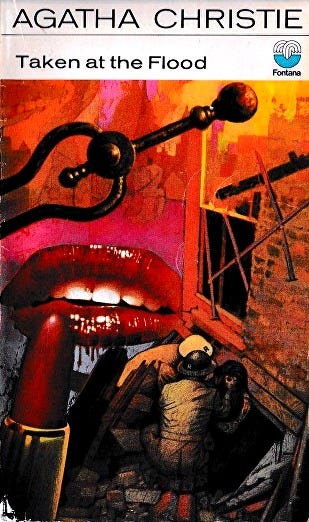
Quite a sexy book, this one. Agatha can do sexy without it being embarrassing (cf the wedding night passage in dear Dorothy’s Busman’s Honeymoon). It is also a Poirot; there is no particular reason why I have chosen so few of these, and I had no idea that almost half my list would comprise novels with no detective at all. Perhaps those books do have a different quality of inventiveness.
But Poirot is at his best in Taken at the Flood. I particularly like him when he deploys his rather fatalistic cosmopolitan wisdom. ‘Can you love someone you don’t trust?’ he is asked, by a young woman attracted to a man whom she intuits to be dangerous; to which Poirot laconically replies: ‘Unfortunately, yes.’
The brilliance of Taken at the Flood resides in its conjuring of post-war Britain, which Agatha - the incidental social historian - also does to considerable effect in A Murder in Announced, Mrs McGinty’s Dead and the Westmacott novel The Rose and the Yew Tree. The set-up is almost painfully simple. A family of the insufficiently-moneyed, upper-middle-class kind into which Agatha herself was born, whose need for funds is laid appallingly bare by the aftermath of war, has been relying on ‘prospects’ from a rich relation to shore up the damage and the dodgy roofs. Before he died, however, the old so-and-so took himself a wife; the money that the family had thought of as ‘theirs’ now lies in the possession of a young Irish woman, whom they besiege with varying levels of well-bred desperation, and whose fraternal protector (the sexy one) taunts them with the fact of their own obsolescence.
From my biography:
Taken at the Flood is a dark book: a serious challenge to the notion that Agatha Christie is ‘cosy’. Its mood is that of grey, confused, bomb-wrecked England. There is a sense that hitherto normal people are living by the law of the jungle. When a character says that ‘There have been dreadful things in the papers lately. All these discharged soldiers – they attack girls’, the reply is ‘I expect the girls ask for it’ (only Agatha’s perceived cosiness allows her to get away with this kind of thing).
It is as though the rules of behaviour have changed for ever. Criminality has become commonplace. The roots of society have been torn out and thrown about and anything – including murder – might be acceptable if it leads to individual advancement. Identities are fluid: the tricky old Christie device of having, say, Miss Durrant pretend to be Miss Barton in one of the Thirteen Problems – ‘the whole thing hinged upon one old woman being so like any other old woman’ – now has a real resonance.
There is daring in this novel: the facade is in place, but only just.
Comments
Nothing yet. Say the first thing.
Sign in to join the conversation.