
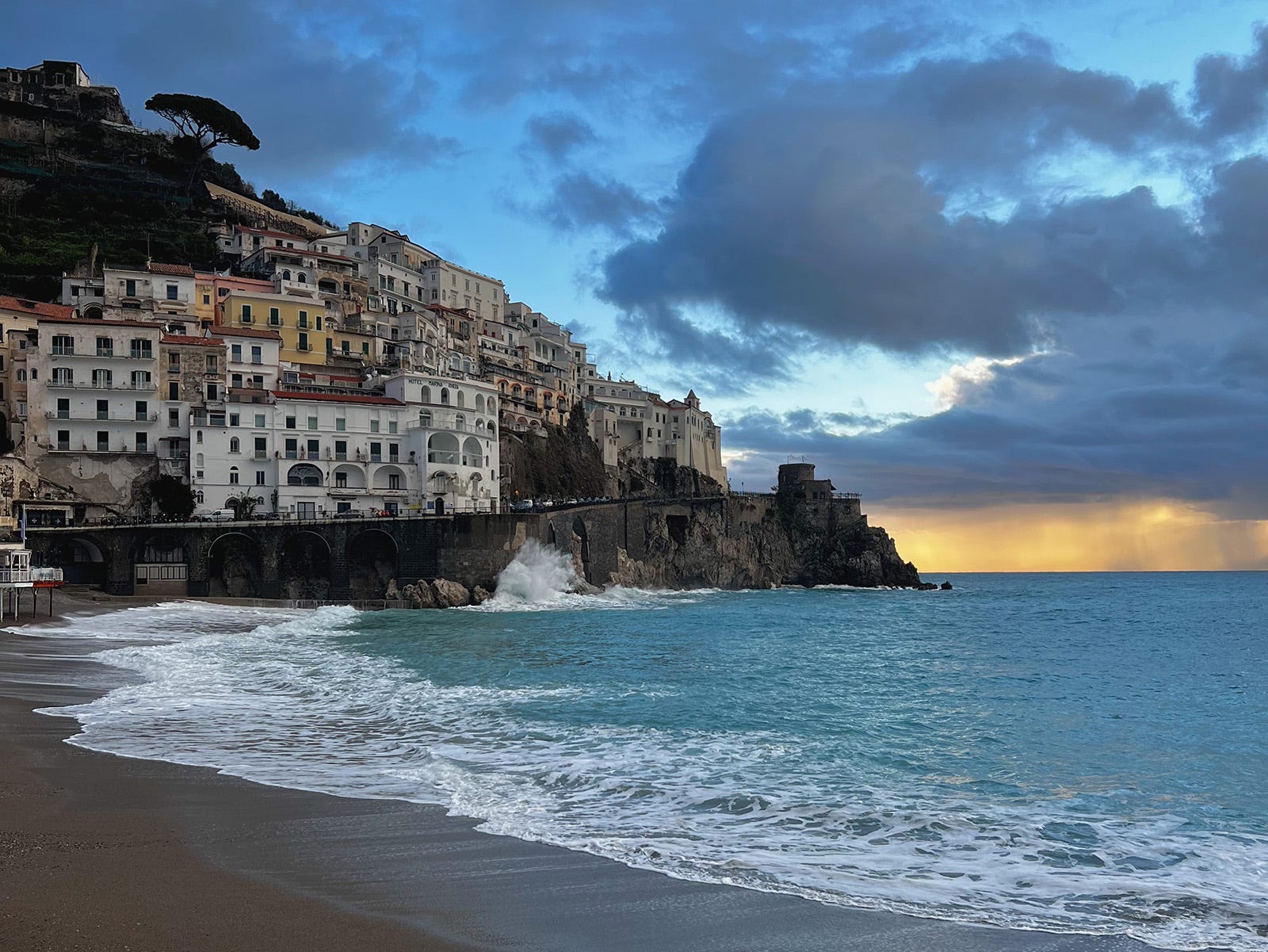
We’ve made it to the giorni della merla. In Italy, the period from January 29th to the 31st is called the “days of the blackbird,” and is traditionally the coldest time of the year. Here, blackbirds are a harbinger of spring, much like the robin, and there are a surprising number of legends around the birds. One, for instance, says that the merla got its color by hiding in a chimney for warmth from the cold – and came out black from the soot.
Not unlike Groundhog Day in America, which comes a few days later, there are many popular beliefs about what the weather on these late January days indicates about the arrival of spring. According to tradition, if the giorni della merla are nice, it means winter will last longer. While if they are very cold, it means winter will be over soon.
Deep in these dark winter days of so much discontent around the world, I reached for Osbert Sitwell’s book Winters of Content, which has been sitting on my shelf for about a year now. The title, if anything, promised a momentary escape into another time, another place.
It was around this time last year that a footnote in a relatively unknown Italy travelogue first introduced me to Osbert Sitwell (1892-1969), English author and younger brother of Edith Sitwell. Last winter, I wrote about my time with Spike Hughes and his book Out of Season, and how it led me to Sitwell’s books. If you missed it, here’s how the story began:
As a year-round Amalfi resident, I have long been curious about the way the tourist season has shifted over the past century. These travelogues documenting long journeys through Italy in the winter months are particularly intriguing. So often, it’s the Italy I love most. It’s odd to me now how focused the travel season has become on the hottest time of the year. There is much to discover in the pages of Sitwell’s winter travels, just as there is much to enjoy about Italy in what we would now term “off season.”
As I read, Sitwell quickly became an interesting character. An author with a deep love of Italy from a young age, he traveled extensively in Italy—and around the world—and wrote about it in several travel books – along with novels, essays, poems, satire, and plays. Like his older sister and younger brother, his life was dedicated to literature and art. He also happened to love Amalfi. My kind of fellow!
But my introduction to Sitwell, via Spike Hughes, was his travel writing through two of his books: Winters of Content, More Discursions on Travel, Art and Life, first published in 1932, and his 1954 collection of travel essays The Four Continents: Being More Discursions on Travel, Art and Life. With those publishing dates, I was interested to read about Sitwell’s travels in Italy before and after WWII. I tracked those books down last winter, but didn’t have a chance to get back to them until recently. And, I have to admit, I only recently realized that I had been reading the titles as “Discussions” not “Discursions.” But discursions is a much better word. It’s more of a roving, roaming, rambling – a word with an implied warning sign reading: "Digressions Ahead!” Discursion sounds like it has excursion in it, as if “we’re going on a trip” is built right into the word.
So, lace up your rambling shoes, we’re setting off on a little discursion inspired by Osbert Sitwell.
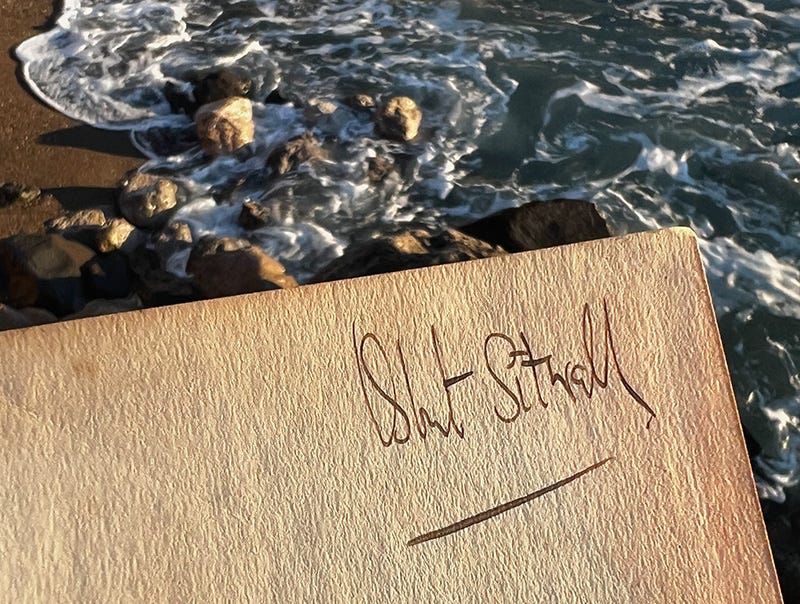
When I opened my copy of Winters of Content, I noticed the author’s signature on the inside cover. Surely not, right? But looking closer, that O combined with an S is definitely his signature. So, as I walked around Amalfi one morning carrying the book, I thought of how he had once walked the streets of Amalfi. I wondered where he might have sat, where he stayed, which views he enjoyed. The small wonder that this book he once held had made its own journey back to Amalfi. Imagine the discursions there …
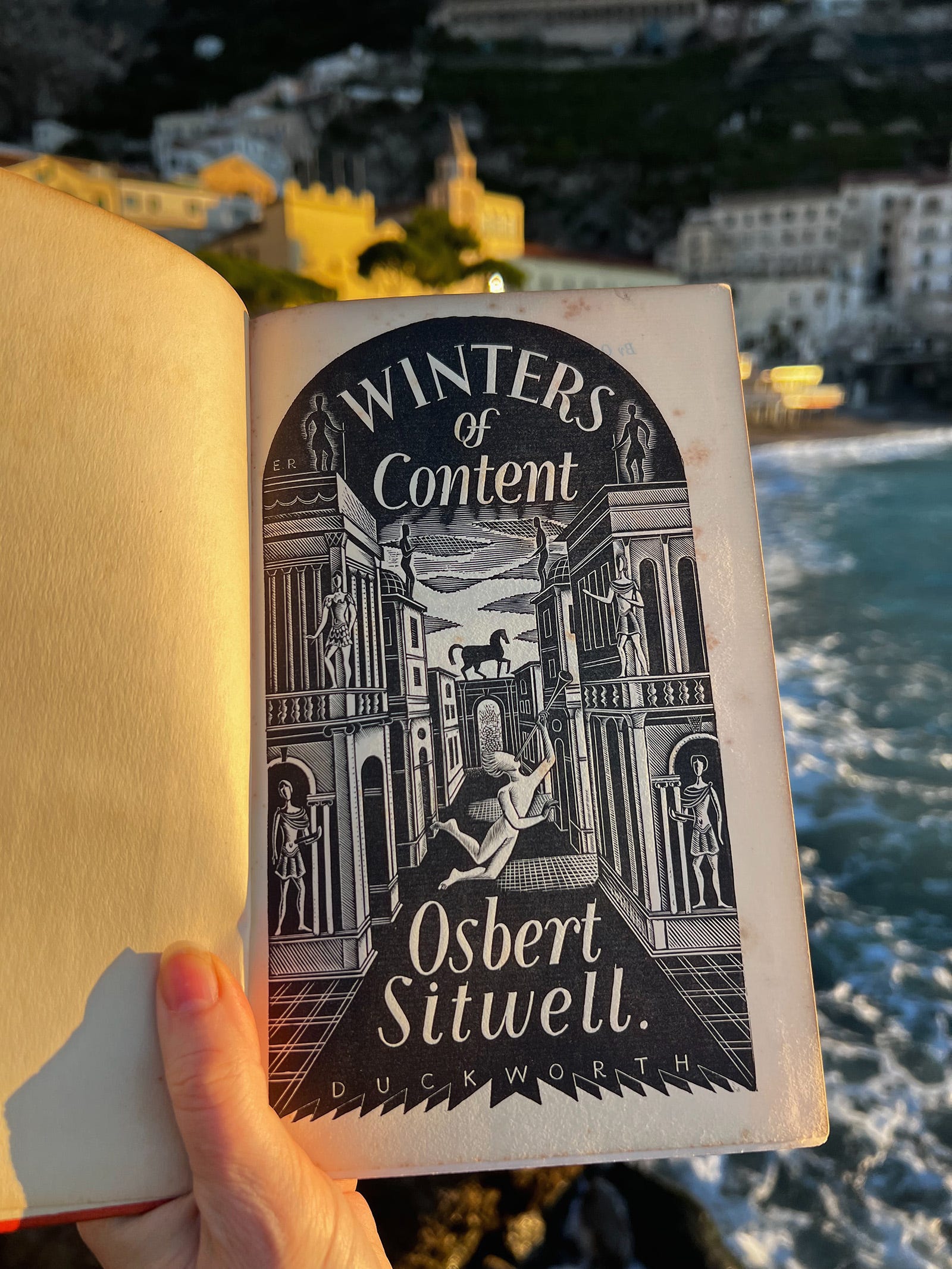
—Winters of Content edition from 1932.
Just inside is a frontispiece wood block design by the English artist Eric Ravilious (1903-1942). I very quickly learned with Sitwell that nearly everything has a good story. I hadn’t ever heard of Ravilious, but he was a beautiful painter—especially watercolors—book illustrator, and wood-engraver. He had a surprisingly modern style, evident in this frontispiece, with its geometric Art Deco design. What Sitwell wouldn’t have known in 1932 was that Ravilious would soon serve as a war artist, and be remembered as the first British artist to die on active service in WWII. But as a man who had served in the trenches of Flanders during the First World War, it is surely something that would have touched him deeply.
And this is how it goes when you’re on a discursion with Osbert Sitwell. Every page you turn has another story, another connection, some interesting new thing to uncover. He was, after all, of the type of family who had things done like getting a family portrait painted by John Singer Sargent.
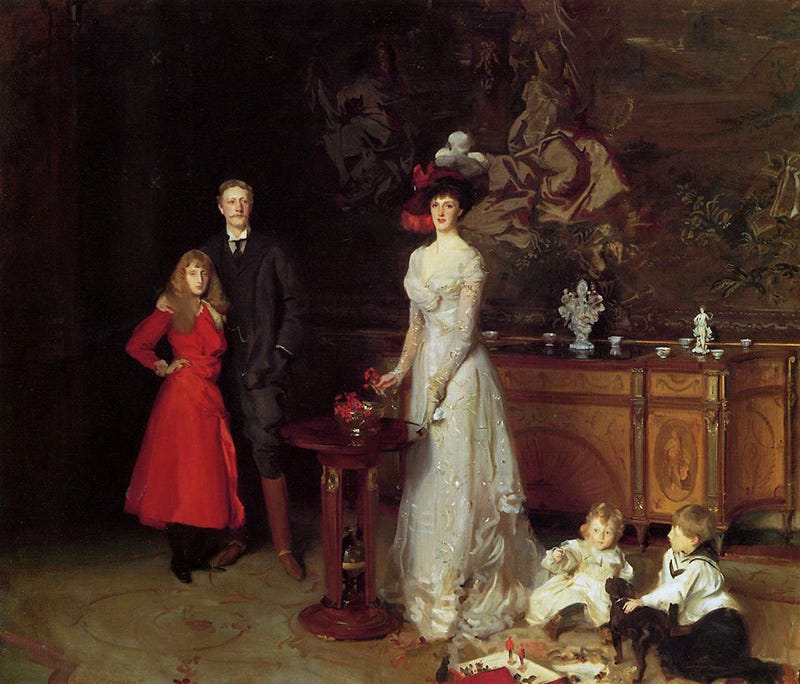
—The Sitwell Family by John Singer Sargent (Private Collection). Young Osbert is on the lower right.
While I enjoyed reading Winters of Content, and following Sitwell’s travels from Christmas in Venice down to New Year’s in Puglia and the rest of the winter months in Emilia-Romagna, what I really started to wonder about was the man writing the book. He was himself quite a character. In digging around a little more, I saw that he had written an autobiography called Left Hand, Right Hand! But not any autobiography, a 5-volume series that he worked on between 1941 and 1956 that was described by George Orwell as “among the best autobiographies of our time.”
Well, one has to take a look, right?
Just a little one though! But the more I poked around his autobiographies, the more I was struck by this curious, Italy-loving writer. What I found was quite a surprise!
The first was that he came by his love of Italy honestly. Osbert Sitwell was, at least, a 4th generation Italy enthusiast. He writes in great detail about his great-grandfather’s travels through Italy in the first volume of his autobiography. He writes: “In the winter of 1817-1818, when he was twenty-seven years of age, my great-grandfather went to Italy, for pleasure and the improvement of his mind.”1 Note: in the winter. He might also have been a 4th generation lover of traveling to Italy out of season.
Osbert’s father, Sir George Sitwell, 4th Baronet, was a very peculiar man by all accounts – especially his son’s. But he did have one very fine quality: buying a castle in Italy. In 1909, he bought the Castello di Montegufoni, located in Montespertoli, about 12 miles southwest of Florence. Moreover, he bought it in Osbert’s name. Dating back to the 10th or 11th centuries, and full of a “forlorn grandeur” Sir George appreciated, there are certainly stories in those walls.2 Osbert’s father set to work restoring the castle, even hiring Italian futurist artist Gino Severini in 1921 to work on the decoration and designs.
And I really am quite serious about the stories in those walls. Like Botticelli’s Primavera? During WWII it was just one of 271 artworks removed from Florence and hidden in Montegufoni – as in many other places around Tuscany. And there were photographs taken during this time! While the text of this video is in Italian, you can see the paintings while they were stored at the castle, along with the Allied forces after they arrived. That all of this exists, it just blows my mind:
You can actually stay at the Castello di Montegufoni today. Yes, of course, now I want to stay there!
Then came all of the Amalfi Coast connections. Osbert Sitwell’s godfather was none other than Ernest William Beckett, Lord Grimthorpe (1856-1917). Don’t worry if that name didn’t ring any bells for you. But if you’ve visited the Villa Cimbrone in Ravello, then you have encountered one of his great loves. Beckett bought the property in 1904 and created the beautiful villa and gardens that travelers from around the world visit today. (His ashes are even buried in the gardens.) While Sitwell didn’t care much for his godfather, he was immediately captivated by the setting: “The position, the view from the terrace, is perhaps the most lovely in the world.”3
Most lovely, second to Amalfi that is. Besides his dislike of Grimthorpe, young Osbert was particularly attached to Amalfi. So much so that for about 20 years it became his second home.4 In volume 2 of his autobiography, his love of Amalfi comes out as he ponders the appeal of the Amalfi Coast, which he shared with Charles Laughton (yes, that Charles Laughton):
“He and his wife … used to stay at Ravello every winter, for several years running, while I was a mile or so away, downhill, at Amalfi. … Often I wondered why it was that these seas, so different from those of the East Riding, made this equally intense appeal both to him and me; as formerly they had to my godfather Lord Grimthorpe, whose family had come from Whitby, near by … Perhaps this coast, with its mountains and caves and buttresses, its waterfalls and groves of orange and lemon protected by walls of rocks, its idyllic woods of chestnut trees, every branch covered with feathery lichen, its blue skies and mountain clouds, and the long sweeping shore sacred to pagan divinities, may have realised some idea formed in childish years. Certainly Charles Laughton, like myself, found here some attraction that he could not define or resist …”5
What a beautiful description of the Amalfi Coast. We’ll come back to Sitwell’s time in Amalfi, but first, there’s more. Because even earlier he had another connection. Sitwell attended Eton College, which he didn’t particularly, ahem, enjoy. Though he does write about how he felt an affinity for St. Andrew—Amalfi’s patron saint— which for some reason, they celebrated at Eton. This sparked a lovely memory:
“I used, with feelings of the greatest satisfaction, to observe the fishermen of Amalfi rewarding their patron saint for a good catch by attaching a painted tin fish or two to his stone image, which stood above the fountain in the cool piazza, pressed in between the torn limestone rocks, with their fragrant oases of oranges and lemons.”6
This I adore. If you’ve seen any of my videos of the processions of Sant’Andrea in Amalfi, you’ll know that my favorite detail is the jangling of the little silver fish that hang off the statue as it’s carried through town. So this image of tin fish—I’m imaging like ex-votos—being hung on the statue of Sant’Andrea on the fountain in the piazza is beyond lovely.
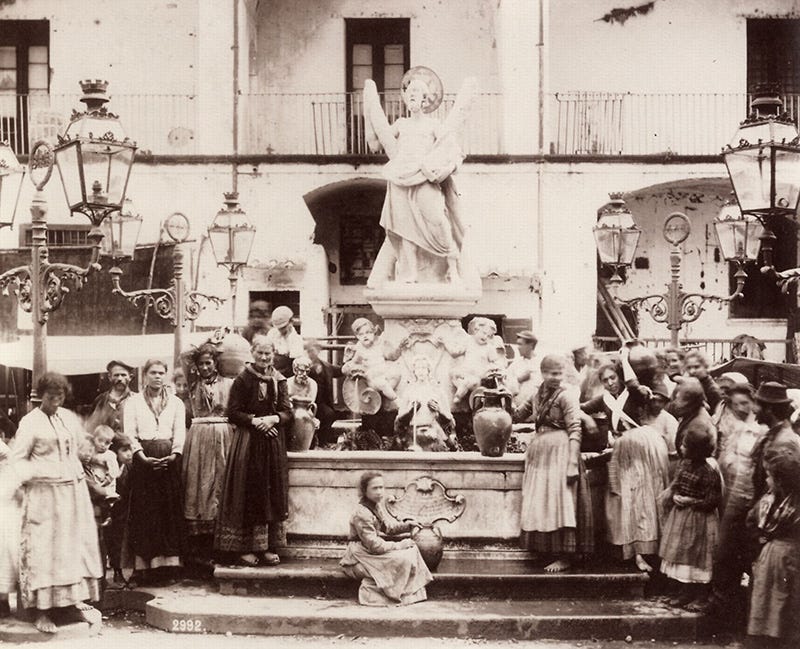
—Photo of Amalfi’s Fontana di Sant’Andrea c. 1890. (Giorgio Sommer)
Young Osbert seems to have first visited Italy when he was 19, when his father would have only recently bought the castle. The third volume of his autobiography, Great Morning, includes a lot about his early years in Florence and especially at the Castello di Montegufoni. Although at odds with his father, he couldn’t resist the allure of Italy:
“Nothing, no amount of worry, could make one unhappy for long in Italy, at the age of nineteen. The country was too heartening, and the people, with their vital natures, too welcoming, to allow of more than a passing depression.”7
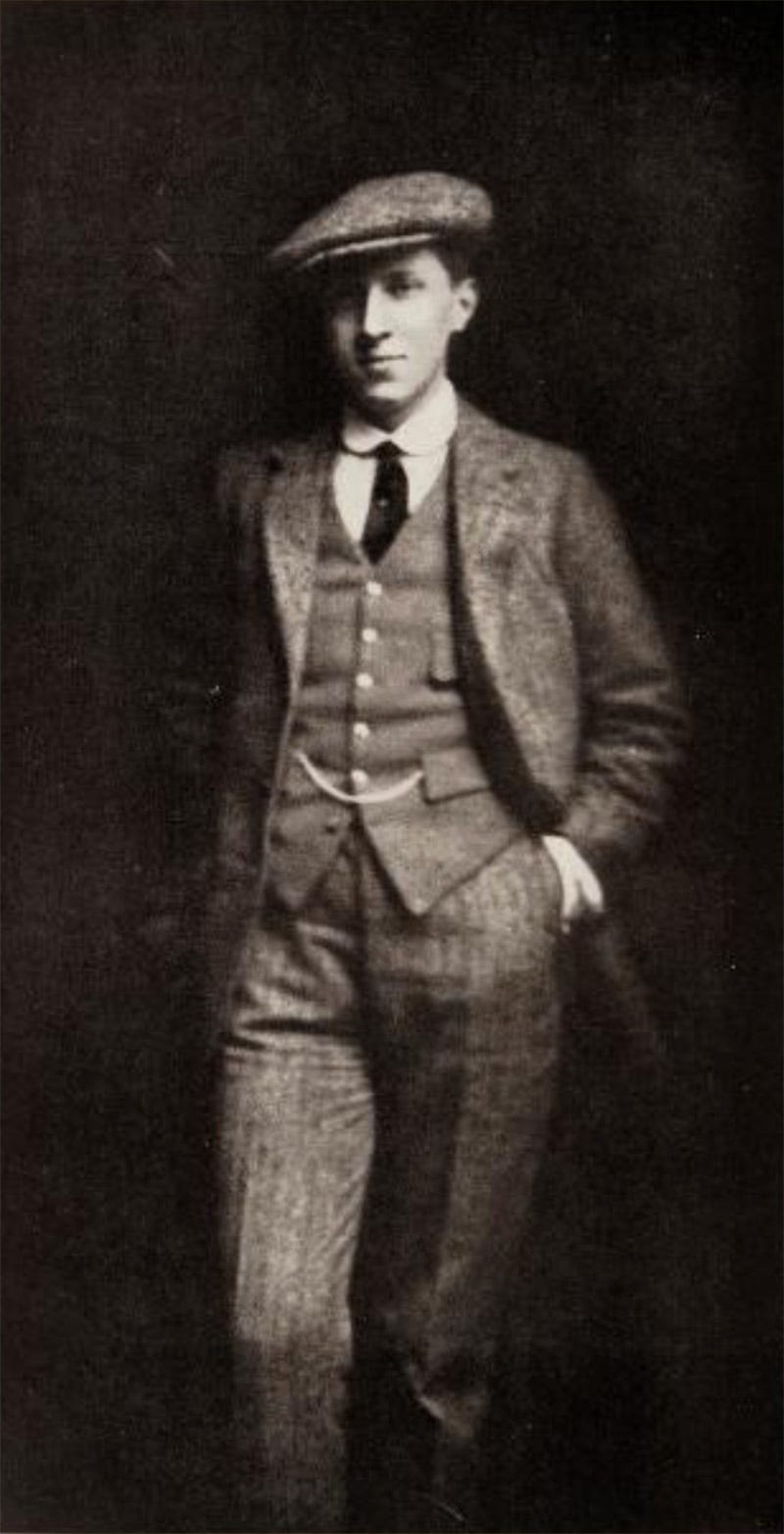
—Osbert Sitwell, age 18 from Great Morning, Volume 3 of Left Hand, Right Hand! (1948)
Of all the places he visited in Italy, and there were many, Sitwell had a particular attachment to Amalfi. Which, much to my enjoyment, he wrote about more in the fourth volume of his autobiography, Laughter in the Next Room. There he goes into great detail about his many visits to Amalfi, especially in the winter, where he would hide away with his brother, or occasionally his sister, to write. His “first-chosen and much loved refuge” always the Cappuccini hotel—now the Anantara Convento di Amalfi—where many writers and artists have found inspiration.8
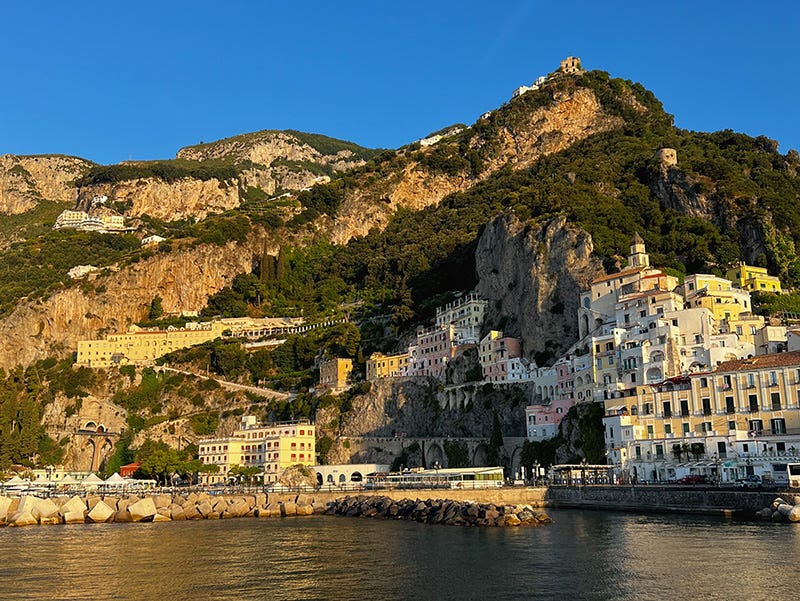
—View of Amalfi with the Anantara Convento di Amalfi hotel clinging to the cliff on the left.
What I love about Sitwell, however, is that he didn’t just pay a visit. He came, he stayed, he returned. He wrote a great deal here, with a view overlooking Amalfi and those long sweeping shores and “mountain clouds.” In his autobiography, he shares an incredible portrait of the hotel itself and it’s proprietor Alfredo Vozzi, who I have only heard stories about in Amalfi. He describes the hotel’s decor—“its walls could not be seen for the number of pictures hanging on them; small paintings of the Neapolitan neighborhood, executed in the romantic yet factual idiom of the so-called Scuola di Posillipo, which had flourished in Naples from 1820 to 1850”—which today you can still get a sense of in certain rooms at the Hotel Luna Convento in Amalfi.9
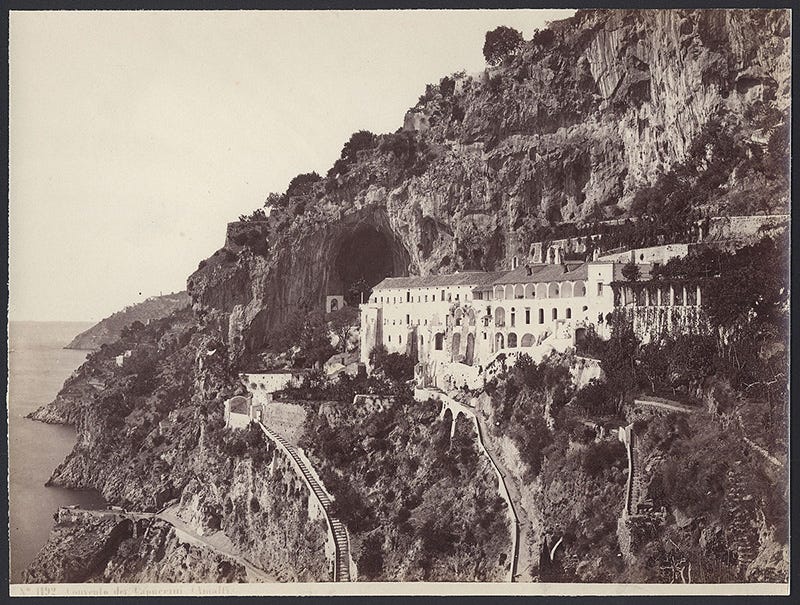
—The long steps leading to the Cappuccini hotel. (Giorgio Sommer)
During those early visits, when there was not yet an elevator at the Cappuccini, Sitwell describes the 300 steps to reach the hotel. (Or, apparently, you could be carried up by two men in a chair.) “This remoteness from the world, and the absence of central heating, helped to keep it comparatively empty in the winter, when it became to my mind an ideal place for writers.”10 Yes, quite. While I am particularly fond of my central heating—after 12 years of freezing without it in Scala—I couldn’t agree more with Sitwell about November to March being the best time of year in Amalfi for contemplation and creativity.
I could sail away on his beautiful descriptions of the Amalfi Coast landscape as he took it in from the Cappuccini hotel. Amalfi, from Sitwell’s first visit was “a place of excitement and inspiration.”11
“I must emphasize, moreover, that the landscape affected me in a way in which no other has except my own, came to me with some deep personal appeal or claim. Directly I had seen it, when I first stayed there as a boy of nineteen, in 1912, I had at once felt with the landscape, and with its people, too, this deep sympathy … During this first visit a glimpse of the future had asserted, or insinuated, itself, as it sometimes does, and though I had then entertained no suspicion that I should ever become an author, the knowledge had filled me that one day I should return here to spend much time engaged in a task that afforded me a sense of completeness – and, in fact, much of my earlier work was written here. No doubt the monastic air still retained by the Cappuccini, the atmosphere of peace emanating from its ancient, rustic cloister of Saracenic arches, painted a flashing white, which gathered to itself all colors, would have helped any artist in his work.”12
This struck a particular chord for me, because of its deep familiarity. When I first stepped off the bus in Amalfi, back in February (winter!) of 2007, I looked up at the mountains, the arches of the town’s cemetery, and had a similar “glimpse of the future” feeling. Later that night, I wrote in my travel journal (on Amalfi handmade paper) that I didn’t know how or why but I knew that this place was going to be important in my life. Like Sitwell, at that point I also wasn’t entertaining any suspicions of being an author. But this place, that task, and how it shapes me, continues to afford me a sense of completeness like no other. While he was writing about experiences from nearly 100 years ago, I get this man.
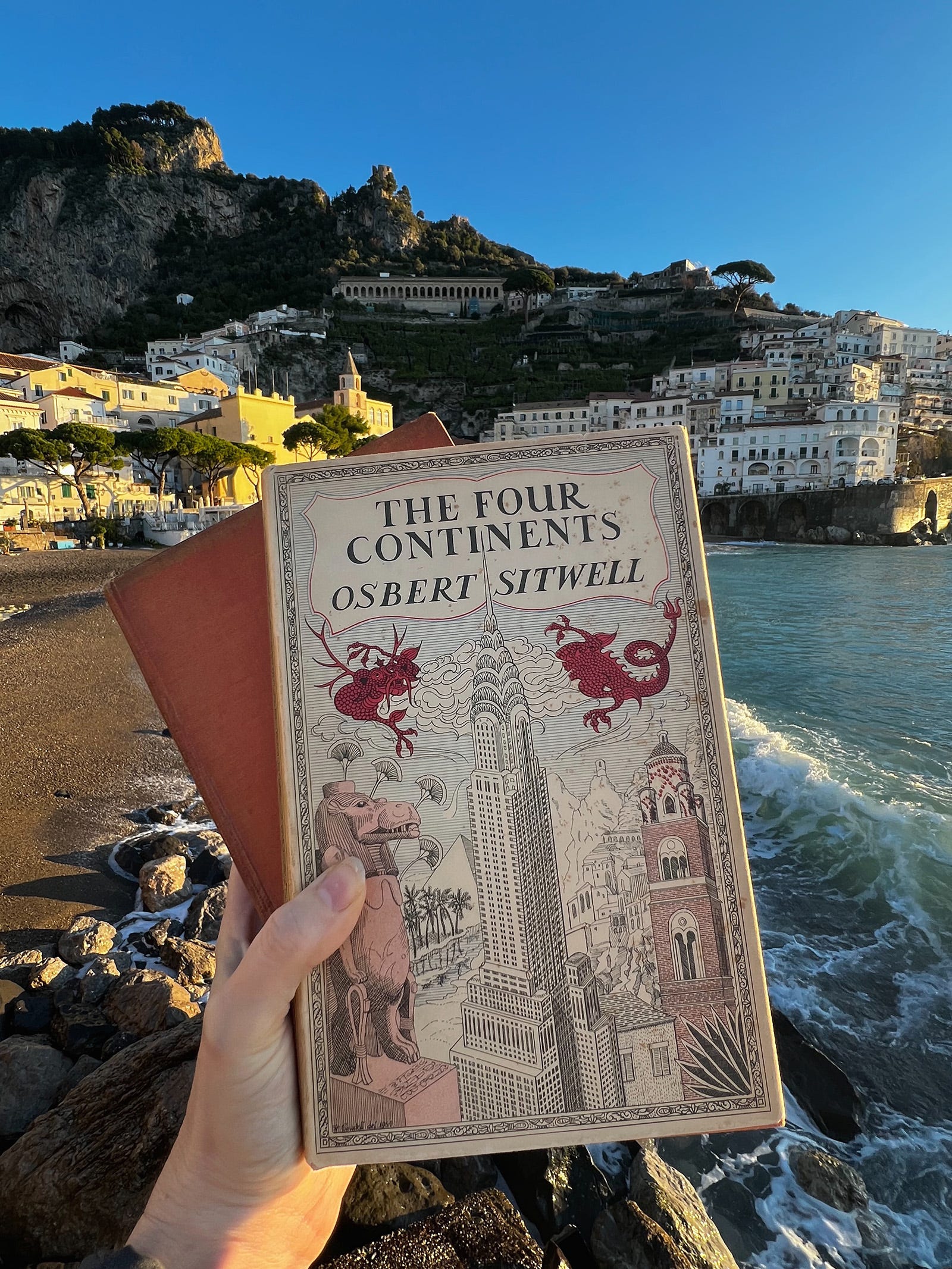
Then it was time to get into Sitwell’s book The Four Continents: Being More Discursions on Travel, Art and Life, which was published in 1954. This book has a dedication to Amalfi right on the cover. You can see the the campanile (bell tower) and hillside of Amalfi, including the arches of that very cemetery that struck me, and the Torre dello Ziro, on the right side of the book cover. The cover was by H. Cowdell, who I wasn’t able to find out much about, except that he designed many of Sitwell’s book covers, especially those published with Macmillan & Co. It’s a beautiful design though, capturing details from the across the four continents that Sitwell writes about in his second book of discursions.
It opens with Sitwell laying on his bed in Amalfi pondering the right name for the book, with Round the World in Sixty Years being a great option. Memories of Amalfi, as well as his return to the Cappuccini hotel after WWII, are woven in throughout the essays in The Four Continents. It’s a place that was so much a part of him that his first return there after so many years was a joy:
“I was back again at Amalfi, in the hotel that had been a monastery, back again … in my room in which in years past I had spent so many peaceful nights and arduous days of work: an environment so congenial to me, and so auspicious to my writing that, superstitiously inclined, I used always to write in notebooks bought in it. (Some amount of reason, however, may have underlain my folly, because Amalfi was the first place in Europe paper was made…) My eye, my mind, my memory and my imagination, seemed to work better here than elsewhere.”13
You see, I know this man. There’s something remarkable about finding, in the pages of history, to have such a kinship with another writer. To find that the strange things that have shaped your life might not be quite so strange after all. And, most of all, that somehow they might not be mine – if that makes any sense. Perhaps, there really is something in this place, which Sitwell happened to find and that, by chance, I bumped into as well on that winter day. Is that possible? Lost in the pages of his books, it seems so.
By the 1950s, Sitwell was already struggling with Parkinson’s, which would cause him to have to slowly abandon writing over the next decade. But, surely the memories of those winter days writing at his beloved hotel in Amalfi would have stayed with him. After traveling the world, it was Italy that became his home. He spent much of the later years at the Castello di Montegufoni, where he passed away in 1969. He’s buried in the Cimitero Evangelico degli Allori in Florence, with a copy of his debut novel Before the Bombardment, written, of course, at the Cappuccini in Amalfi.14
At the end of Winters of Content, Sitwell wrote about his time in Italy: “… I have loitered so long in the country, which, after England, is most dear to me.”15 Hopefully, I haven’t gone on too long with this discursion on Sitwell. There is so much that could be said. To do something of a paraphrase Whitman, we, all of us, contain multitudes of stories. I find hope in that – in all the connections of life, what we share with those who came before, and what we leave behind for those to come. During these winter days, I know I have found some contentment in my time with Osbert and his many stories. As he so wisely wrote once, “No night is eternal, though every night seems long.”16
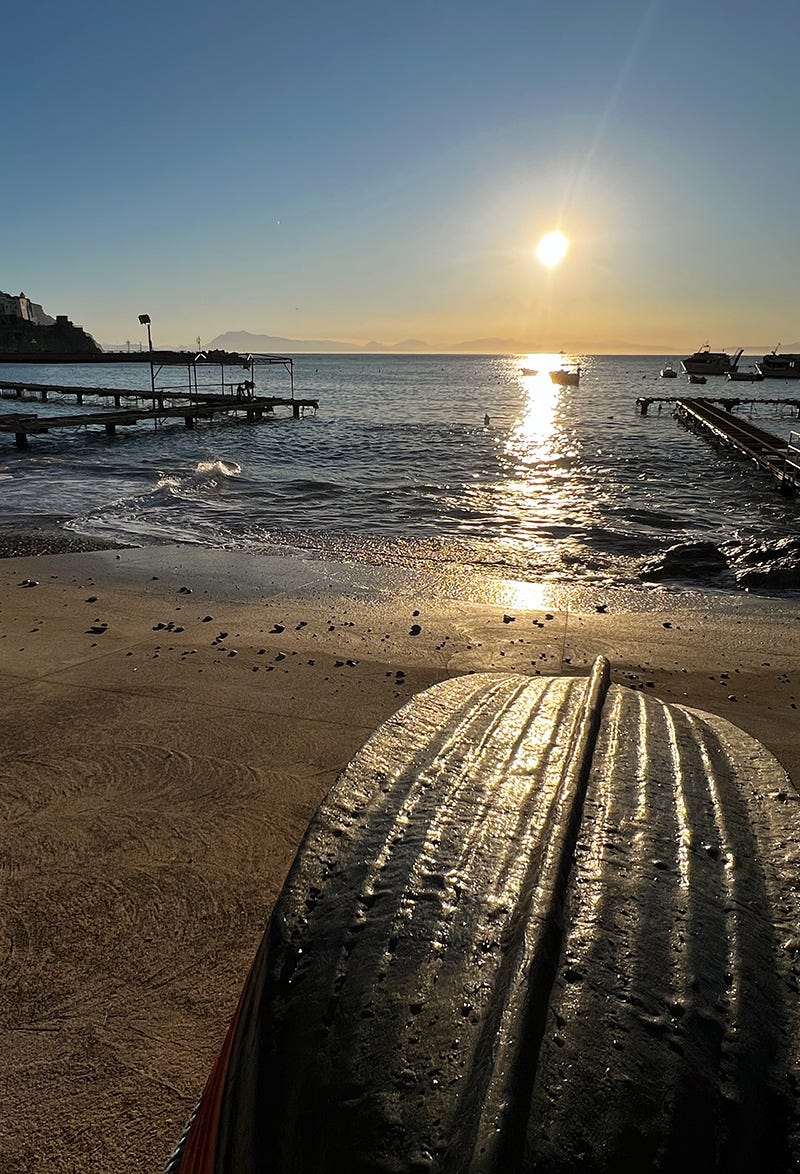
What do the giorni della merla in Amalfi say about spring this year? I’m not really sure. (Given the option of a chimney right now, I would probably hide in it too.) While the last few days haven’t been the coldest of the winter so far, we have had a week of bad weather, winter storm advisories, and exceptional amounts of rain. So I’m officially calling it: the blackbirds say early spring! If there’s anything we all need right now, it’s hope that spring is very much on the way. And, in the meantime, we can remember that no night is eternal.
Philip Ziegler, Osbert Sitwell (Knopf, 1999), 45.
Philip Ziegler, Osbert Sitwell (Knopf, 1999), 46.
Sitwell, Volume 2: The Scarlet Tree (Macmillan & Co., 1946), 127.
Sitwell, Volume 3: Great Morning (Macmillan & Co., 1948), 154.
Sitwell, Volume 4: Laughter in the Next Room (Macmillan & Co., 1949), 138.
Sitwell, Volume 4: Laughter in the Next Room (Macmillan & Co., 1949), 139.
Sitwell, Volume 4: Laughter in the Next Room (Macmillan & Co., 1949), 140.
Sitwell, Volume 4: Laughter in the Next Room (Macmillan & Co., 1949), 140.
Osbert Sitwell, The Four Continents: Being More Discursions on Travel, Art and Life (Macmillan & Co., 1954), 20.
Sitwell, Volume 4: Laughter in the Next Room (Macmillan & Co., 1949), 212.
Osbert Sitwell, Winters of Content: More Discursions on Travel, Art, and Life (Duckworth, 1932), 289.
Osbert Sitwell, Volume 1: The Cruel Month (Macmillan & Co., 1945), viii.
No posts
Comments
Nothing yet. Say the first thing.
Sign in to join the conversation.