
0:00
-12:16
Over the weekend, I went on a wonderful family holiday to Whitby (if you have not been before, do add it to your list: Visit Whitby). I have mused further about the books which I didn’t read, the bookshops I was delighted to visit and the Star Party I attended over on LinkedIn. It was at this Star Party that a glimmer emerged. I mean, how could it not? Stood on a cliff, with the view of the historic Abbey fading away into the dimming light, the famous whale bones rising to our left and a faint moon starting its ascent into the night’s sky.
For a further visual representation, this was the sign advertising said Star Party, how could we not attend?
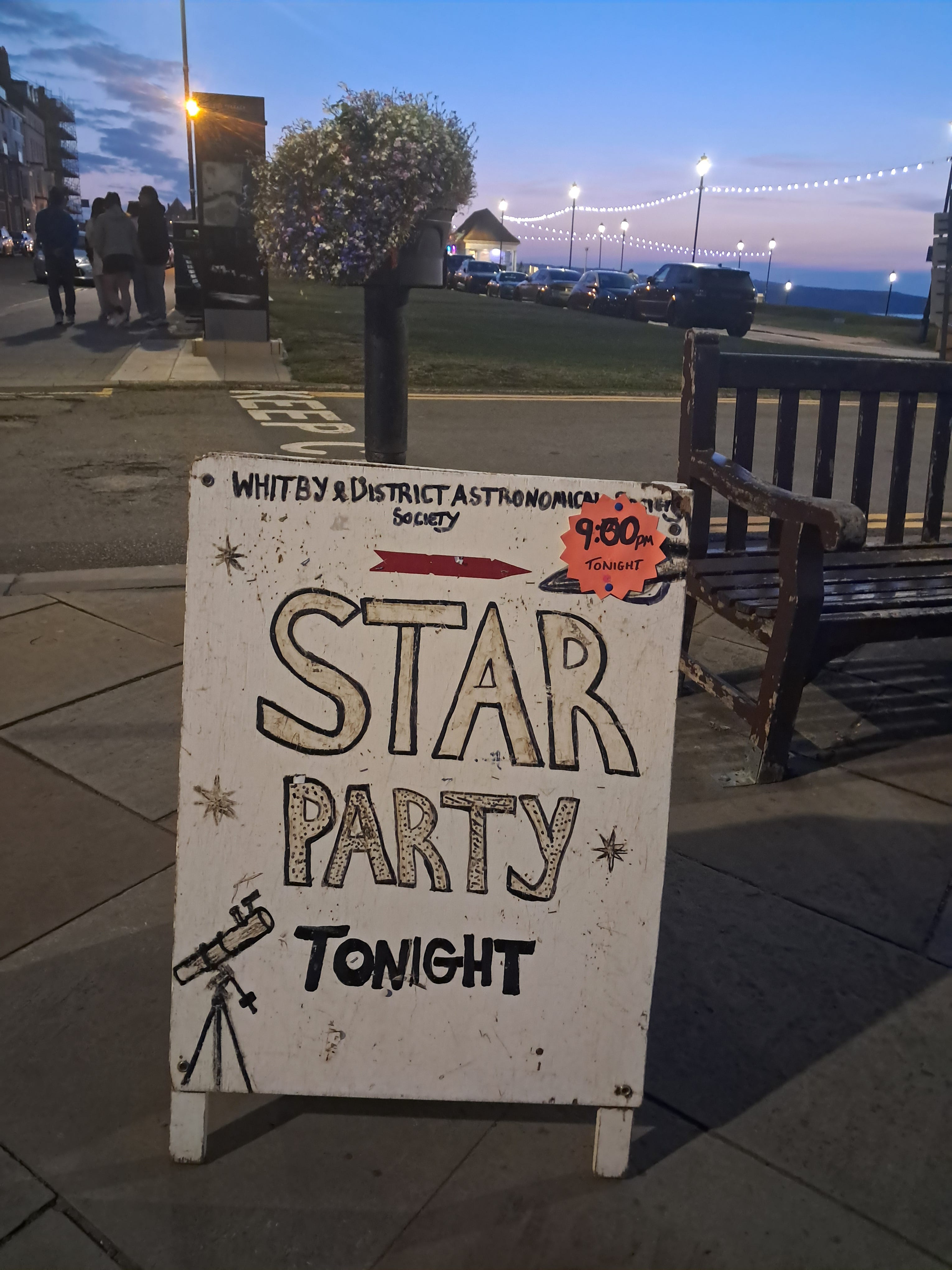
The free event was held by Whitby & District Astronomical Society, whose enthusiastic members had brought their impressive telescopes and stargazing equipment to share with those whose curiosity had been piqued. It was an enjoyable event, made all the more so by the depth of knowledge and authentic interest which was so palpable in each of the society’s members. So, of course, the question had to be asked!
“When did you become so interested in the stars and our solar system?”
The reply?
“When I was about 4, I was gifted a book…”
And here, the glimmer emerged.
It’s not a new thought I have had. Conversations between those who are involved in encouraging children and young people to want to read of course include the idea of interest. Yet, there are layers involved in this that are perhaps a little more niche and nuanced than they at first seem. As the new school year gets under way, it seemed a good time to explore these.
So, what might need to be considered when we are thinking about how interests show up in children’s reading choices and motivations? Below are two suggestions which I hope can be actioned with minimal time spent preparing. Think of these as prompts as you enter into conversations, and curate opportunities, for your pupils to read this year - in the classroom, and beyond!
I invite you to recollect the number of times you have taken your class, or perhaps your own children, to the library only to be met with the utterance, “I don’t know what to read.” Or perhaps even, “I don’t like any of these books.” And, let’s be honest, sometimes the choice presented to us in a bookshop or a library can be a little overwhelming.
There has been a lot of thought, particularly in recent years, about how spaces holding books are organised. I remember my first visit to my secondary school’s library. Having lessons on how to use the Dewey Decimal System. Feeling totally overwhelmed, especially as I felt that books and words were my friends and numbers were not. These numbers presented an initial barrier to me in being united with a new book. As a fan of organisation, I could of course see the merit in a classification approach which supported the navigation of a large library, and over time I softened to this. Yet, barriers can inadvertently exist in how books are presented to our children and young people. Spines forward, arranged in a system which supports a “tidy order” but does not perhaps nurture emerging interests or ‘tapestries of texts’ (a phrase coined by the Opening Doors team which I just adore).
So, how can interest be uncovered in a deliberate engagement with our reading spaces?
Consider the visuals. This may take some stepping back and putting yourself into the position of those in your class or school. Is the reading space inviting? What makes it so? I have been so lucky to visit a number of schools (including Hallsville Primary School, who I have written a whole glimmer about) who are doing this marvellously! Some of the key, meaningful, touches I have noticed:
A mixture of spines forward and covers forward. To create interest and intrigue. Think about how these books may be interchanged, regularly.
Objects relating to particular series of books, and book themes, being placed on shelves, hanging from ceilings, pinned to displays. An invitation to make a connection between the object and the plot. A prompt for a child familiar with the book to exclaim, “It’s the golden compass!” A conversation starter between peers, “You must read this one.”
Curate the arrangement of your books with intent. Perhaps some of the overwhelming elements of an alphabetical or number-based system is that it loses a sense of meaning to those searching for their interest. Creating links, a little pathway between books which share a similar focus point or theme, can empower those who have a little spark of interest in a particular genre or broader topic. I have seen some really effective displays over the years which offer a further bit of guidance for pupils who are not sure of their next read, “If you like this, then you’re sure to be into this…” As adults, we may recognise these tools on apps like Goodreads or through those on social media whose reading habits we feel an affinity with. If you have not read ‘The Book Whisperer’ by Donalyn Miller this is a highly recommended suggestion for considering how the children themselves can be involved in the organisation of books within their spaces. I also wrote a glimmering round-up of the book here:
Make spaces inviting and consider what the data is telling us. One of my most popular sessions with schools is around ‘Reading for Pleasure - and growth’. I have recently spoken to teachers within Summit Learning Trust on this topic, and found it powerful to share with them data from The National Literacy Trust:
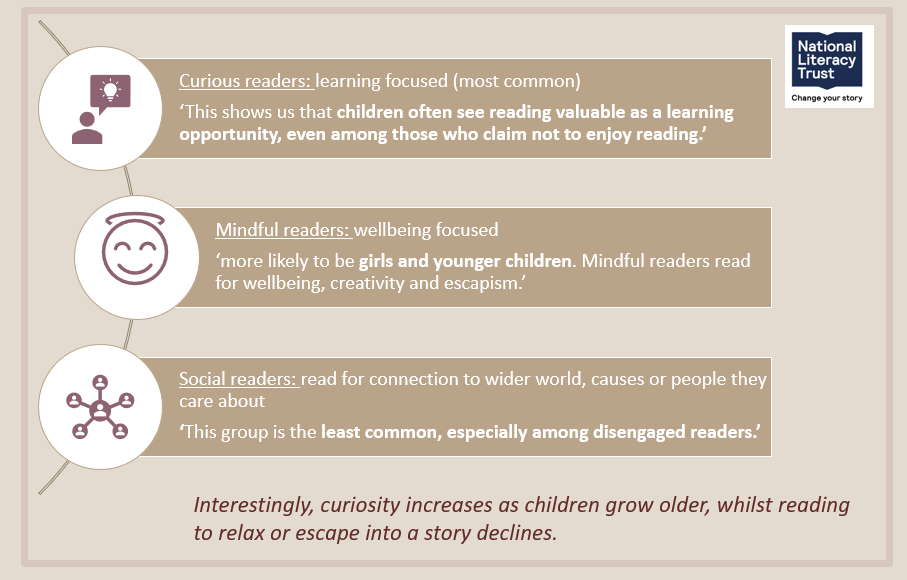
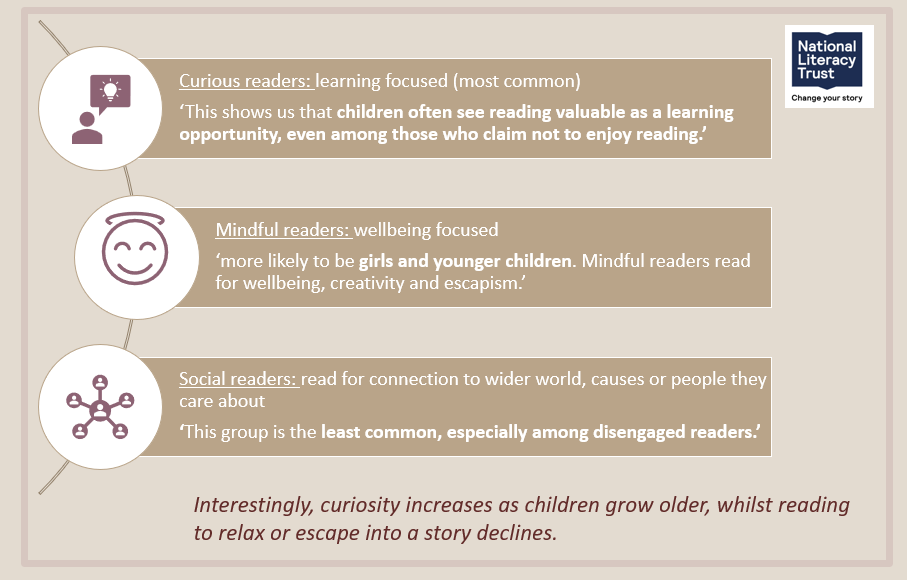
When we consider how and why the majority of our children like to read, we can think about how the spaces (and time) created for interest to develop can be supported by reading environments and spaces.
Curious readers may want to explore multiple books at a time, they may want to make notes or jot down questions. Are they free to move around the space, do they have their own reading journal to collect their thoughts?
Our mindful readers will most likely enjoy settling into the comfy beanbags under the twinkly lights. Do they have a sustained amount of time to read, to really lean into these moments of wellbeing?
Can the social readers have spaces where they can sit together and quietly discuss? How are they sharing recommendations? Do they have some ownership over their reading spaces and the means to be swapping and recommending books?
In his response about the gift of a book about space being the catalyst into a interest which has lasted a lifetime, this gentleman from the Astronomical Society was revealing a little about his reader identity. To return to this idea of tapestries, these texts (in their many forms) which work together to influence our interests, hobbies, thoughts and feelings. At the OU/UKLA Reading for Pleasure Conference last year, Teresa Cremin, CBE promoted those in attendance to plot their reading engagement on a tree, which represented the passing of time. The roots were spaces to look back and record specific books (or types of stories) which we remembered from childhood, into our school years, our time as teens and into adulthood. It was a brilliant activity, and one I would recommend doing with your school teams or with your class. What this visually represented was how our lives had influenced our reading choices - and vice versa. Attendees shared times when reading had dropped off for them, and when they had found an interest again - and why. The ebb and flow was authentic. What you’re reading, why and who for.
So, how can we support our pupils in exploring their reader identities and using these to empower them?
“Whatever you’re into, read into it” - I just love this key message from the National Year of Reading, 2026. Starting with an interest, or uncovering an interest through reading, and then allowing this to take you on a journey. Just Imagine’s Reading Journey is an incredible tool for supporting children to discover their volitional reading habits. Take a look at Nikki Gamble’s insights into this: So, what ARE children reading? Emerging reflections from The Reading Journey
Build a culture and practices which invest in the feeling of reading belonging to the individual. As I reflected on in my LinkedIn post (shared above) on my weekend away I took multiple books to read (and was excited about the prospect of doing so) and ended up only reading half of one. Now, I could have been cross at myself for not reading more, feeling guilty for not achieving my quota of reading material completed. Yet, I of course, didn’t. I had a brilliant weekend with my family, chatting, walking, playing cards, laying in! There wasn’t the time for reading - and that is ok. When we say to our pupils they must read this many times a week, they must read this many books a month, the control is taken away from them. They are being extrinsically not intrinsically motivated. This is not to say that regular reading and engagement with a range of books is not valuable - it absolutely is. Instead, it is considering how this is presented. Instead of ‘policing’ reading, how do we get to the heart of each child’s reader identities to gain insight into what, and how, they like to read? This is where true motivation can be found.
Don’t underestimate the power of curriculum in uncovering reader interests and subsequent identities. The number of hours we spend with our pupils each week is sizeable. We are in the privileged position to be able to guide and inspire through the texts which we choose to use within our lessons. There is a whole glimmer of its own on this - watch this space!
If you are interested in continuing your thinking around reader identities and nurturing an authentic interest in reading do follow:
Jon Biddle , Jo Beer , Anna Szpakowska and Sarah Bagshaw-McCormick on Substack.
You may also like to explore further messages around the National Year of Reading 2026 in my Substack round-up from earlier this year:
No posts
Comments
Nothing yet. Say the first thing.
Sign in to join the conversation.