
If you’re new here, I share regular insights and actionable ideas on writing, place and cultural connection through the lens of a novelist and travel writer (Lonely Planet, DK Travel, etc.) in three newsletters: Storycraft, Write Your Way Around the World and The Green Travel Guide. Writer’s Edition Members receive an additional full monthly post and monthly gifts from the Explorers’ Club (along with free access to the Travel Writer’s Starter Bundle + more). Welcome, and thanks for coming on the journey!
If the post is too long for your email, open in the browser to read the full post.
I’m still deep in the novel writing at present - so it’s early starts for walks on the island before the sun climbs over the mountains. Then it’s indoors into the shade to write. This month sharing lots on writing, travel writing, and island life.
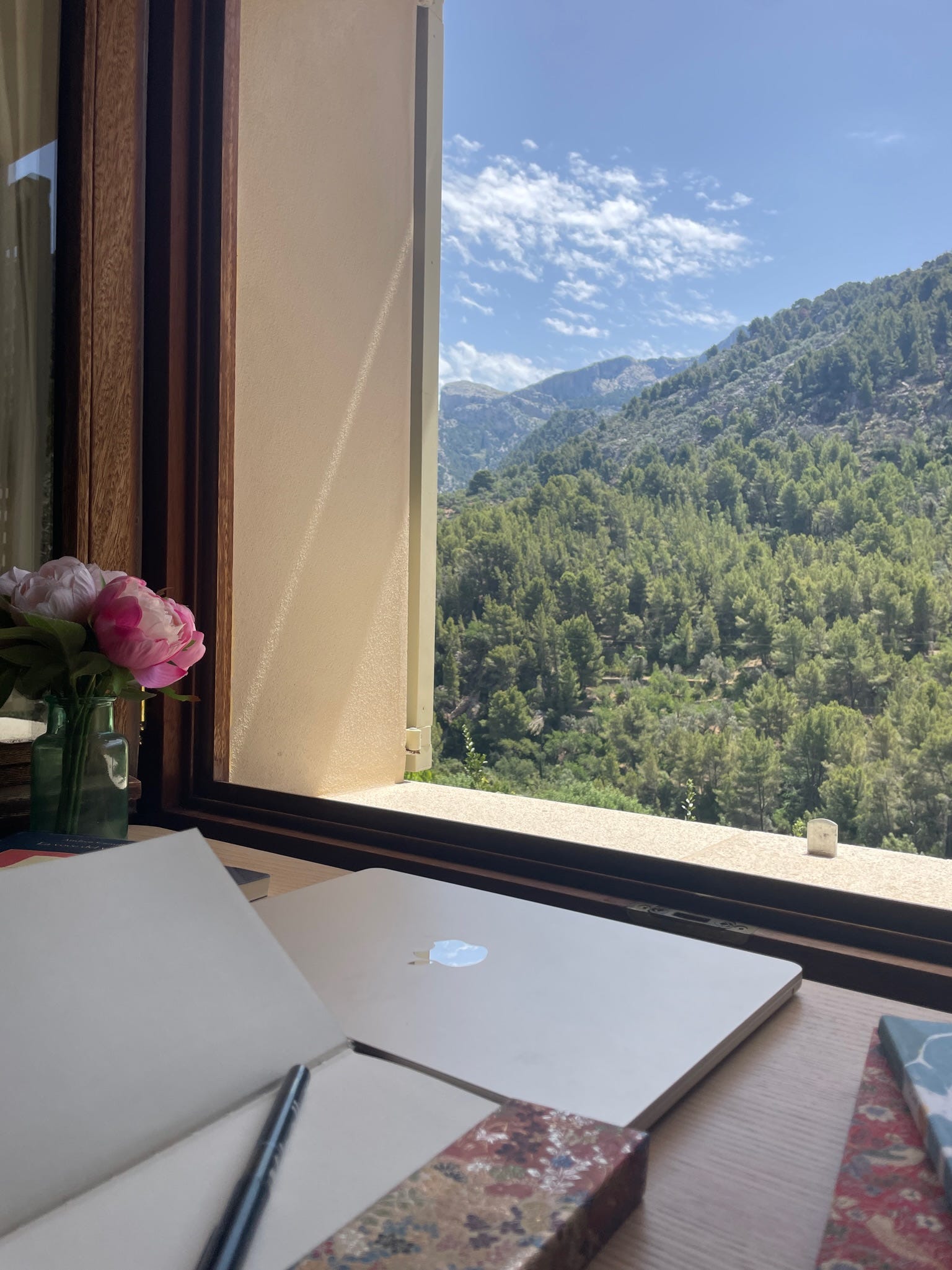
July’s Writer’s Edition covers:
In Writing - On When to Stick and When to Change
How Conflict Resolution Frameworks Can Help Your Writing
Different Ways of Describing Place (A Close Read): Dervla Murphy
Writing Exercises for Perfectionists
Behind the Scenes of a Writing Life
Early Bird Access to the Travel Writer’s Starter Course
July’s Writer’s Edition Gift - Writing Train Journeys: A Guide for Fiction & Travel Writing
Not all ideas make it to the finish line - and that’s okay.
When I’m writing novels, I’ll usually have five or six book ideas hanging around - some for years. It’s a little bit like planes on a runway - you think you’re ready for take-off only to discover that something’s missing, or you had an idea you loved, and you’re ready to work on it now, but traffic control says you’re going to have to hold on, there are others in the queue ahead of you.
Part of the writing life - whether writing novels, journalism, travel writing - is knowing which ideas to throw your energy behind and when.
The best method I’ve found for doing this - over years of highly unscientific trial and error - is to learn to look out for the ideas that I keep circling (why this idea, story, place?). To find your best stories, it really needs to be something where there’s something at stake for you - that could be thematically, in terms of learning curve, even a goal you’ve set yourself.
Sometimes you may not even see all that clearly as to why a story matters to you. It’s only when you search a little deeper you’ll begin to see what’s at stake.
And that is important. Why?
You can come up with a gazillion story ideas that editors or publishers or readers may (or may not) love - but if you don’t love that story, if you’re not genuinely curious about the ideas you explore on the page, don’t expect the editor/publisher/reader to care either.
So, don’t go for the obvious stories - go for the ones your gut is telling you, you need to write. I once had three novel ideas I was interested in, and in a moment of uncertainty asked my agent which they felt was the best to pursue first. Rookie mistake! Several months and one painful draft later, I’d written a new novel - it had all the requisite pages. But it didn’t work on the page. Because it wasn’t the story I’d needed to write in that moment. I hadn’t given it the space it needed to grow.
What I learnt from the experience is that when it comes to your writing, you need to tune out all the noise, and really listen to your gut. Take your time. On the upside, when I wrote the next novel it was very much an exploration of what I cared about and was interested deeply in in that moment. That emotional difference always shows on the page.
There’s timing too. Sometimes, it’s the right moment to share a story - it chimes more. How often do we see a book that is ‘quiet’ later find a readership because the themes resonate strongly with a particular moment in time. We could say this of The Great Gatsby, Walden, A Time of Gifts or The Snow Leopard - all books with quiet initial readership that found their way to much wider audiences.
Another way of knowing, do I stick or change with an idea is, does it flow? When you write do the words come easily (not all the time, but overall)? There’s a kind of energy you feel with a piece of writing when it’s working. You’re just the channel for the words after a while. If, on the other hand, you find yourself struggling with an article or a commission, that’s a sign too.
Your creative energy is precious so think about how you’re spending it, and where you can, look for work that helps your creativity expand.
If you’re writing something at present, or thinking about writing something, does it excite you? Do you feel drawn to writing about it? Always try and start there.
Writing can sometimes be more like mediation and conflict resolution than we’d imagine. Breaking it down here for you.
In conflict resolution it’s common to use:
Curiosity - are you curious about the other person’s story independent of yours?
Openness - can you hear their perspective without resorting to layering your feelings onto what they are saying?
Step into their shoes - can you ask ‘what do you really want?’
Stay objective and neutral - you’re not agreeing, you’re understanding
Reframing - being able to play back the concerns while finding a way to bring both sides into the same shared story
Really conflict resolution is about storytelling - the stories we tell ourselves, the stories we tell about ourselves and others, the story frame through which we see situations.
You can use this same way of seeing when you write fiction or if observing in travel writing - the same mediation skills can help strengthen your writing.
Are you curious and open when you write? Can you step into the shoes of your character and let them surprise you? Can you take the time to understand? Then how does that transform the story you’re telling?
A few of my favourite writers to read for this balancing of compassion with curiosity include Tolstoy, Elizabeth Strout, Chekhov, William Trevor, George Eliot, Marilynn Robinson. Each writes character deeply, without judgement and with great humanity.
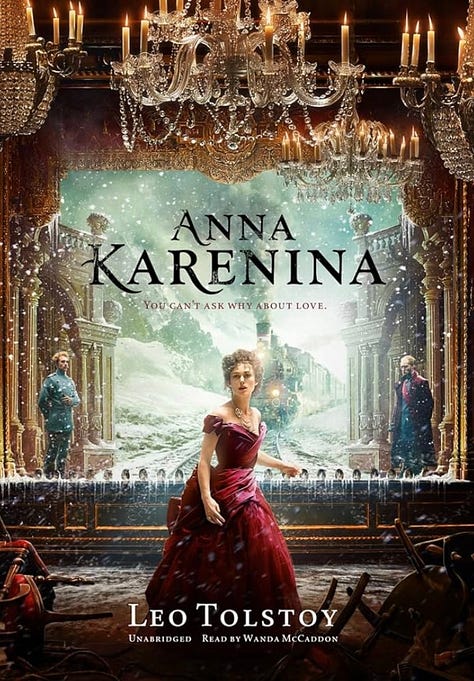
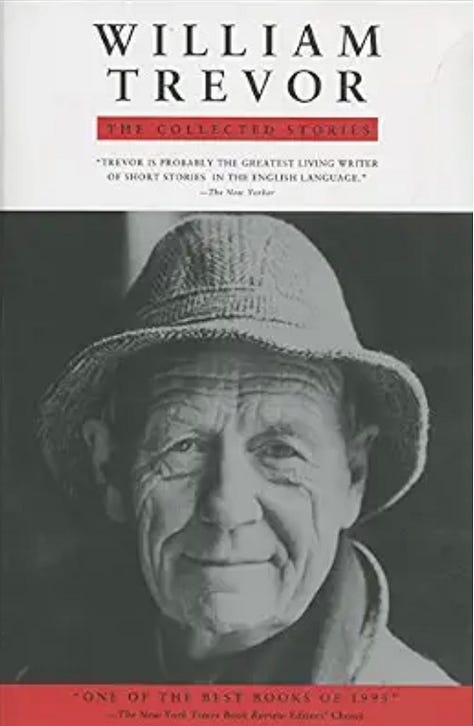
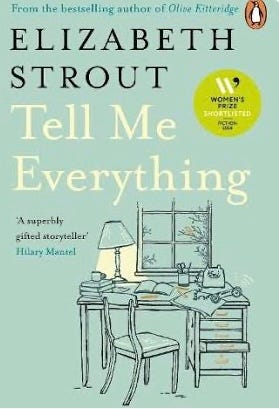
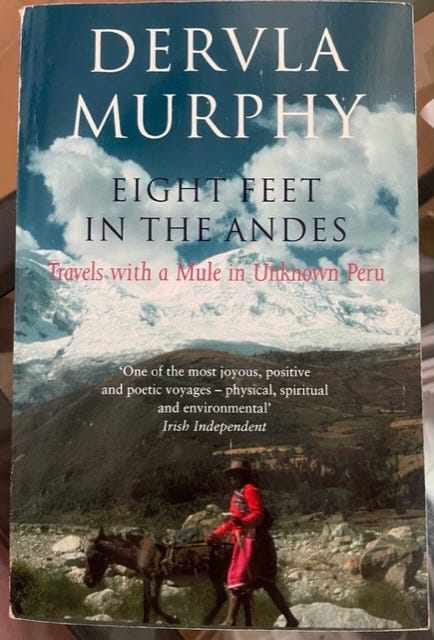
Let’s read this excerpt below from Dervla Murphy’s Eight Feet in the Andes: Travels with a Mule in an Unknown Peru. Dervla was a fantastic writer of place and intrepid voyages, with a deep and fearless love of travel, exploration and cultural connection. Irish, she dreamed as a child of cycling from Ireland to India, a challenge she achieved in the 1960s (you can read the tale in: Full Tilt: Ireland to India on a Bicycle (1965)).
Here I’ll take a closer read of her work. As a way of reading it may be helpful to you for your own reading and writing. In this passage she’s exploring the Andes with her young daughter Rachel who she often brought along on expeditions, and a mule, Juana.
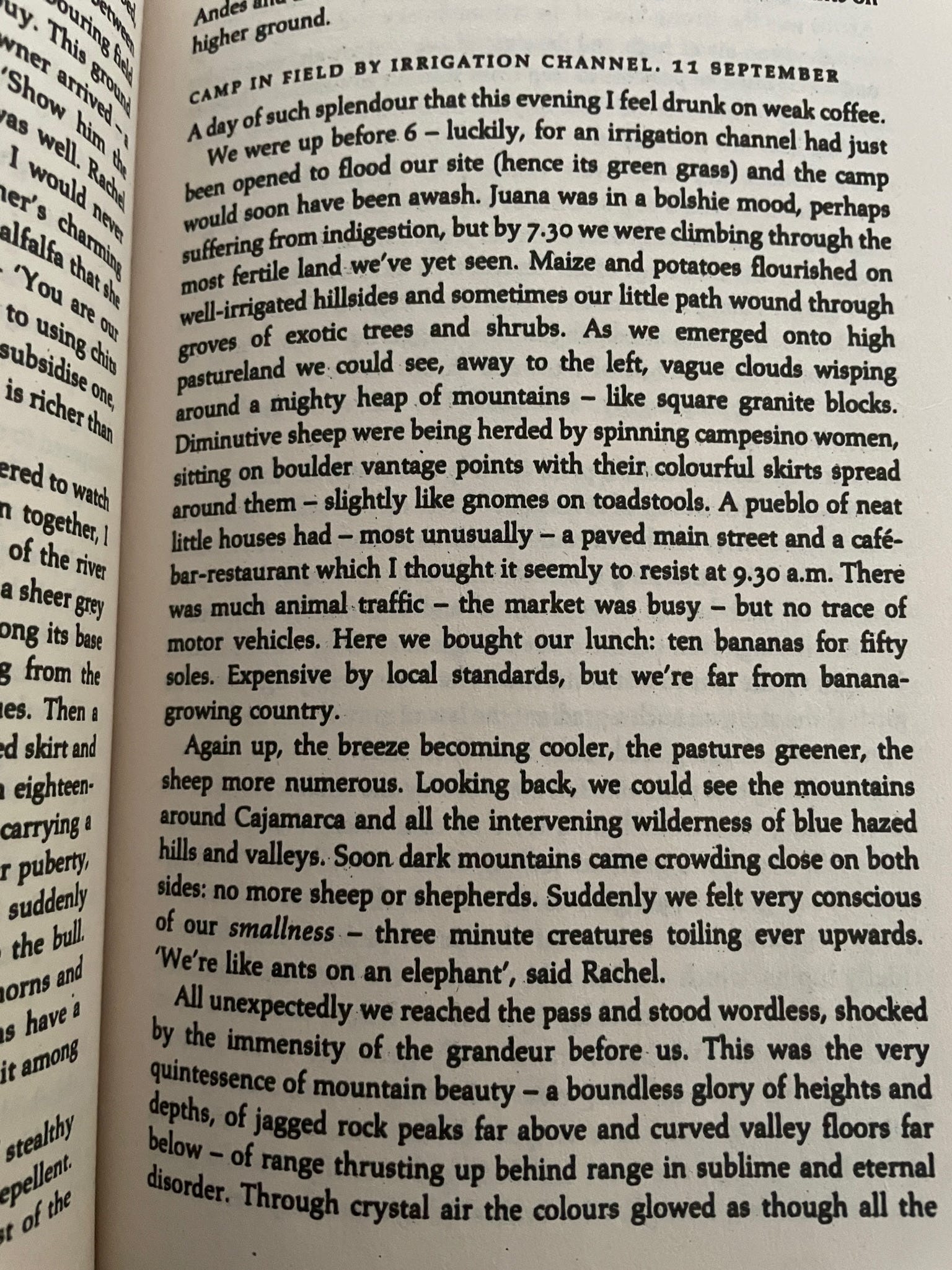
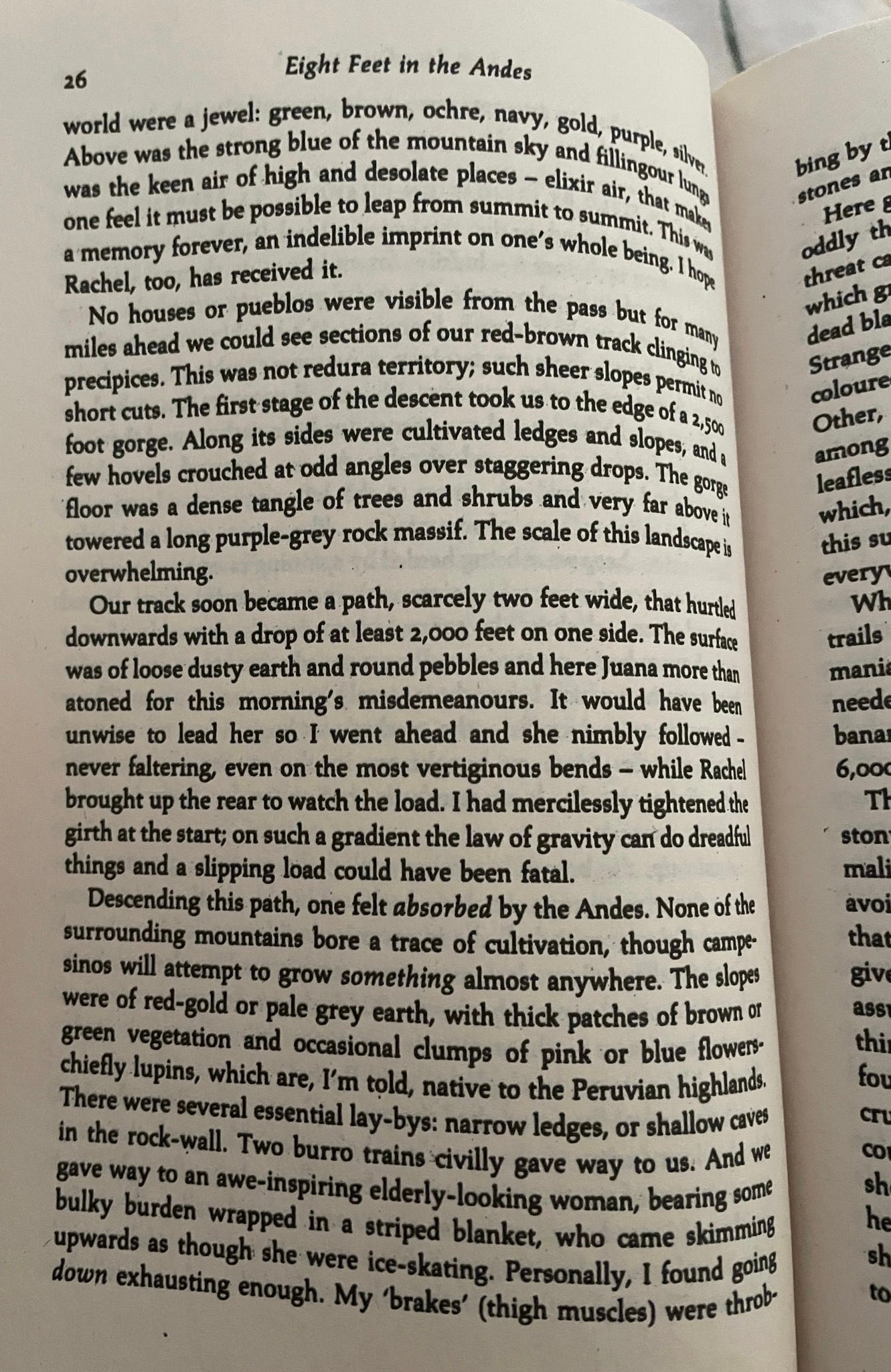
Dervla was a meticulous recorder of her experiences, wanting to capture them untainted by perception over time. In her writing we see her gifts of observing closely, her generosity in the way she writes, and also she brings us in to her own gradual learning.
Look at how she goes for the small detail, not the grand backdrop. She pulls the reader close. It’s weak coffee, the irrigation channel, the disgruntled mule (“Juana was in a bolshie mood”). She makes you feel like you’re there along with her, experiencing the same discomfort and small inconveniences.
The writing reflects her note-taking too. She builds up the landscape the way a painter would, one brush stroke at a time, words layering. Fertile land, well-irrigated hillsides, groves of exotic trees and shrubs.
We see from her perspective. “Diminutive sheep were being herded by spinning campesino women”, up in the high pastureland. We’re down in the town amongst life “the market was busy” before she sets back off into the higher pass with her young daughter Rachel and Juana, the mule.
She uses repetition of rhythm to layer the scene further. “Again up, the breeze becoming cooler, the pastures greener, the sheep more numerous.” Note the musicality. She is pulling us along with her on the ascent.
She looks back and it’s all “blue hazed hills and valleys”. She’s not telling us about the vastness of the landscape, she’s showing it through her impressions. Then Rachel names it, “We’re like ants on an elephant.”
Dervla shifts from observation of the exterior world to interior sensation.
“Suddenly we felt very conscious of our smallness.”
She highlights that smallness, because it’s key to her experience of travel, what travel teaches us.
Her writing is both spare and lyrical at once: “range thrusting up behind range in sublime and eternal disorder.” Or “the keen air of high and desolate places”.
This brings depth to the descriptions, and to the journey. Here she acknowledges the immense beauty of the landscape as they “stood wordless, shocked”. She holds it as “a memory forever, an indelible imprint on one’s whole being.” She is full of awe and curiosity at the grandeur of the natural world, the immensity of what she is looking out over. But we only get the grandeur at the top of the climb - she doesn’t open the scenes there.
Dervla is strong at signposting for the reader. She doesn’t want you to get lost in the prose. Note how often she’ll use transition words to move us along: we emerged/looking back/soon/suddenly/unexpectedly/descending. Each shift helps the narrative unfold.
She plays with scale constantly - zooming up close, then out, then finding a middle ground - its intimate tiny details meeting sweeping panorama. We anchor in descriptions: colourful skirts, bananas, neat little houses. Then we’re dropped into valleys, boundless glory, sheer slopes, “three minute creatures tolling ever upwards”. She moves between these scales with ease, weaving in anecdote and impressions with description.
The prose is always moving forward. The imagery is playful, the “awe-inspiring elderly-looking woman” who “came skimming upwards as though she were ice-skating.”
The prose itself often mirrors what she’s describing - movement becomes clipped and observational, the jagged mountain cliffs see the prose ascend and drop, an echo of the description.
It’s prose shaped by landscape and experience.
For all those who’ve patiently waitlisted (thank you!) I’m delighted to confirm that the Travel Writer’s Starter Course begins on 27 August. It is a six week programme with focused lessons delivered each week. You’ll work on a piece of your own writing alongside lots of practical exercises, and you’ll receive personalised feedback on your work. There’s also a live Q&A.
This is for anyone starting out in travel writing keen to understand the writing landscape better. It’s for all those who want to develop their own writing, and learn how to approach publication with confidence.
You can read full details and sign up for early bird access here (before 17 August). Please note I’m keeping the group sizes small to give the best possible support to everyone taking part. Do hope you can join! Full details including a week-by-week breakdown below:
Comments
Nothing yet. Say the first thing.
Sign in to join the conversation.