
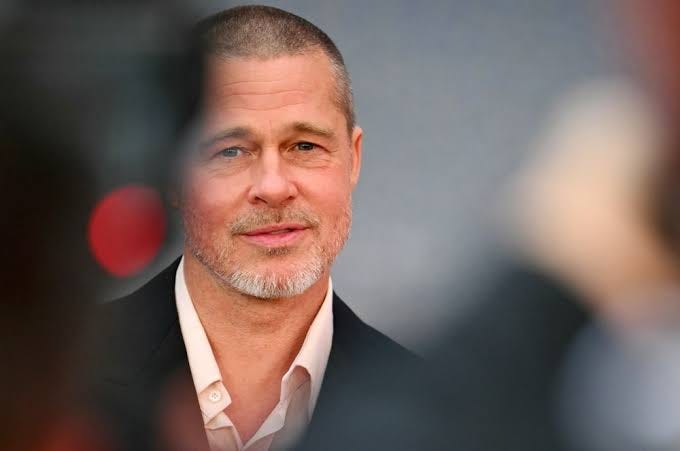
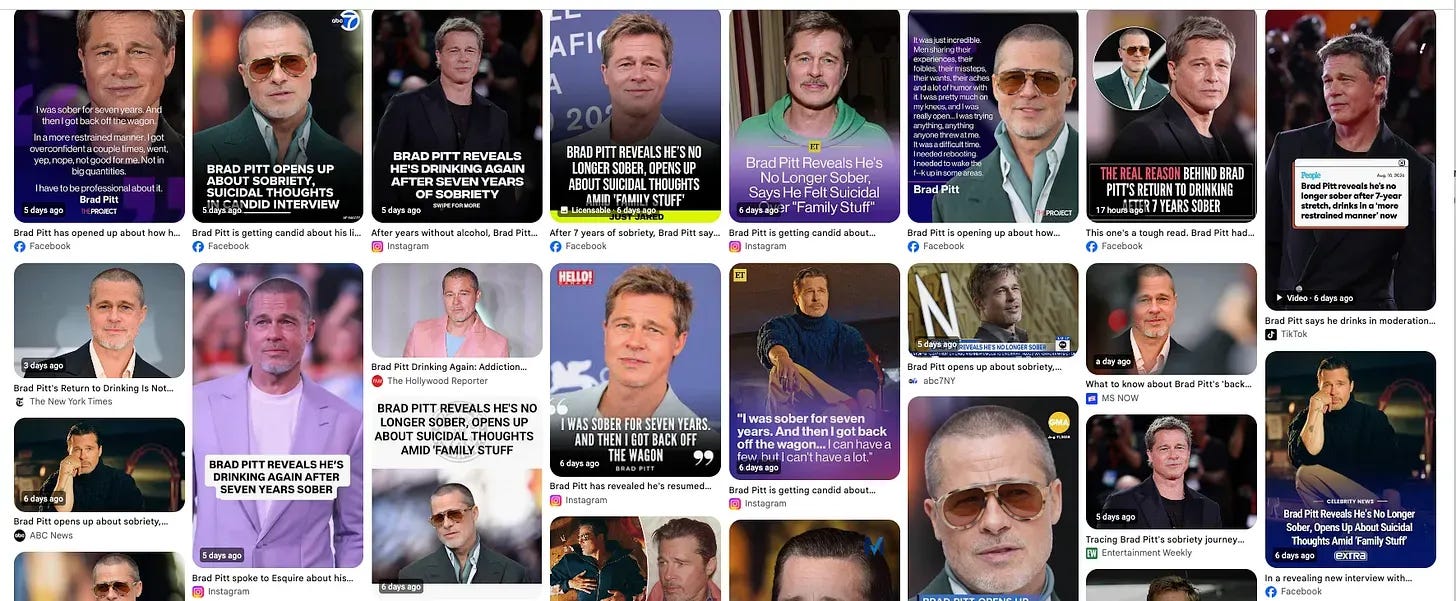
My phone started blowing up last week after the Brad Pitt Esquire piece dropped, wherein he disclosed he’s back to drinking after seven years of sobriety. Instagram messages, texts, a few emails, and a lot of buzz of in The Luckiest Club community and meetings. My feeds have been flooded too—even here on Substack.
It’s a small part of the overall piece; the totality of it is here:
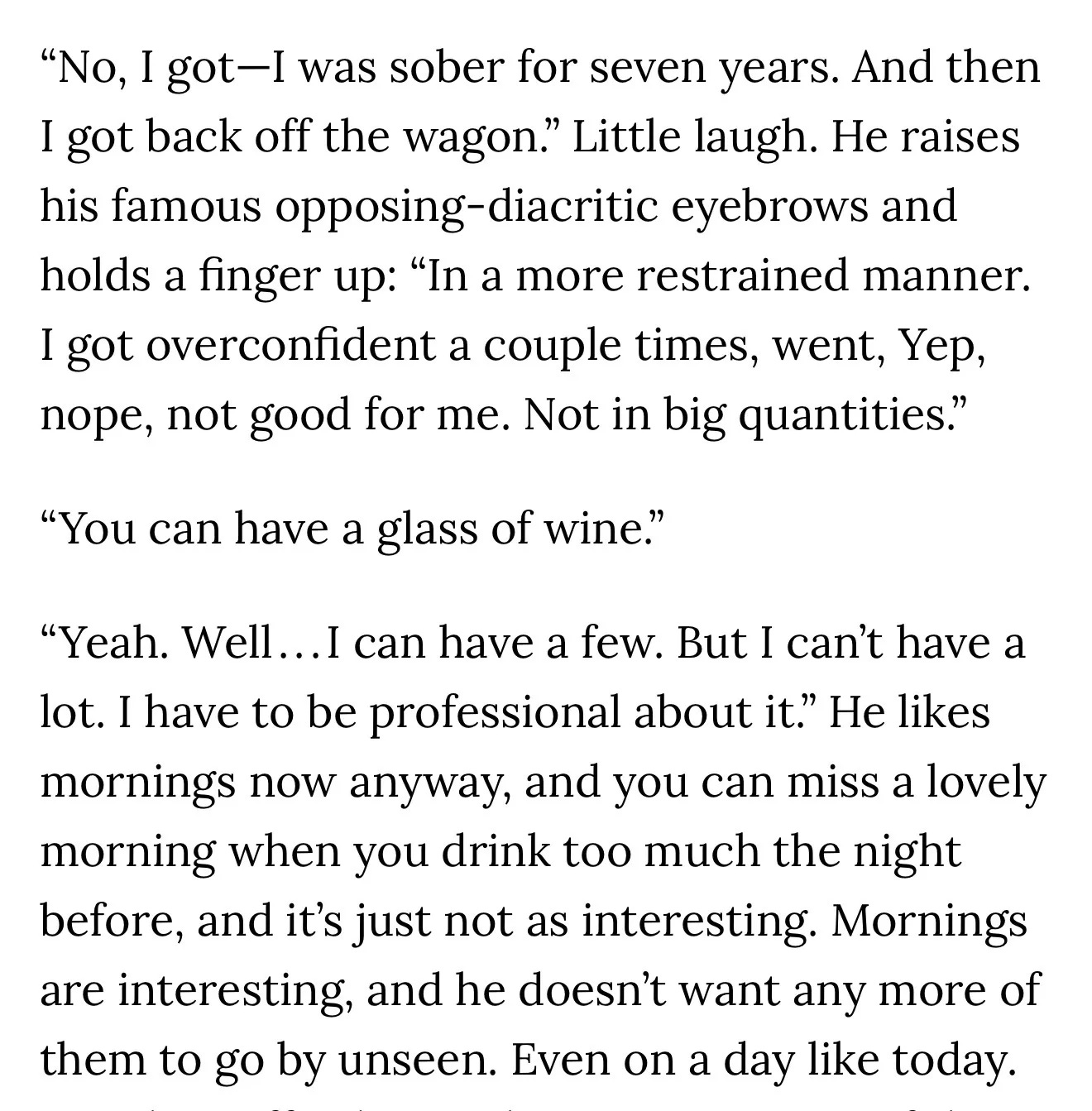
I had zero inclination to write or say anything about this, but got to talking with a friend over the weekend and realized perhaps I do. Not about Brad’s decision or situation, exactly (this will shock you, but: I don’t know Brad Pitt! I’ve never talked to him, been with him when he was drinking (or not), and I don’t know what’s in his head or heart), but about the collective reactions to news like this, and my experience with such things.
When I was fifteen, my dad stopped drinking. He announced it one day when we were out to lunch—me, my brother, and him—and I noticed he hadn’t ordered his usual beer. He said he was done with it, “Enough weekends spent on the couch ignoring my kids.”
I remember feeling relieved, like something had been lifted, or perhaps confirmed or explained. My grandma (my mom’s mom) had told me numerous times growing up that his drinking had been part of why they divorced, though I never saw him egregiously drunk that I remembered. He drank consistently, but so did everyone else. Still, it wasn’t hard to imagine it as a “problem”—whatever that meant, exactly, to a kid—because my dad’s demeanor had always been intense, with extreme fluctuations. Big highs, big lows. It felt more or less like believable lore, and by the time he told me he was stopping at fifteen, I welcomed anything that might lend more stability.
He went all in on AA. Got a sponsor, had a copy of the Big Book laying around the house, went to multiple meetings a week. When we were with him on the weekends, Joe and I would sit in the car while he went to a meeting before we’d go to dinner and a movie—our long-standing Saturday night tradition. He’d come out of those meetings buzzing like a bee. He had new, sober friends. Got a girlfriend who was also sober (and half his age). Started working out again and talking brightly about the future.
Ten years later, on a trip back home to meet his new wife, I noticed he was drinking wine at dinner with her. I panicked, cried on the phone to my brother, and then to my dad when I returned back home to Boston a few days later. It felt like the floor had been ripped out and nothing was safe or sure anymore. He assured me that the decision to drink was not a rash one, that he and his new wife had talked about it at length. He said he realized he had a spiritual problem, not a drinking one, and that his time in sobriety had helped him work through that, but that he didn’t need it anymore. I was suspect, but what say did I have? I was twenty-five years old at the time and lived thousands of miles away. My brother, who still lived near my dad in Colorado, promised he’d report back if things seemed to be going off the rails.
Fast forward ten more years, and I’m the one facing sobriety.
My dad, unironically, is one of the people who points out my drinking as problematic. When he does this, I argue, “But you went back! You were able to find a way to do it normally.” He doesn’t argue with me here, just focuses on what he sees in me, and this infuriates me. This fact—that he went back to drinking after ten years of sobriety—sticks in my craw; it’s menacing. I turn it over, spit at it, wonder how it could possibly be true. It goes against everything I’m hearing in my own meetings—everything I’m hearing everywhere. It’s one of the things that keeps me stuck in my desperate search for a third door.
Ultimately I decide that if I get to ten years of sobriety like he did, I can decide then if I want to drink again or not. I put it aside.
Here’s what everyone wants to know: How did it work out for him?
When I tell this story, it’s what people always ask, and they usually ask it as if they already know the ending: that it couldn’t have turned out well. But the truth is: I don’t really know. Has my dad died of alcoholism, or suffered severe consequences from his drinking? No. Have I seen him drink too much on occasion in the past twenty years? Yes. Does that seem to be a regular thing? No. Do I have a clean answer for where alcohol sits in his life, or whether or not he has a problem with it? I do not. My gut answer is, I don’t think he does. But I do think he suffers otherwise, and always has. I realize this may be entirely unsatisfactory, and I get it. For a long time, it would’ve been for me, too.
On the whole, people I’ve met in recovery—in the thousands at this point—have not returned to ‘normal’ drinking after sobriety. Which is to say their relationship to alcohol is not neutral or even kind of destructive, but very, very bad. Many have died. Some just seem to struggle off and on, to varying degrees. Others have disappeared, sometimes for years at a time, and then come back and say they’re ready to try again, and that it was hell. Stories like my dad’s are not the norm, but, of course, they’re out there—of course they are.
Regardless of what Brad Pitt’s deal is, or my dad’s, or anyone else’s: drinking for me is a living hell.
When Brad talks about drinking like a “professional” I don’t even know what that means. No, really, what does that even mean? When other people talk about moderation I feel my chest actually constrict. I never wanted to moderate, ever. I mean, sure, I wanted to believe I could if I tried, but really what this meant is that I wanted to believe I could drink as much as I needed to drink without suffering the consequences of how much I needed to drink. And I needed to drink it all, all the time. And I’m not using the word need here as I just kinda want to drink more but need as in there is literally no way I can stop.
Look: I could probably, for a very limited time, “hold it together.” I’m sure I could make it through a couple dinners with my friends, a party or two, maybe even a few weekend nights on my own, without drinking far too much. But the amount of effort that would take? The amount of brain space drinking or not drinking or when am I drinking next? and am I okay? and do people notice? and is this too much? and will it be obvious if I have another? and and and—OH MY GOD, NO.
Moderation, professional drinking, a few glasses of wine: that is not the place I want to live. That is me pretending to be a zebra when I’m an elephant. And for what? A few hours of…something…with every moment in between consumed by torturous mental gymnastics?
But, look: I get it. It took me years to let go of alcohol completely, to rewire my brain and my body so that it didn’t feel like something was missing. It took time for me to see that being able to drink alcohol was not a prize, not a gift, but the opposite of what I actually wanted in this life. And until I got to that place, I was pissed. I was slightly or very sad. I was frustrated by news like Brad’s, and rigid about what sobriety needed to be for people so that I could feel safe and justified in my own. And this is normal: it’s totally normal. Identities are rigid when they’re still being formed, and that’s okay.
I know this part might be really annoying, so I’m sorry, but the truth is: whatever you felt when you read about Brad (or learn about any similar-type story)—relief, fear, anger, vindication, dread—it has more to do with where you are right now than it does with him. I’m not saying that in a finger-pointing way, but a kindhearted, I’m-with-you one. My first reaction to the headline was two-fold: no, thank you, and who cares. Not because I think Brad doesn’t matter as a person, but because it’s none of my business, and I knew a pile-on was coming.
But that wouldn’t have been my reaction in early sobriety! It might not have been my reaction three or four years in, either. Back then I’d have had a lot of feelings about it, and I’d have needed to talk them out. If you’re having feelings about this, it’s probably worth doing the same. Things like this point to where we are in our own process—and while that’s often uncomfortable to look at, it matters.
Love,
Laura
Maybe you’ve told yourself you’ll stop drinking tomorrow (again), maybe you’ve seen a hundred Day 1’s, or maybe you’re just curious what a week without alcohol would feel like.
Push Off From Here is a guided 7-day start, led by me and Eric Johnson: two 75-minute live workshops (Sat, Aug 22, 12–1:15 PM ET to plan your week, Sat, Aug 29, 12–1:15 PM ET to talk about how it went) plus daily morning and evening support emails in between. Replays will be available for those who can’t make it live. You’ll also have the option to try The Luckiest Club free for 7 days for extra support, meetings, and connection.
Cost: $77. No labels or forever decisions, just a real start with great support. ♥️
Register for Push Off From Here ($77)
I’m teaching my writing and meditation course, The Practice, this fall from Sept. 8 to Oct. 20. Join me if you’re in transition, wrestling with a big decision, moving through fear, or craving a meditation and journaling practice you can actually stick with. Zero writing experience necessary; the work we do is guided personal journaling.
Paid subscribers here will get a code for 15% off—I’ll drop the link in the chat tomorrow.
Learn More & Join The Waitlist
You are reading Love Story, a weekly newsletter about relationships, recovery, and writing from Laura McKowen. Laura is the founder of The Luckiest Club, an international sobriety support community, co-host of the Dear Vernon sobriety podcast and the bestselling author of two books, We Are The Luckiest and Push Off from Here.
You can give a gift subscription here.
Comments
Nothing yet. Say the first thing.
Sign in to join the conversation.