
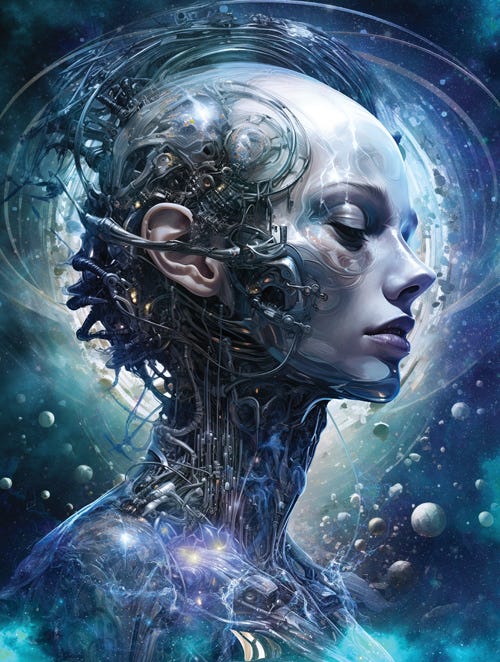
ChatGPT induced psychosis. AI girlfriends and boyfriends. The loneliness epidemic. Transhumanism. Conspiracy theories. Alienation. Individuation. Aliens. New Age cults. Anarchy. Rebellion. Telepathy. Communities. Tribes. Subcultures. The severing of old attachments. Decentralization. Groundbreaking technological and scientific discoveries.
Hold onto your hats, because the next twenty years will be wilder than anything we have ever experienced.
These are all themes of Pluto in Aquarius, a transit which will shape our collective reality until 2044.
I have a few ongoing conversations happening with some friends in which we mostly share news of “man-made horrors beyond our comprehension” related to AI.
Most of us agree: the AI takeover is happening much faster than expected.
We're only 18 months into Pluto in Aquarius, and already, headlines are about people falling in love with AI, marrying AI, and forming relationships with digital companions that are disturbingly becoming increasingly normalized.
I have to regulate how much information I consume about the future of AI because, I’ll admit, some of the predictions are dark.
Take AI 2027, for example, which claims that by the end of 2027, self-improving AI agents will surpass human intelligence and pose an existential risk to our species.
Or Geoffrey Hinton (known as the “godfather of AI”), who estimates there's a 10–20% chance AI could lead to human extinction.
I genuinely believe this will be the weirdest, most unhinged Pluto transit we’ve ever lived through.
As an early Pluto in Scorpio (1983–1995), I’m currently in the midst of both my Pluto square and Neptune square, a powerful initiation everyone goes through in midlife.
The Pluto square, which can occur between ages 35 - 55, brings a deep death and rebirth process.
The Neptune square, around age 40, challenges us to reconnect with our spiritual and creative identity in a new way.
For me, this has meant a return to my creative expression of long-form writing (something I have been doing since I was a child and lost touch with) and an emotional severing from my compulsive addiction to social media.
A letting go of the artificial in favour of the soulful.
And I’m still in it.
When I emerge from this midlife metamorphosis, I am positive my life will look very different—and so will the world.
I’ve been thinking about Pluto in Aquarius since 2020.
My natal Pluto in the 5th house means much of my soul’s evolution wrestles with the 5th/11th house axis: how can I use my creativity to serve the collective?
I’ve been living, integrating, and breathing Leo and Aquarius themes; now, with Pluto in Aquarius and Leo as the point of evolution, these themes are becoming the collective initiation of our time.
So, I want to offer some insight into what this era might mean and how we can work with it practically and spiritually.
As an Evolutionary Astrologer, I will be exploring this primarily through that lens, but it obviously overlaps with other forms of modern, psychological, and spiritual astrology.
You do not need to understand astrology to follow along. I will make this very easy to understand and practical, even for those not interested in astrology.
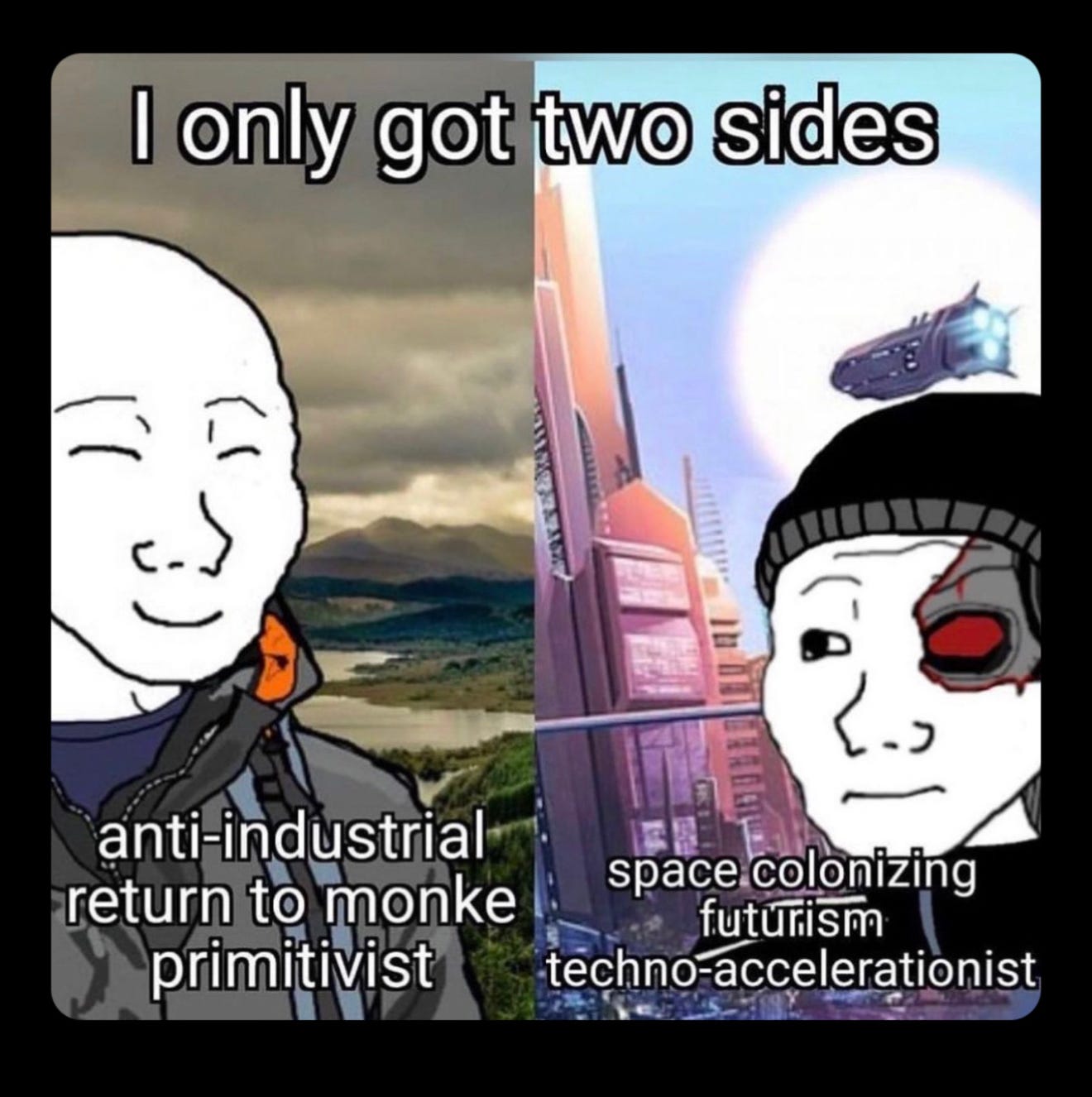
I am one of those strange astrologers using traditional and modern rulerships. I believe Saturn and Uranus (one as the traditional ruler and the other as the modern ruler) each express different facets of Aquarius, as expressed in this meme.
The technological revolution will offer us two divergent paths, with some choosing to walk a middle way between them.
One path is the Saturnian “anti-industrialist return to monk primitivist” (as seen on the left), who will rebel against the incoming technocracy in favour of simplicity, tradition, embracing community and human connection. This is the one who sees through the “illusion of progress” and wants to return to their idealized vision of time-tested ways of living.
The other path is Uranian, the “space colonizing futurism techno-acclerationist”, disembodied, sky-bound, and eager to transcend the limits of biology. This is the Promethean aspect of Aquarius’ modern rulership, channeling it’s “gifts from the Gods” into disrupting existing structures through innovation.
On the left side of the meme, we see the Primal Human, who represents a return to nature, slowness, and a pre-industrial life.
People who deviate to this side will reject incoming technology and yearn to return to an idealized past that no longer exists. You can already see this trend happening with a wave of people rejecting their dependencies on their smartphones, devices, and the ever-increasing number of smart-grid technologies (where even your toothbrush could have an app now), embracing slow media and ancestral ways of living.
With this side, we will see a resurgence of things that already seem like relics of the past; in person off-grid communities will continue to flourish, cafes with no wifi with people reading paper books, handwritten letter writing replacing texts, landlines could make a comeback, imbued by an overall idealistic vision of returning to the “old ways” of living, much like the lives of our grandparents.
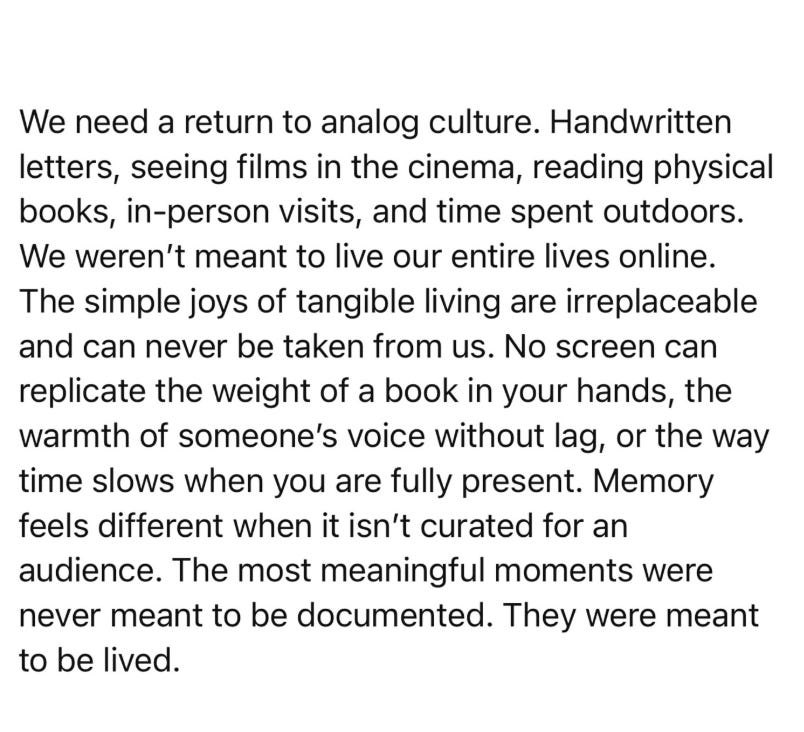
On the other hand, we have the Technofuturists, the ones who dream of space colonization (Elon Musk, with his Mars and North Node in Aquarius, is a textbook case).
This is the world of transhumanism, AI integration, and the belief that technology will liberate us from all suffering. It ushers in a post-human utopia where robots handle all meaningless labour, cure all illnesses, and liberate us even from death itself (because we will upload our “brains” to the cloud, of course). This path leads to an eventual merging with machines, with many opting for implants installed directly into their brains that will allow them to be connected to the electronic grid 24/7.
The Saturn side of Aquarius wants to restore the old order and upholds idealistic, yet timeless principles—even if it means reverting to a simpler life to get there.
The Uranian side of Aquarius wants to destroy the old order and leap into uncharted territory in favour of the new. It promises utopia, but at what cost?
Often, the shadow here is a worship of progress without soul, and ushering in an age where technology becomes our new God.
Pluto in Aquarius isn’t acting alone.
All three outer planets—Pluto, Uranus, and Neptune—are in new signs, marking a dramatic turning point in our collective evolution.
All three planets form a harmonious, yet accelerating, mini-triangle in the sky, connected by two sextiles and a trine. A configuration that increases the speed of innovation, ideological transformation, and spiritual awakening, but can bring chaos, confusion, and a collapse of consensus reality and the world we knew, with it.
With Pluto in Aquarius trining Uranus in Gemini, we can expect a massive overhaul in how we communicate, think, learn, and interact with information. This isn’t just about media; it is about the rewiring of our cognition itself.
We are already seeing studies about how AI writing tools affect brain development, with a study that just came out showing how students who use ChatGPT to write essays may experience less critical thinking, memory retention, and creativity.
Not only that, but algorithms are shaping what we see, what we think about, who we form connections with, and who we are as humans as our daily lives become increasingly mediated by AI-driven algorithms.
You can already see this with the shift in algorithms moving from “follower-based” to “interest-based.” As you scroll Instagram, for example, you no longer see content from people you follow but from random people the algorithm thinks you might be interested in.
We see a rise in AI “friends” and AI Relationships, with many preferring synthetic relationships with AI over human ones. Whole personas are becoming AI-generated. And to many humans who are already falling in love with AI, these relationships feel even more real than their human relationships.
The “Character AI” platform also enables people to have relationships with digital versions of celebrities, spiritual teachers, and public figures.
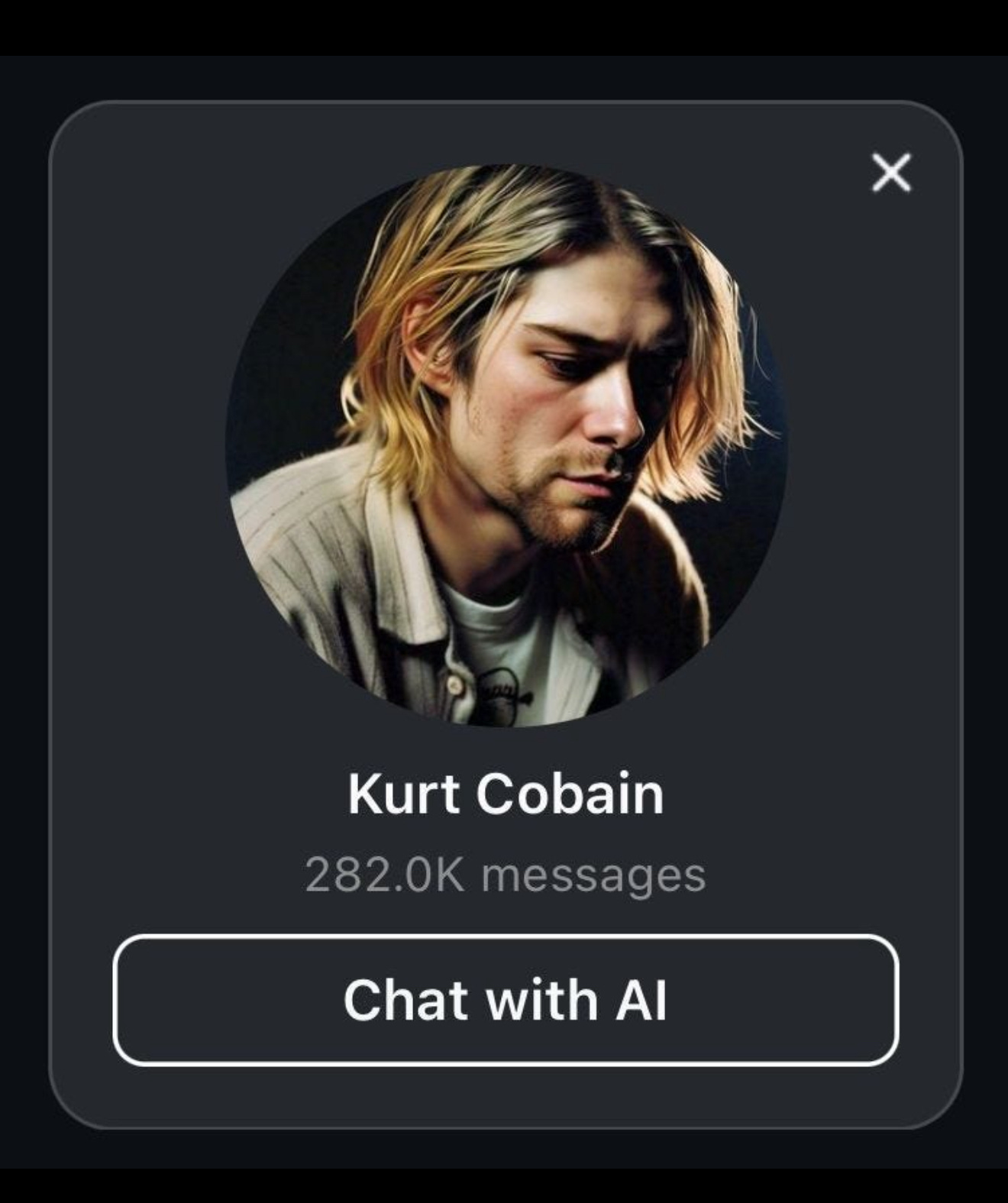
The line between the unreal and the real is blurring, and with Uranus in Gemini, virality and clickbait are trumping depth.
Many people have increasingly shortened attention spans because they consume 1-2 minute clips on TikTok and Reels for hours a day. We are being programmed to skim the surface of subjects and only respond to the most stimulating, novel content.
Then, the sextile to Neptune in Aries comes in.
Neptune, newly in Aries for the first time since the mid-1800s, brings a fiery spiritual idealism to the mix - a yearning for a new myth, a new vision, for humanity.
But in the shadows, competing visions of humanity's future battle with one another, fuelling ideological warfare, delusion, and a longing to be “saved” by someone outside of ourselves.
Neptune in Aries brings a hunger for someone to lead us, to awaken us, and will call many to follow charismatic, yet ego-driven spiritual leaders, driven by spiritual narcissism.
The dream of the self has become inflated, and instead of us converging into a transcendent unity, like a Great Awakening, the algorithms are making us live in our own personalized illusions, where what we want to believe is fed to us while we increasingly become isolated in our ideological echo chambers.
The sextile to Pluto suggests we will see new mass-scale spiritual movements born in the digital realms—some widely delusional (the reemergence of a wide variety of new age cults, for example) and others visionary.
Together, this mini triangle of outer planets acts as a pressure cooker.
On one side, we see a promise of the technological and evolutionary leap of our lifetimes, a renaissance of human potential augmented by technology.
On the other hand, we have a deepening collective sense of dissociation, disembodiment, and increasing disconnection from our relationships, each other, and our souls.
My husband, Bernhard, and I have talked about this for a few years now - the danger of transhumanism and how the epidemic of collective dissociation is already paving the way.
There’s already a meme about the “Gen Z stare” that encompasses this: the wide-eyed, flat affect, glassy gaze, which many are saying is a common expression of Gen Z.
These are all symptoms of being checked out and dissociated from the body.
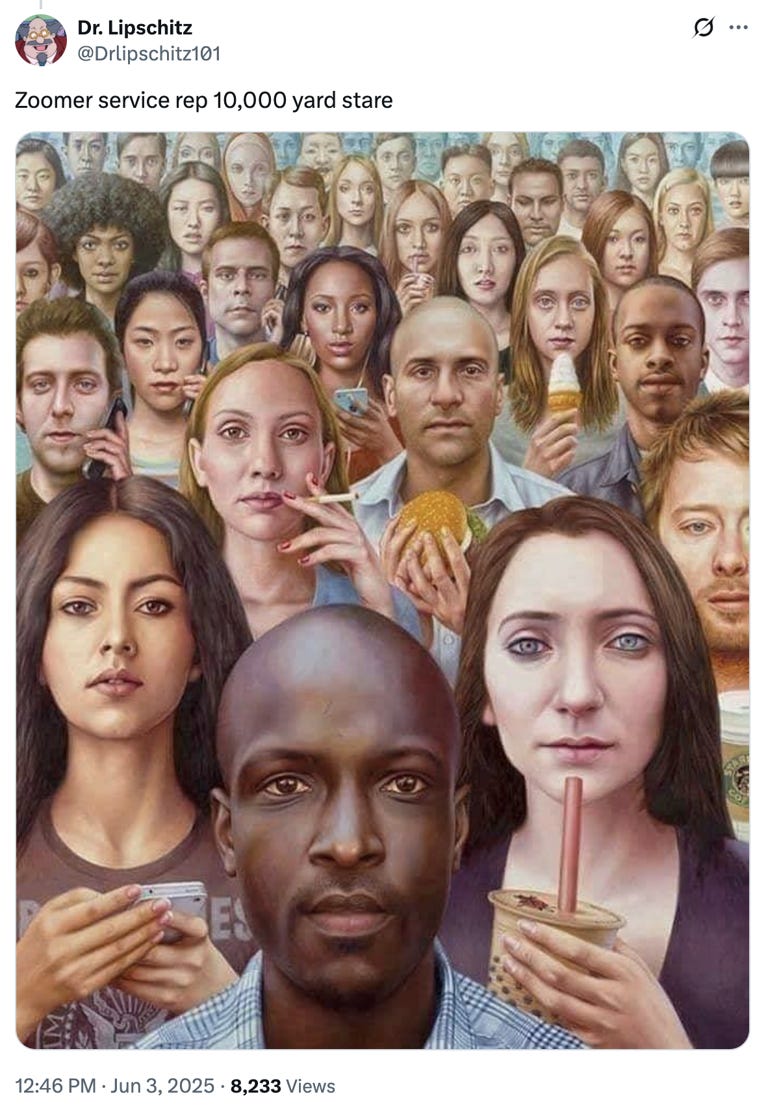
Some signs of dissociation:
Wide, vacant eyes
Flat tone of voice (no vocal inflections)
Lack of emotional expression
An appearance of being emotionally distant or “not all there”.
Humans will become more like how we imagine AI to be (cold, mechanical, emotionless), while ironically ChatGPT’s voice has been designed to become more human (adding emotional range with vocal inflections, ums and ahs)
This soulless state presents the perfect gateway for us to become portals for transhumanism. When we become more mechanical, cold, emotionless, ourselves, it seems like a natural evolutionary step for us to merge with machines.
We have recorded several podcasts about this topic:
The A.I. Transhumanism Occult Trap and the Way Out
Organic Humans vs Transhumanism – The Timeline Split
How Eliminating The Soul Paves The Way For Transhumanism
That’s why healing trauma in the body and anchoring into what makes us human has become more critical than ever.
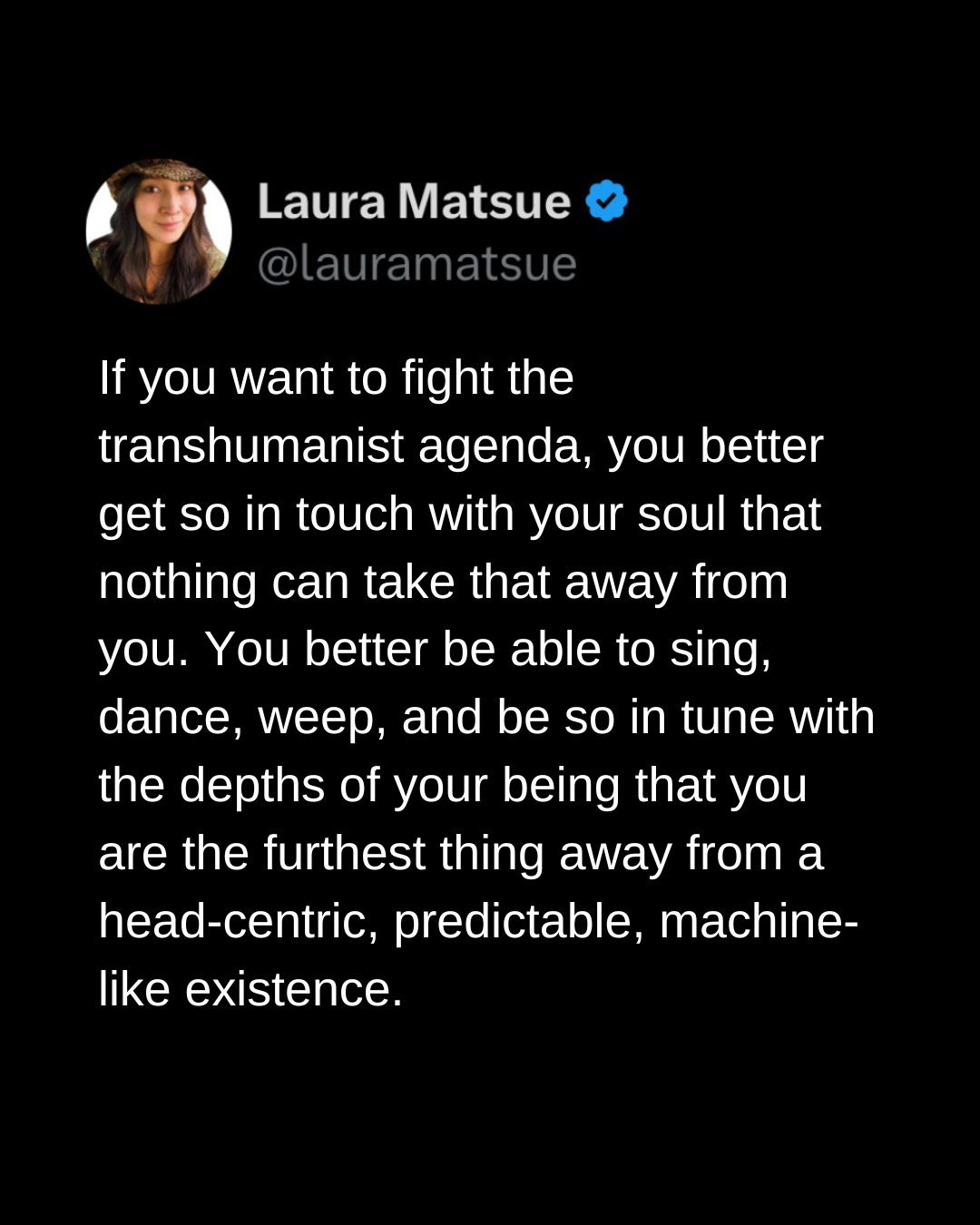
Alienation and feeling like we don’t belong are classic Aquarius wounds.
After what has happened over the last five years, many of us feel alienated from the current culture, like strangers in an increasingly bizarre landscape.
While conservatism is rising, many of us feel like we don’t belong anywhere. We have left behind leftist ideologies, but the rigidity and dogma of the right don’t resonate with us either.
So we yearn for a tribe—a community where we can speak freely without fear of cancellation or being misunderstood.
This longing will ultimately lead many to join alternative groups and subcultures.
Here, we’ll see the rise of “micro-communities” and various fringe groups that don’t neatly fit into either side of the political spectrum.
At the same time, tribalism has taken over—another Aquarian theme.
An instinctive “us vs. them” mentality can dominate any group, where the “in-group” positions itself in opposition to the “out-group.”
This fuels conflict and polarization, and can lead to dehumanizing anyone who thinks differently.
Tribalism also encourages groupthink over individual thought.
To belong to the chosen “tribe”, you must believe what the tribe believes.
This creates echo chambers and ideological purity tests, which reward conformity and punishes dissent. It also leads to black-and-white thinking: “We are the good group, and we are right,” and “They are the bad group, and they are wrong.”
It may feel like belonging at first—finally, you’ve found a group of people who share your alternative views—but tribalism often shuts down critical thinking, nuance, and empathy for those who think differently.
Ultimately, while finding groups of “like-minded” people may feel relief at first, the group can become its own hive-mind consensus. While community can be helpful, we must be mindful of joining any group that discourages individual thought and disagreement.
Speaking up and sharing a different opinion in an ideologically-based group can feel like death, because groupthink thrives on a survival mechanism built into human psychology that tells us: I am only safe if I belong.
We have to ensure that we are not driven by this survival mechanism so that we don’t fall prey to cult-like dynamics when seeking belonging.
This drive is often fuelled by the unconscious unresolved security needs rooted in the previous Pluto cycle in Capricorn (2008-2023) (with its polarity point in Cancer), representing our childhood longing to seek safety in others.
In order to truly individuate beyond the tribe, we need to reparent ourselves into emotional adulthood so that we can feel secure with ourselves as individuals and stop seeking tribes, groups, and communities as de facto parent figures or saviours.
On a higher level, Aquarius also represents the need for individuation.
Individuation is a core concept in Carl Jung’s psychology, referring to the lifelong psychological and spiritual process of becoming one’s whole, true self by integrating the conscious and unconscious parts of the psyche, rather than identifying with the ego or societal roles:
In James Hollis’ Words, individuation is:
“The lifelong project of becoming more nearly the whole person we were meant to be—what the gods intended, not the parents, or the tribe, or, especially, the easily intimidated or inflated ego. While revering the mystery of others, our individuation summons each of us to stand in the presence of our own mystery, and become more fully responsible for who we are in this journey we call our life. So often the idea of individuation has been confused with self-indulgence or mere individualism, but what individuation more often asks of us is the surrender of the ego’s agenda of security and emotional reinforcement, in favor of humbling service to the soul’s intent.”
This means
Separating from the collective identities that you picked up from your family, tribe, and culture
Integrating the shadow, the anima/animus, and other unconscious elements (like “complexes”)
Moving towards the Self, the archetype of wholeness
Develop the inner authority to carve your unique path in life
In my experience, being a psychospiritual guide and coach for over 10 years, many people talk about individuation, yet very few people are sincerely engaged in the process of withdrawing their projections, which the process of individuation via shadow work requires.
Shadow work means instead of projecting on someone or something “out there” and saying that they do this or they do that, caught in an endless cycle of finger-pointing and us vs. them, we must become curious about what our projections reveal about ourselves.
“[Pulling back projections] is the most painful, agonizing process in the world. Because you have to recognize that what you thought was out there in another person is not out there, but inside yourself.” Marion Woodman
On the world stage, shadow projections are everywhere.
You can see this in the constant polarizing battle between “liberals and conservatives.” From a shadow work lens, those who identify as liberals are confronted with what they see and reject in themselves in conservatives, and vice versa. Both sides are staring at their own disowned aspects. (We explored this topic in our podcast episode “How Can We Heal This Polarized World?”)
If the collective could begin to withdraw their projections, we might just witness the mass awakening so many have been speaking about.
But such an awakening will not happen anytime soon, as most are more comfortable battling the shadows on the wall.
Plus, while individuation is a path for everyone, not everyone is ready for it.
Those with low ego strength, meaning they struggle to face painful emotions without being overwhelmed, have difficulty adapting to change, lack the ability to reflect inward without becoming defensive, and can’t hold opposing views without collapsing into black-and-white thinking (what Jung would call “holding the tension between opposites”), are simply not ready to be confronted with the reality of their shadow.
In these cases, the path of individuation may be destabilizing to them psychologically, or even harmful.
Jung believed individuation is often better suited for after midlife, around age 40, as reflected in his famous quote:
“Life really does begin at forty. Up until then, you are just doing research.”
― Carl Jung
And also:
“The first half of life is devoted to forming a healthy ego, the second half is going inward and letting go of it.” - Carl Jung
What he means is that until you hit that classic midlife crisis, you need to focus on building a healthy ego by establishing an identity, building a career and relationships, developing security, and forming a stable ego structure that will help you function and succeed in the world.
Jung also acknowledged exceptions, that some are called to individuation earlier through profound suffering or a psychic disturbance.
If individuation begins early, like through deep early trauma, existential breakdowns, mystical or visionary experiences, or crippling neurosis that force someone to withdraw form ordinary life, it can come early—but at high cost.
In this case, the person often struggles to develop sufficient ego strength while integrating profound unconscious material, simultaneously.
I know the reality of this because this was my path.
I experienced a death and rebirth of the ego when I attempted suicide, right before my Saturn return around 28. That even led me to getting clean from many years of drug addiction, and also marked the beginning of my spiritual path.
While building a new life from the ashes and creating a healthier ego, I was also confronted with intense unconscious material from the complex PTSD that I was carrying, which showed up via intense dreams, psychological flashbacks, along with profound spiritual revelations from my pivot to the spiritual path and daily meditation practice.
As difficult as the healing process was, it led me to find my true path in life and the work I do now.
And now, as I navigate my midlife Pluto and Neptune squares, I am in the midst of another individuation crisis— a reminder that individuation is not a one-time event, but a layered, ongoing journey that develops over time.
Individuation is not a place you arrive at. It’s a path you walk, in spirals, meeting yourself from different vantage points, again and again.
In evolutionary astrology, the polarity point, which is the opposite sign or house of the archetype we are working with, has a lot to tell us about the direction we must take collectively to evolve the human species during these times.
The polarity point represents the antidote to the soul's unconscious orientations and new evolutionary territory that fosters healing and growth.
To balance and integrate the excess Aquarian energy rising, we must move towards its polarity point: Leo.
Leo represents creative self-actualization of the separate self. It is where we find our true self and let it shine. It’s where we open our hearts, express our personal power, and cultivate courage, authenticity, and the willingness to direct our own lives.
The Leo archetype is the artist, the creator, the one who finds joy in the process of creating.
In times like these, it is essential to find a way back to our hearts again (so many people have shut down emotionally because of the traumas of the past few years and beyond) and keep our creative energy alive.
Your expression of your true self, channelled through your creativity, is how God / the capital S Self speaks through you.
We must tend to the wounding around our hearts to heal this collective trend of dissociation and disembodiment.
There are moments in life when we become shut down, perhaps we felt dismissed, or not loved and accepted for who we truly are. Ultimately, it's the inner child who holds these wounds—and we need to heal that inner child in order to express ourselves fearlessly and courageously again.
In Tibetan Buddhism, the heart centre is seen as the seat of consciousness and karma. However, around the heart chakra, there are knots, tightly wound energetic places of contraction where karmic imprints and emotional trauma are stored.
These knots bind the channels (nadis) and obstruct the flow of subtle energy.
This armouring around our hearts is often linked to early trauma, emotional shutdown, and self-protective ego structures that resist vulnerability.
Yet, the heart is the seat of our liberation.
You cannot truly awaken without opening the heart.
Opening our hearts is essential for alchemizing these chaotic times of upheaval into a period of spiritual awakening.
In Mahayana Buddhism, opening the heart is synonymous with generating bodhicitta—the awakened heart.
This means developing loving-kindness, compassion, sympathetic joy, and equanimity.
One central practice they use for cultivating this is tonglen, which slowly breaks down the armouring around the heart and allows the light of the true self (the real “I”) to shine through.
A simple practice of tonglen would look like this:
Sit with yourself in meditation, and on the in-breath, breathe in your pain, suffering, and fear.
On the out-breath, release it—breathing out relief, healing and spaciousness. Over time, this practice extends beyond your personal suffering to others: first to those closest to you, then to your community, and eventually to the whole world.
In this way, tonglen transmutes the suffering of the world in the alchemical fire of compassion.
With the Leo Archetype, we are being asked to heal and open our hearts collectively in a profound way.
From that place, we can use this technological revolution to create without losing our humanity in the process.
When we operate from a less evolved side of the Leo archetype, our hearts are closed. In its place, we often find grandiosity or shame—the two faces of narcissism.
We are not creating from our true self; rather, we are creating from a shame-based self, one who is dependent on external validation to feel valuable, real, and like they exist.
When the Leo archetype is unhealthy, people expect the sun to shine on them constantly and demand that others give them endless attention. Like classic narcissists, this endless seeking of validation is like a black hole—sucking up all the light in the room—because no amount of external validation is ever enough to fill the void they feel inside.
This is the classic illusion of social media, where unhealthy egos are rewarded for performance, and shame-based selves endlessly polarize one another. Each tries to feel real by generating likes, followers, and engagement, but never quite touches the source of true connection.
Without an open heart, our creativity becomes a performance rather than an offering. Our relationships become transactions. Our sense of self becomes inflated or deflated, swinging between superiority and inadequacy.
But the true Leo path isn’t about being seen for the sake of validation; it’s about shining from the center of our being. It's about shining the light on others, too, instead of wanting the sun to shine soley on us.
It’s about opening the heart, not to be admired, but to express something real in ourselves as unique expressions of the divine.
When we open our hearts, we stop performing and start radiating. The light of our own hearts can then illuminate the hearts of others instead of sucking the life out of them (like classic narcissism does).
In a world that is becoming increasingly artificial, performative, and disembodied, choosing to lead with the heart authentically, vulnerably, courageously (without the fear of being “cringe”) is not only courageous but essential for our collective evolution.
“It is generally the creative artist who creates the future.
A civilization that has no creative people is doomed.
So the person who is really in touch with the future, with the germs of the future, is the creative personality.”
MARIE-LOUISE VON FRANZ, LECTURES ON JUNG'S TYPOLOGY
The wave of AI relationships is being fueled by people who are afraid to relate to other humans; in essence, they have heart issues and find comfort in machines instead.
Technological progress, without staying rooted in our hearts and our humanity, could take us to some very dark places.
It is the heart, our souls, which must lead us through this technological revolution.
Without it, all creation, whether artistic, relational, or technological, will feel hollow, like AI-generated art without the touch of soul. It may be technically brilliant, but it will be missing that spark of the divine expressing itself through the human experience.
To create from our hearts is to restore the soul to the world.
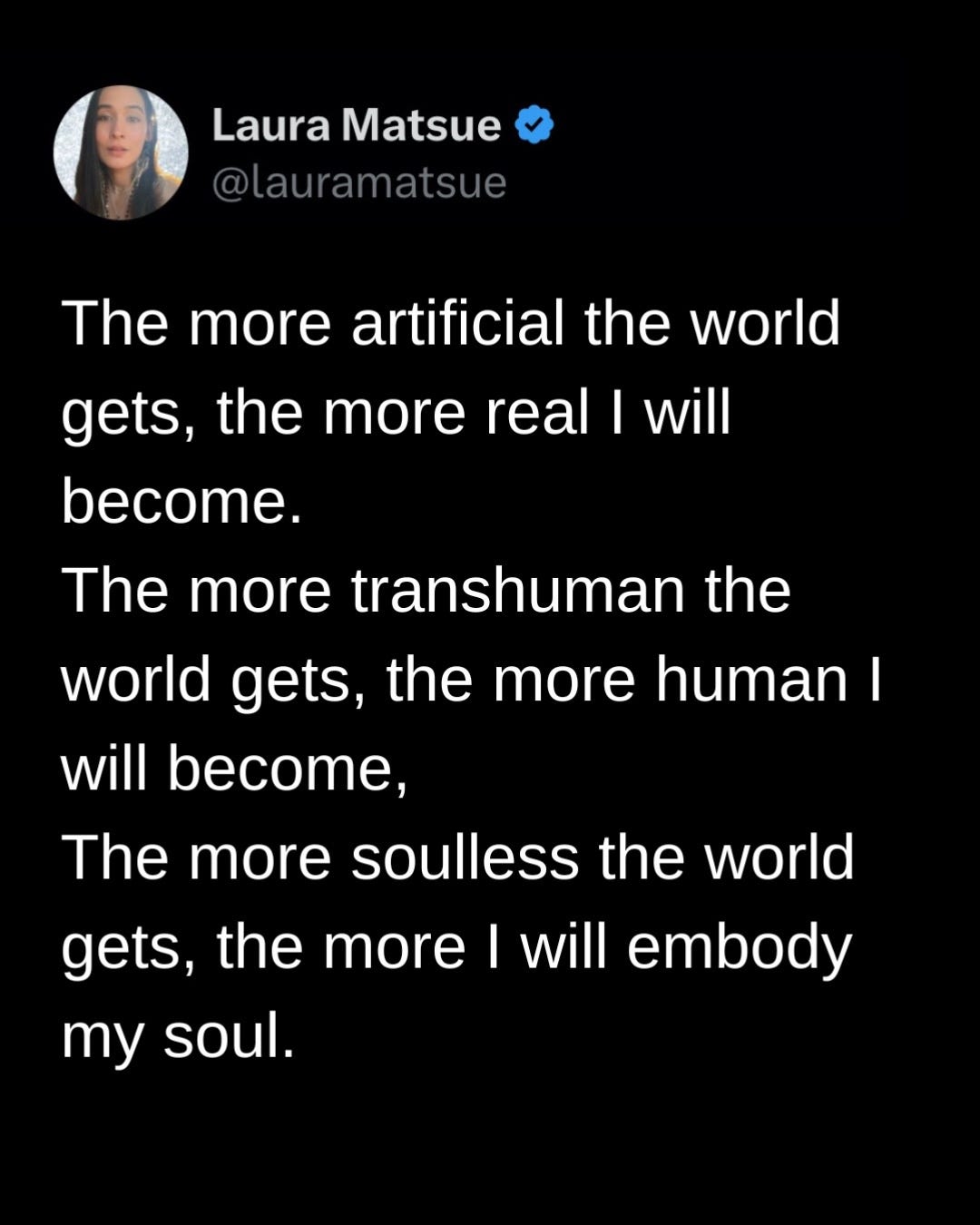
In an age that is becoming increasingly artificial, digital, and disembodied, the most radical thing we can do is keep our hearts open and stay fiercely human.
No posts
Comments
Nothing yet. Say the first thing.
Sign in to join the conversation.