
Niche ID is about the choices we make when we build for creative life. It explores non-linear journeys, cross-category concepts and the lore of the modern niche.
Get it on Apple here.
The oral tradition’s in our DNA. And that’s why this conversation with Professor Leigh Wilson, in the School of Humanities (English Literature) at University of Westminster feels so special.
Leigh is co-editor of Contemporary Women’s Writing and she works on modernism, the role of publishing in literary culture, and the experimental novel through the 20th century. She also co-runs a project on the Contemporary Small Press at Westminster.
This work brought Leigh together with audio producer, Kate Bland, to found Spiracle in 2022, an independent literary hub specialising in audiobooks, articles and podcasts.
I discovered Spiracle last year when I bought Enid Bagnold’s The Squire as an Audiobook in a Card for my sister’s baby shower. It was the last hour in Walthamstow’s The Every Space. Six had already smashed a terrarium (the owner was very gracious) so spotting the right gift at the right time, right after that, rebalanced the scales of the universe.
In this episode, Leigh shares her own “right book at the right time” gifting story, plus a professor’s persuasion for readers to engage with audio text for a “deeper, immersive experience.”
And to that point, don’t just read this one. Enjoy listening, and let me know what you think.
For the sake of continuity back in episode 10 of the podcast/newsletter, I said I’d revisit a thread about ‘podfade’ and consistency when we hit episode 21.
Sounds arbitrary, but Spotify’s Riverside stats show that if a podcast reaches episode 21, it finds a strange place among the top one percent of podcasts worldwide, simply by its virtue of continuing to existing. We’ve now made 24 episodes. Well done Niche.
I’ve never outsourced my production or editing. There’s just too much to be learned by doing it myself. That said, even just releasing an episode a fortnight, (alongside my actual paid work) takes a lot of time and energy.
I may well wrap this series after episode 11 and then return with a third series (perhaps with funding or sponsorship) later this year or continue at a monthly, or TBC cadence.
Sidebar, but I’m listening to Sam Pamphillon’s reading of psychoanalyst Adam Phillips’ 2025 book, On Giving Up on the Spiracle’s Podcast at the moment. It’s a literary and philosophical examination of choosing our futures, and what we must give up (sometimes temporarily) to feel more alive. Always the long game.
Again, let me know what you think and we can settle on a plan after Niche’s 25th episode (Season 2: Episode 11), later this month.
Below, some choice themes (lightly edited) from our audio conversation.
I was aware from my work on modernist writing that small presses were incredibly important in the early 20th century, in actually getting authors’ work out to be read.
After the first couple of her novels Virginia Woolf was self-published, and together with her husband they set up their own press, Hogarth Press, which published the rest of her novels.
James Joyce’s Ulysses was published in Paris by Sylvia Beach [in 1922, Joyce’s 40th birthday]. Beach owned a bookshop there and basically set up a publishing company to publish it. That kind of do-it-yourself ethos was really important.
Radio sound producer Kate Bland, got in touch with me because she found the Contemporary Small Press website [a project Leigh was working on at Westminster to research and support independent presses in the UK]. Kate had produced a couple of audiobooks for independent presses and it made her realise how difficult it was.
This was in 2020. Audiobooks were a flourishing way of engaging with books and yet it was really hard for independent presses to get a foothold in that world because of the difficulty of dissemination and distribution.
It’s easy enough for an independent publisher to get an audiobook made if they can get the funds together. It’s easy enough for them to put it on Audible. But nobody will ever find it.
And actually, I think that’s not just a problem for independent presses, it’s a problem for the bigger presses and big publishers as well.
As users of Audible know, it’s fine if you know what you’re looking for, but it’s really not the place to browse. The discovery piece is still missing.
With Spiracle, we started off thinking: how can we support independent presses in entering the audiobook market? The idea of Spiracle was trying to reproduce the experience of browsing in a bookshop.
There’s been this shift in the status of audiobooks over the last number of years, particularly since the pandemic. Earlier in the century, it was definitely the case that people listened to audiobooks if they didn’t really like reading, if they weren’t readers, or they couldn’t read because they were visually impaired. But actually, that’s really changed.
It’s still a really important way of accessing books for people who are visually impaired but now people who see themselves as keen readers are fans of audiobooks as well.
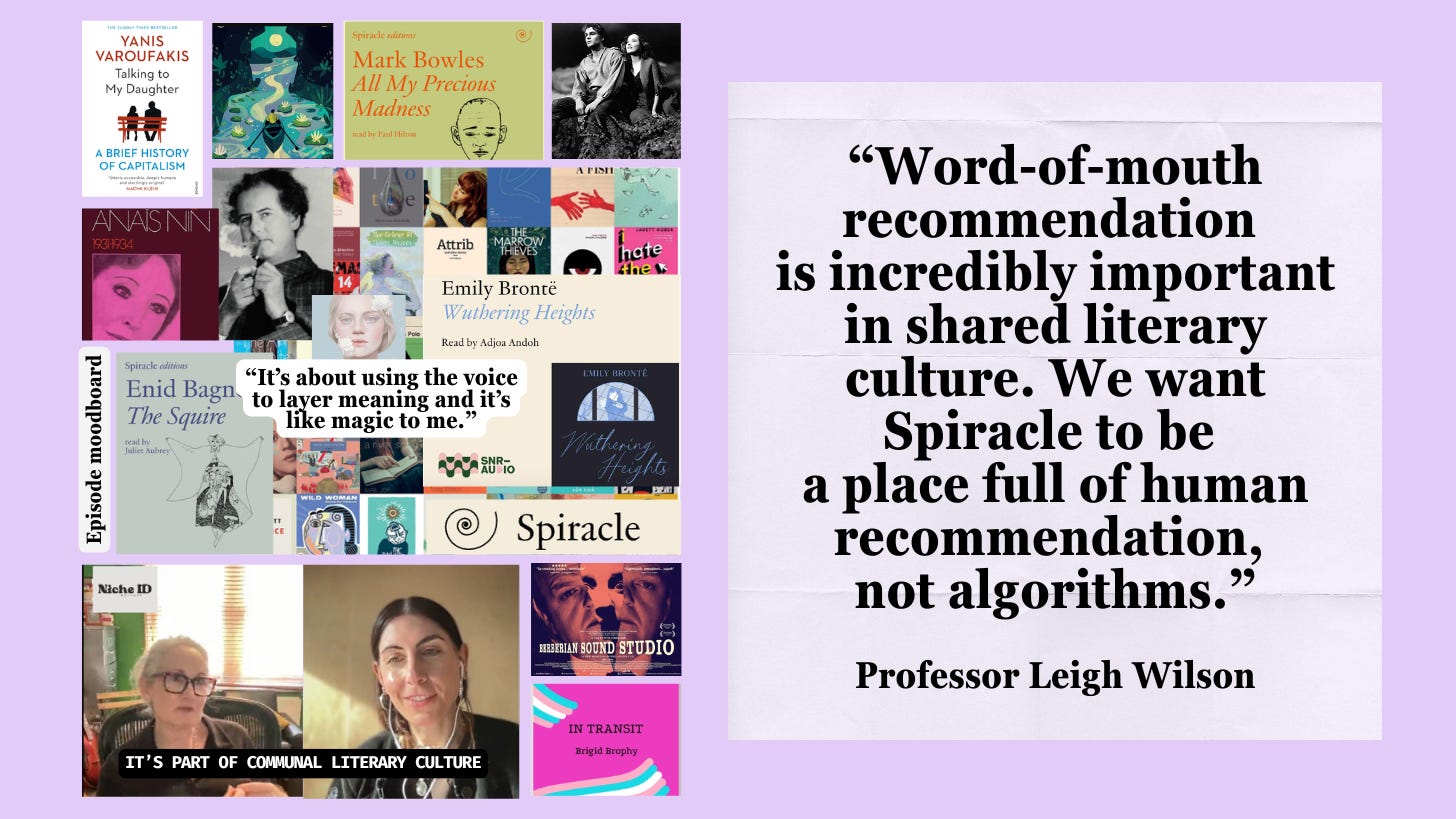
Word-of-mouth recommendations are incredibly important in book culture and that’s part of that communal literary culture. We wanted Spiracle to be a place that was full of human recommendation, not algorithms.
“Spiracle wants to bring audiobooks into shared, vibrant communal literary culture.”
I’ve recommended to my students for decades that they listen to books, even when it means having to go and borrow CDs from the library or even cassettes.
Particularly when I used to teach modernism, I’d say, “listen to it.” And it really did transform their experience of those books. Obviously they’re English literature students, so they were slightly embarrassed. It was like they didn’t want to admit that they’d actually listened to a text. Now, that’s really changed.
Most of my friends, for example, read books and they listen to audiobooks. Sometimes they’ll swap between those two different mediums in reading one book. I think that’s more common now. And the fact that people do that, suggests that they’re not seeing a massive chasm between those two experiences.
“I’ve recommended to my students for decades that they listen to books.”
When you’re reading a hard copy of a book, you know where you are in that book. You can see how many of the pages are either side, and you can place yourself spatially within the physical copy of the book. It’s much harder to do that on audio because you’re not able to orient yourself spatially.
Plato worried that with the dominance of writing, people wouldn’t remember things anymore. For him, hearing things was the way to remember them, not to see them written down. But I guess we’re so absolutely people of print now, that it’s the other way around.
Maybe it depends on how old you are too. I know my sons, who are 19 and 21-years-old watch loads of long stuff on YouTube. Just people talking about stuff. And honestly, I can barely listen to it because it seems so unstructured. But they absolutely can. They remember it and they remember where they are in the conversation and what happened. Maybe there’s some sort of habituation to it.
I think the reader [the narrator of the audiobook] is really important. Until I met Kate and I started to work on this, I would have said that I didn’t really believe it made that much difference.
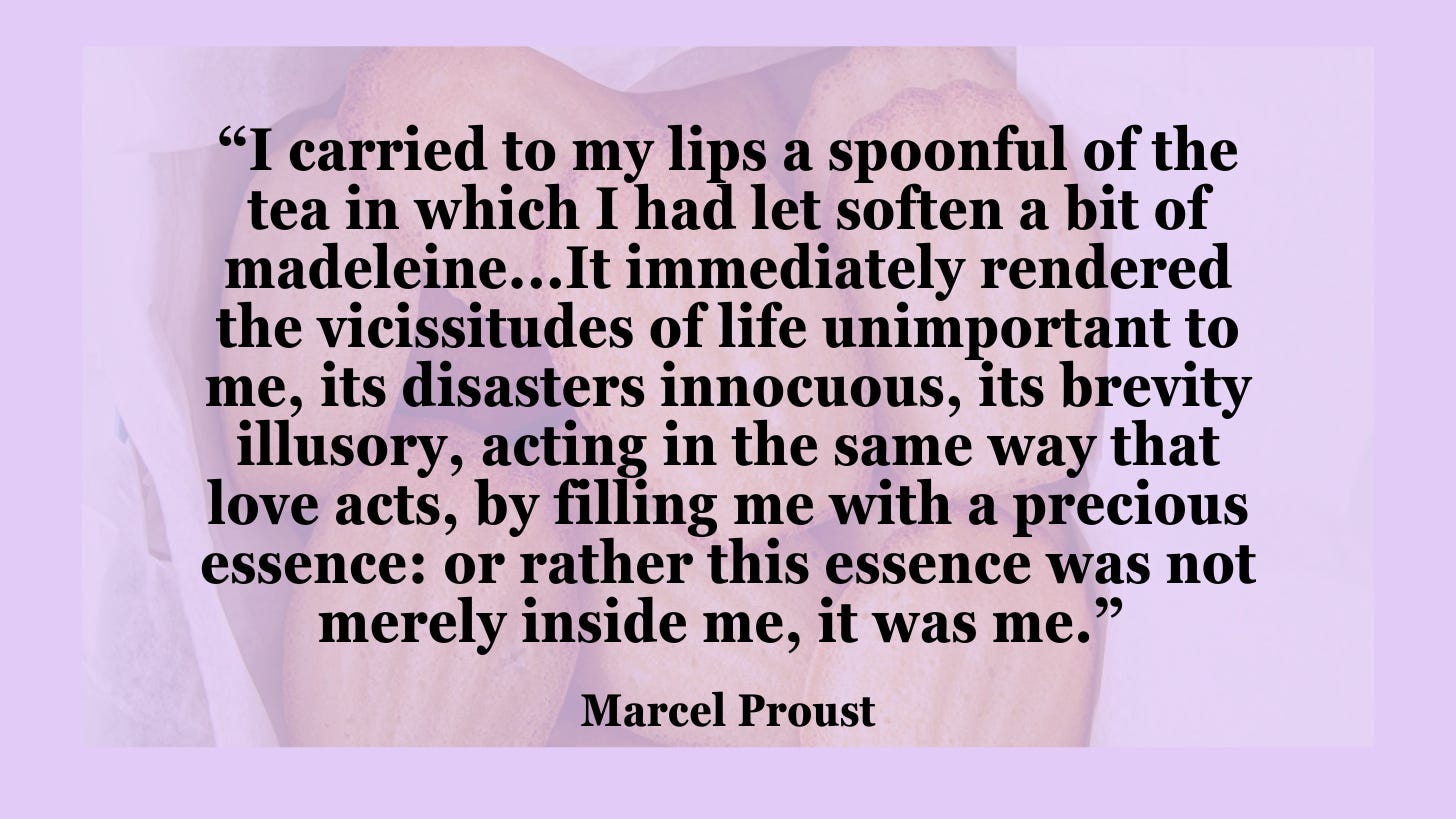
But we had an event a couple of years ago in-person and the brilliant actor Fiona Shaw, read as a way of showing the power of reading things out loud. She read the madeleine scene from à la recherche du temps perdu [In Search of Lost Time]. Honestly, it was the most extraordinary thing I’ve ever heard. It was just amazing. It’s about using the voice to layer meaning, and it was like magic to me really. Now think it absolutely can change your sense of a book, particularly novels.
There are so many brilliant actors who are brilliant readers [narrators] of audiobooks. Obviously, authors can read their own books. And sometimes that works, sometimes it doesn’t.
There’s something about being mesmerised by a voice. It takes us back to being read to as children or told stories. When there is a single voice, it’s much more intimate and there’s a proximity rather than a distance.
A few times, independent publishers have sent us something that they’re going to publish and asked if it would make a good audiobook, and it just wouldn’t work. Particularly, more experimental writing and particularly if typographical experiment is important, it’s really hard to convey that in audio. A slightly blunt example, but how would you narrate a blank page?
One day, I’d like us to try and do a more challenging novel, and turn it into an audiobook.
There’s one novel that I think about quite a lot in terms of whether you could make it into an audiobook. It’s Brigid Brophy’s In Transit, 1969, but it’s been recently republished and it has a lot of puns. Puns that work because you can see one meaning in the way it’s spelt on the page, but you can hear another one. But it will be the other way around in an audiobook. You could hear but you wouldn’t be able to see the typographical joke.
[N.B Personal recommendation, but dropping Peter Strickland’s 2012 psych-horror film, Berberian Sound Studio, here as a great, underrated cinema reference for unsettling visual/audio puns. The band, Broadcast, soundtracked the film and while you don’t ‘see’ the puns unless you watch the movie, the soundtrack’s here.]
Spiracle’s Audiobook in a Card is a physical greetings card you give as a gift.
Now, audiobooks used to be sold in bookshops when they were on CD or on cassette. But obviously bookshops have been separate from the world of audiobooks since audio became a [non-physical] digital product. It’s a way of bringing audiobooks into the physical world and of bringing bookshops into the world of audiobooks.
Audiobook in a Card is part of a communal literary culture because if you give a gift to someone, it’s a recommendation. It’s saying, “I know this title, I know you and I know that you’ll love it.”
The book that I gave away that means the most to me, was to my older son. He didn’t read when he was a teenager. We’d always read to him, we’d always given him books, but he didn’t read.
I bought him Yanis Varoufakis’ book, Talking to My Daughter about Capitalism. He loved it. And now he’s studying economics and he’s a massive reader. That was the right gift: the right book, the right moment.
We want to be able to give people a way of discovering books in a way that’s meaningful to them. A lot of this is about making connections. People think of listening as private, but actually it’s part of a wider communal experience.
Spiracle does a lot of in-person events and that’s another way of bringing audio books into this communal literary culture. Publishing is a mystery to most people. And one of the things we really want to do is to talk about publishing and what it is and what happens, what it means and how it could be different.
Last night we had an event about the publisher Peter Owen, who was a really important publisher between the 1950s to the 70s. We were thinking about him as how it relates to the experience of independent presses now and what they might be able to learn.
There were people there who said in the Q&A, “I don’t know anything about publishing, but I came because I want to know.”
People want to know how a book gets made. Who decides what to publish? What are the principles of selection in deciding? It’s about opening up what has, so far, been a mysterious world to many people.
I wrote about Wuthering Heights a few months ago. And whatever one may think of the film, if it gets more people reading and listening to it that’s a very good thing.
The voices who are telling the story in Wuthering Heights are really strong and central to it. There are two narrators, Lockwood and Nelly Dean and obviously when that’s on screen, those narrators disappear almost completely, but listening to the story as it’s told will transform people’s experience of it.
My other recommendation is a novel which we co-produced with the independent publisher, Galley Beggar Press. It’s Mark Bowles, All My Precious Madness. It’s a fantastic novel, funny and clever and read by Paul Hilton. In fact, it won a best literary fiction prize for audiobooks from The Speakies awards, which started last year.
I’m a strategic copywriter and podcaster. I’ve worked with brands including On, Condé Nast and Skin+Me. Check out my website. You can reach out on Substack, or message me here.
No posts
Comments
Nothing yet. Say the first thing.
Sign in to join the conversation.