
Niche ID is about the choices we make when we build for creative life. It explores non-linear journeys, cross-category concepts and the lore of the modern niche.
Get it on Apple here.
Hello! The new season’s back and full of conversations worthy of 1x speed. Expect experimental ideas that make sense, no-strategy strategy and guests you wanna make friends all at a sustainable monthly-ish cadence. Thanks for getting it <3
Creative advisor and entrepreneur, Kel Rakowski ( of @h_e_r_s_t_o_r_y) joins me with her dog, Mishka, at home in Brooklyn to talk about her three pillars of focus: creativity, process and taste.
A self-identified “late-bloomer,” Kel’s personal story starts with making friends on the internet, and spans coming out, founding (and selling) a multi-million dollar business, losing her creative self, finding her creative self and growing her Popular Substack to 10k+ 📈 subscribers.
But no hero’s journey happens overnight. Kel spent two years playing with her output before she honed her focus. Her style of research-as-creative-practice is unguarded, honest and full of practical advice that’s grounded in her own obsessions. She calls it, “Getting to know yourself to get to know your work.”
TLDR: You start by committing consistently to the creative work, any creative work, and the self comes next.
Below, some choice themes (lightly edited) from our audio conversation.
I grew up five hours north of New York City in the 80s. AOL dropped when I was a teenager and I was like, ‘My God, I’ve been waiting for this my entire life.’
As soon as I had access to talk to other young people that lived anywhere else besides where I grew up, I could start to find community for myself.
I was in the music chat rooms and I’d meet up with new friends to go to shows in Syracuse. Immediately, I saw this was my place and I was staying up until 3am talking to friends in California.
I convinced one of my best friends [who I met online] to go to the same art school as me, and the first day of class was the first time we met in person. I’m very comfortable making friends online because I’ve been doing it my whole life.
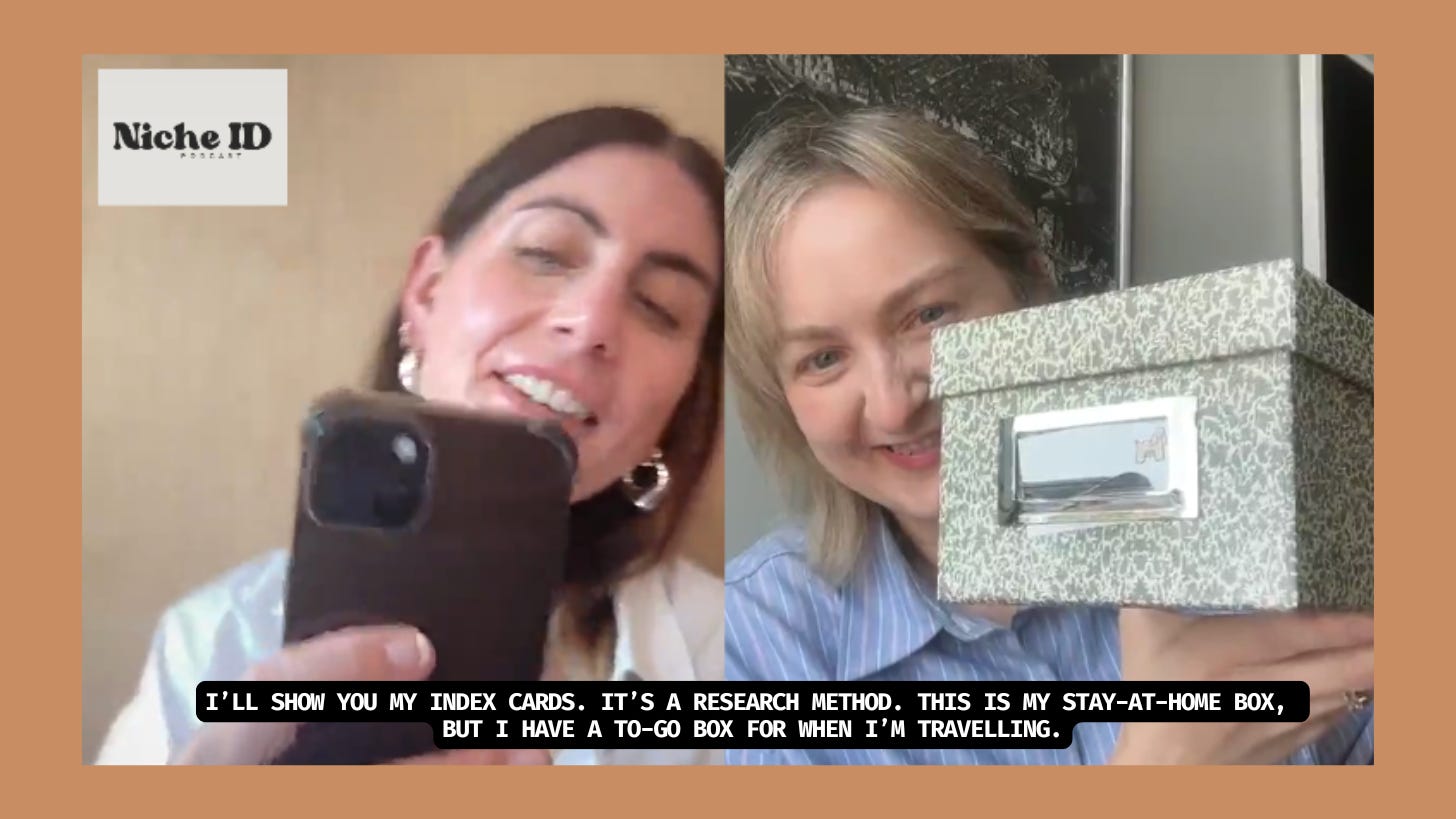
If I’m using the digital, I want to make sure I’m using the tactile as well.
When I started the @h_e_r_s_t_o_r_y Instagram page, I was just posting pictures of historic queer culture from the 40s to the early 2000s and people were calling it an archive.
And I was like; this is not an archive. This is an Instagram page of images. This is owned by a company. It’s not lasting. What happens when this technology is out of date?
To me it’s just pictures on the internet. You can enjoy them and interact with them, and learn and take it in your own direction. I think of it as a starting point.
“The real archives are offline and not owned by a company.”
Paper still has such high value. I want to encourage more people to start taking time to actually make a book of what they’re seeing on the the internet, but also gathering things offline too.
[Kel created Lex, the LGBTQ+ social app. It was acquired in 2024, grew to over a million users, and raised $7.2 million.]
When I moved from art into the tech and VC world with Lex, I was jumping in the deep end.
I moved from working at a small independent magazine, to managing people, running a company and pitching. There were parts I liked, but most of it wasn’t a fit for me.
I can give my best self in the very early days because if I have an idea, I’m gonna make it happen. And then once it’s in the world, I’m not really interested.
I got off track from what I loved. So, for the past few years I’ve just been getting back to the the place of just having an idea and making it happen.
“It’s all about trusting yourself, even if you’re not cut from the same background as other people in business. You need to own your story.”
The Popular Substack took off in March when I wrote a post on digital image archives. It helped me understand that other people are also into my weird obsessions. And that’s when I reframed everything.
I was like, okay, I’m writing about creativity, process and taste. That’s my beat. I love it. And it’s a bit about self study, getting to know yourself. So it’s coming a lot from my own experience.
Doechii also reads and subscribes to Popular. I’d written about her creative process because I was inspired by her album that won the Grammy [Alligator Bites Never Heal].
One of my top performing posts is about her process and she must have found it from that. She’s got a burner Instagram and talked about Popular there, I think some of the growth came from that.
Your creative practice doesn’t have to be public. It can be just for you.
An easy place to start is have a consistent routine where you draw or write every morning. You can still have your freelance job, but also have fifteen minutes every single day where you build it into your life.
You don’t need to build a Richard Serra sculpture and time’s gonna go by anyway. If you make one drawing a day for a year, that’s hundreds of drawings. Something will come from that.
“To attract an audience, you have to be literal. Just close the gap.”
There’s tons of conversations about niche now but I honestly find comfort in having three words that I can fall into. It took me a long time to find that focus.
Niches might come in and out of your life. You might have a niche for ten years and then that morphs into another idea. But somehow the thread is you and you’re gonna find your way. For me, that’s really grounding.
My three lanes are creativity, process and taste but I also talk about friendship, learning about yourself and building your own business. Things just grow from that.
If you’re trying to attract an audience, sometimes you have to be literal. Just say exactly what you’re doing, it really helps. Just close the gap. Readers can look at your bio and within two seconds, they know what you’re about.
I’m a strategic copywriter and podcaster. I’ve worked with brands including On, Condé Nast and Skin+Me. Check out my website. You can reach out on Substack, or message me here.
No posts
Comments
Nothing yet. Say the first thing.
Sign in to join the conversation.