
Niche ID is about the choices we make when we build for creative life. It explores non-linear journeys, cross-category concepts and the lore of the modern niche.
I’m pressing send from the mountains in Chamonix, the land of trail vests and eye jackets, where all those little ritualistic rules that make so much sense at home (treadmill running, cereal for breakfast, default online shopping etc.) suddenly feel ridiculous.
This piece has lived in various iterations a while, but it’s worth setting free before August fades, Equinox rises and we all head home to alt-altitudes, changed but the same, back to all those little annoying reinstated rules we set for ourselves come autumn.
I’ve got some fresh niche conversations lined up for September too. Watch this space.
“The best storytellers are fans first.”
Asad Ayaz, Disney’s chief brand officer
A portal is a two-way door that either side of any (interdisciplinary) world can pass through, bringing opportunity for both sides. Leveraging fandom across intersecting (sub)cultures, is a powerful way to build one.
Fans have commonalities with collectors but fandom tends to be more community-oriented and generative.1 Take sports. Research shows 86 percent of fans watch sports to help them feel part of something.2 And 49 percent of new sports fans became fans in the first place through shared stories of fan-created content.3
The act of generative fandom (your zine, documentation on social feeds, fan-fiction etc.) can become a portal that attracts others when you share it because your vision, your inspired interpretation of ‘the thing’ has its own form of memetic energy.
Even if (or in most cases, in spite of) the centre of that ecosystem being seemingly out of reach, generative fandom leads to greater intimacy, and often builds a portal to new worlds by-proxy.
“If you love a thing, you need to be part of it.” Sj Hockett told me over coffee. “It’s like old punks trading mixtapes or going all-out for records that are super hard to find. You might not be directly interacting with the band or the source, but you’re just trying to grab what you can.”
Sj created IRL Sports without a commission from the corporate sports world. And that’s kinda the point: riffing off an ‘unofficial’ or ‘unsanctioned’ creative direction is in the DNA of generative fandom.
Using fandom to refine your unique POV (in Sj’s case: sports, cycling, representation) builds the door between access that might feel out of reach and worlds that, with compounding commitment, want in on yours.
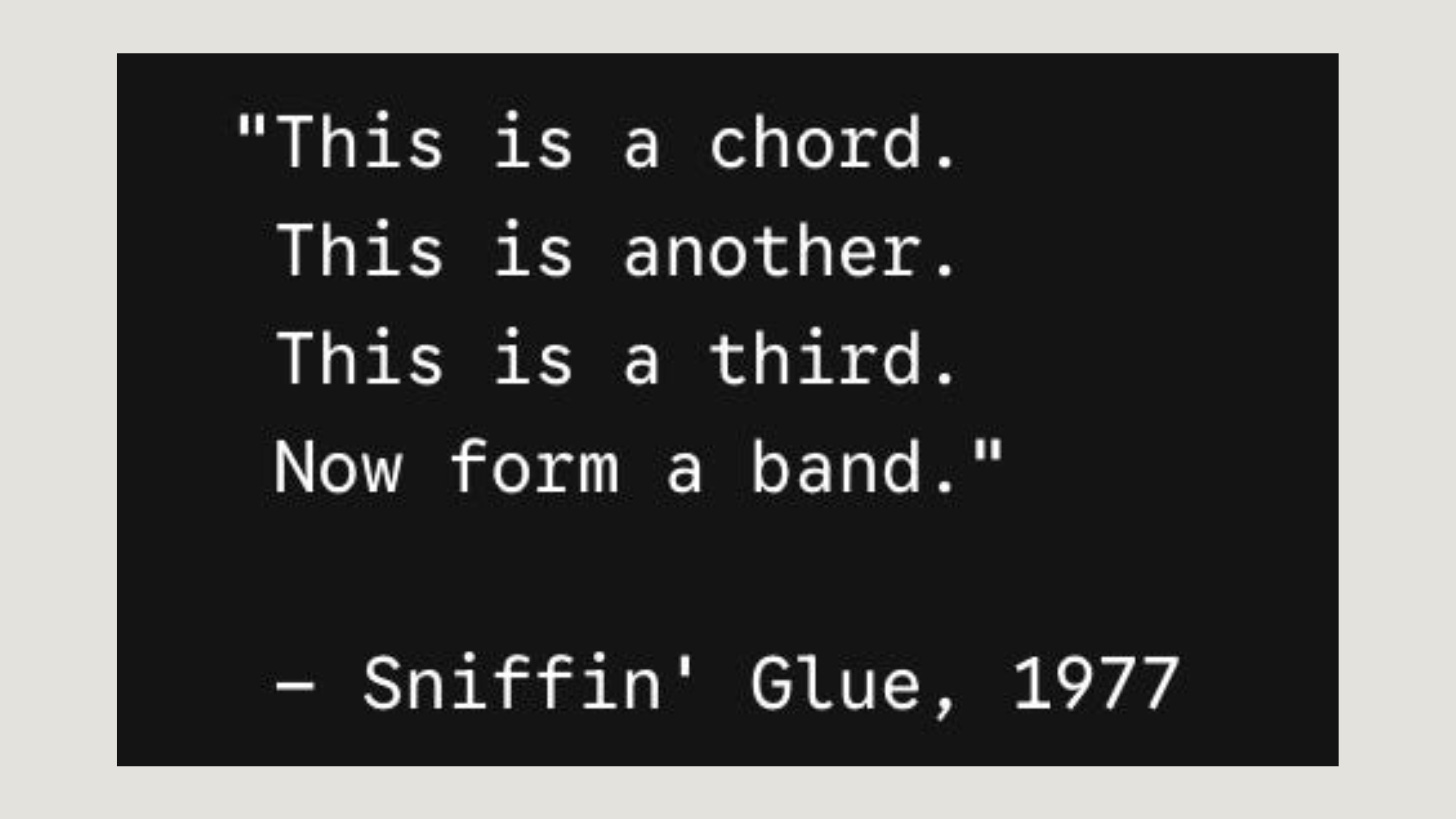
Sj “stole” her zine’s tagline from 70s punk phenom, Sniffin’ Glue. And there’s a thread here: Sniffin’ Glue was a 1976 zine ultimately about punk-as-inspiration itself. Zero gatekeeping and more ‘here’s how to feel part of something.’ Fandom as belonging.
Sniffin’ Glue’s founder, Mark Perry, quit the zine in ‘77, fearing absorption and/or exploitation by the mainstream press. In just 12 issues, he’d established himself as a critical tastemaker, all without a single legacy institution asking him to be in the room. The zine built a portal, and IMO its most compelling legacy was born through championing fandom at its most generative.
Perry both documented the (chaotic) structure of the scene and built an instruction manual for future counter-institutions. This simple, singular advice sums up the zine’s ethos, “This is a cord. This is another. This is a third. Now form a band.”
Note that true generative fandom is abundant. Sure, it can make money (the concept of ‘selling out’ is complicated in 2026) but it’s also an antidote to extractive ‘fame’ or modern virality as an end-goal to be monetised in and of itself.
Sj’s portal-building started with screenshotting Eurosports and culminated in media access across the world’s most prestigious bike races. Similar stories of generative fandom show up repeatedly across Niche ID guests and conversations.
Photographer Ben Rayner reviewed CDs as a teen in his bedroom before he captured the metal scene from inside, “I just started with things I had,” he told me. “And it quickly snowballed from there.” Kel Rakowski wrote (as a fan) about Dochii’s creative process, and it blew up her Substack. Jessie Hyman researched fandom at Spotify and came to the conclusion, “There are so many different versions of fandom,” and the portals you can build from just wanting to feel part of something are infinite.
Increasingly, the portals we build through generative fandom are more diverse and powerful than the legacy playbook of institutional access. The (once, anti-establishment) DIY approach has evolved as both a creative choice and as a necessity. True generative fandom still leaves portals open for others to join in the spirit of belonging.
And that’s the point. Generative fandom’s open to all. Portals of opportunity and connection increasingly appear when you start from where you’re at. Remember, you get a pass if you create.
Ofc the word ‘generative’ here isn’t referring predictive models or AI. It’s more about having the ability to produce or originate new life or ideas from a source of inspiration that’s unique to your own passions and POV (in this case, fandom for ‘the thing,’ be that sports, music, celebrity etc.)
Gen Z report from ACC Intelligence. Fans make fans, who make fans etc. srs you can’t move for a flywheel round here.
Let’s work together
I’m a strategic copywriter and podcaster. I’ve worked with brands including On, Condé Nast and Skin+Me. Check out my website. You can reach out on Substack, or message me here.
No posts
Comments
Nothing yet. Say the first thing.
Sign in to join the conversation.