
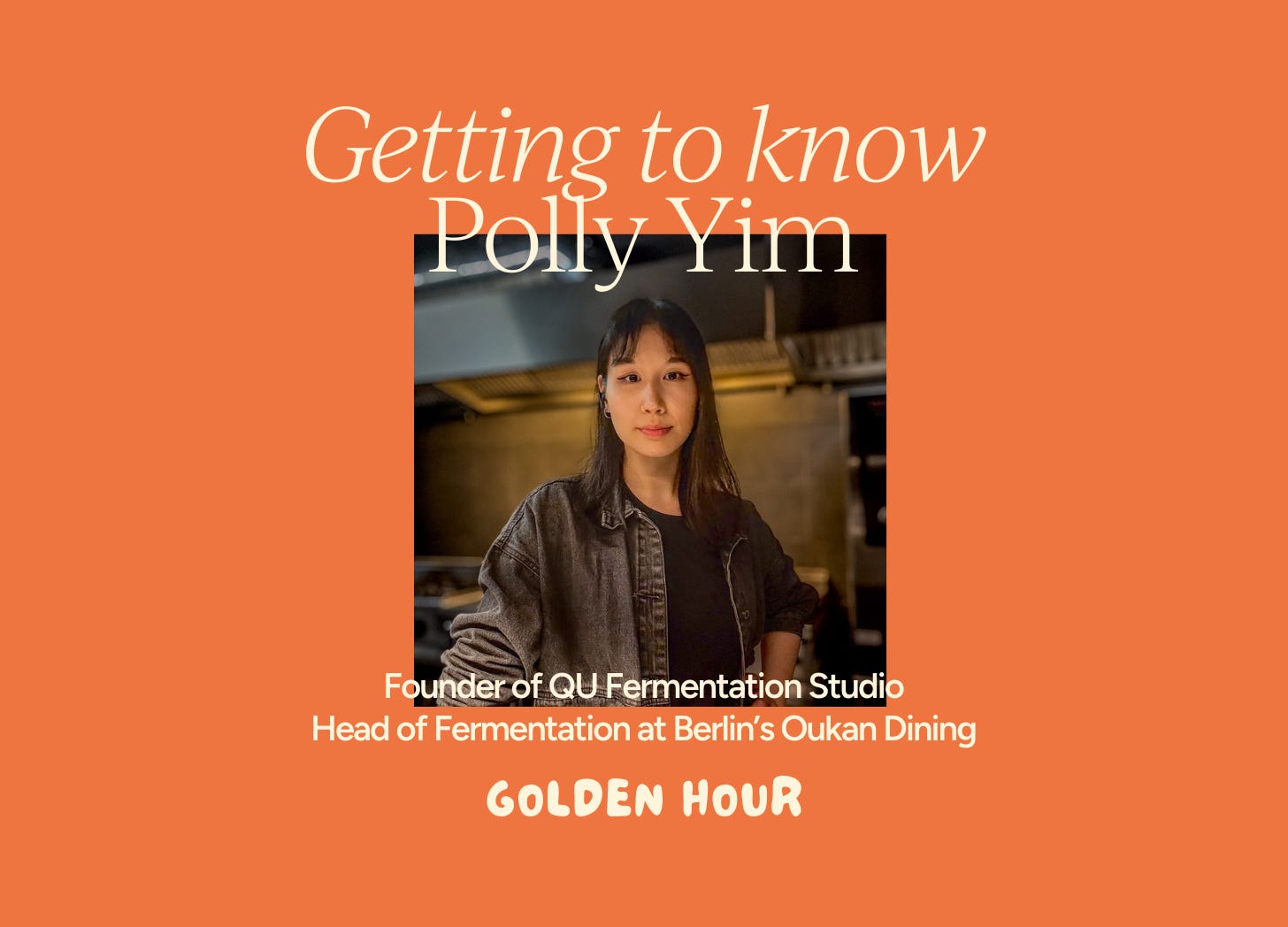
This interview kicks off a new Golden Hour conversation series spotlighting Asian diaspora chefs, mixologists, hoteliers, storytellers, tastemakers, and creatives — sharing both the hard truths about Asian representation today and the joy, pride, and complexity of shaping it.
As a city that attracts the bold and self-expressive, it’s no surprise that Berlin has its fair share of fascinating people — and Polly Yim is absolutely one to know. As the founder of QU Fermentation Studio and the creative and technical mind behind Oukan Dining’s Fermentation Lab, she’s proving that fermentation isn’t having a comeback, because it certainly never left. And no, we’re not just talking about kimchi and sauerkraut.
A bit of backstory: I met Polly at a makgeolli workshop she co-hosted with Haru Project last year in the stunning dining room of Oukan Dining, a Japanese-inspired vegan fine dining restaurant in Berlin’s Mitte neighborhood. It felt less like an event and more like being invited into her home, as she shuffled in and out of the kitchen in her apron, preparing personal banchan sets for each guest. Early afternoon melted into early evening — easily the longest I’ve stayed at a workshop without once eyeing the door. I couldn’t stop thinking about it, so I let her know. And just like that: she’s our first guest of 2026.
Read on for Polly’s fermentation origin story, her candid take on where Berlin misses the mark on Asian cuisine, and the boundary-pushing Chinese fine dining restaurant she swears by.
Hi! Tell us a bit about yourself.
I’m Polly. I grew up in New York City, specifically in a small neighborhood of Brooklyn called Midwood, where many Chinese immigrants and Orthodox Jewish families live side by side. My family is originally from Hong Kong, so I grew up in a Cantonese-speaking household. It’s a childhood many second-generation Asian American kids will recognize — I remember going to Chinese school on weekends and eating dim sum with my family. I’m grateful I grew up with exposure to both cultures.
You’ve been in Berlin for a decade now. Let’s jump back in time — What was the move like?
Moving to Berlin opened up a third space for me. Growing up in Asian America, you’re always oscillating between certain cultural reference points, making sense of your identity between two worlds. But Berlin’s Chinese migration history isn’t like New York’s, so suddenly, I became my own cultural reference point. Moving as a young adult meant I had more agency in shaping who I was becoming, and because I had to start from scratch, it was both freeing and lonely at the same time. I started out by learning German, but there’s a very small and temporary community in that.
I don’t think I was able to find a true sense of long-lasting community until quite recently, actually. Partly because more Asian people have been moving to Berlin, but also because I’ve reached a point where I have my own career here, my own projects. The more I immersed myself in fermentation, the more community found me.
Fermentation! Let’s get into it. How did it all start for you?
Kimchi is the answer! I attended Korean church when I was younger, and Sunday dinners was where all the 아줌마 (ajumma — a Korean term for middle-aged women, used familiarly, like calling someone "auntie") made their own kimchi. All I could think was: this is f*cking amazing. Every kimchi version felt like a self-expression of the person who made it. Even when everyone made cabbage kimchi, no two were the same. From there, I’m mostly self-taught, learning through internships at breweries. My first production internship was at Hana Makgeolli in Brooklyn, where I worked under the amazing owner and head brewer, Alice Jun.
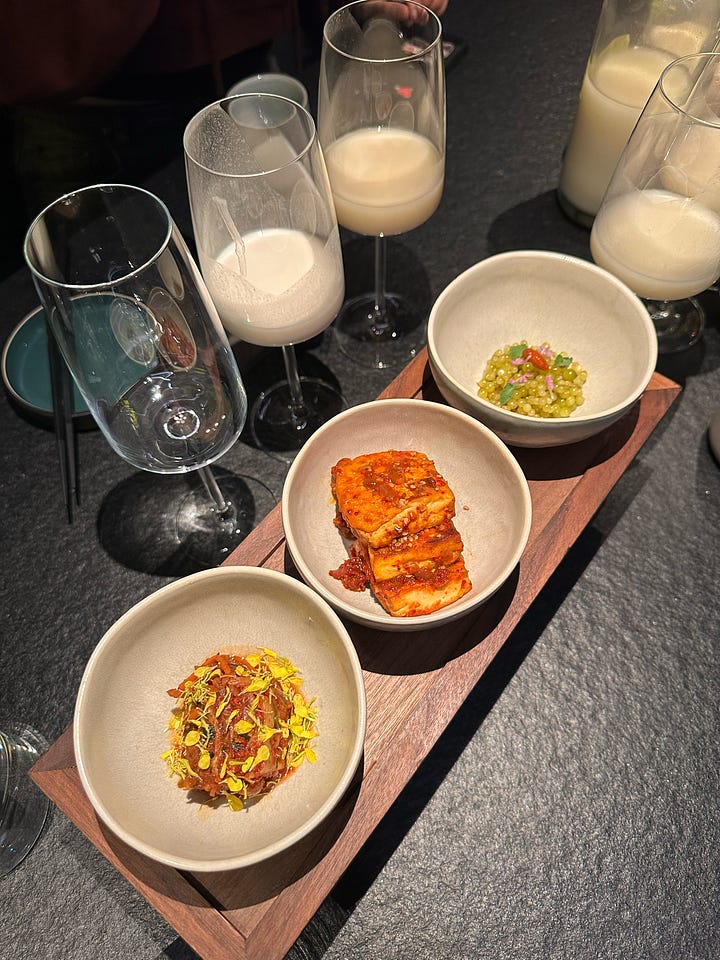

You’re now the Head of Fermentation at Oukan Dining. How did that role come about, and what does it look like day to day?
I originally came into Oukan for a trial as a production assistant in the fermentation section. When the former Head of Fermentation left, I was asked to step into the role full-time.
The work is deeply seasonal. Certain things, like miso or shoyu, are better when started cold. You can make them during the summer, but they become too active too quickly and it affects the flavor. Conveniently, it works out well for me: Berlin winters have limited produce, so I’ll spend that time on miso, shoyu, and grain and legume-based ferments. Come spring and summer, I shift toward capturing microseasons with plants, flowers, and vegetables.
We’re also very lucky to have close relationships with small local farms. Last year, for example, we made umeboshi with green strawberries, and I just texted the farmer: “Hey, how do they look this week? Send me a picture.” If you’re working in gastronomy in a large city, farmers are often too busy to bother with that kind of back-and-forth. We’re at exactly the right scale for it.
On a weekly basis, it’s a mix of maintenance, like stirring shoyu, with R&D and production for the mise en place.
Let’s talk about QU Fermentation Studio, which you founded. What inspired the concept, the name, and philosophy behind it?
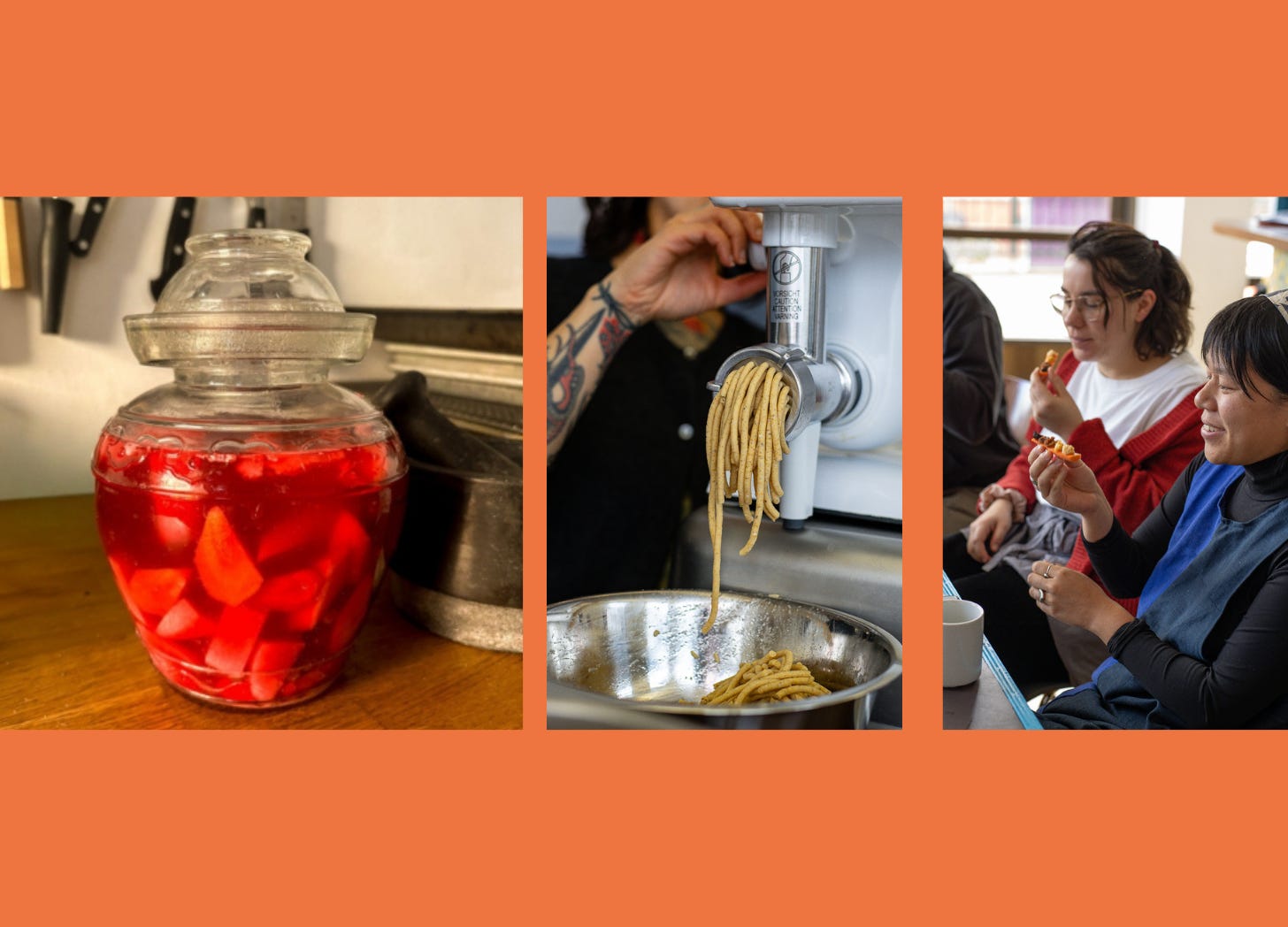
I started QU in 2021 before working in restaurants. I was working as a recipe developer at the time and wanted to do something more fun and engaging, so I began teaching public workshops, mostly on miso or lacto-fermentation. I also ran a six-seat supper club out of my apartment in Berlin for two years. The dinners were always built around a theme, and over time, fermentation became the main theme. QU’s mission these days is to demystify fermentation for the public through workshops, community events, and collaborations with farmers and chefs.
As for the name: “qu” (麴) is a Chinese yeast starter, sometimes called Shanghai yeast balls. It’s traditionally used to make soy sauce and grain liquors, and what makes it special is that it’s wild fermented. You don’t add any culture; you just let them hang out, and they eventually develop their own microbial ecosystem. It’s a reflection of myself. I draw on tradition, but I adapt to what’s local and high-quality. At Oukan, for example, instead of wheat, we use Grünkern (half-ripe spelt) to make soy sauce, because it’s deeply rooted in German agricultural and baking tradition.
As an Asian woman working in Berlin’s gastronomy scene, how would you describe the state of Asian representation today? What do you feel is missing or still evolving?
In the food scene here, European styles of cooking are still very dominant. When it comes to Asian cuisines, people expect it to be cheap — that’s been the default, shaped by early immigrant communities building businesses from the ground up and making do with what they had. They’ve gained a reputation for being low-quality, regardless of the reality. I have friends trying to start everything from casual bánh mì shops to fine dining restaurants, and it’s not easy. They’re slowly finding their base, but they’ll still get customers asking: “Why are your bánh mì €15? Shouldn’t they be €10?”
There’s also a real tension around sourcing. In Berlin, buying local is a marker of quality and it’s what all the high-end restaurants are doing. But that logic was built around European cuisines. If you’re cooking Asian cuisine, then you have to think: “Well, what if I want to source lemongrass or Szechuan peppercorn? What percentage do I have to source locally?” There’s a lot of mental gymnastics involved that French or Italian restaurants simply don’t have to do.
There aren’t many Asian people working in Berlin’s gastronomy scene yet, but I think we’re just at an earlier stage and these things take time. A lot of children of immigrants here are still navigating parental expectations: become an engineer, become a doctor, live an upper-middle class life. Going into gastronomy may never be on the table. But I’m excited to see how it develops, especially how Asian-German people develop their own unique food culture, rather than take cues from the U.S.
For those wanting to dig into Berlin’s Asian food and culture scene, where would you send them?
UUU is my favorite casual fine dining restaurant. Yuhang is awesome, and I think she’s doing something really special for Berlin, because there aren’t that many places that serve Chinese fine dining. She’s making tofu from scratch, using okara (soybean pulp) for desserts, making her own century eggs, and sourcing soy sauce straight from China. All of these are small details, but they add up. I love that she doesn’t treat Chinese food as a static thing. She brings a contemporary voice to it while staying rooted in traditional techniques.
Dotori is a Korean-owned anju bar with great food and great wine. It’s one of the only places in Berlin where I always run into someone I know. There’s almost a birthday party every time I’m there and the whole restaurant starts singing — I love that. I find the atmosphere to be warm, not pretentious.
Soi & Co. started as a soy milk shop, originally selling different types of soy milk (but I’m not sure that landed well with the German market). Now, they’ve pivoted to making tofu and soy-based cheesecakes, and some of the best vegan pastries I’ve ever had.
Gelispark is a new Chinese-owned cultural space near Görlitzer Park, mostly female and queer-led. They host workshops on things like furniture-building and zine-making. It’s a great place to create, cook, and gather.
Mr. Noodle Chen is a super casual chain, but I love it. The noodles are handmade and the food comes fast. It’s like being in China.
Give us a hot take! It can be as mild or spicy as you’d like.
People often misunderstand fermentation. They think all fermentation is stinky, and that it’s just pickles and hot sauce. I find that very offensive! Coffee is fermented. Chocolate is fermented. Wine — the most foundational alcoholic beverage in many European countries — is fermented. Fermentation has existed across cultures for centuries. I want people to look back at everything they've ever eaten and realize how much of it was fermented all along.
This has been so lovely. Before we let you go, what’s next for you? Anything upcoming we should have on our radar?
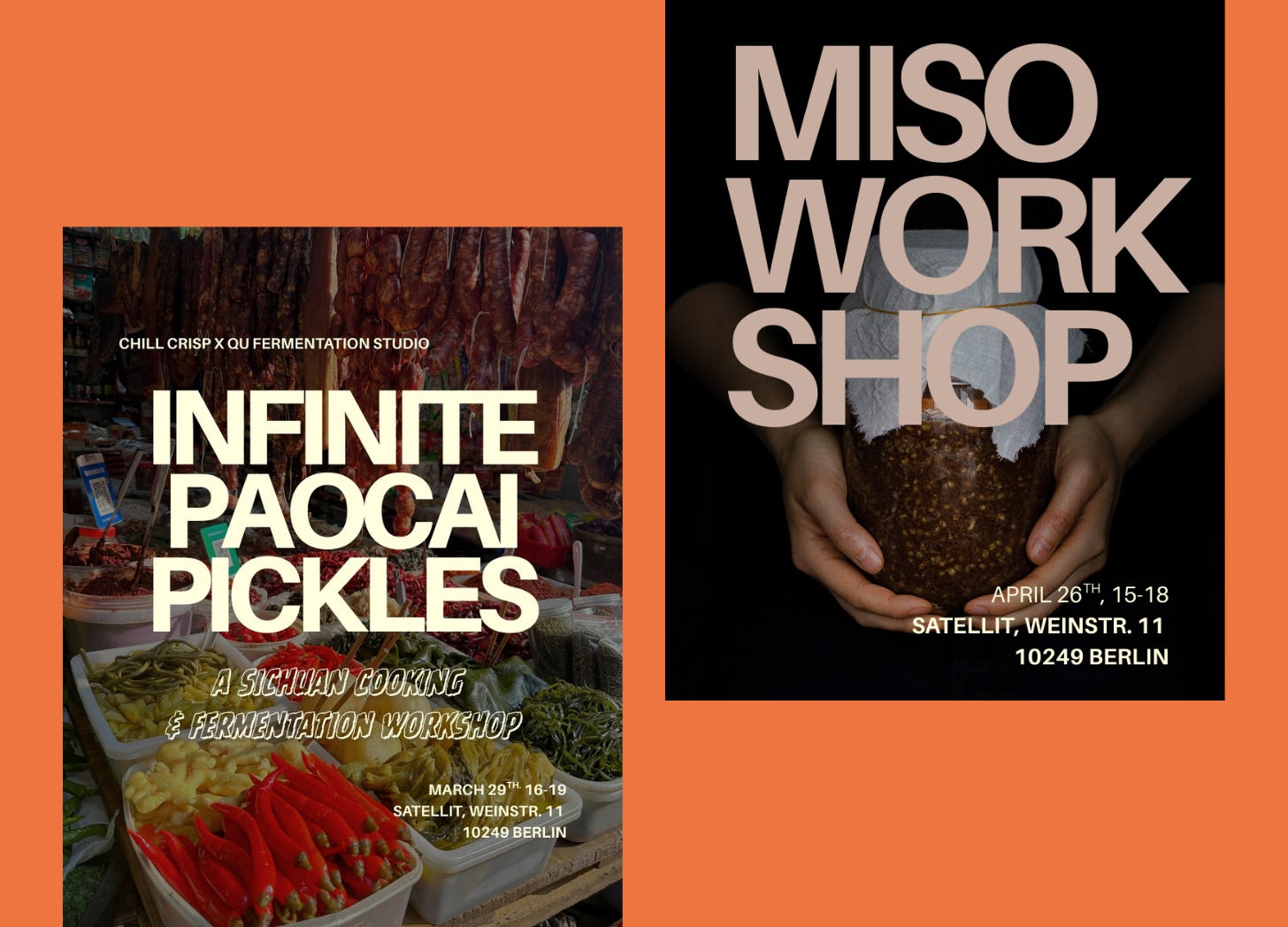
Later this month, I’m co-hosting a Sichuan cooking and fermentation workshop, Infinite Paocai Pickles, with food writer and recipe developer Xueci (who also writes on Substack). That workshop has actually sold out already (details shared above anyway!). Separately, at Oukan, I’ll be collaborating with Stephanie of Berlin-based fine spirits and fruit schnapps distiller Schnapserwachen to make our own distilled spirit out of koji. Lastly, on April 26th, I’ll be hosting a miso workshop and this one still has open spots. If you’re in Berlin, come ferment with us!
Thank you so much for reading my newsletter, and hope you enjoyed it! If there’s anything you loved or didn’t quite connect with, I’d love to hear your thoughts. Your feedback is truly appreciated and will help me make this a more enjoyable read for you!
Until next time, Laura x
Comments
Nothing yet. Say the first thing.
Sign in to join the conversation.