
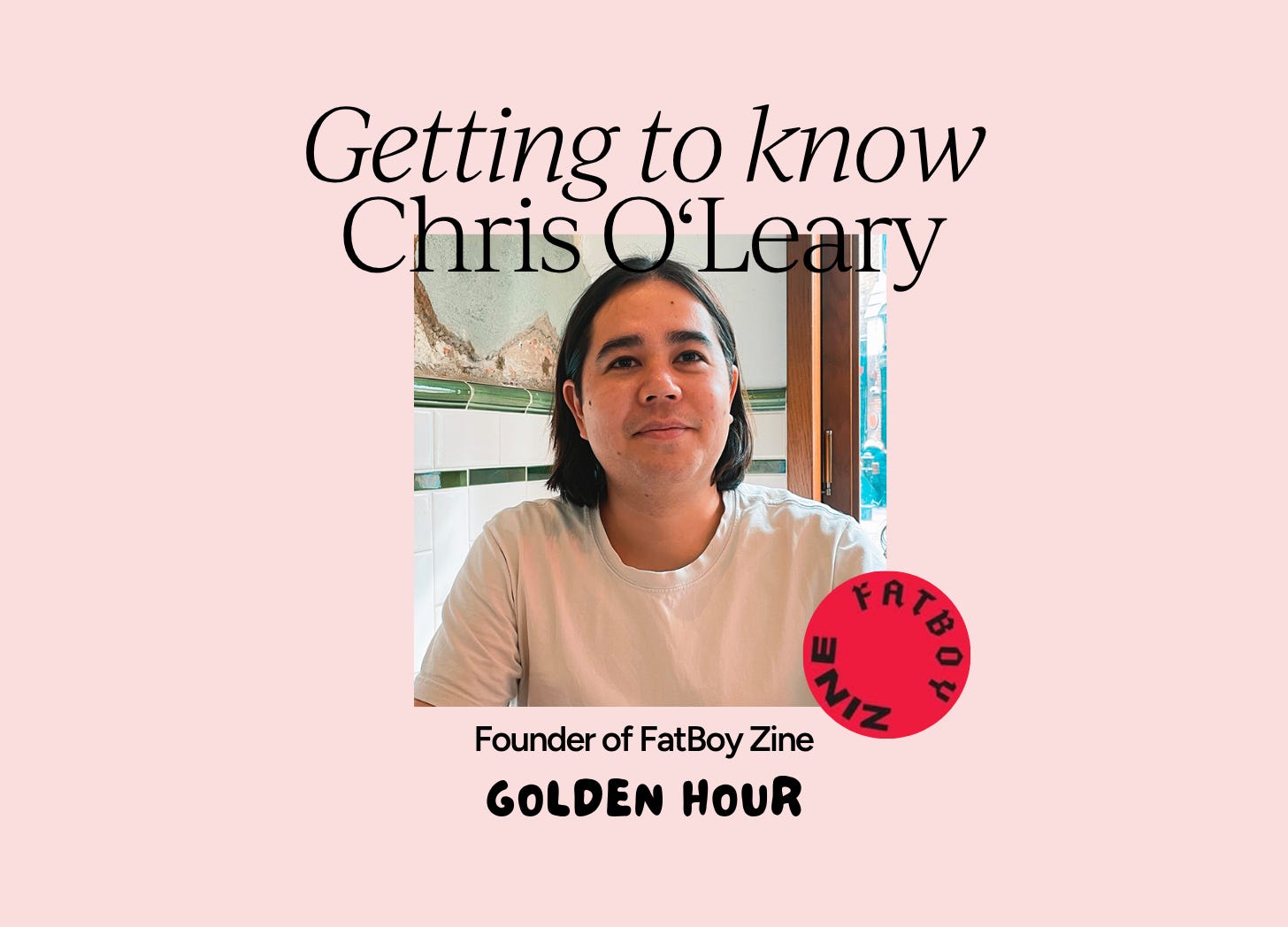
This interview is part of a new Golden Hour conversation series spotlighting Asian diaspora chefs, mixologists, hoteliers, storytellers, and creatives—sharing both the hard truths about Asian representation today and the joy, pride, and complexity of shaping it (This conversation has been lightly edited for length and clarity).
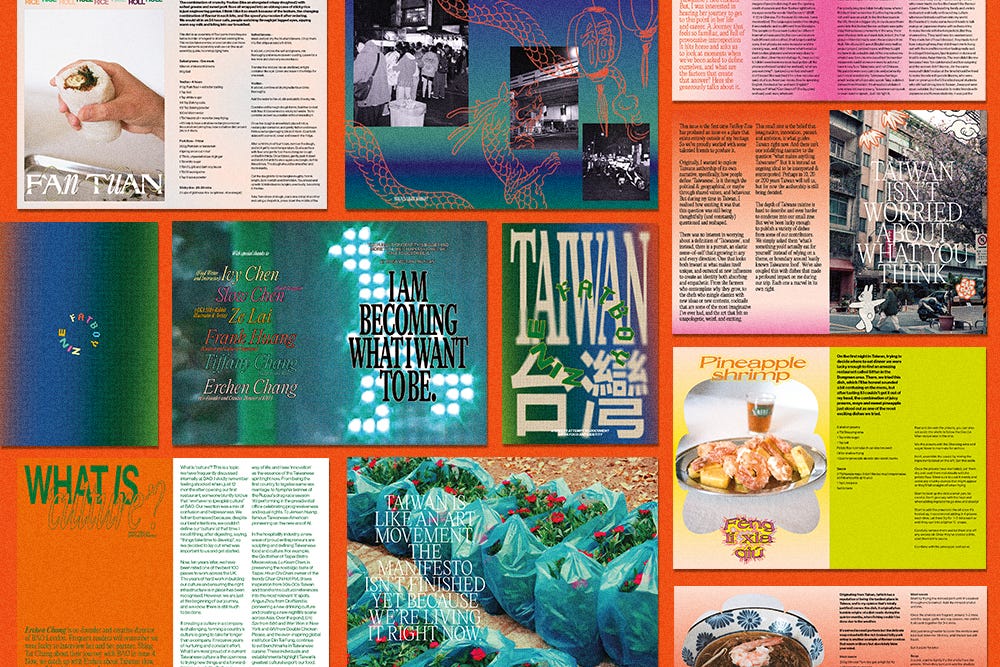
On a trip to Taipei a few years ago, while perusing one of my favorite bookstores, 朋 丁 pon ding, I caught a glimpse of the word “TAIWAN” and its Chinese characters, “台灣” largely stretched across a zine’s cover. It was impossible to miss, and with my interest piqued, I flipped through, instantly hungry. A year later, the zine found me again—this time at Heath Newsstand in San Francisco. I wanted to know who was behind this beautiful love letter to Asian culture and flavors.
That would be Chris O’Leary, the founder and creative director of FatBoy Zine, a publication he describes as “a greedy attempt to document a small part of Asian food and culture.” Chris doesn’t see food as just nourishment, but rather as something that carries cultural depth and the ability to heal. He’s deeply connected to a network of chefs and creatives shaping how we eat, cook, and tell stories—and it’s no coincidence. Spend a few minutes chatting with Chris and it becomes clear: he’s thoughtful, disarming, and easy to be around.
I’m so thrilled to share Chris’ story in his words, his passion for food and zines, and his most unfiltered takes. Please read on!
Hi! Tell us about yourself. Who is Chris?
I’m a creative director living in London with my partner, Emily, and our cat, Cora.
I’m originally from Hong Kong. My mum’s Filipino and my dad’s British. I grew up in Hong Kong until I was around 8-9 years old, when we moved to the Philippines. I loved my childhood in Hong Kong, and I’ll say Hong Kong in the 90s as a kid was unbeatable—everything just seemed so exciting and freeing. When we moved to the Philippines, we moved to my mum’s village in the countryside, which had a very different vibe. I learned to love the quiet and nature a lot more. Eventually, we left and moved to Liverpool—again, a very different vibe.
I don’t know if I’d say any specific place or culture was the most formative. Although in my heart I feel the strongest connection to Hong Kong, I think each place taught me something different: Hong Kong taught me to be ambitious and excited, the Philippines taught me to be free and appreciative, while Liverpool taught me to be resourceful and less serious. They’re all beautiful places, for different reasons, to me.
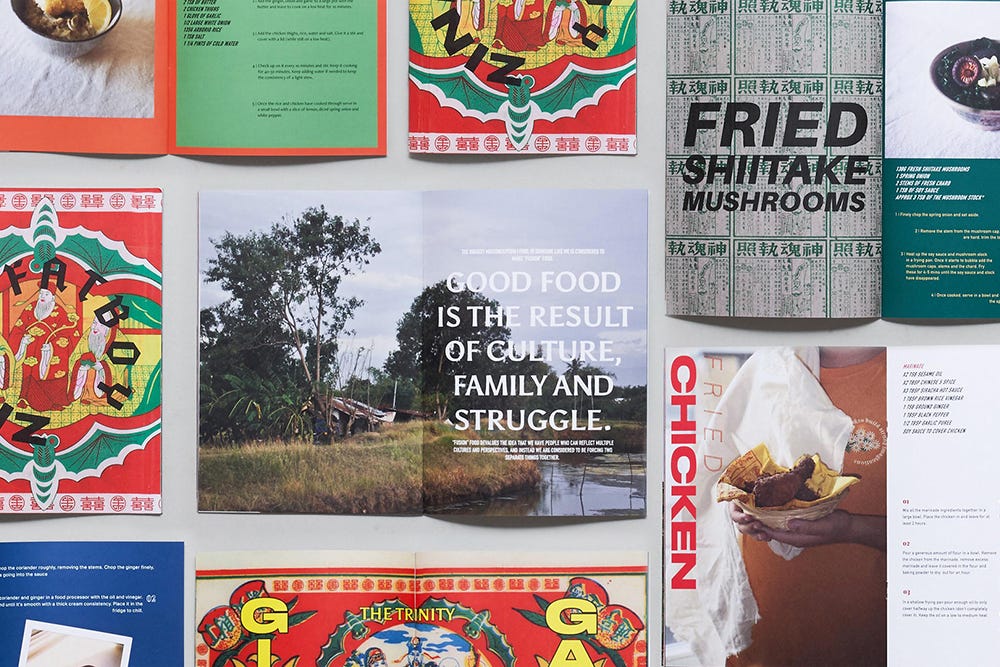
Let’s chat about your publication, FatBoy Zine, which seems to embody a wide range of cultures, perspectives, and experiences—much like your own life. How did the zine first come to be?
I wish it was a simple, straightforward journey, but to be honest, it was quite a difficult time. I’d lost my mum quite suddenly in 2017, and of course, that absolutely destroyed me. We were really close, and I was struggling a lot.
There were a few factors that led me to start FatBoy Zine from that. Firstly, I was looking for comfort, and I tried making dishes she’d cook for me as a kid. But there weren’t any recipes written down, so I tried to recreate them as best I could. Also, in the aftermath, I felt a distinct lack of connection to my culture and roots. It was like I’d realized I hadn’t been engaging with my heritage for a long time, and I hated that. Lastly, I went to bereavement therapy, and my therapist encouraged me to pursue more writing—specifically stream-of-consciousness writing to help me process.
I started to cook and write in a stream-of-consciousness way—making recipes and writing them down alongside how I felt. After a few months, I felt better and had this stack of writing, with no idea what to do with it. A few friends in publishing and photobooks suggested I make something, for myself and for other people out there who might be struggling, so I did. It took around eight months to get my ideas and process in order, but when I released it, the reception was amazing.
People were messaging me saying they had similar experiences and were looking to reconnect with their heritage and culture. It was the best response I could’ve hoped for—that people could see themselves in the work and open up—so I decided to keep publishing.
Thank you for sharing that with us, and I’m so glad that what you’ve created has resonated with so many people. How many issues have you released so far? How do you decide on the theme, stories, and featured guests?
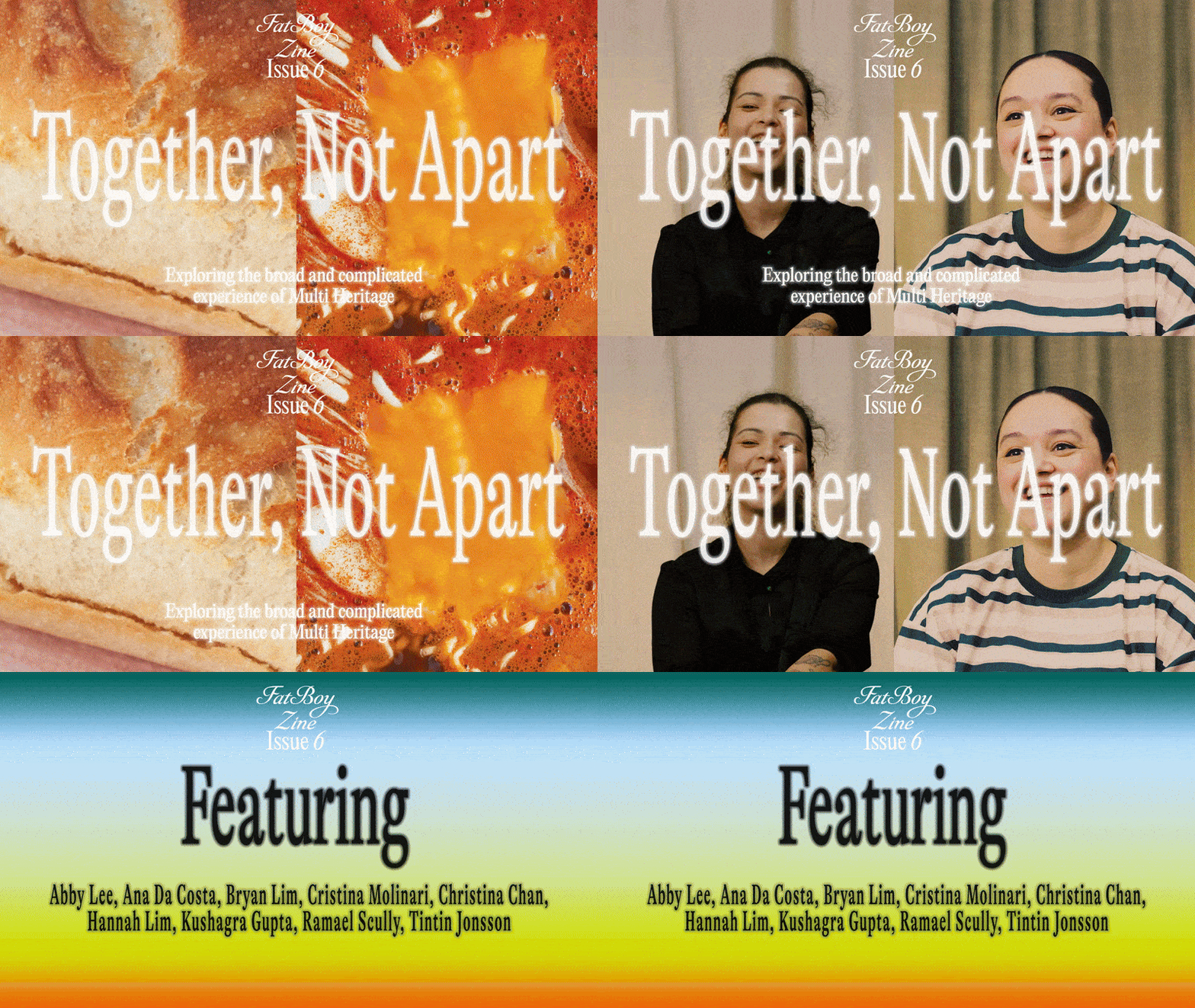
We’ve released six issues so far, ranging from specific geographic locations to more abstract themes. Originally, I thought about doing them all based on places, but I soon realized I didn’t want to become a “city guide” or potentially ignore the diaspora I was a part of. I decided to pursue bigger-picture themes like “multi-heritage.”
To be honest, there’s never a big, strategic moment that decides the themes. It’s always down to conversations I have that are interesting and get me thinking. It’s totally based on gut feeling, and I think that works because it lets me pursue really intense topics and doesn’t limit me.
Once I’ve decided on a theme, I spend a few weeks writing and rewriting a statement about it: how I want people to feel, what’s interesting or boring, observations on what other people think—still all in stream-of-consciousness form. From there, once I have my idea formulated, I look at people I admire, from chefs to writers and artists, and I think about whose work and point of view would bring an interesting perspective to the theme. Sometimes it might seem obscure, but I pay a lot of attention to a person’s work, their underlying points of view and beliefs. I base my commissions on that, and it always leads to an interesting conversation for the zine.
You’re based in London, which is widely viewed as a global hub for diverse culinary traditions. Does that feel accurate to you? How would you describe Asian representation there today, in both the food scene and media?
I would definitely agree with that statement. As a place for diverse food, London spans not just geographic locations, but ideas, ambitions, skill levels, and history—it’s unfathomable, and I love that about this city. I’ve been running FatBoy Zine for around eight years now, and I’m still uncovering so many things, which is great.
Asian food representation in London, in my experience, has always been quite tricky. There are a lot of historical dynamics that can lead to a narrow view of Asian food, like associating certain Asian countries with automatically being “high-end” and others as “cheap and accessible.” Some people may judge a restaurant on its authenticity, equating it with quality, without wanting to find out what the owner and chef are trying to achieve. This isn’t unique or limited to London or Asian food, but it is annoying.
There has, however, been more understanding of these dynamics, and a lot of great writers advocating for more open-mindedness. It has been improving: general awareness of regionality, lesser-known cuisines, and dishes is growing, and people are more interested in asking questions rather than going straight to comparison.
I’ve been most excited about these newer groups of chefs and creatives who are exploring the boundaries of art and food simultaneously. Bao definitely helped lead the way, and now we have people like Lil Wong Bakes, Swilipino, Lai Rai, Mae Maglanoc, Rahel Stephanie, Ana Da Costa, and loads more. They’re messing with flavors, textures, regionality, art, community, and business in ways that felt unattainable a few years ago. And what’s brilliant is everyone knows each other—you can go to a pop-up, bake sale, or book launch, and every talented chef and artist is there, supporting each other as friends.
As for what’s missing, sadly it’s always funding. There are so many talented people, community groups, and support systems, but that next level of financial access and growth—though slowly improving—remains tricky.
You’ve just listed off some really cool and talented people. For those of us wanting to explore London through a more cultural lens, where else should we be looking?
If you’re in the Soho/Covent Garden area, you must hit up Mae Maglanoc’s spot, Donia, or Panadera, then head over to Gosh! Comics for a browse, followed by a drink at TOKKIA.
Walk around Earl’s Court for great Filipino shops and restaurants, like Lutong Pinoy, then head up to the Design Museum or Japan House for some art and culture.
Check out the Southeast and East Asian Centre’s events, like supper clubs and pop-ups—there’s always something good happening there. From there, you can take an eight-minute bus ride down the road towards Hoxton and eat at any of the sick BYOB Vietnamese restaurants there. Everyone’s got a favorite and will assure you their spot is the best, but simply try them all and see what you like.
I haven’t been yet, but Rice Paddy has got people talking. Also if you’re here at the right time, check out Peckham 24’s photo exhibitions. We try to go every year, and it’s always great.
You could also come down to my neck of the woods in Clapton. Within a five-minute radius, there’s an insane collection of brilliant Asian restaurants like Mambow, Uchi, Hai Cafe, and My Neighbours the Dumplings. After a meal, take a walk through the Marshes and enjoy the vibe.
Moving away from London for a minute, have you ever traveled anywhere where you thought: “Wow, the food here is incredible”?
Taiwan, 100%. We traveled there for our fifth issue (and I also proposed to my partner on the same trip). I expected to enjoy the food, but I had no idea how much of an impact it would have on me. From breakfast and night markets all the way to the cocktail scene, it’s all so genius and varied. I’m always thinking about going back.
Give us a hot take! It can be as mild or spicy as you’d like.
I swear this list could be so long, but I’ll stick with one thing. It’s not something that’s necessarily wrong (OK, it kind of is), but it definitely annoys me. It’s when people and businesses decide an Asian ingredient (e.g., matcha, ube, books, films, chilli oil) is popular, then proceed to explain it back to you like you need educating. It’s crazy how people have the confidence to repeat soundbites back to you, thinking you haven’t also been overexposed to the exact same video on Instagram or TikTok.
This happens every time something from Asia gains popularity, and I almost instinctively expect people to tell me why this is important for me to understand.
This has been truly lovely. Before we let you go, what’s next for you? Anything that we should have on our radar?
I can’t lie, this is going to be a big year for me, and I’m just hoping I can stay sane long enough to pull it all off. I’ve just helped organize London’s first-ever publishing fair dedicated to food. The Food in Print Magazine Fair was a cooperative effort between myself, Vittles, and Pit Magazine to bring indie publishing to a bigger audience and connect people to new food writers.
FatBoy Zine issue 7 is also coming out this year. As a sneak preview, it’s all about Asian sweets and desserts. Some incredible chefs agreed to be involved, so I’m really excited.
Lastly—and this is my biggest life change since last year—I’ve recently quit my full-time job as Creative Director for Warner Music Group to build and expand FatBoy Zine. I’ll still be publishing the zine, but I also want to slowly build out FatBoy Zine Studios, a creative studio dedicated to food, music, and publishing.
Thank you so much for reading my newsletter, and hope you enjoyed it! If there’s anything you loved or didn’t quite connect with, I’d love to hear your thoughts. Your feedback is truly appreciated and will help me make this a more enjoyable read for you!
Until next time, Laura x
Comments
Nothing yet. Say the first thing.
Sign in to join the conversation.