
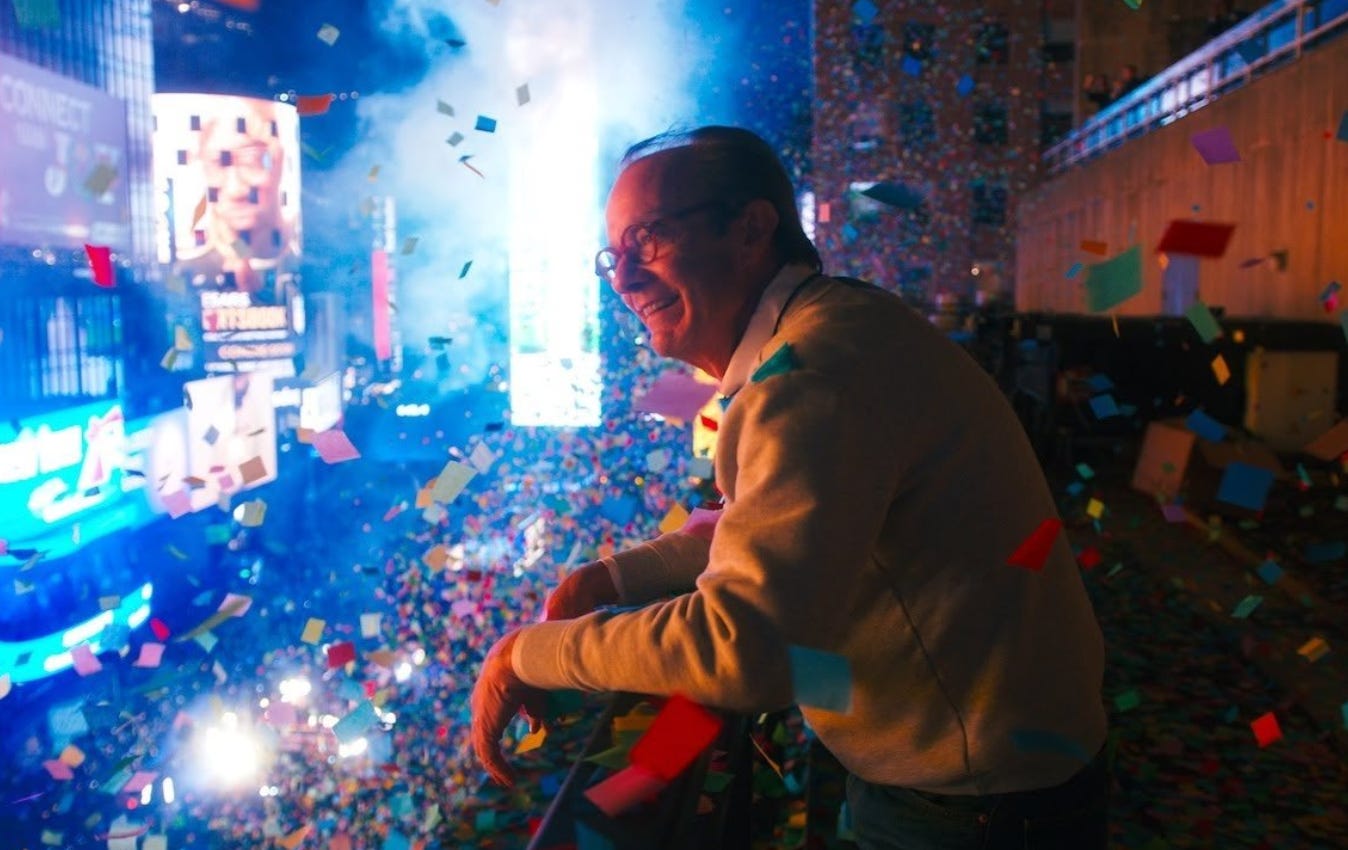
Note: This post was originally slated for January 8th. Publishing was delayed due to the wildfire crisis in Los Angeles. A list of resources is available via my pinned post.The New Year’s Eve celebration in Manhattan’s Times Square is iconic. This year, roughly one million people from around the world gathered together (without bathroom access!), to revel in the mutually disarming effects of unbearably bright ad displays and Andy Cohen. They waited for the momentous ball drop, its descent marking the arrival of a shining new horizon.
This year, I learned something new about the affair: The colorful deluge of confetti cascading down on revelers — all 3,000 pounds of it — is dispersed by hand.
I had stumbled across Joshua Charow’s short film about Treb Heining. Heining started his career selling balloons at Disneyland (tying 1,000 an hour by himself). He later ventured out on his own and became the “father of balloon decorating.”
In 1991, he was asked to transform New Year’s Eve in Times Square into a more family-friendly event. A “confetti blizzard” was the result. Now, more than 30 years later, Heining and his team continue this spectacular ritual.
I can’t say I remember ever wondering about the mechanics, but I think I’d assumed the confetti was machine distributed. That would make sense, right? Surely, machines would be the most efficient, cost-effective option and would be more precise, more consistent. Not so.
To start, Heining’s crew is comprised of volunteers, some of whom have been part of the tradition for decades. Not only does this keep the budget reduced and mitigate against costs of purchasing, maintaining, transporting, and storing equipment, Heining had to cap the total number of volunteers. There are more requests to volunteer than can be accommodated.
In addition, the confetti consists of specialized 2” by 2” paper squares, which are too large for a machine to process without clogging. Heining and his core team, including a member who manufactures confetti cannons, are well-versed in their industry’s technology. According to Heining, “there’s just nothing that can match our volume with the same effect.” (It also causes “confetti arm.”)
In one of the world’s largest cosmopolitan cities, this famed event eschews automation; there’s even a certain cachet to its artisanal approach. Innovation isn’t always synonymous with being tech-forward: In 1991, the confetti blizzard was innovative in its novelty, but not in its use of technology. For decades, this hand-dispersed methodology has worked best because people are the essential ingredient to achieve the night’s enchantment.
Do the revelers below know the confetti is distributed by hand? Does that detail matter to them or change how the moment feels? I don’t know the full answer, but after watching Joshua Charow’s film, I know I feel differently about NYC’s beautiful ritual. Heining’s emotion-filled dedication is infectious. The confetti isn’t just a magical experience for those on the ground. It’s also become a treasured, magical event for Heining and his coterie.
Charow’s film was released two years ago. Currently, it has one million views and more than 1,200 comments. YouTube user @elliem6251 sums it up perfectly:
“I think this is so wholesome because it’s people. Always thinking that it was machines and now finding out that it’s people is so moving because it’s just such a human experience to celebrate things together and the fact that it’s people bringing this huge part of the joy is just so wonderful.”
***
Comments
Nothing yet. Say the first thing.
Sign in to join the conversation.