
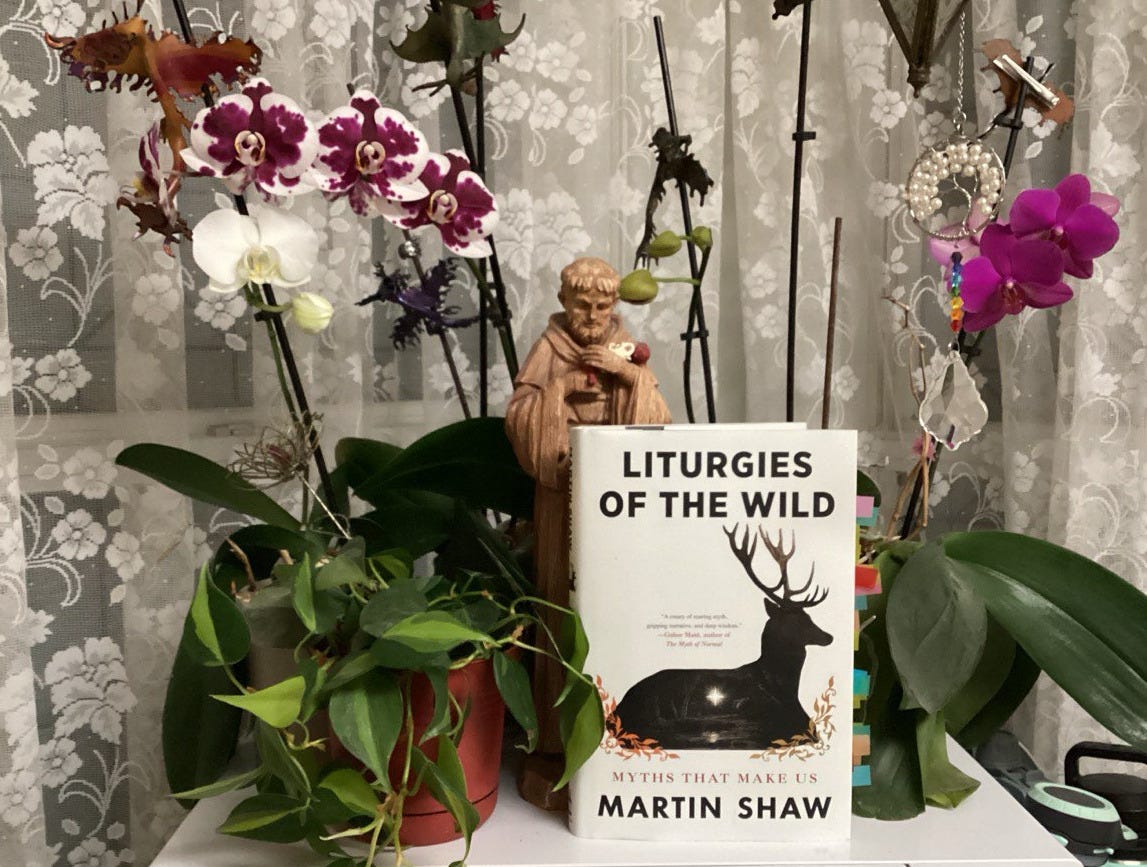
First off, let me say that I feel really honored to have been sent this early copy of Martin Shaw’s new book, Liturgies of the Wild. I can happily say without qualification that it’s a lovely read, very intelligent and full of meaning and most definitely worth your time. But if you’re reading this, you probably expect to hear something like that, right? I mean, this was my first official experience reading Shaw’s published work, but he’s been in my periphery now for quite a while. People far wiser and more renowned than I have acknowledged his work as a great gift, a presentation of truly original talent.
So, on one hand, I’m not going to tell you anything you don’t already anticipate. What I can give you, here, is a window into my experience with this book, and the journey I went through as I turned its pages. Because-- I’ll be honest-- in the first few chapters, I realized that there was going to be a process. Want to walk through it with me?
You see, it’s undeniable that Dr. Martin Shaw is the inheritor of the mythopoetic movement; he even claims on his website to be developing a “Christian mythopoetics,” which lies at the heart of what this particular project hopes to enact. That movement and I have never quite meshed-- when we’ve been at the same party, we’ve always kind of looked at each other from across the room with not a little bit of side eye.
Most recently, I sympathized with Norah Vincent in her fascinating memoir Self-Made Man, and I thought her experience at a mythopoetic men’s retreat was heart-breakingly realistic. She found the storytelling and symbolism to be moving and beautiful, the men she met to be genuinely desirous of relationship and encounter, but ultimately she could not shake the suspicion that the movement was lacking something, and to identify that lack would be to reveal the feared spectre of impotence lurking deep in the background. She never found what she was looking for.
I’ve tried to read Iron John two or three times, but it’s never grabbed me-- likely because, being a woman, I’m not its intended audience. I can see, however, that some people (men, most likely) may find it helpful, may find some sort of hook in its narrative that they can latch their own lifestory onto, drag it out into the open, and start the hard work of growing through it. I’m not opposed to the mythopoetic movement, but every time I’ve tried to read pieces of Bly’s work, I get a pretty visceral response that its material is not for me, that it reflects a misunderstanding or mischaracterization of my own experiences. I’ve identified four main areas where I think this mismatch is happening.
First, I’m coming to think that while archetypal symbolism is rich, useful, and fascinating, it’s an error to think of archetypes as having stable, universal content that can be mapped onto everyone’s individual experiences in ways that will predictably solve problems and engender personal growth. Sure, that might happen, but it’s not guaranteed to work like that, or in any predictable way, really. To interact with archetypes this way is to flatten the symbolic into formula, squash metaphor into allegory.
This category error is where the Freudian roots of the mythopoetic movement show how they limit its usefulness, particularly in how they calcify into a stage-based development that follows a linear progression.
Now, the mythopoetic movement isn’t purely Freudian, obviously-- it draws heavily upon Jungian archetypes and Joseph Campbell’s Hero’s Journey. But if the concepts and words are Jungian and Campbellian, the grammar of thought is unmistakeably Freudian. What is individualized, paradoxical, less sex specific, and curious about suffering in the Jungian/Campbellian becomes collectively prescriptive, literalized, gender-essentialist, and oriented towards developing adjustment to society in the Freudian. Instead of a broad structural pattern open to interpretation, we get an explicitly gendered archetypal system. If you’ve read Patterns for Life, you already know how I feel about systems, and if you’ve read any of my work on Nuclear Eros, you know how I feel about gender essentialism.
Iron John centers the Oedipal wound in a broad way, and pushes its readers into framing the mechanics of their growth through it, largely by examining emotional repression and retrieving authenticity that was left somewhere in memory. This is not wrong per se—it’s obviously true that bad parenting causes grave wounds that need to be aired in order to be healed. But the precise way in which it’s written is just not a universal way of experiencing intrapersonal growth. There are more than one kind of bad father or bad mother, and bad parenting in general is not easily reduced to an extension of the gender wars, though we as a society keep trying to do so in all manner of ways.
Plus, as a wise woman once explained to me regarding my own mother’s experience with chronic depression, knowing what went wrong in the past is not at all the same skill set as knowing how to move forward in the future.
You see, if you experience mythic storytelling as living, ambiguous, and above all, particular, the flattening of archetypal symbolism can end up writing everything with the grammar of dyadic conflict.
I think this is how we’ve come to find our experience described as tension between the civilized self and the self as barbarian, between modern and pre-modern human experience. While it is true that our contemporary society has challenges that are unique to history, it’s also true that many of our troubles are the same old troubles of yesteryear, just with different faces. The troubling assumption is that modernity has catastrophically severed us from an authentic self that can only be found in the past. The old mythopoetic movement can’t seem to escape this polarity.
Finally, the mythopoetic movement places strong emphasis on group identity and transmission-based mentorship within the group. While the mechanics of both have an undeniable resonance, I don’t see them as the ultimate expression of human communion. Rather, I think they are swinging the pendulum too far in the opposite direction.
I guess you could say that my criticism of the mythopoetic movement in general is that it’s a universalized oppositional response to a particular set of circumstances. It’s an antithesis, where what we’re really hungry for is synthesis.
Do you know Hegel? Thesis—antithesis—synthesis? In this model, the antithesis that elevates the wild as authentic and the domestic as corrupt is in opposition to the original progressive thesis of barbaric depravity vs. civilized society. We’ve got a false dichotomy set up for us, and we need a way out.
That’s the background of my wrestling with the mythopoetic movement, which left me with a slew of questions when I picked up Liturgies of the Wild: Would Shaw avoid these problems, or would he just dress them up them in different garb? Would Shaw be able to evolve the mythopoetic method of story, symbol, and psyche-nature integration out of its gendered, Freudian, nostalgic historical, group-oriented mode? Or was he just going to slap some Jesus onto it and call it good now? Would Shaw be able to heave this curious artifact out of the 20th century and into the bright and critical gaze of the post-post-modern 2020’s?
Because I do believe we’re currently in a synthesis-forming stage (with this, at least) in our collective unconscious hive-mind, and-- spoiler alert and glory to God-- I think Dr. Shaw has decisively shown himself as part of this movement. His work prior to his conversion to Orthodox Christianity seems to have done a lot of heavy lifting, but ultimately, the baptism of his imagination has allowed him to shatter the glass box that contained mythopoetic storytelling and lug it out into its cosmic level of power.
Okay. Let’s pause there. I want back up and come at this from a different angle, a story-way that shows what I’m talking about. Because Martin Shaw’s storytelling, while mythopoetic, is not overtly psychological. He’s ringing the bells of the subconscious through fairytale, and there’s a reason why this works, but it’s not an benignly omnipotent force. It has some real limitations and dangers. I like to think of stories as “containers,” both in the psychological and conceptual meanings. They hold things together for our imaginations to encounter. A good story is a container big enough to hold multiple, often ambiguous meanings, and so allow people from different walks of life to find different pieces of resonance within them. Shaw is a master of this.
But there’s a hard ceiling on Shaw’s pre-baptized storytelling, one I’d like to look at through the lens of Battlestar Galactica from twenty years ago. It’s a prime specimen of modern symbolic storytelling, one that turns Jungian archetype and Campbell’s Hero’s Journey into an explicitly mythopoetic religion, and by doing so, starkly illuminates the borders of its explanatory power. We need to look at the container itself, and not just what the container holds for us.
In BSG, the Colonial pantheon functions not as deified spirits with personalities, but as psychic energies, like Jungian archetypes that engage the practitioner in primarily energetic/psychological ways. In the practiced religion, there’s an acknowledged energetic dimension that is interacted with through prophecy, oracle, vision and dream all as symbolic encounters, and the sacred texts function as living documents that require interpretation through experience. Both the individual characters and the starships themselves are engaged with journey as odyssey through encounter with this energetic realm.
It’s an incredibly compelling framework, with multiple characters on different vectors of growth, development, and collapse. Because it’s so good for so long, you can’t look away when it starts to become unbearably painful. And I’m sure I’m not the only person who Clockwork-Oranged my eyeballs open to find out how it all ended.
You see, the show’s ending—”this has all happened before and will happen again”—is where the mythic framework collapses into the dark underbelly of unbaptized, pagan myth. Cyclical renewal, even in its most genuinely mythic and archetypal pagan sense, is not ultimately a force of Good, but instead a precisely engineered cosmic dualism. The shadow side of it is that depending on where you’re standing, you can see that cyclical renewal looks an awful lot like eternal recurrence without the possibility of transcendence. Joseph Campbell’s return and the cyclical renewal of the universe utterly crumbles into Nietzsche’s abyss.
I think that while the show’s writers were working within the mythopoetic framework, the story itself got too big and started pushing beyond it, toward something that even myth itself can’t ultimately accommodate. The mythic container cracked under the weight of what was emerging. (Side note: This is all evident even without getting into the fascinating syncretic stew that gave birth to Mormonism, which can be argued to be a mythopoetic form of Protestant Christianity that is aggressively anti-nihilistic in addition, and also a thematic element in the show. But that’s way beyond the scope of what we’re talking about here.)
BSG dramatizes what happens when you build a narrative universe from syncretic mythological fragments (Mormon, Greek, Campbellian, Jungian)—it works compellingly as long as the story container holds. But when the story pushes toward its ultimate questions, the seams show, and underneath is not integrated transcendent meaning but nihilistic void. This is the true limit and danger of mythopoetic storytelling.
Mythopoetic frameworks—whether in Bly’s writing, the popular scifi understanding of the theology of Mormonism, or the story of Battlestar Galactica— all share the same vulnerability: they assemble meaning from mythological raw material, but the assembly itself may not bear the weight of genuine existential encounter. The containers are too small; the grammar is borrowed. They may be asymptotically true, but ultimately cannot scratch the itch for the limit itself, Truth as Person. Without being baptized, mythological thinking dances right up to the edge of the abyss and threatens to strand you there.
The energetic realm of archetypal, mythopoetic symbolism can hold a lot of different meanings for us. But without roots in a more profound, expansive, and as of yet mostly unknowable spiritual reality, it can only end in despair.
Which is why it’s really very interesting that Shaw has become an Orthodox Christian. Liturgies of the Wild demonstrates how that experience of conversion has cracked open his story containers and caused them to do that neat thing creation seems to do in the presence of the holy: spiralize and fractalize throughout multiple layers of reality that we didn’t even know were there. Epistrophe, Shaw calls it, “a turning about, seemingly concerning the past but not much to do with old times at all” (p 104). This is time as viewed from above it. Shaw’s story containers have unfolded into new dimensions.
One of the ways that Shaw demonstrates this spiraling is in the structure of the chapters themselves, which move between meditation, personal story, and mythic story in non-linear ways, hinting at connection and revelation without making those connections and revelations explicit. Shaw tells his stories with faith and trust in the people who are listening, that they will encounter the stories in the way that is necessary to them, regardless of any evidentiary message. Shaw’s Christian mythopoetics is not just for the men’s retreat anymore-- he has succeeded in opening the method to anyone with a humble heart and an open ear.
Another main theme of the book is how the mythopoetic realm itself is inextricably linked to the act of dreaming. In fact, the genesis of this book is Shaw’s own dream-encounter at the end of a vigil, a mystical experience in physical reality that unfolds into private dream-space with words that command him to re-encounter the faith of his youth.
This initiatory dream is the crack in his previously sufficient container. Once it has been dreamed, he must follow the quest to where it leads-- abandoning the limits of his previous framework and growing into something new. A paradigm shift.
“Dreams are shifting inner-mythologies,” he says (156), and this reminds me instantly of a study I read last year (forgive me, I cannot for the life of me find the source), which seemed to show that the dream-life of analysands appears to conform to the style of psychotherapy with which they are being analyzed. What the study indicates is that we can and do manufacture coherence to our own dreamlives through paying attention to them and allowing this sense of inner mythology to emerge. Especially after reading Liturgies of the Wild, I expect that if Christian mythopoetics grows as a movement, it will engender a fresh form of dreaming among the people who practice it. I know that might sound a little too New Age for some, but Shaw calls on the story of Joseph and reminds us that “to ignore dreams completely is unbiblical and cuts us off” from our own deep inner story (177). Wise words.
Perhaps part of our mistake is in thinking of dreaming as only a private endeavor. In one of the most striking metaphors in the book, Shaw describes his experiences of Divine Liturgy as a kind of “Christian dreaming”-- a phrase so unutterably lovely I don’t know what more to say about it than to simply express my deep satisfaction with the comparison. One of the wonderful things this concept does is show how the experience of liturgy works energetically on the worshipers who enter into it, binding them all together on a very particular kind of plane. I’ve written elsewhere about the importance of distinguishing between the energetic and spiritual realms, and Shaw’s metaphor here helps explain what I mean: a dream can have spiritual meaning, but is not spiritual in and of itself-- we aren’t walking directly where angels tread. It’s an experience occurring somewhere other than lived physical reality, but that can also intersect with physical and spiritual existence.
This liturgical dreaming extends beyond the gathered assembly. Shaw calls the Sign of the Cross “an attention that makes the daily luminous” (118)—a gesture that carries the energy of liturgy into ordinary time. The daily and the cosmic are not separate realms requiring wilderness retreat to bridge them; they’re already interpenetrating, already spiraling together. We only need the power of attention to see it.
Elsewhere, Shaw refers to this new framing in this way: “Christianity is a dream in which the very best of us is encouraged to emerge” (163).
Hmm. That’s an interesting, revelatory way of saying it. Not wrong, not at all, but its phrasing reveals something very meta going on in Shaw’s book, hinted at with the word emerge, and the image this sentence gives of personal progress.
You see, the conversion story is, itself, a myth. It will be chanted in its liturgical form this coming Sunday in all Orthodox parishes across the world in the form of the Parable of the Prodigal Son. Notice the movement in the story-- the son goes out into the world, experiences sin to its limits, suffers famine and poverty, and then mysteriously comes to his senses.
You might wonder if he had a dream.
But even more than this, I think the form of conversion story that Shaw is using has a particular heritage in Anglo-American Christianity. Ever since Wesley’s heart warmed within him, and the brothers hit the road encouraging revival among the people, the sharing of testimony and conversion has become its own kind of storytelling ritual, in which each individual person grafts his personal myth of transformation onto the Vine of Christ in dramatic, public ways. For those of us with histories in charismatic movements, there’s a specific flavor to this myth, where the spiritual inciting incident is followed by an emotionally intense experience of guilt, repentance and renewal. The true container of this story, however, continues to fractalize like frost growing on a windowpane-- for repentance never truly ends. And if we remain faithful, we learn this lesson over and over again in new ways.
You see, the Anglophone myth of conversion has its own limits, defined by its culture and time period. As Shaw travels further up and further in to the mystery, he will find that the Anglophone conversion myth is too small to describe his continued experience of transformation. And that will be reflected in his storytelling. He has inklings of this already, as in his chapter on prayer: “Prayer changes our relationships with pretty much everything” he says (116), and then he writes later of “paying the toll of being ordinary” (218) as part of the spiritual life’s dues—a glimpse of what the long obedience will require. The convert’s initial encounter with the numinous must necessarily settle into the dailiness of practice, the patient formation that happens in repetition rather than revelation. He’s in for a wonderful surprise—not because the luminous fades, but because the unfolding of story teaches us that the fullness we thought we wanted is smaller than we had imagined.
This book is about meaning in myth on so many different levels.
Shaw has exploded the mythopoetic movement out of the errors I identified in the beginning of the essay. He trusts his fairytale archetypes to work on his listeners regardless of their specific understanding-- he suggests interpreting ideas, but does not insist on them. He jettisons the primacy of linear time altogether, instead constantly inviting us into the holy space of spiralized liturgical time, broken out of its small containers and released into the wild. Instead of healthy adjustment to society and relationships, we’re invited to meet God and embark on a journey of theosis. Freud has been thanked for his historical contributions and asked to sit down.
Because Christ has transfigured time itself, Shaw is able to step out of the false dichotomy of barbarian vs. modern man and patiently hold space in the paradoxes and contradictions of our contemporary existence. He does so by telling us stories that are living, ambiguous, and above all, able to be metabolized by the reader as particular. “There is no-one-size-fits-all to a mythic life,” he reminds us (30). You don’t have to go into the wild to find yourself-- you can sit under a bush in your backyard in the middle of town and enter into something deep. The gift of creation is profligate and extravagantly given as long as we open our eyes to see it. Shaw’s new framing of the mythopoetic movement opens this up to those of us who encounter wilderness in our hearts, regardless of where we are.
And Dr. Shaw has rescued the mythopoetic movement from its “we men” collective framing around a shared masculine wounding, and instead opened it up to the broader human experience of suffering and cross-carrying. His chapters on death, passivity, limit, and evil have the ability to reach into the depths of many a wounded heart and offer a sweet balm, a hand up, or a witnessing eye. And his chapters on prayer, on praise, and on dream all weave a bridge between the old poetics of mythology and the new, baptized storytelling of the True Myth. His simultaneous shyness and boldness at praising his new Beloved reminds one very much of a young man newly in love.
In this transformed mythopoetics, elders do not initiate externally by performing an action onto younger people, passing on a specific thing that they lack. The initiators--the journey-beginners-- in this framework are the stories themselves. Shaw uses the metaphor of story as technology several times throughout the work, saying that stories are “an ancient technology that enables emotional literacy” (7), that they “assist in the growing of consciousness and the slow tempering of maturity” (31), and that they are “technologies for defeating demons” (96). These are not the simple framings of the mythopoetic movement of the 20th century, and they acknowledge a far larger spiritual reality.
This way of opening up stories into expansive containers is refreshing and more than pleasantly surprising. The abyss of mythopoetics is being transfigured into a threshold of encounter.
Yes, Dr. Shaw has made a great beginning of transfiguring the mythopoetic movement for a Christian audience.
But it is only a beginning. Dr. Shaw is quite new to Orthodox Christianity, as he makes clear in the work. The enthusiasm and zeal of the new convert shines throughout the entire piece, and it is lovely to behold. I am personally excited to see how this continues to evolve, as Shaw continues in his “long obedience in the same direction” as Eugene Peterson and Nietzsche so memorably put it. I will pray for him, though, as I pray for all “young” Christians who are thrust into the spotlight of especially Ortho-celebrity-- because the attention of the masses is much like the hungry eye of Sauron, and its gaze is heavy. I don’t think we’re doing these people any favors with it, asking them to represent an ancient tradition with less than a handful of years of experience. I know how much struggle has been present in my own life and growth in the Church over the past two decades-- to think of having to live that in the public eye is harrowing indeed. But if Martin Shaw and others like him can persevere through the crucible, I’m confident that in twenty, thirty years, Christian mythopoetics-- this process of tumbling story together with spiritual truth and lived experience-- will become a serious discipline of creative liturgy through which communities of Christians can encounter and behold God, each other, and creation more deeply.
On a sensory level, I can’t end this essay without praising Martin Shaw’s craft. His prose is a joy to behold: the language is fresh and surprising and begs to be read aloud and felt in the mouth. The work as a whole succeeds throughout its multiple layers of meditation, personal story, and fairytale, laid out as a fractal within the mythic-frame of conversion story. It’s a pleasure to encounter.
I don’t know what you will find in Liturgies. There’s so much going on, your experience is likely to be completely different from mine. For myself, especially as a writer, I feel like I’ve found shards of mirror that help me see myself a bit better, and shards of lens that help me see others more clearly. I’m quite sure that Shaw has sprinkled a bit of wild yeast into the brew of my imagination. One piece of advice -- “...always pay attention to where in a story your attention vacates the scene: That’s the place to circle back and attend to,” I feel is a masterclass in storytelling in a bite-sized nugget.
I think we’re all desperately hungry for storytelling that transcends the containers we’ve become accustomed to. How could a story like Battlestar Galactica be retold with this new kind of spiralizing myth, that reaches further up and further in than anything the old mythic frameworks were capable of? I don’t know, but I think a discipline like Shaw’s Christian mythopoetics could help unlock the imaginations of a new wave of storytellers who are ready and willing to attempt the task.
Thanks for walking with me through my journey through Liturgies of the Wild. I’d love it if you let me know your own thoughts about the book when you encounter it for yourself.
Thank you for reading! That you made it all the way down here in this attention economy is a real gift and blessing to me. If you enjoyed my work, would you please consider sharing it with your circle? I’m releasing a few projects this year, and I’d love to reach the people who might be interested in it.
Comments
Nothing yet. Say the first thing.
Sign in to join the conversation.