
Welcome to all my new subscribers! I’m glad you’re here. Friends who have been here a while know this already, but part of my household’s Lenten fasting practice is serious digital abstinence. Our family’s habit goes back over a decade, and is not the same for every fasting period! As I’ve explained before, on the eve of a fast, we all sit down together and talk about ways that our screens and digital experiences are affecting us, and we each commit to a particular realistic reduction. Sometimes this looks like a complete screen fast, but more often than not, we simply try to refocus our screen use into activities that foster family relationships.
I’ll be honest, I need a screen fast for myself. Just in the past week, I’ve had essays make me cry in despair and notes make me irritable and even outright angry. That’s not why I’m here. All this to say that I won’t be around here much the next few weeks!
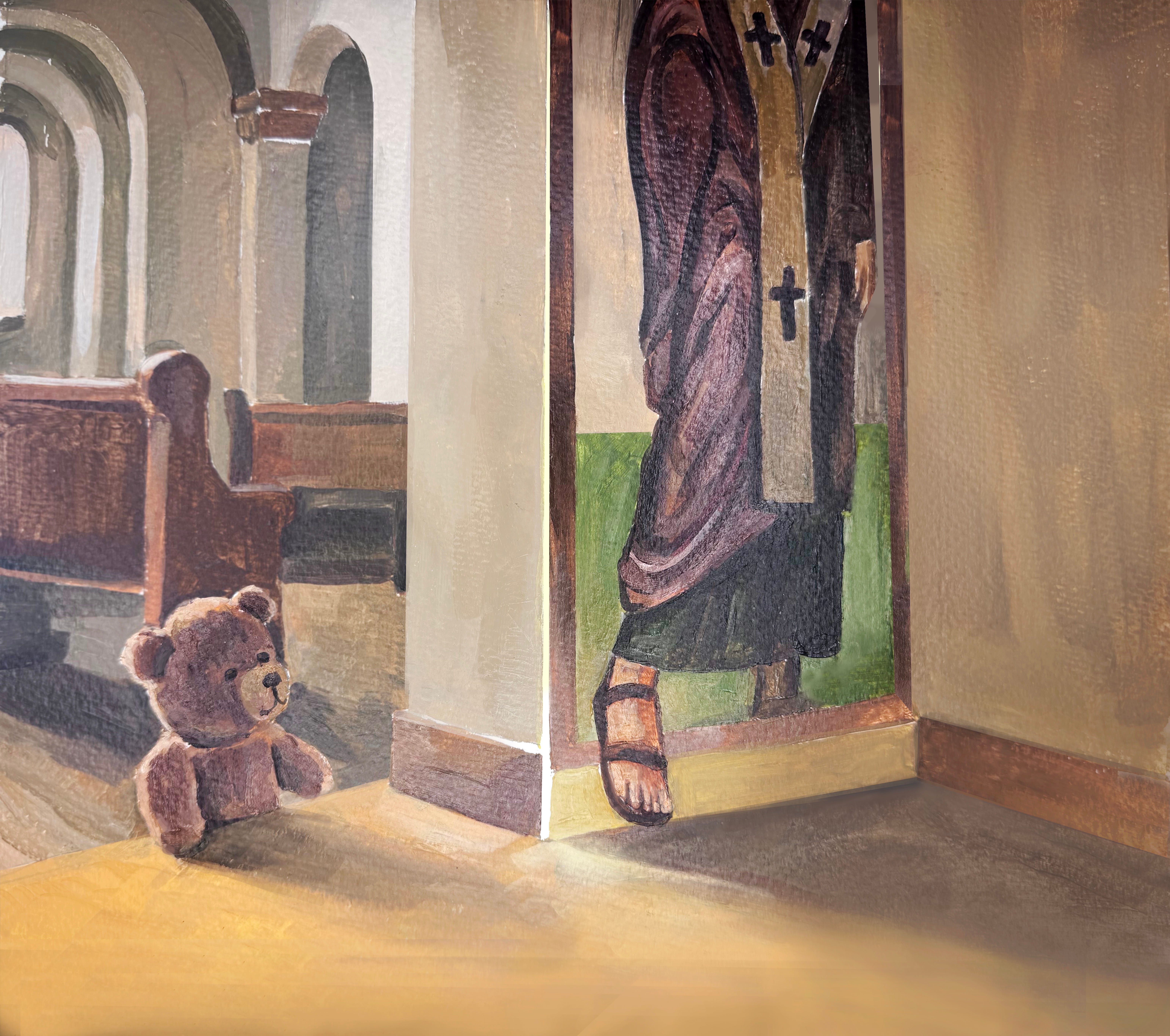
But that’s a good thing in the long run, because I’m hoping to have my next children’s book ready to launch by Pascha! Here’s a sneak peek of the cover:
In the meantime, I’m also reading a few books that Fred Durbin recommended, so I’m sure I’ll have something to say about those at some point, both also being reinventions of the western genre, and thus something to tumble about with all these thoughts about an enchanted Americana.
You also may recall that late last year I was working on a presentation about caregiving for an ailing parent, particularly while homeschooling (as that has been my experience). That project has been backburnered for the time being, simply because in living out the reality again, I just can’t sustain the right energy to work on the project. The text is nearly complete, though, awaiting the acceptable season.
I wish you all good strength for Lent, and I’ll leave you with a few of my latest thoughts-- the kinds of spooks that haunt me on the eve of a fast.
“’Imagine that you were on the threshold of this fairytale, sometime billions of years ago when everything was created. And you were able to choose whether you wanted to be born to a life on this planet at some point. You wouldn’t know when you were going to be born, nor how long you’d live for, but at any event it wouldn’t be more than a few years. All you’d know was that, if you chose to come into the world at some point, you’d also have to leave it again one day and go away from everything. This might cause you a good deal of grief, as lots of people think that life in the great fairytale is so wonderful that the mere thought of it ending can bring tears to their eyes. Things can be so nice here that it’s terribly painful to think that at some point the days will run out.’
You sat stock still on my lap. And I said: ‘What would you have chosen, Georg, if there had been some higher power that gave you the choice? Perhaps we can imagine some sort of cosmic fairy in this great, strange fairytale. Would you have chosen to live a life on earth at some point, whether short or long, in a hundred thousand or a hundred million years?
...Or would you have refused to join the game because you didn’t like the rules?’”
Most people know Jostein Gaarder for his curious and lovely Sophie’s World. It was my first introduction, too, and was directly responsible for my philosophy minor and several odd screen names I used in the early 00’s. As much as I loved Sophie, it was Gaarder’s other books that ended up making me a devoted fan. I have read The Solitaire Mystery more times than I can count, and the quote above is from his fairytale love story, The Orange Girl.
Jostein Gaarder reliably conjures for me that delightful feeling of getting high off of philosophy-- that ecstatic bliss of standing at the edge of the abyss and breaking out into song and dance. This high is pretty different from getting high and talking about philosophy. Or, rather, thinking that you’re talking about philosophy, but mostly just saying something incomprehensible like, “It’s all one, man! The eye in the bushes is watching!”
The latter is a rocket ship that can never get off the ground-- for the briefest instant, you’re in the stars, but you find you can never recapture that elusive feeling sober. The best you get is deja vu at a whiff of patchouli. The high of great sobriety, in contrast, brings with it a gentleness, a finesse, a lightness of perception that involves becoming aware of ever more exquisite levels of details, ever more profound comprehension of expansion.
But in order to get that high off of philosophy, you pretty much also have to pitch a tent on the brink of the abyss. The ecstasy of creation is accompanied by outrage at its violating violence; the bliss of its beauty by terror in the face of its annihilation. Awareness, yes, but also awareness of contingency, fragility, and lack of anything but the barest whiff of agency. This might be why Kirillov is my favorite Dostoevsky character, even though he claims to be a consistent atheist.
But I get it. Because, you see, no matter how great your faith, it can only take you to the edge of the abyss and maybe hold your hand there. Death still means taking that step out into the void. And however we experience the reality of memento mori, whether it is in the frigid wind of the abyss or in the cold breath off the freshly dug grave of a loved one, that given moment is one of profound urgency.
The ecstasy of Gaarder is balanced for me by what Dr. Mark Epstein articulated in The Trauma of Everyday Life, a poetic and practical synthesis of Buddhist psychology: Everything is burning. In the grand scheme of things, on the timeline of the universe, everything I care about is already broken, everyone I love has already lived and died. We are each a blink.
Which brings me to that quote above. I reread it last week and was delighted by its resonances both with Cherokee teachings and with some of Origen’s own musings. I was taught by my friend that the Cherokee belief is that we are each, in the timeless moment before birth, were given a choice as to whether to accept this particular life to incarnate. Our presence here indicates that we chose the life, sufferings and joys together. Origen pondered something similar, though his teaching on the preexistence of souls was ultimately rejected by the church-- likely because he inferred that the quality of material existence one was born in indicated one’s spiritual bent. I think it’s pretty easy to see the spiritual danger in such a belief-- that someone born into suffering might deserve such a life because of the quality of their soul doesn’t sound Christ-like at all.
But the Cherokee belief is a little different. It asks you to think. What is there to learn from this life? What joys can I be thankful for? What sufferings can grow my compassion?
As Gaarder points out repeatedly, an individual’s existence is positively miraculous. Think of how many human beings had to survive and have children-- at exactly the right time-- for you to be here! One untimely accident in 967 BC, one extra case of the plague in 1348, and you’re dust that never comes together. There is an undeniable fairytale quality to our existence, and whether or not you really believe it, it’s fascinating to ask: What did I want to experience in this life?
As much as I love the fairytale framing, I think that we must be careful with the narratives we tell ourselves about ourselves. Storytelling can be tricky. We can concoct a mesmerizing thread of meaning, cast ourselves as main character in situations where we might just be sidelined extras. The story we tell ourselves can become a mask of beautiful, logical words that ends up hiding us from the raw experience of being fully alive, instead offering a blanket of dissociation to protect us from the teeth-rattling intensity of it all.
Even the best stories we write about ourselves are just not sufficient to the task of annihilating the abyss. We can dance on the edge, but we can’t leap across.
For this, we need Pascha. Not a big old supernatural perception thing, where we’re granted epistemological certainty that flings a rainbow bridge across the depths and escorts us safely across. I’m not going to tell you that the experience of Pascha will miraculously cure you of existential wrestling. Though I’ve had plenty of supernatural experiences, in a strange twist of fate, almost none of them have been religious since I became Orthodox. I’ve come to believe this is for a reason. Too often supernatural experience, especially the kind that leads you to epistemological certainty, is just a hair’s breadth away from forcing you to question your sanity-- sometimes for good reason.
No, we don’t need cemented belief; we don’t need a removal of doubt or an anesthetic for our pain. As I’ve said before, healing doesn’t mean that things get fixed back to the way they were before they got broken. The locusts will eat the years.
What we really need is an actual bridge built across the abyss, regardless of our ability to perceive it, which is precisely what Christ says He has built for us. And just like in the stories, there will come a time when we will each of us lift a foot and place it out in empty space. Can you trust the Man when He says your foot will land on something solid?
Participating in Pascha helps you, bit by bit, to see than you can. Every moment spent in the kairos of liturgical time, every repetition that restructures the firing of your material synapses, every time your heart thumps in time with the demand for the gates to be lifted up, the Spirit of God whispers that what we can perceive now is only a fraction of the fullness of reality that awaits.
Catch you on the flip side.
Comments
Nothing yet. Say the first thing.
Sign in to join the conversation.